






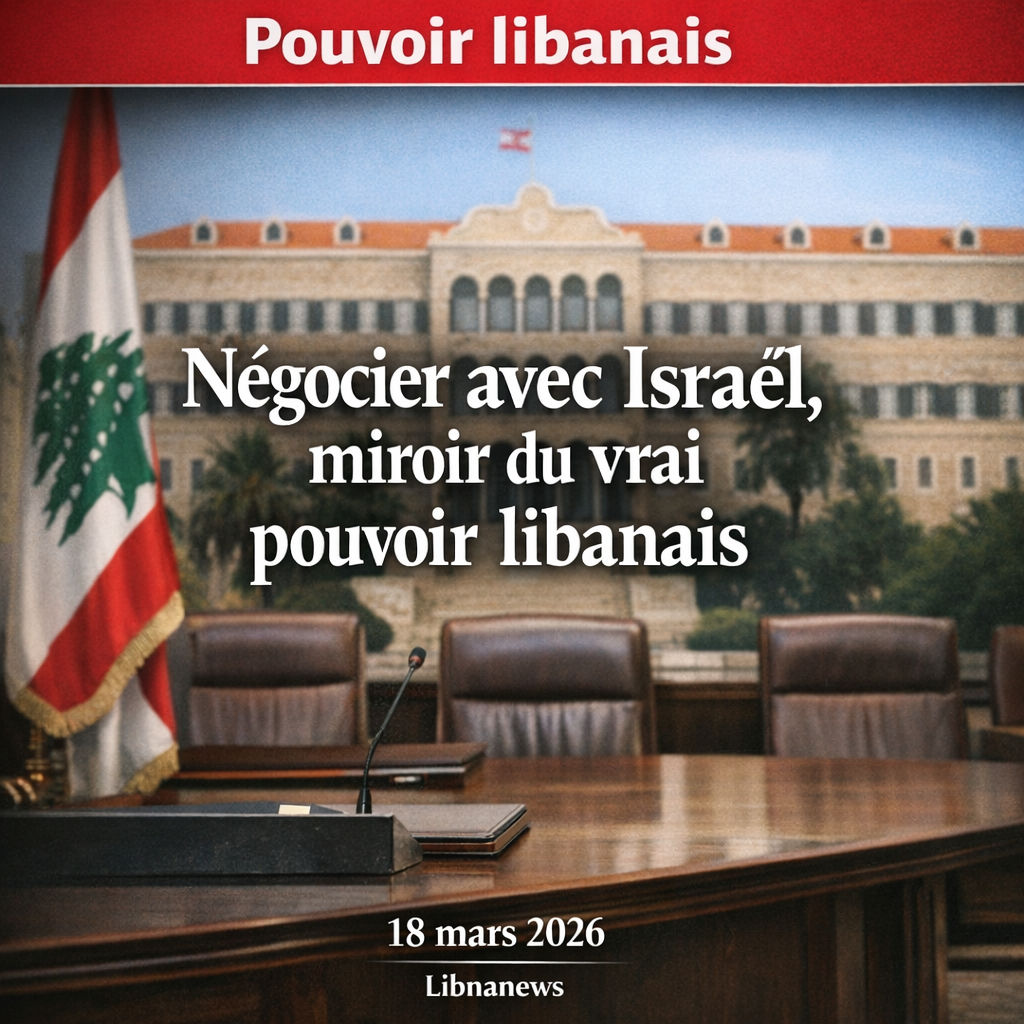
The constitutional text makes the question simple. Lebanon has a clear decision-making chain for any international negotiations. The President of the Republic leads the negotiation in agreement with the Prime Minister. The government must then approve the outcome. Parliament shall intervene when the nature of the agreement so requires. Taken to the letter, this framework gives the image of an orderly State with distinct institutions, established procedures and an unambiguous political hierarchy. In this reading, negotiations with Israel would be a classic mechanism of sovereignty. It would be prepared by the executive, supervised by the Council of Ministers, and validated within the institutional framework. This base has been recalled in recent days in the Lebanese press, at the very moment when the Presidency was working to prepare a diplomatic and technical cell for a possible dialogue. The image offered at the outset is therefore that of a State which knows, in law, who decides, how it decides and according to which procedure it engages the country.
But in Lebanon, the text is never enough to describe the real power. That is precisely what the negotiations with Israel reveal. As soon as we leave the constitutional plan to enter the political field, the clarity displayed becomes blurred. The reservations expressed about the methodology, the timetable and above all the composition of the delegation show that the decision does not belong to a single centre. It circulates between several poles of legitimacy, several community balances and several blocking capacities. Negotiations, apparently diplomatic matters, became an institutional indicator. It shows not only who speaks on behalf of the state, but who can slow down, frame, redefine or neutralize the state’s speech. This gap between official architecture and actual practice is at the heart of the Lebanese crisis. It is not just an administrative fragility. It is a structure of power, where institutional legitimacy and the ability to impose a decision do not always coincide.
It is in this context that Nabih Berri’s reservations take on full meaning. They cannot be reduced to a mere formal objection or to a sensibility of representation. The information published in recent days shows that the Speaker of the House has not given his final agreement on the inclusion of a Shiite person in the delegation and that he remains attentive to the composition of the group to carry the Lebanese position. This caution is not a detail. It states that any sensitive negotiation in Lebanon must first pass the test of internal equilibrium. The file is not only international. It relates to the division of roles between the Chair, Government, House Presidency and Community Leadership. In questioning the method and the delegation, Berri implicitly recalls that no process of this magnitude can be initiated without taking into account the place of each pole in the mechanics of power. He’s not just defending a presence. It defends a right of control over the very definition of the initiative.
Explorez la carte en direct des evenements et points de situation.
This position also reflects a deeper reflex, peculiar to the Lebanese system. In a state where balances are based on permanent negotiation between communities and leadership, controlling the composition of a delegation is a matter of controlling the political scope of the process. Who sits, who speaks, who signs, who approves and in what capacity: each of these questions commits more than a protocol. It affects the real hierarchy between institutions and political forces. In this, Berri’s prudence goes beyond the one person of the Speaker. It expresses an ancient truth of contemporary Lebanon: the state does not act as a bloc. It acts as an addition of partial legitimacys, forced to recognize one another before producing a common line. When such recognition is lacking, the law remains in place, but the decision is frozen. The negotiation with Israel exposes this logic because it obliges everyone to say, even indirectly, how far he is prepared to let the other speak on his behalf.
The other lock, even more decisive, comes from Hezbollah. Here too, the facts reported in recent days shed light on the depth of the blockage. The movement refuses direct negotiation under the current conditions and rejects the idea of dialogue under military pressure. In several reports, it is presented as opposed to the approach, or even as being alien to a process which, according to its managers, does not concern it or serves Lebanon’s interest in the current context. This position has a major scope. It means that a non-state actor, but with an autonomous military power, recognizes the right to influence a fundamental diplomatic choice. Hezbollah does not have constitutional legitimacy to conduct the negotiations. However, its refusal is sufficient to reduce the margin of the official state. This is where the truth of the Lebanese power ratio is played. The institution has the right. The armed organization has the capacity to prevent this right from becoming a decision.
The negotiation dossier therefore reveals the coexistence of several decision-making centres. The first is formal. It is enshrined in the Constitution, embodied in the Presidency, the Government and, as the case may be, Parliament. The second is political. It goes through block leaders, guardians of denominational balances and actors able to withdraw their coverage from a process. The third is strategic. It is represented by Hezbollah, whose arsenal, internal discipline and anchoring in a part of the Shiite field give it a greater ability to influence than a simple party. In many states, these three levels converge. In Lebanon, they coexist without confusion. That is why the constitutional chain, which is clear on paper, is not enough to produce a unified foreign policy. Between the norm and the intercal decision a diffuse veto system, where everyone can recall that legality does not exhaust the reality of power.
This duplication of power is not new, but it appears here with rare sharpness. For years, the Lebanese State has been trying to maintain a fiction of coherence between institutional sovereignty and strategic autonomy of Hezbollah. This fiction has sometimes been achieved through ambiguity, compromise or the priority given to the status quo. The issue of negotiating with Israel puts it in crisis. Because it requires the appointment of an interlocutor, a mandate, a clear political language and, above all, the engagement of the country on behalf of an identified authority. Hence, Lebanese duality ceases to be abstract. It becomes visible. On the one hand, a Presidency which seeks to make the institutions work within the framework envisaged. On the other hand, political forces that intend to guide the process. And above this scene, or next to it, an armed organization that refuses the state to turn war into negotiations on its own terms.
The weakness of the Lebanese proposal on the outside scene comes largely from this. The information published by Reuters indicates that Israel and the United States consider the Lebanese offer unbelievable, not only because of the military context, but because Beirut does not have the ability to impose its line on Hezbollah. The obstacle is therefore not only diplomatic. It’s structural. When a State does not fully control war and peace in its territory, its negotiating word mechanically loses its strength. He may propose, open, report his availability. It cannot guarantee that its offer will translate into reality. This weakness is not first of all that of a president, a government or a minister. It is based on the real architecture of Lebanese power. The country has recognized institutions, but it does not concentrate all strategic decision-making resources in these institutions. However, the international credibility of a State is measured precisely by this concentration.
It should also be noted that this fragmentation does not only produce impotence. It produces a particular form of governance. Each power centre acts less to decide definitively than to prevent a decision that would upset existing balances. The Presidency is moving forward, but with caution. Berri temporise and frame. Hezbollah blocks or delegitimizes. The government is composing. Parliament is waiting for its time without being in a position to give the initial impetus. This system is not based on unified sovereignty, but on regulation through mutual restraint. It holds as long as the subjects can be postponed. It is fluctuating when war forces to choose. The negotiation with Israel belongs to this category. It requires a decision on a matter where national symbolism, regional logic, memory of conflicts and community balances overlap. That’s why she acts as an x-ray of the real regime.
Basically, this dossier reveals less a debate on the opportunity to negotiate than a more radical question: who really governs Lebanon when it comes to war, peace and strategic choices? The constitutional text gives a clear answer. Political practice gives another. In between there is a hybrid order, where the official state retains the face of legality, while other actors hold decisive parts of the concrete authority. In that order, negotiations with Israel became impossible to think of as a mere diplomatic act. It affects the real distribution of power, the hierarchy of the veto and the uncertain boundary between recognized institutions and the autonomous armed force. The divide opened by this debate is therefore not confined to Israel. It exposes the deep nature of the Lebanese system: a fragmented power, where institutional authority exists, but does not in itself encompass strategic decision-making. And as long as this dissociation remains, every major crisis will bring the country back to the same question, that of a State that speaks on behalf of Lebanon without always having everything that makes it possible to engage Lebanon.