






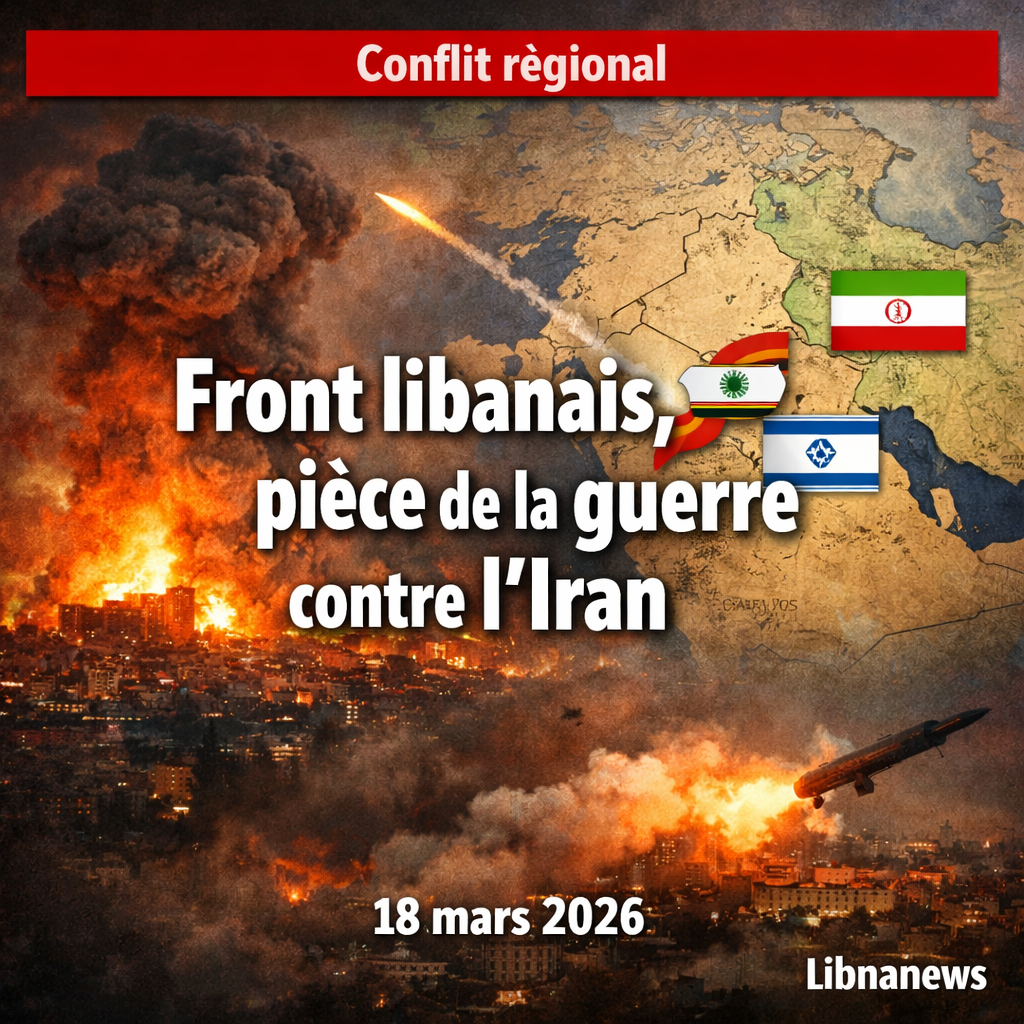
The Lebanese front is no longer a peripheral theatre that could be isolated from the rest of the near-eastern crisis. Since the beginning of March 2026, the military sequence shows, on the contrary, that Lebanon is part of a comprehensive confrontation between the war against Iran, the pressure exerted on Tehran’s regional allies and the desire to reshape the security balances from the Levant to the Gulf. The signals sent over the past few days are in the same direction. Political discussions remain blocked, strikes widen beyond the border strip, threats also affect maritime approaches and the Lebanese scene increasingly appears to be one of the points of contact for a regionally structured conflict. Reading the Lebanese front as a strictly bilateral crisis now leads to missing the essential. What is happening in southern Lebanon, in the southern suburbs of Beirut or in the Bekaa also speaks of Tehran, Washington, the Gulf energy routes and the ability of regional actors to hold several theatres at once.
A conflict that crosses the southern border
The first is the way in which the diplomatic sequence was short-circuited by military logic. Information published in recent days indicates that Israel has refused, at this stage, a Lebanese proposal for direct negotiation and prefers to pursue the accumulation of benefits on the ground before any serious discussion. This refusal is not a mere procedural detail. He said that, in the eyes of Israeli decision-makers, the balance of power remains malleable and that it would be premature to freeze politically a situation still likely to be transformed by weapons. In this context, Lebanon is not treated as a matter of urgency, but as a space where military time must continue to produce its effects. Negotiations are no longer seen as an instrument for immediate de-escalation. It becomes the horizon of a sequence where today’s tactical gains must turn into diplomatic benefits tomorrow. This reversal of the timetable profoundly alters the reading of the conflict. It means that war precedes compromise, shapes it and intends to impose its own parameters.
This logic is even clearer when the geographical extension of the strikes is observed. The operations carried out in recent weeks are no longer limited to villages in contact with the border. They have affected the southern suburbs of Beirut, several sectors of the South and the Bekaa, which broadens the Lebanese vulnerability map and moves the war towards areas that are less of the conventional front than national depth. Such enlargement has both a political and a military function. It is intended to show that no area deemed useful to Hezbollah’s military or logistical apparatus escapes pressure. But it also serves to impose a new hierarchy of risks on the Lebanese State itself, now exposed to an increase in the national cost of war. From this perspective, the depth of the territory becomes a strategic language. Going further is a reminder that the Lebanese theatre can be completely reconfigured if the regional confrontation continues to rise. The Lebanese front then ceases to be a line. It becomes an expanded space of coercion.
Explorez la carte en direct des evenements et points de situation.
The maritime dimension further reinforces this transformation. Several recent signals point to the maritime border and coastal approaches as another lever of potential pressure, whether it be movements in the eastern Mediterranean, securing navigation routes or the vulnerability of energy spaces. This extension towards the sea changes the very nature of the crisis. A land front may sometimes be contained by local arrangements, targeted mediation or de-escalation mechanisms. As the sea fully enters the equation, the stakes become wider. They relate to traffic, logistics, strategic facilities and the relationship between the Eastern Mediterranean and the Gulf. Lebanon no longer appears only as Israel’s northern neighbour. It becomes a geopolitical node placed on a regional tension line that connects the Levant to the Arab energy space. That is why the Lebanese front must be considered in a broader continuity, where local military pressure is combined with a battle of control over access routes, supply capabilities and economic balances.
Simultaneous fronts complete to confirm this scale change. Since 28 February 2026, several media outlets have described an ongoing American-Israeli war against Iran, the repercussions of which have spread to Lebanon and, in the same movement, the Gulf States. This concomitance has nothing decorative. It reports a saturation strategy. The aim is not only to strike an opponent on a specific point, but to force him to constantly think several theatres at once, to disperse his means, to arbitrate between his priorities and to manage a cumulative pressure on his regional relays. Lebanon is essential in this arrangement because it represents one of the places where the Iranian strategic depth is most directly projected towards the Israeli front. Treating him as an isolated theatre therefore makes no sense. It now functions as one of the dials of a larger confrontation, where each local escalation produces a regional message, and where each regional evolution immediately resonates on the Lebanese scene.
Lebanon as a lever of strategic pressure
The second dimension of this war is Lebanon’s role in regional calculation. Lebanese territory increasingly appears to be an indirect lever against Tehran. This logic does not consist in moving the war against Iran to a mere substitute ground. Rather, it aims to act on Iran’s strategic environment by weakening one of its main support points for the Levant. The choice has clear rationality. A continuous frontal confrontation with Iran on its own soil carries major risks of explosion and a wider response. On the other hand, increasing pressure on the Lebanese front makes it possible to test the strength of a central ally of Tehran, to use its capabilities, to force it to allocate its resources differently and to send the message to the Iranian leadership that the cost of the war will also be paid on the margins of its regional influence. The Lebanese front then becomes an echo chamber. What is playing in it aims Beirut immediately, but speaks in Tehran for the duration.
The analyses published in the Lebanese press in recent days emphasize a logic of military achievements. This concept is central to understanding the current sequence. It means that operations not only seek to neutralize an ad hoc threat, but to create new realities on the ground, which will then affect any negotiations. A emptied area, a monitored axis, a depth made vulnerable, a reduced freedom of movement or a normalised rhythm of strikes can become as many elements intended to change the terms of a future arrangement. The goal is not only to achieve an immediate tactical result. It also involves installing lasting constraints and moving the starting line for future discussions. From this perspective, the war on the Lebanese front is seen as a military political modeling operation. Firepower is used to produce more favourable negotiating conditions, not simply to respond to a security emergency.
The fall of the red lines, often mentioned in the comments of recent days, is part of this same dynamic. What seemed difficult to imagine only a short time ago gradually became admissible and then almost routine. Deeper strikes, more diverse targets, more visible pressure on the capital or on the inner axes move the threshold of what is considered normal in war. This slide is decisive. It is not just an escalation. He organizes a learning of coercion. As the red lines fall, actors get used to a broader, more mobile and less framed war by the old implicit rules. The Lebanese front here serves as a regional laboratory. It allows us to measure how much climbing can go without immediately tipping into a total burning, while increasing, level after level, the pressure on the Iranian camp. Thus, war is not only progressing in intensity. It also progresses by habituation.
This strategic instrumentalization of Lebanon has an equally important domestic political effect. The more regionalised the war, the more the distinction between the Lebanese State, Lebanese territory and the armed actor operating in the name of a logic of regional confrontation becomes a central issue. Operations also seek to force this dissociation. By raising the national cost of war, they are driving Lebanese institutions to find themselves confronted with an increasingly acute contradiction: to preserve the State, to protect the population, to limit destruction, while remaining caught in a conflict whose engine far exceeds national priorities. This tension weakens Beirut’s margin of manoeuvre. It fosters indirect diplomatic pressure to further isolate the Lebanese front from its domestic political legitimacy and to present it as an extension of a strategic confrontation dictated first by the Iranian axis. Again, Lebanon is no longer a simple battlefield. It becomes a space where the separation between state sovereignty and regional logic of confrontation is experienced.
A war that recomposes regional order
The third key to reading is American involvement. The texts published since the beginning of March describe not only constant political support for Israel, but also a much more direct articulation between the war against Iran and developments in Lebanon. This data changes the scope of the sequence. When a power like the United States becomes part of the general order of the fronts, the war ceases to be an addition of local crises. It takes the form of a hierarchical regional campaign, where each theatre meets a wider objective. Lebanon is neither marginal nor secondary. It becomes one of the places where simultaneously issues of deterrence, credibility, strategic communication and balance between escalation and control are resolved. Washington does not just act in the diplomatic background. Its involvement helps to define the margins of action, the pace of pressure and the overall geopolitical framing of the conflict.
This involvement also makes the Levant’s function in the present war more legible. The Lebanese front serves as a compression zone. It must contain an ally of Iran, weigh on the credibility of the Iranian projection in the Middle East and remind Washington’s regional partners that confrontation is not only taking place on Iranian territory. At the same time, this pressure on Lebanon conveys another message: any future negotiations on the regional security architecture must take into account the Lebanese file, the place of Hezbollah and the broader issue of Iran’s relays in Arab countries. In other words, the war in Lebanon is also preparing for the post-war period. It is already working on the contours of a future regional power relationship, where the respective place of Tehran, Washington, Israel and the Arab States will be renegotiated under the compulsion of military events.
But such a strategy involves a reverse risk, that of war wear and tear. Several recent analyses point out that the confrontation with Iran has not produced a rapid shift and rather tends to settle in time. This is a decisive point. A campaign designed to impose a decisive shock can turn into a conflict of endurance, especially when the adversary retains nuisance capabilities, strategic depth and regional relays. In such a scenario, the Lebanese front is taking on new importance. It no longer serves only to exert pressure on Iran. It also becomes one of the places to measure the capacity of the American-Israeli camp to sustain a prolonged effort without losing political control of the conflict. The longer the war lasts, the higher the costs, the more the internal balances of the allies tend and the more difficult the issue of exit becomes. Lebanon then reflects less a consolidation victory than a regional battle whose effects are dispersing and accumulating without leading to net stabilization.
This perspective of wear is already redefining regional balances. The Arab Gulf States do not regard the Lebanese front as a mere distant scene. The texts published since 7 March show that military developments against Iran, their extension to Lebanon and their repercussions in the Gulf are part of a single strategic sequence. This obliges Arab capitals to recalculate their position between caution, security coordination, preservation of their vital facilities and the avoidance of widespread deflagration. Lebanon is thus placed at the heart of the near-eastern matrix. His crisis is no longer exclusively Lebanese. It becomes a parameter of energy stability, of the American posture in the region and of the ability of regional powers to avoid a structured conflict against Iran becoming a lasting disorder. This return of Lebanon to the great regional game does not give it any more autonomous weight. On the contrary, he stresses the weakness of his ability to dissociate his immediate destiny from the calculations of others.
It is this loss of strategic autonomy that perhaps constitutes the major political fact of the period. The more regionalized the conflict, the less Beirut can hope for separate treatment. Lebanon’s time now depends on a broader timetable, set by the evolution of the war against Iran, by the level of American engagement, by Israel’s attitude and by the ability of external mediations to pull away something other than fragile breaks. The Lebanese front is therefore part of a comprehensive strategy against Iran in two ways. It is first one of the spaces where a major ally of Tehran strikes. It is then one of the instruments that allow the relations of power in the Middle East to be redesigned under pressure. At this stage, Lebanon no longer appears as an isolated front, but as a piece of a larger device, where the war already produces the terms of the next regional recomposition, without it being known what new order could emerge from such a trial.