






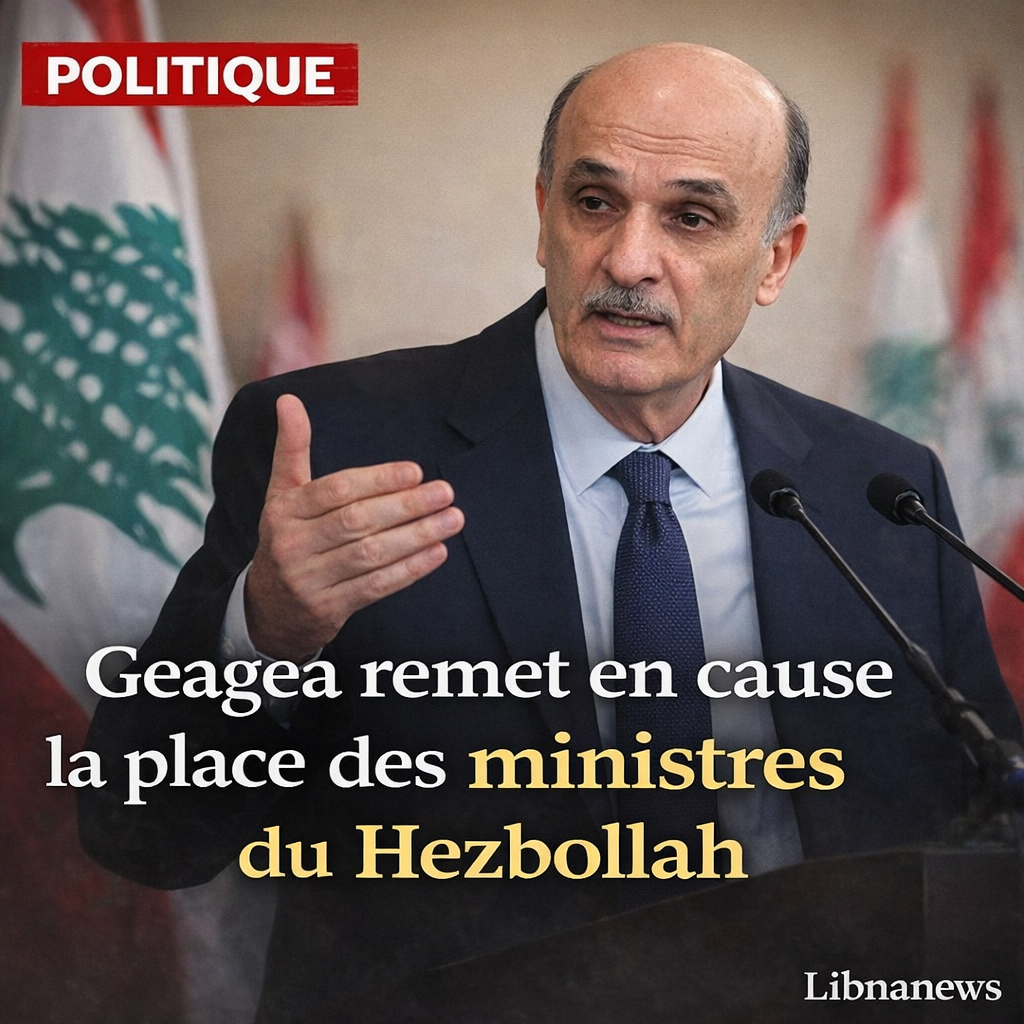
Samir Geagea relaunched Wednesday, March 18th the debate on Hezbollah’s presence in the government. In a statement to the al-Markazia agency, the Lebanese Forces leader questioned the status of the party’s ministers after the decision of the Council of Ministers prohibiting its military and security branches. He said that « the government cannot contradict itself by keeping illegitimate elements in its midst, » while saying that it respected these ministers « as individuals. » He also indicated that this issue would be raised later in the firm.
This statement comes in a context marked by an intensification of the conflict between Lebanon and Israel. Since the end of February 2026, Israeli strikes have spread far beyond the South, affecting Beirut, its southern suburbs and the Bekaa. The bombings caused hundreds of deaths and thousands of injuries, as well as massive population displacements. At the same time, the Israeli army has increased warnings to civilians in several areas, while conducting operations on infrastructure and roads, including south of the Litani River.
A Statement Related to a Recent Government Decision
Samir Geagea’s position is directly consistent with a decision taken by the Lebanese government on 2 March 2026. On that day, the Council of Ministers announced the ban on all military and security activities of Hezbollah, entrusting the military and security services with the task of preventing any armed action outside the State framework. The decision also provided for a plan to restrict arms and disarmament, particularly in areas north of Litani.
Explorez la carte en direct des evenements et points de situation.
Since that announcement, the government has stated that it wants to restore exclusive state authority over security and the use of force. However, the situation on the ground remains unchanged, with the continuation of military operations and the continued presence of Hezbollah in the security equation. Ministers affiliated with the party continue to serve in the cabinet.
It was in this context that Samir Geagea asked the question of the coherence of the executive, directly linking the decision of 2 March to the current composition of the government.
Increased international pressure
The issue of Hezbollah is not limited to the internal Lebanese debate. It is part of a regional and international framework marked by growing pressure, particularly from the United States. Washington regularly calls for the disarmament of Hezbollah and the strengthening of the role of the Lebanese State, particularly in the South.
These pressures have increased with the expansion of the regional conflict involving Israel and Iran. The United States supports Israeli operations and considers Hezbollah to be a central player in this axis. In this context, the question of its military capabilities and its presence in Lebanese institutions has become a major diplomatic issue.
At the same time, several diplomatic initiatives have been mentioned in recent weeks to achieve a ceasefire and stabilization of the southern border. These proposals include progressive disarmament mechanisms and enhanced deployment of the Lebanese army, but they face significant differences between the parties concerned.
Persistent internal political tension
Internally, Samir Geagea’s statement comes in a climate of political tension exacerbated by the war. The government has to deal with both the management of bombings, population displacement and the security situation, while maintaining a fragile balance between its various components.
In this context, the issue of Hezbollah remains central. The party maintains political representation in Parliament and government, as well as a decisive role in confrontation with Israel. At the same time, some political forces contest this duality between institutional participation and autonomous military capacity.
Samir Geagea also referred to statements by some Hizbullah officials warning of the risks of confessional fitna and internal chaos. He considered that the State should have acted earlier in this regard, stating that « legitimate authority has missed an opportunity » and that it should have arrested those who incite civil war and religious tensions.
A question now before the Council of Ministers
The statement of the leader of the Lebanese Forces is not accompanied at this stage by a formal request for the withdrawal of Hezbollah ministers. However, it introduces a point of debate that Samir Geagea has indicated that he wants to raise within the government.
For the time being, no decision has been announced on the status of these ministers. The firm continues to operate in its current configuration, as the war continues and international and regional pressures remain strong.