

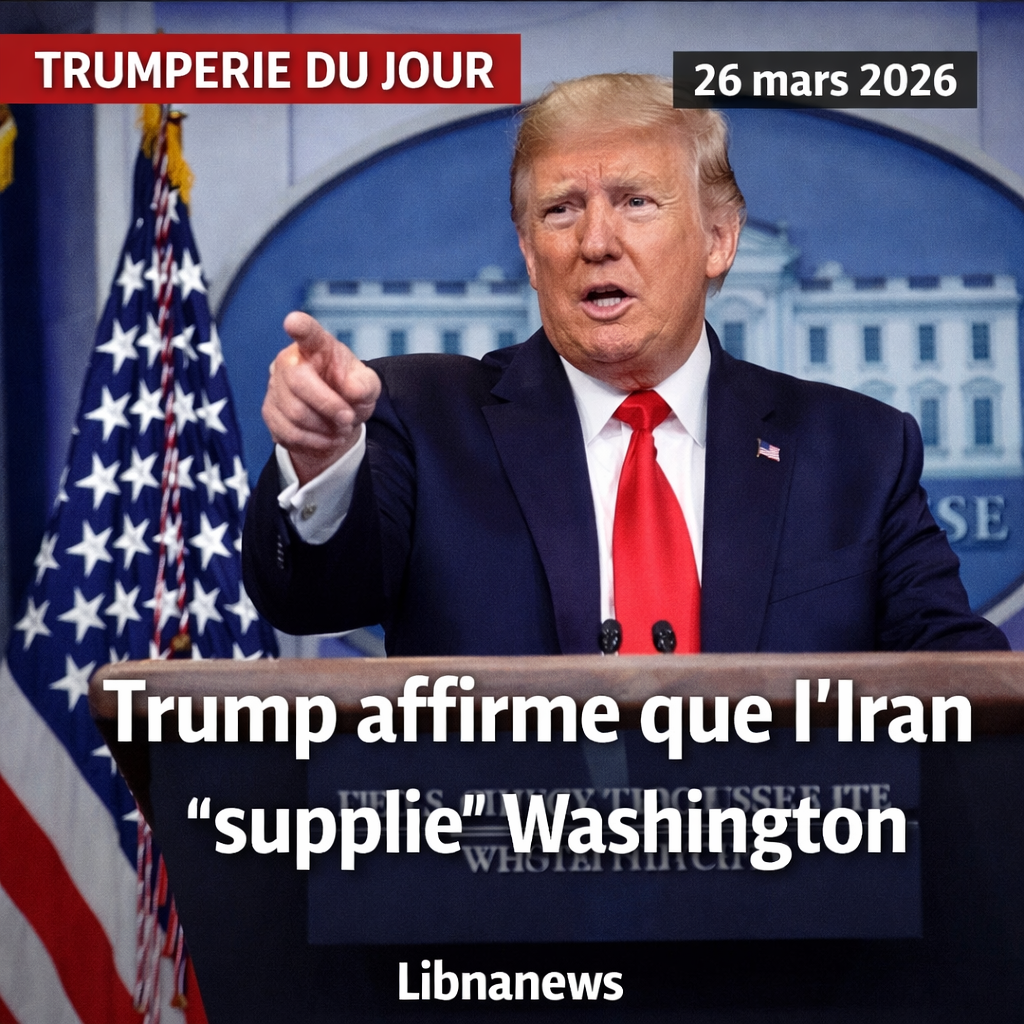
U.S. President claims Iran « plies » Washington to conclude agreement
Donald Trump said on Thursday that Iran is now seeking to reach an agreement with the United States to end the war, while suggesting that Washington was not sure of wanting to respond positively. In front of the press in Washington, he assured that Iran « ply us to make an agreement, » before adding that it was « not sure to want to sign an agreement ». As a result, his envoy Steve Witkoff spoke of « strong signals » in favour of a compromise and confirmed the transmission to Tehran of an American list of fifteen points through Pakistan.
The US President has also sought to set up the idea of a military victory in progress. He claimed that the United States was « in advance of their schedule, » explaining that it had first been estimated that it would take « four to six weeks » to achieve the targets. He added that the Iranian regime « now admits its defeat », which would explain his readiness to reopen the diplomatic channel.
A first point of fragility: the war must have been short, it enters its fourth week
This is one of the most criticized aspects of his speech. The US administration still presents the operation as limited, but the war began on 28 February and is now entering its fourth week. However, the White House continues to talk about a « four to six weeks » horizon to bring the campaign to an end, and some of the signals given over the past few hours suggest that this calendar could still slip until before the planned presidential move to Beijing in mid-May. The contrast is therefore clear between the initial idea of a rapid sequence and the perspective of a conflict that stretches.
This extension of the wartime weighs all the more as Donald Trump continues to speak as if the outcome was almost settled. Explaining that Washington is « in advance » while maintaining an additional several weeks horizon, the White House maintains an ambiguity: the offensive is presented as controlled, but it is obviously not closed. Several American experts also point out that the positions of Washington and Tehran remain very distant and that a rapid agreement seems unlikely at this stage.
Ormuz remains closed in fact, despite Washington’s goals
Donald Trump also linked his strategy to the reopening of the Strait of Ormuz. It is one of its stated objectives, with the long-term reduction of Iranian military capabilities. But again, the gap between the discourse and the situation on the ground remains visible. Iran retains coercive control over this strategic sea route, imposes restrictions, taxes certain passages and continues to make it a central lever of its indirect negotiation with Washington.
The other weakness in the US is the lack of clear external support to impose a rapid reopening. The Gulf States want a solution, but they do not want any uncontrolled burning or settlement that would leave Iran strengthened. Several European partners remain behind, and Donald Trump himself criticized the little involvement of some allies. In other words, Washington sets a maximum target on Ormuz without yet having sufficient international alignment to guarantee it politically and militarily in the very near future.
Iranian missiles continue to hit Israel
Another angle of attack on the presidential story: despite statements about Iran’s weakening, Iranian fire did not stop. In recent days, missiles have struck Arad and Dimona near a sensitive nuclear site, wounding many civilians. On 24 March, Tel Aviv was also hit by new waves of missiles. And this Thursday again, damage and several minor injuries were reported in central Israel after further Iranian fire.
This persistence of strikes weakens directly the argument of an already decisive campaign. Of course, Israel’s defence systems intercept most of the projectiles, and Israeli and American military officials claim to have destroyed a large part of the Iranian launchers. But the reality remains that of a country hit almost daily, sometimes with heavier or more complex salves than expected. Once again, Donald Trump’s speech on a victory that has already been achieved comes up against a much less linear military chronology.
An agreement presented as imminent, while Tehran still rejects the American offer
The third point of tension concerns diplomacy itself. Donald Trump assures Iran that he wants a deal. Yet the Iranian response transmitted through indirect channels remains negative at this stage. A senior Iranian official described the American proposal as « unilateral and unjust », believing that it was primarily in the interests of Washington and Israel. Tehran continues to claim that diplomacy is not completely closed, but it rejects the current terms of the American plan.
The gap remains deep on the very content of a possible agreement. The US 15-point plan would include the nuclear programme, ballistic missiles, Iranian support for its regional allies and the Ormuz question. In return, Iran calls for a lasting end to the war, compensation for the destruction suffered, security guarantees and the inclusion of the Lebanese case in any broader solution. The contrast between Trump’s formula for an Iran that « plies » and the rigidity of positions actually exchanged explains why no agreement is yet in sight.
The victory speech masks a simmering conflict
The presidential statement seeks to impose a simple image: Iran would have lost, Washington would have gained the advantage, and the conclusion would now depend on American goodwill alone. But the evidence accumulated in recent days complicates this story. The calendar is extended, Ormuz is not reopened, Iranian fire continues against Israel and diplomatic positions remain very remote. Even on the American side, several officials recognize that nothing yet guarantees the conclusion of an agreement.
The core of the problem is this: Donald Trump speaks as if the war was entering its final phase, while the facts show rather a conflict that is prolonged, regionalized and continues to produce major military, energy and diplomatic shocks. His intervention on Thursday therefore reinforces as much the image of maximum pressure as that of a growing gap between the political communication of the White House and the reality of the ground.






