

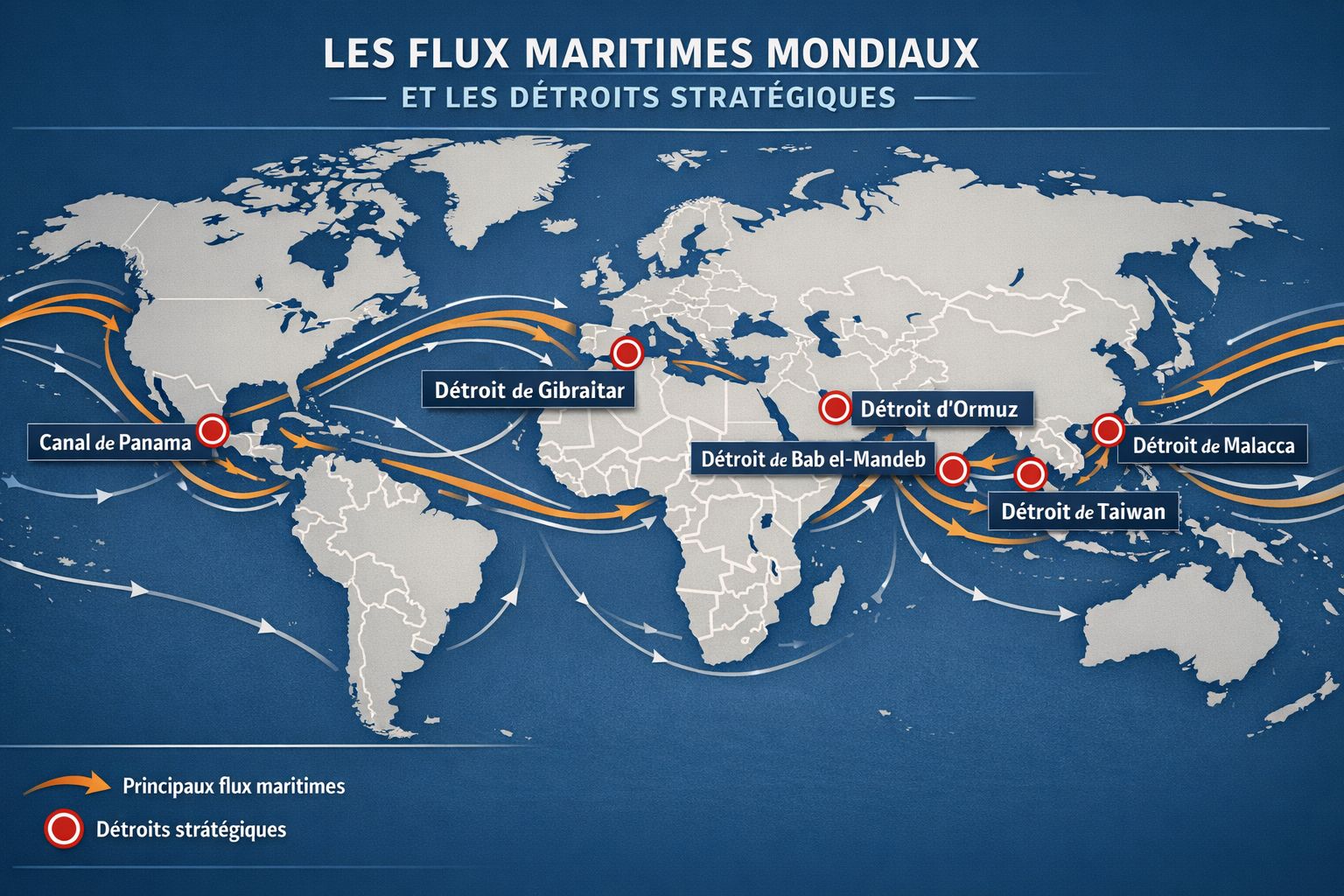
On board a cargo ship, the salty wind runs through the bridge, the chains grinting, and the horizon narrows to a few kilometers wide. Here, every meter counts, every manoeuvre can have planetary repercussions. Welcome to the world of straits, these narrow passages that control the flow of world trade and dictate the pace of the global economy.
When geography becomes authority
One might think that in a digital and ultra-connected world geography was no longer important. Yet more than 80% of trade flows through the sea, and a handful of narrow passages concentrates most of these flows.
On deck, the captain searches the horizon. Going around a strait like Ormuz or Malacca is not just a detour: it’s adding thousands of kilometers, days of delay, hundreds of thousands of dollars in fuel and insurance. Every wave, every current, every wind becomes a strategic data.
Ormuz: the energy core of the planet
In southern Iran, the Strait of Ormuz is a vital cordon. Every day, almost 20 per cent of the world’s oil flows there. The sailors tell of the nights when the tension rises: a tanker approaching too close, a drone flying over the strait, and the markets instantly panic. A temporary closure, and oil prices are rising, refineries are panicking, nations are back to calculating each litre.
Malacca: Asian artery under pressure
The Malacca Strait is a thin corridor between Indonesia and Malaysia, but it transports energy and goods to billions of people. The sailors tell the lines of ships that simmer, rotating engines, waiting for their turn. China sees much of its energy passing through it: a local disturbance becomes a global dilemma.
Bab al-Mandeb: the red door
Between Yemen and East Africa, Bab al-Mandeb can turn a few waves into a global crisis. Here, a local conflict or an attack on a cargo ship forces ships to bypass Africa, adding thousands of kilometres to their route and millions of dollars to costs. Mariners know that this strait is fragile: a small incident, and the global economy is wavering.
Gibraltar: Mediterranean guardian
The Strait of Gibraltar, thin as a line drawn on a map, connects the Atlantic to the Mediterranean. Ships approach with caution, because although the military threat is low, the slightest disturbance — a breakdown, a storm, a blockage — can slow down shipping on an entire continent.
Bosphorus and Dardanelles: Turkish veins
These Turkish-controlled straits link the Black Sea to the Mediterranean. Exports of cereals and hydrocarbons are vital. Ukrainian and Russian sailors know that the Montreux Convention can change things overnight, that military restrictions can turn a daily passage into a strategic impasse.
Taiwan: The Red Thread of Technology · Global Voices
The Taiwan Strait, separating China from the island, is a passage where much more than maritime trade is involved. Ships carrying semiconductors, essential for our phones and computers, sometimes cross military ships watching each movement. A blockade here never remains regional: its repercussions are felt up to the store stalls and production chains around the world.
The weight of a closed strait
Each closed strait, even a few hours, causes a domino effect: explosion of transport costs, delays, congestion of ports, and rising prices of goods. The example of the Suez Canal showed that only one incident could paralyze world trade in a few days, transforming ports into floating truck lines.
The straits, instruments of power
Faced with these vulnerabilities, the great powers are on all fronts:
• The United States is patrolling the Gulf and the China Sea.
• China builds alternative bases and roads.
• Iran transforms Ormuz into a strategic lever.
• Turkey strictly controls its straits.
Each passage is now an instrument of power, a lever that can make the world economy as tenuous as a ship in the storm.
Conclusion: where globalization meets the sea
On board a cargo ship, crossing a strait, we realize that globalization is not only virtual. It is tangible, fragile and dependent on these narrow corridors. These straits are not mere geographical accidents: they are levers of power, points where a few kilometres of water can decide the fate of billions of people.
The digital world can progress at the speed of light, but it remains a prisoner of the laws of the sea. And on these seas, the straits hold the keys.






