

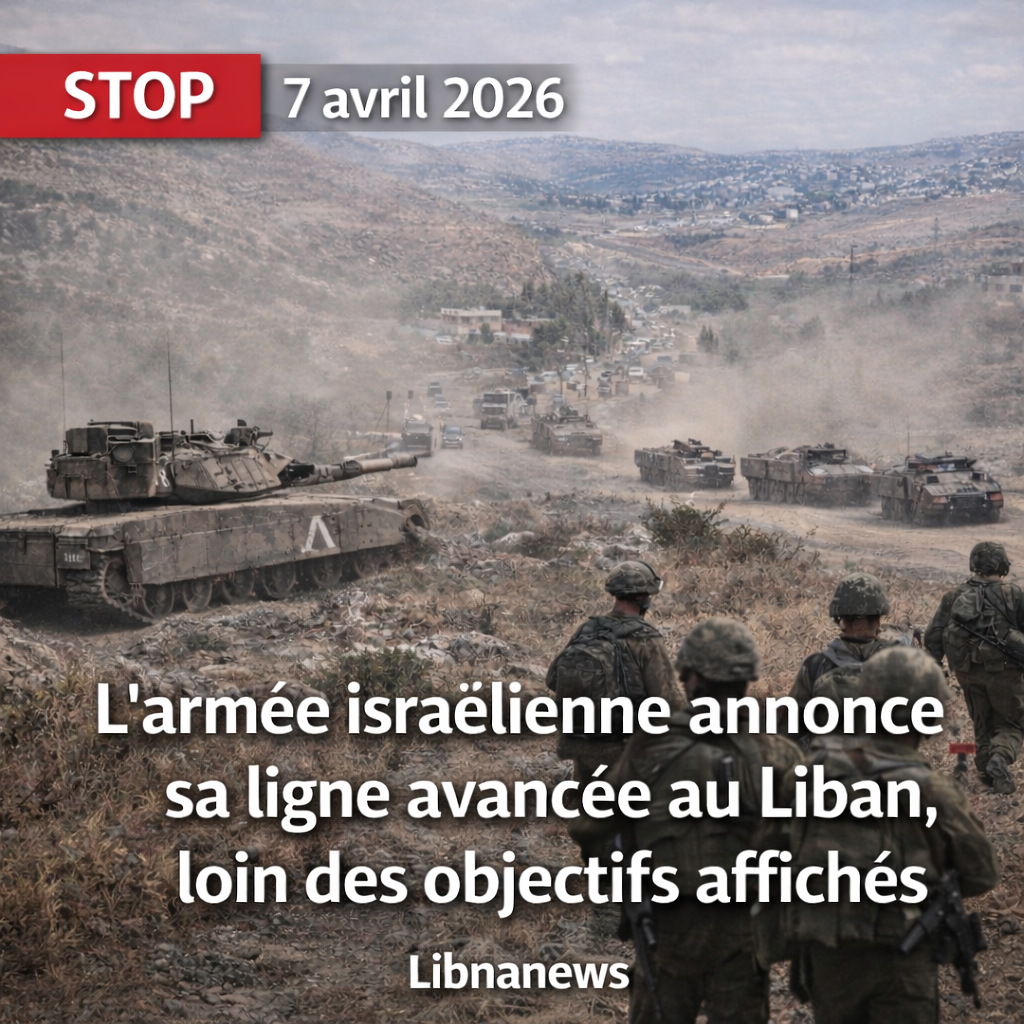
On Tuesday, the Israeli army announced that it had completed the deployment of its troops to the ground in southern Lebanon up to an « advanced line of defence » against Hezbollah. In its formulation, the press release wants to suggest a strategic level reached, almost a stabilization step after several weeks of operations. But behind this mastered presentation, there is a growing gap between the Israeli political narrative and the reality of the ground. The army does not specify how far its soldiers advanced into Lebanese territory. On the contrary, several Israeli media reports indicate that the staff does not at this stage intend to push well beyond 20 kilometres north of the border. Israeli politicians have, however, multiplied much more ambitious statements, evoking a « security zone » up to Litani, up to about 30 kilometres from the border in places, with in the background the idea of a lasting remodelling of southern Lebanon.
It is this contradiction that today deserves to be looked at closely. Because the Israeli announcement does not mean that the IDF has achieved all the goals that have been set in recent weeks. Rather, it means that an advanced scheme has been consolidated, in a framework that seems to be more limited, more defensive and more cautious than the official rhetoric of the government of Benyamin Netanyahu and the defence minister Israel Katz. In other words, political power has sold a maximalist perspective on southern Lebanon, while the army seems to settle in a more contained logic: to dig, to hold, to destroy certain infrastructures, to postpone Hezbollah’s firing capabilities, but without going as far as the total occupation of southern Lebanon as some words might have suggested.
From safe glacis to fantasies of annexation
The announcement of the Israeli army comes in a much more radical political climate than the mere vocabulary of « advanced defence » suggests. For within the ruling coalition, some officials no longer speak only of a buffer zone or a distance from Hezbollah. They already speak as if southern Lebanon could be permanently cut off from Lebanese territory.
Bezalel Smotrich said that the Litani should become the « new northern border of Israel ». This sentence is nothing of rhetorical detail. It amounts to defending a de facto annexation of a part of the South Lebanon, or at least to trivializing the idea that Israel could redraw the border by war. In the same climate, the Israeli far right is pushing a maximalist vision where Israel’s security no longer passes only through the retreat of Hezbollah, but through a lasting transformation of Lebanese space south of the Litani.
This is what makes Tuesday’s military announcement doubly revealing. On one side, the IDF talks about an advanced line and a defensive device. On the other hand, part of the Israeli political power suggests that the real objective is far beyond the scope of a limited military operation. The gap is therefore immense between the relative prudence of the military communiqué and the political project suggested by Smotrich and carried by the far right.
And this gap also says something about the limits of the offensive. The more the ministers speak of a remodelled southern Lebanon to the Litani, the more reality on the ground shows that Israel remains far from such a goal. The announcement of the « advanced line » then looks less like the achievement of a strategy than a way to give the appearance of a success to a progression that remains partial to the ambitions displayed.
A « Advanced Defense Line » as a Success
In its statement, the Israeli army states that its forces have « completed their deployment » on an anti-tank line and are continuing their operations to strengthen this advanced line of defence and remove the threat to the people of northern Israel. This formulation is important. She is not talking about total control of southern Lebanon. It also does not speak of a progression to Tyre, Nabatiyah or the whole area south of the Litani. It describes a protective device, first designed to reduce the threat of anti-tank missiles, rockets and infiltrations against Israeli towns near the border. The vocabulary of the army is therefore, in itself, more limited than that of political personnel.
The problem for Israel is that this military prudence comes after several weeks of much wider announcements. Israel Katz reiterated that Israel intended to establish a « security zone » up to Litani. He even claimed that the army would control the remaining bridges and the entire area, while preventing the return of Lebanese residents displaced south of the river until the security of northern Israel was guaranteed. Reuters also reported that Katz had referred to the destruction of all houses in villages close to the border according to a model already applied in Gaza, and that he presented this space as an area to be neutralized on a sustainable basis. These are objectives of territorial and demographic transformation which are quite different from the mere completion of an advanced line.
This difference is not a nuance of communicators. It touches the heart of strategic reading. When a minister talks about control up to the Litani, he sets up the idea of a deep territorial shift. When the army announces that it has consolidated a defensive line without specifying its exact course, it suggests on the contrary a narrower objective: to hold a military ice, not to administer the whole of southern Lebanon. In between, there is a substantial gap. And this gap today feeds a critical reading: Tuesday’s announcement looks less like the achievement of an ambition than the more modest reformulation of objectives that have become difficult to achieve in their maximum version.
On the ground, the advance remains far from full control of the south
The first element that weakens the Israeli narrative lies precisely in the real depth of progress. The army gave no precise geographical details of its maximum advance point. However, this absence is not insignificant. Several Israeli media, relayed on Tuesday, indicate that the staff does not currently plan to go beyond about 20 kilometres north of the border. This does not mechanically cover the whole of southern Lebanon. Especially as the Litani is not at constant distance from the border: depending on the sectors, it can be located between a few kilometers and about thirty kilometers to the north. In other words, even if the army were to hold certain advances up to 20 kilometres, this would not mean that it controls the entire area that the political power has publicly designated as its objective.
The World, in an analysis published on 4 April, also described a gradual Israeli progression, with a reoccupation of areas already held by Israel before the ceasefire of November 2024 and extensive control over several second-line villages. The newspaper referred to a strip of about five kilometres deep on several fronts, while noting that the army had reached El-Biyada on the coast, about eight kilometres from the border, and the outskirts of several localities further east. This is not a homogeneous conquest of the whole of southern Lebanon, but a mosaic of penetrations, targeted destruction, reoccupied positions and control corridors. Again, there is a striking contrast between the political image of a fully reshaping south and the military reality of partial, sectoral and incomplete progress.
It should be added that the Israeli army itself seems to send contradictory signals. The World reports that several Israeli media reported on Friday that the army was no longer targeting Hezbollah’s « complete disarmament » by military means alone, a scenario deemed unrealistic by a military source quoted by several newspapers. Of course, spokesman Nadav Shoshani and Israel Katz then tried to reaffirm the continuation of this long-term goal. But the simple fact that such inflection has been relayed reveals something essential: even on the Israeli side, the feasibility of the stated ambitions is debated. And when the army now speaks mainly of « advanced line » and « additional protection » for the north of Israel, it seems to confirm, in a hollow, a refocusing towards more limited goals.
Maximum rhetoric, a more contained practice
Thus, Israeli power played on two registers. The first is the political auction: the security zone to the Litani, the systematic destruction of villages close to the border, the inability of Lebanese displaced people to return to the south until the security of northern Israel is guaranteed. The second, more military, is an action that seems to seek above all to make Israel’s northern front less vulnerable in the short term, destroying border villages, cutting down certain axes and holding forward points. The difficulty for Israel is that these two registers do not fully coincide.
The maximalist discourse has an inner utility. He reassures an Israeli opinion traumatized by Hezbollah fire, evacuations from the north and the feeling that Israel can no longer tolerate a return to the status quo before. It also serves as a deterrent to Beirut and Hezbollah. But on the ground, lastingly to the Litani, or even beyond, according to some more blurred discourses, would require extensive, costly and politically explosive occupation. This would involve controlling denser areas, dealing with a more diffuse guerrilla, maintaining more exposed logistics lines and assuming an even greater diplomatic cost. That is precisely what makes the gap so visible between words and facts.
The fundamental criticism is there: Israel continues to speak as if it were re-drawing all of southern Lebanon, while Tuesday’s military announcement looks above all like the consolidation of an advanced, destructive and aggressive curtain, but more modest than the political objective sold since the end of March. It’s not military nothing. For Lebanon, this is even a serious violation of sovereignty and de facto occupation of parts of the territory. But this is not the full realization of Israel’s ambition, Katz. To present this step as if it were equivalent to mastering the whole south would be to endorse a broader narrative than what the land now seems to confirm.
What the facts say, and what Israel promised
| Element | What Israel Announces Politically | What the Army Lets See |
|---|---|---|
| Target depth | Security zone to Litani | No precise public route |
| Target displayed | Leveraging Hezbollah, Controlling the South | Consolidate an advanced line and protect northern Israel |
| Territorial scope | Control of a vast area south of Litani | Sectoral progression, varying depth according to fronts |
| Military Ambition | Disarmament of Hezbollah | Several Israeli signals evoke an unrealistic short-term objective |
| Current outcome | Strategic Transformation Narrative | Advanced device more limited than maximalist discourse |
This table summarizes the strategic malaise of the sequence. Israel has raised the political ceiling much higher than what its army appears able or willing to assume immediately.
Southern Lebanon is not a strategic vacuum
It is also necessary to recall a fact that is often overlooked in the Israeli story: southern Lebanon is not a mere space to « clean » or « hold ». It is a inhabited, structured territory traversed by roads, bridges, villages, agricultural land and mass displaced populations. Reuters reported that Israel had destroyed several bridges on the Litani River and that more than one million people had been displaced by strikes and evacuation orders, while more than 600,000 displaced inhabitants had been explicitly threatened not to return south of the river according to Katz’s comments. The World also stresses that the destroyed bridges on the Litani River are essential for the delivery of essential goods for the inhabitants remaining south of the river.
This changes the scope of the Israeli announcement. To say that a defensive line has been completed is not only to announce a military position. It also endorses a process of destruction, forced displacement and profound alteration of civilian life in part of Lebanese territory. The « advanced line » is not a geometric abstraction. It is accompanied by razed villages, destroyed infrastructure, cut bridges and a remote population. In other words, even if Israel has not achieved all its declared objectives, it has already imposed a massively destructive fait accompli on Lebanon. Criticism of the gap between ambitions and results should not lead to a reduction in what is actually happening on the ground.
This is even what makes Tuesday’s announcement particularly problematic. It is trying to transform an operation that has not yet been completed into a stable strategic success. But the situation is still moving. The destruction continues. Hezbollah maintains nuisance capabilities. The Israeli army claims to have to continue to act to prevent its reconstruction. If the line was really enough, why should the operations in the area be extended? The answer is simple: because this line is not a final point. It is an intermediate state, presented as an achievement for political and psychological reasons.
The Israeli announcement also says the limits of the offensive
This sequence must be read not only as a message of strength, but also as an indirect admission of limits. A power that promised to impose a security zone up to the Litani, to destroy the threats, to prevent the return of the displaced and to push Hezbollah far north, finds itself putting forward the completion of an « anti-tank line » without detailing its course. This does not reflect total confidence. This also reflects the need to give a legible form of victory to a campaign whose real goals become blurred as they come up against the ground.
The contradictory signals in the Israeli press are in the same direction. On the one hand, politicians continue to talk about a lasting transformation in southern Lebanon. On the other hand, military sources suggest that a deeper occupation or complete disarmament of Hezbollah would be unrealistic. In military language, this often means redefining goals to make them compatible with acceptable costs. We don’t say conquer the whole south anymore. They say: maintain an advanced line, prevent anti-tank missiles, remove the immediate threat. This slide does not cancel the violence of the offensive. It simply reveals the recalibration.
For Lebanon, this nuance is politically important. For it shows that the Israeli discourse on a total grip on the south should not be repeated as it is without examination. Yes, Israel is advancing, destroying, holding positions and imposing deeds. Yes, Tuesday’s announcement confirms an Israeli military presence on Lebanese territory. But no, this does not mean that the army has achieved the maximum objective of its leaders. Observable reality is more limited, more fragmented, and perhaps more revealing of a sustainable pressure strategy than of a total conquest.
A communication victory more than a total achievement
In the end, the Israeli announcement on Tuesday is mostly like a communication victory. It allows the IDF and the government to present as a strategic level what appears to be intermediate consolidation. It gives a name — « advanced line of defence » — to an incomplete military reality and to clearly revised or at least reinterpreted political objectives. This language operation is classic: when the maximum seems too expensive, the stage reached becomes a new centre of gravity of the narrative.
But this reformulation does not change the substance. On the ground, Israel remains far from the idea of full control of all southern Lebanon as suggested by statements on the Litani and on the future security zone. The front remains active. The exact military objectives remain unclear. Mass destruction and forced displacement have already transformed a part of the south into ravaged space, without ensuring that the threat of Hezbollah is neutralized in the long term. Above all, the gap between the declared ambition and the reality achieved exposes a less flattering truth for Israel: the power of fire is not enough to convert a broad rhetoric of occupation into complete and lasting territorial control.
So this morning we have to look at the Israeli announcement for what it really is. Not the evidence that IDF reached the whole of southern Lebanon that part of its political discourse claimed to reshape. But the sign that Israel seeks to freeze a partial military acquis, at the cost of considerable destruction, by presenting it as a decisive step. The advanced line probably exists. The problem for the Israeli story is that it says less a total conquest than a limit encountered on the ground.






