

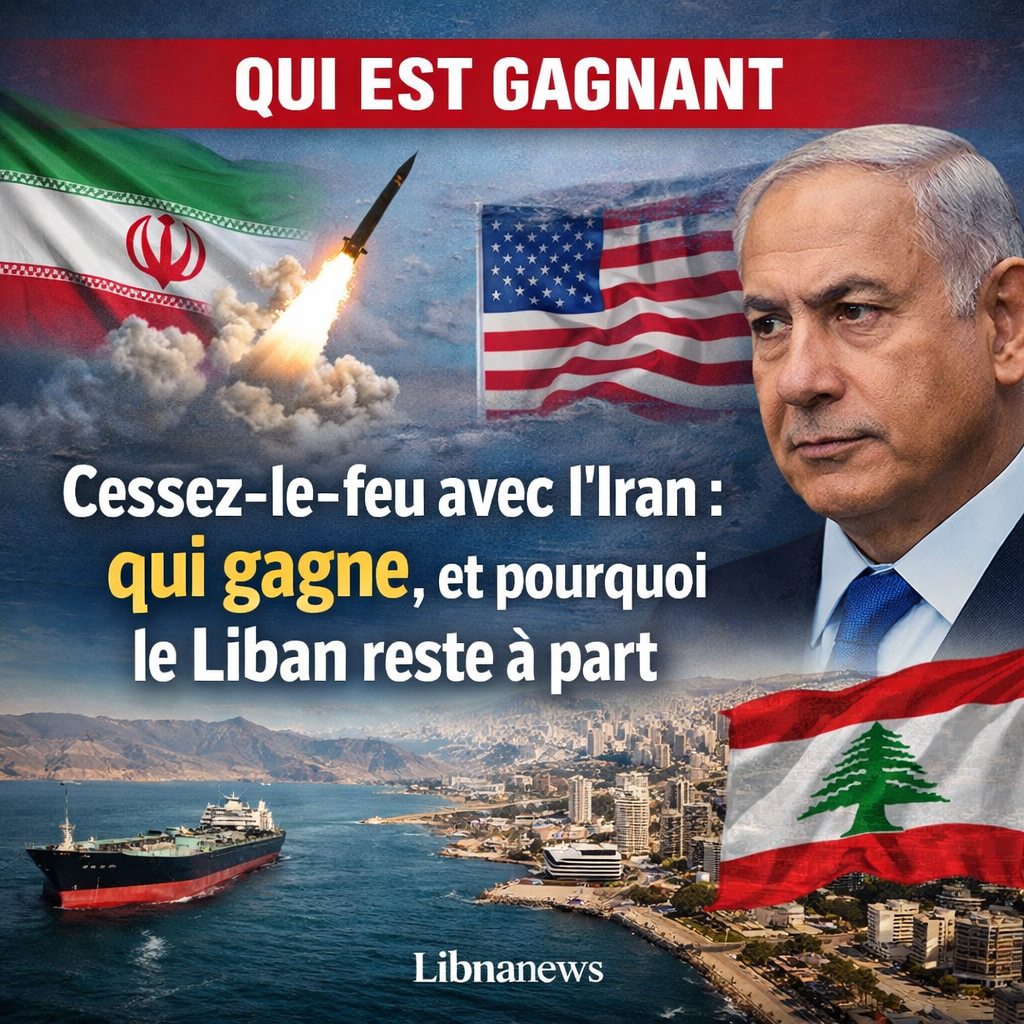
The provisional ceasefire between the United States and Iran did not end the war. He only moved confrontation on another ground: that of demands, red lines and political narrative. Tehran transmitted a ten-point plan, several of which are now known. On the other hand, the famous list of « Trump 15 points » does not appear, at this stage, as a stable public document in major international sources. This asymmetry already says something of the diplomatic moment: Iran has formulated an identifiable political package; Washington advances mainly under successive conditions, keeping a margin of blur. In this game, everyone got an immediate benefit. But on Lebanon, the divergence between Iran, Pakistan and Benyamin Netanyahu shows that the truce has not produced a coherent regional framework.
A truce of necessity, not a peace agreement
The agreement announced on 7 and 8 April is based on a very simple logic: the United States suspends its strikes against Iran for two weeks, and Tehran accepts in return the reopening of the Strait of Ormuz under conditions deemed safe for navigation. Pakistan’s role in this sequence has been central. Reuters, AP and the Washington Post report that the initiative was carried out by Pakistani Prime Minister Shehbaz Sharif and the leader of the Asim Munir army, who obtained from Donald Trump a postponement of the massive escalation that he threatened to trigger a few hours later. This is essential: the cease-fire is not the result of a fundamental détente between Washington and Tehran, but rather of a convergence of interests in avoiding a leap towards a wider war.
The context explains this suspension. A new wave of American strikes against Iran had a potentially enormous cost to Washington: risk of regional explosion, increased exposure of American bases, tension on the Gulf allies, surged energy prices and domestic political wear and tear. Oppositely, Iran had to prevent military pressure from turning into a strategic asphyxiation mechanism. The truce is therefore an urgent compromise. It does not address the nuclear issue, the ballistic issue or the status of the Iranian regional network. It only creates a parenthesis in which both sides try to transform a military power relationship into diplomatic gains.
Market reaction confirmed the scope of this signal. AP, the Wall Street Journal and the Washington Post report a sharp fall in oil prices and a rebound in financial markets after the suspension was announced. This shows that Ormuz’s stake has weighed at least as much as the direct military stake. The ceasefire thus responds to a reality that no one could ignore: when the Strait of Ormuz becomes a military lever, the war ceases to be only regional. It immediately affects global energy flows.
Iran’s 10 points: an already visible negotiating platform
The most documented point at this stage concerns the Iranian proposal. Reuters revealed that a ten-point plan had been transmitted by Tehran via Pakistan, and that Donald Trump himself had found it « practical » as a basis for negotiation. The Guardian then detailed several of these clauses from the versions relayed by the Iranian state media. What appears through these overlaps is that Iran did not only demand an end to the bombings. He proposed a much broader reconfiguration, based on security, economy, regional sovereignty and the status of his allies.
In broad terms, Iran’s plan includes the long-term end of American strikes, the cessation of attacks against Iran and its allies, a protocol for the reopening of the Strait of Ormuz, the lifting of sanctions, the thawing of Iranian assets abroad, a logic of reconstruction or compensation, a stronger international guarantee and, according to the versions, a recognition of the principle of nuclear enrichment. The most ambitious, and probably least acceptable, point for Washington remains the American withdrawal requirement from the Middle East. This is not a negotiation detail. It is a challenge to the regional architecture defended by the United States for decades.
This Iranian platform didn’t get any improvised. It is consistent with Tehran’s strategy since the beginning of the crisis. Iran has tried to convert every vulnerability of the moment into a currency of exchange. The military threat produced a request for a guarantee of non-aggression. The shock on Ormuz produced a request for political recognition of an Iranian role in this artery. Economic suffocation brought the issue of sanctions and frozen assets to the centre of the discussion. Finally, the regional war allowed Tehran to attempt to include its allies in the political perimeter of the negotiations. That is why the Iranian text gives the impression of being maximalistic: it is. But it is methodical, as a basis for opening up the ground for discussion.
What can be reconstructed from 10 Iranian points
No full document has yet been published in an official form, line by line, by an accessible institutional source. On the other hand, the following points are sufficiently converging to be considered the hard core of the Iranian plan.
| Iranian point | Political scope |
|---|---|
| Sustainable cessation of American strikes | Secure Iranian territory and avoid a new phase of bombing |
| Stopping attacks on Iran and its allies | Extending political protection to Tehran regional partners |
| Reopening of Ormuz under negotiated protocol | Transforming maritime safety into a coded subject |
| Maintenance of an Iranian role on Ormuz | Recognising Tehran Centrality in the Gulf |
| Lifting of sanctions | Getting structural economic looseness |
| Freezing of frozen assets | Recover immediate financial margins |
| Reconstruction assistance or compensation | Monk the cost of war |
| Withdrawal of United States forces from the region | Sustainable reduction of strategic pressure |
| International guarantee, including United Nations | Preventing a quick return to strikes |
| Recognition of the enrichment principle | Maintaining an Iranian nuclear red line |
Taken together, these points show that Tehran is not seeking a mere technical truce. He wants recognition of a status. Iran is not just asking that he be stopped from being hit. It demands that the exit of the crisis include its place as a regional power, its right to exist as a nuclear actor in certain forms, and the consideration of its network of influence. That is precisely what makes this platform difficult to accept in its entirety for Washington and even more so for Israel.
Trump’s 15 points: a more blurred than real political object
This is where the public story is blurred. The « Trump 15 points » formula circulates in several diplomatic comments and readings, but the major sources consulted do not publish, at this stage, a complete, clear and verified American list in fifteen clauses. Reuters reports the truce, Pakistan’s role, Trump’s recognition of Iran’s plan as a basis for work, as well as his insistence on Ormuz and on the future treatment of nuclear power. AP discusses outstanding issues, including missiles, sanctions and the US presence. The Washington Post stresses the suspension of strikes and the political cost of escalation. But none of these media reproduces an official American document entitled « 15 points ».
This does not mean that the American position is illegible. On the contrary, it appears fairly clearly through its public priorities. The first is the complete, immediate and safe opening of the Strait of Ormuz. The second is the cessation of Iranian attacks against the United States, Israel and regional partners. The third is the reintegration of the nuclear dossier into a framework that allows Washington to assert that it does not leave the Iranian uranium stock, enrichment capabilities or sensitive infrastructure intact. In addition, the issue of missiles, the reduction of the threat posed by Tehran’s allies and the maintenance of an American presence in the region are added. These blocks are visible, but for the time being they do not constitute a text numbered and stabilized in fifteen points.
This difference between the two platforms is revealing. Iran put an articulated plan on the table. The United States seems to move forward under successive conditions and red lines. Tehran is trying to redefine the exit order. Washington’s main aim is to prevent this exit from being interpreted as an Iranian victory. It’s not the same logic. One is politically offensive. The other is strategically defensive.
What Washington wants to get without having made it public again
Even in the absence of an official 15-point list, the American position can be reconstructed fairly accurately. The heart of American demand lies around six axes: the safety of navigation in the Gulf, the protection of Israel, the limitation of the Iranian nuclear programme, the control of the ballistic threat, the supervision of the role of allied groups in Tehran and the maintenance of a regional architecture where the United States does not yield its strategic position. Reuters further reports that Trump claims that any future agreement would « completely » deal with Iranian nuclear materials, even if he did not give any details about the fate of the stockpiles or the control mechanisms.
This means that, for Washington, the current truce is acceptable only if it opens up to a broader framework where Iran cannot transform Ormuz into a lasting gain, nor can it retain all its sensitive capabilities without compensation. The United States can accept a break. They can even tolerate a negotiation phase that leaves Iran with a limited communication victory. However, they cannot politically endorse an agreement that would give Tehran the lifting of sanctions, the recognition of enrichment, the intact maintenance of its regional relays and an American withdrawal from the Gulf. It would be, from Washington’s point of view, a strategic surrender.
Who gets what right now?
Iran gets time first
The first Iranian benefit is military. The suspension of the American strikes for two weeks represents a concrete, immediate and vital gain. In a high-intensity war, 15 days allow to disperse assets, repair facilities, reorganize logistics chains and restore part of internal control. For the Iranian regime, this is not a calendar detail. It’s a strategic breath.
The second Iranian gain is diplomatic. The fact that Trump speaks of the Iranian plan as a « practical » basis gives Tehran implicit recognition. Iran is no longer just the subject of pressure. He also became a co-author of the negotiating ground. This evolution is important because it allows the Iranian power to argue before its opinion that it has not entered into a logic of surrender. He can claim that he resisted, imposed his themes and forced Washington to deal with him other than by pure ultimatum.
The third win is for Ormuz. Although the reopening of the strait also benefits the United States and markets, it validates a reality that Tehran has long sought to impose: the safety of this seaway cannot be considered for long without Iran. The mere fact that navigation is now part of a political negotiation with Tehran is for the Islamic Republic a form of recognition of its geostrategic centrality.
The United States gets the bulk of the emergency
The first American gain is the avoidance of a wider war. It’s probably the heaviest benefit of meaning. The Washington Post reports Trump retreated about 90 minutes before his own ultimatum. This decline does not translate into ideological conversion. Rather, it shows that a larger offensive exposed Washington to a risk that he no longer wanted to assume. By suspending the escalation, the White House gives itself time and avoids being locked into a war whose outcome remained uncertain and the cost potentially very high.
The second American gain is economic and maritime. The opening of Ormuz is Trump’s clearest condition. On this point, Washington can claim a tangible result: the world’s main energy artery ceases to be totally blocked. It is a crisis management victory more than a strategic victory, but it is real. Markets immediately translated into oil and financial asset prices.
The third gain is procedural. The United States is getting talks without having given up on the essentials. Sanctions are still there. No military withdrawal is made. No detailed public recognition of Iran’s right to enrich uranium was granted. Washington is therefore entering a diplomatic phase by still retaining its main structural levers.
What Iran is not getting yet
The temptation to read the truce as a total Iranian victory does not stand up to the examination of the facts. Tehran has not yet obtained the lifting of sanctions. Nor did he get the American withdrawal from the Middle East. It did not secure a binding international mechanism that would prevent a return of strikes. Finally, the nuclear issue remains surrounded by deep ambiguity. The Guardian pointed out that the reference to enrichment appeared in some Persian versions of the text, but not in all English versions. This difference is not anecdotal. It shows that Iran may seek to preserve several stories among the target audiences.
On the inside, too, the regime remains under pressure. AP reports demonstrations hostile to the agreement, led by radical segments that see it as an unacceptable form of compromise. While the Iranian power may present the truce as a consequence of its firmness, it knows that any prolonged negotiations with Washington involve an internal ideological cost. The Islamic Republic has saved time. It has not yet transformed this time into sustainable gains.
What the US does not yet get
Nor can the White House present the situation as a fully consolidated victory. Nuclear remains the main dead angle. Reuters reports that Trump claims that Iranian nuclear materials will be processed in a final agreement, but no public mechanism is detailed at this stage. As long as the concrete content is not on the table, Washington cannot claim to have neutralized the threat it places at the centre of its argument.
The Iranian ballistics programme is not settled either. AP explicitly cites this as one of the major issues still open. Finally, the issue of the Tehran regional network, including Hezbollah, remains explosive. This is where the promise of a « double » or « bilateral » ceasefire reveals its limitations. The United States obtained a break on the main axis of the conflict. They did not obtain a harmonized regional framework.
Lebanon, breaking point in the official narrative
It is on Lebanon that the divergence becomes the most visible. Pakistan and Iranian relays suggested that the logic of the truce extended to Lebanon. Reuters, AP and the Guardian report, however, that Benyamin Netanyahu immediately claimed the opposite. His office had made it clear that the ceasefire did not apply to Lebanon, and therefore not to the war against Hezbollah. This rapid stance has a clear political function: to prevent Iran from transforming the American-Iranian truce into a regional umbrella covering its allies.
For Tehran, including Lebanon in the spirit of the agreement would be immense in scope. This would lead to the recognition that the security of Hezbollah and, beyond that, that of the « axis of resistance », falls within the same political package as the suspension of strikes against Iran. For Israel, accepting that reading would be extremely costly. This would mean that Jerusalem would be imposed, even indirectly, limits of action on its northern front through negotiations, primarily between Washington, Tehran and Islamabad. Netanyahu therefore refuses this extension because it would alter the symbolic power ratio to the benefit of Iran.
For Lebanon, the consequence is heavy. If the truce stabilizes between Washington and Tehran while leaving the Lebanese front active, Beirut becomes the peripheral theatre where confrontation continues while the major powers negotiate elsewhere. Reuters and AP already indicate that fighting with Hezbollah and Israeli actions on the ground are continuing. This means that Lebanon may be the residual space of the crisis, which does not fully enter into the compromise but continues to suffer the effects.
Netanyahu supports the break, but refuses enlargement
The Israeli position may seem paradoxical, but it is consistent. Israel supports the US suspension of the strikes against Iran because it does not want to expose itself to a break with Washington at a time when the American ally is trying to regain diplomatic power. On the other hand, Jerusalem wants to preserve its freedom of action over Lebanon. Hence this double line: yes to a break on Iran; No, no, no, no, no, no, no, no. Reuters sums up precisely this posture: support for the ceasefire on Iran, exclusion of Lebanon from the scope of the agreement.
This positioning also shows that Israel does not regard the war against Hezbollah as a mere by-product of the confrontation with Tehran. The Israeli security apparatus wants to maintain the idea that the northern front is a matter of its own logic, linked to the perceived immediate threat on the Lebanese border. This dissociation has a direct political effect: it weakens Iran’s attempt to portray the ceasefire as indirect protection of its allies.
Reading board: who wins what?
| Actor | Immediate earnings | Obvious limits |
|---|---|---|
| Iran | Military respite, return to negotiation, implicit recognition of his lever on Ormuz | No immediate lifting of sanctions, no firm guarantee on nuclear or US withdrawal |
| United States | Re-opening of Ormuz, reduced risk of burning, maintenance of sanctions levers | No comprehensive regulations on nuclear, missiles or regional allies |
| Israel | US support preserved, freedom of action claimed in Lebanon | No lasting clarification on the regional continuation of the truce |
| Lebanon | No direct gain guaranteed | Risk of remaining the excluded front of the main compromise |
This table summarizes the reality of the moment. Iran probably won more tactically. The United States maintains more structural levers. Israel protects its margin of manoeuvre in Lebanon. Lebanon, on the other hand, was not constituted as a subject of autonomous negotiations. He remains a theatre more than an actor.
The real question: tactics against strategy
In the very short term, the advantage leans on the Iranian side. Tehran avoided a new sequence of strikes, placed its themes at the centre of the discussion and recalled that no security scheme in the Gulf can ignore. For a pressurized diet, these are important gains.
In the medium term, however, the United States remains better armed. They retain sanctions, military superiority, coalition capacity and the initiative on whether or not to validate a final agreement. Washington has accepted a break, but has not yet conceded the strategic transformations Iran demands. That is why the strongest reading is neither that of a total American victory, nor that of an Iranian triumph. The truce above all reflects an exchange of necessities: Tehran needed to breathe; Washington needed to avoid a burning and reopen Ormuz.
What the rest will say
The continuation will be played in the ability of mediators to transform this pause into more precise text. Three cases will be decisive. The first is nuclear, because it structures the American narrative of the Iranian threat. The second is the sanctions regime, because it conditions the possibility for Iran to present the truce as something other than a mere stay. The third is regional, and especially Lebanese: as long as Lebanon remains outside the recognized perimeter of the ceasefire, any reading of a general appeasement will remain misleading.
Lebanon will, in this regard, be the main indicator of the sincerity of the process. If Israeli operations continue there without any significant change, the conclusion will be clear: the ceasefire will only have affected the Washington-Tehran axis and not the entire regional crisis. If, on the contrary, diplomatic pressure appears to also calm Lebanon’s southern front, then Iran will be able to argue that its objective of widening the framework has begun to produce effects. At the moment, the facts tend to reflect the first hypothesis.
Direct answer to the central question
The10 Iranian pointsare now relatively legible: lasting end of strikes, cessation of attacks against Iran and its allies, protocol on Ormuz with Iranian role, lifting of sanctions, thawing of assets, reconstruction or compensation, regional American withdrawal, international guarantee and, probably, recognition of the principle of enrichment.
The« 15 Trump Points »However,are not published as a complete and verified public document in major international sources consulted. What we can reconstruct is an American matrix: reopening of Ormuz, stopping attacks, processing of nuclear weapons, controlling the ballistic threat, limiting the role of Iran’s regional allies and maintaining America’s strategic position in the Middle East.






