

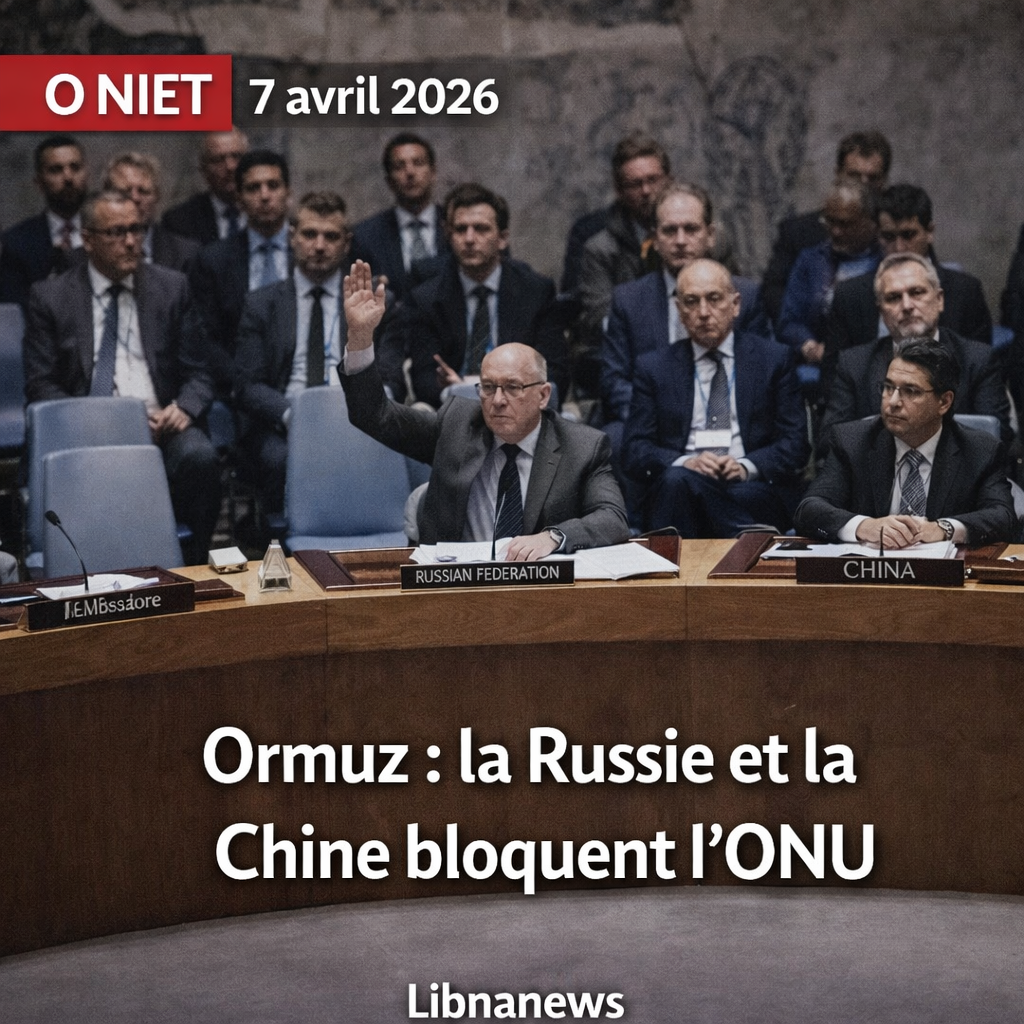
The Russian and Chinese veto in the Security Council changed the Ormuz crisis to another terrain. On Tuesday, Moscow and Beijing blocked a resolution sponsored by Bahrain to secure commercial shipping in the Straits, following a vote that11 votes for,2 againstand2 abstentions. However, the text had been heavily sweetened during the negotiations in an attempt to avoid this scenario. The originally envisaged authorization to use « all necessary means » had disappeared. Only a formulation encouraging defensive coordination to protect navigation remained. Even this lighter version did not pass the wall of both vetoes.
This vote is not just a procedural New York episode. It intervenes a few hours from Donald Trump’s ultimatum to Iran on the reopening of Ormuz, in a context where the war has already caused energy prices to rise and upset regional balances. By blocking the text, Russia and China mean that they refuse to give, even indirectly, UN political coverage to an operation that could be interpreted as an extension of the American-Israeli campaign against Iran. The Security Council thus finds itself paralysed at the exact moment when the crisis required, from the point of view of the Gulf countries and the West in favour of the text, a minimum signal of unity.
A text emptied of its substance, then still rejected
The path of resolution already says a lot of the state of the diplomatic front. Bahrain, supported by several Arab Gulf States and Washington, had initially sought a much more robust text that paved the way for armed protection of maritime traffic in the Strait. Faced with the objections of Russia, China, but also the French reluctance to formulate the most offensive formulations, the project has been rewritten several times. The last mill no longer spoke of the authorization of force. She contented herself withencourageStates interested in coordinating effortsdefensiveto ensure safe navigation. Despite this weakening, Moscow and Beijing maintained their refusal.
It is this point that gives the veto its real scope. Russia and China did not block an openly belligerent text. They blocked a compromise that had already been thinned, freed of its most explicit coercive language. In other words, their message goes beyond a simple editorial disagreement. It consists of saying that, in their eyes, the central problem is not just the safety of navigation, but the war itself and the conditions under which it was triggered. The two capitals have been accusing Washington and Tel-Aviv of having opened this sequence with their strikes against Iran for several days, and they refuse that the UN will then validate a security response that would treat Ormuz as an isolated issue from this context.
Moscow and Beijing want to move the center of the debate
Their diplomatic line is now clear. For both Russia and China, the priority is not to build a UN naval coalition, but to get a halt to military operations. The Chinese statements of the past few days already stressed the need for a ceasefire and a political solution, while Beijing and Moscow coordinated their approach to the Security Council. Their veto this Tuesday extends this position: no text on Ormuz that can be read as an indirect legitimization of an armed framework of the strait as long as the war itself continues.
This choice is not just doctrinal. He’s also geopolitical. China depends heavily on the energy flows of the Gulf and cannot easily accept a maritime security architecture that would further strengthen the US military preeminence on an artery essential to its supply. Russia, for its part, has an interest in maintaining a political reading of the conflict which accuses the United States and Israel and prevents the formation of an enlarged Western consensus in the Council. The veto thus serves both a displayed logic of de-escalation and a logic of power rivalry.
The reverse of Bahrain and the Gulf capitals
For Bahrain, who chaired the Council and carried the text, the setback was serious. The kingdom had been placed at the forefront of the Gulf diplomatic efforts to internationalize the Ormuz issue and to remove a political basis for securing maritime traffic. Watermarking also involved obtaining a form of guarantee against a sustainable closure of the Strait, which directly threatened the region’s economies, oil exports and the stability of world markets. The Russian and Chinese veto deprives the Gulf monarchies of this diplomatic victory and shows that their room for manoeuvre remains closely dependent on the great powers.
It should be added that Bahrain’s manoeuvre had already revealed the fractures of the camp in favour of action. France, in particular, had pushed the most offensive elements of the text to be removed. This point fed into debates in several western capitals and in the European press, some of which saw it as a useful caution, others a problematic hesitation when freedom of navigation was at stake. The final vote did not only highlight the Russian-Chinese opposition. He also showed how even the supporters of the text had to deal with their own differences on how to treat Ormuz.
Washington loses the UN battle but maintains pressure
For the Trump administration, failure is all the more visible as it occurs just before the deadline that she herself set in Tehran. The White House wanted military, economic and diplomatic pressure to rise simultaneously. At the military level, the United States has already increased its regional presence and conducted strikes in Iran. At the diplomatic level, they hoped to obtain at least one minimum text from the Security Council to show that the safety of navigation in Ormuz was of wider international interest than their only war objectives. The veto of Moscow and Beijing breaks this image. Washington is referred to a more solitary logic, or at best to an ad hoc coalition outside the United Nations.
This does not mean, however, that American pressure will decrease. On the contrary, everything indicates that the Trump administration will seek to use the failure of the vote as an argument against the Council’s paralysis and to justify action by other bilateral or plurilateral executives. But diplomatically, the cost exists: without resolution, any more robust security operation in Ormuz will appear more as a camp initiative than as a response validated by the international community. In an already explosive crisis, this difference weighs heavily.
UN confirms paralysis in Middle East
This Tuesday’s vote prolongs a more general reality: on the most sensitive Middle Eastern crises, the Security Council remains unable to produce a common line when American, Russian and Chinese interests are directly confronted. Ormuz does not escape this logic. Western and Gulf States highlight freedom of navigation, energy security and the risk of global economic destabilization. Russia and China say that maritime traffic cannot be treated as an autonomous issue, while it is the product of a war opened by the American and Israeli strikes against Iran. These two stories no longer meet.
This paralysis has very concrete effects. It means that the United Nations cannot, at this stage, offer either a robust mandate, a consensual political framework or a clear mechanism to defuse the escalation around the Strait. The diplomatic front exists well, but it moves outside the Council: discussions between Gulf capitals, exchanges between Beijing and Moscow, American pressure, regional mediation, and attempts to prevent the Ormuz crisis from turning into an open maritime war. The UN remains the scene of disagreement, not the tool of its resolution.
Ormuz became the diplomatic node of war
This veto confirms one thing above all: the Strait of Ormuz is no longer merely a strategic maritime passage. It has become the point where all the lines of the current crisis cross each other. Energy line, because about one-fifth of the world’s oil flows normally flow there. Military line, because any attempt to reopen by force could further expand the war. Diplomatic line, because each power projects on Ormuz its own reading of the conflict. And economic line, because the slightest signal on the strait immediately affects energy prices and market expectations.
The battle around the Bahraini resolution illustrates perfectly. The Gulf countries wanted to refocus the debate on shipping and protecting trade routes. Russia and China reconnected to the general conflict and the initial responsibility of the United States and Israel. The United States, on the other hand, was seeking to test Ormuz for international credibility against Iran. None of these stories imposed upon the Council. The result is a blockage that solves nothing, but that redefines the power relations: Washington loses the UN cover, Bahrain loses its initiative, and Moscow like Beijing show that they remain able to lock the game when they consider the escalation too favorable to the Western camp.
The diplomatic front is entering a tougher phase
There are two immediate consequences. The first is that negotiations are likely to shift to smaller and more informal formats outside the Council. Contacts between the Gulf States, Washington, some European capitals and regional ombudsmen can be expected to intensify in an attempt to avoid a complete breakdown. The second is that Russia and China now assume a more frontal role in this crisis. They no longer merely express reservations. They’re blocking. And this blocking installs them as central actors of the diplomatic front, not just as external commentators.
Tonight, the Russian-Chinese veto did not reopen Ormuz. He didn’t calm the war. But he clarified the diplomatic landscape. On one side, an American-golfi axis that wanted a text, even weakened, to secure navigation and increase pressure on Tehran. On the other hand, Moscow and Beijing, decided to prevent any reading by Ormuz that would circumvent the central issue of the American and Israeli strikes against Iran. The Security Council has decided by powerlessness. And in crises of this magnitude, diplomatic impotence is never neutral: it leaves the field more open to ultimatums, ad hoc coalitions and military calculations.






