

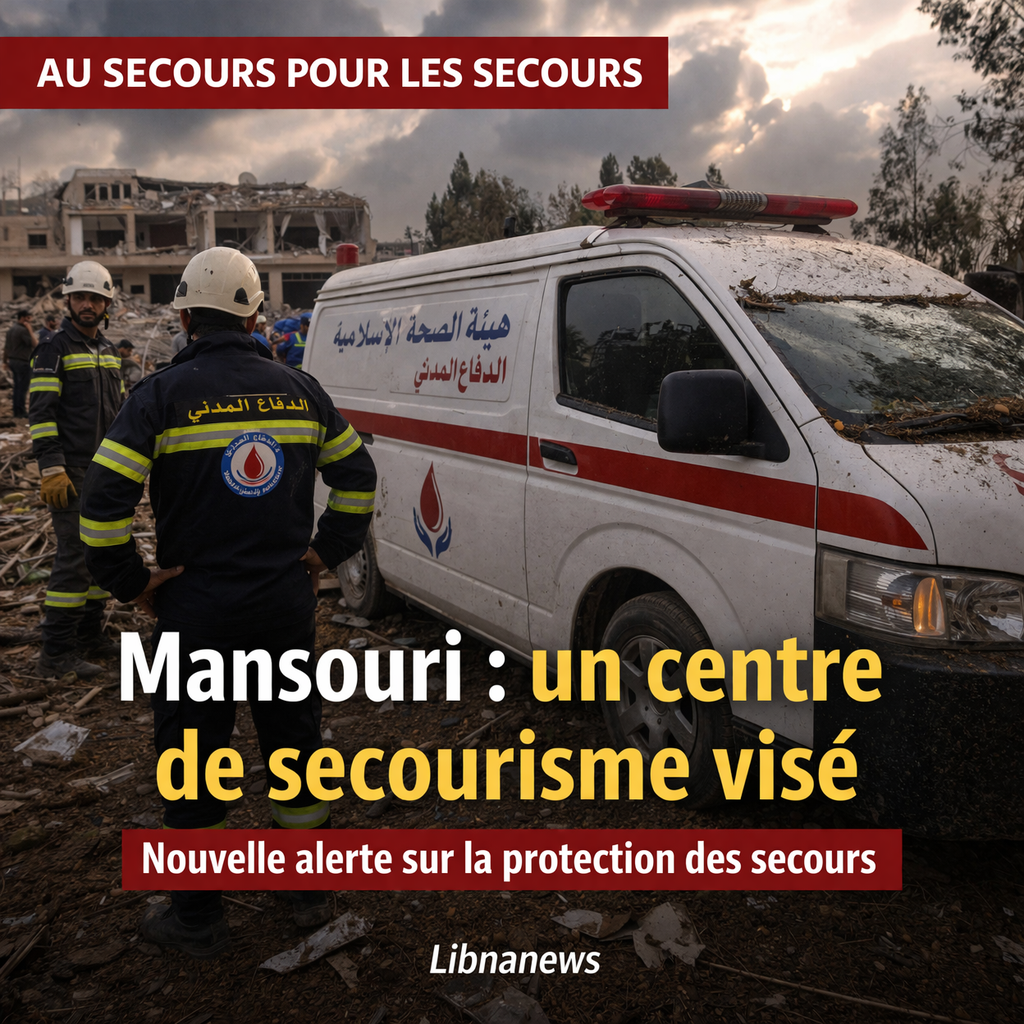
A new first aid centre was targeted on Monday in southern Lebanon. According to the National Information Agency, an air strike struck a civil defence centre under the authority of theHaya al-Sihiya al-IslamiyyatoMansuri, causing several injuries. At the same time, other raids struckHaris,Yater,Bint JbeilandAinatha. The NNA dispatch does not yet provide a consolidated assessment, but confirms that the affected site is well represented as a rescue centre.
This strike occurs in a sequence already marked by repeated attacks on relief workers and health facilities in South Lebanon. The day before, the NNA reported the death oftwo paramedicsin a strike against a centre of the same organization near the hospital ofBint Jbeil. A few hours later, the agency also reported targeting aCivil Defence CentretoDeir Kifa. In other words, the bombing of Mansouri does not occur in isolation. It is part of a close series of attacks on relief personnel and infrastructure.
The general context further reinforces the gravity of the episode. In its situation of 19 March, L31 health workershad already been killed, with dozens of others injured, in the face of repeated strikes against hospitals, primary health centres and ambulances. A few days later, another United Nations survey mentioned64 attacks on health care, having caused51 deathsand91 injured. On Friday, WHO denounced the death ofnine first aid workersin five separate attacks on health facilities in southern Lebanon.
What international humanitarian law says
The legal framework is clear in principle. The International Committee of the Red Cross recalls thathealth units and means of transport must be respected and protected at all timesandmust not be attacked. The ICRC also recalls thatCivil defenceprotection during the performance of their missions, precisely because they participate in the protection of the civilian population from hostilities.
This does not mean that every strike on a rescue centre automatically constitutes, in law, a war crime established in advance. In order for a definitive criminal qualification to be adopted, it is essential in principle to establish the precise facts, the exact nature of the site, its use at the time of the attack, the possible loss of protection and the intention of the author. However,if a clearly protected emergency centre or medical unit is deliberately targeted without lawful military justification, this may fall within thewar crimeunder international humanitarian law. It is therefore a legally serious qualification to be considered, but which requires a documented and independent investigation.
In the case of Mansouri, the public elements available at this time remain limited to the NNA dispatch, which speaks of aCivil Defence Centreand several wounded. No detailed Israeli justification for this precise strike appears in the sources consulted at the time of writing. In the absence of more complete information, therefore, the most rigorous formula is to say thatthe bombing raises a new serious suspicion of violation of international humanitarian lawandcouldif the facts are confirmed,entering the field of war crimes.
A repetition that weighs more and more
What is now striking is no longer just the violence of an isolated incident. It’s rehearsal. In less than 48 hours, local dispatches and international agencies reported killed paramedics, affected centres, hit rescue teams and decommissioned health facilities. This accumulation is beginning to draw an operational motive that humanitarian organizations and health authorities are following very closely. WHO recalled that these attacks directly disrupt access to care and contribute to the closure or partial operation of many facilities.
In Lebanon, this issue has already taken on a national political dimension. In recent days, Lebanese authorities have repeatedly denounced the targeting of first aid workers and journalists. The fact that Mansouri adds to Bint Jbeil and Deir Kifa in the space of one day reinforces this line of denunciation. Again, the decisive point is not just the number of strikes. It is the repeated choice of places related to relief, evacuation and care of the injured.






