

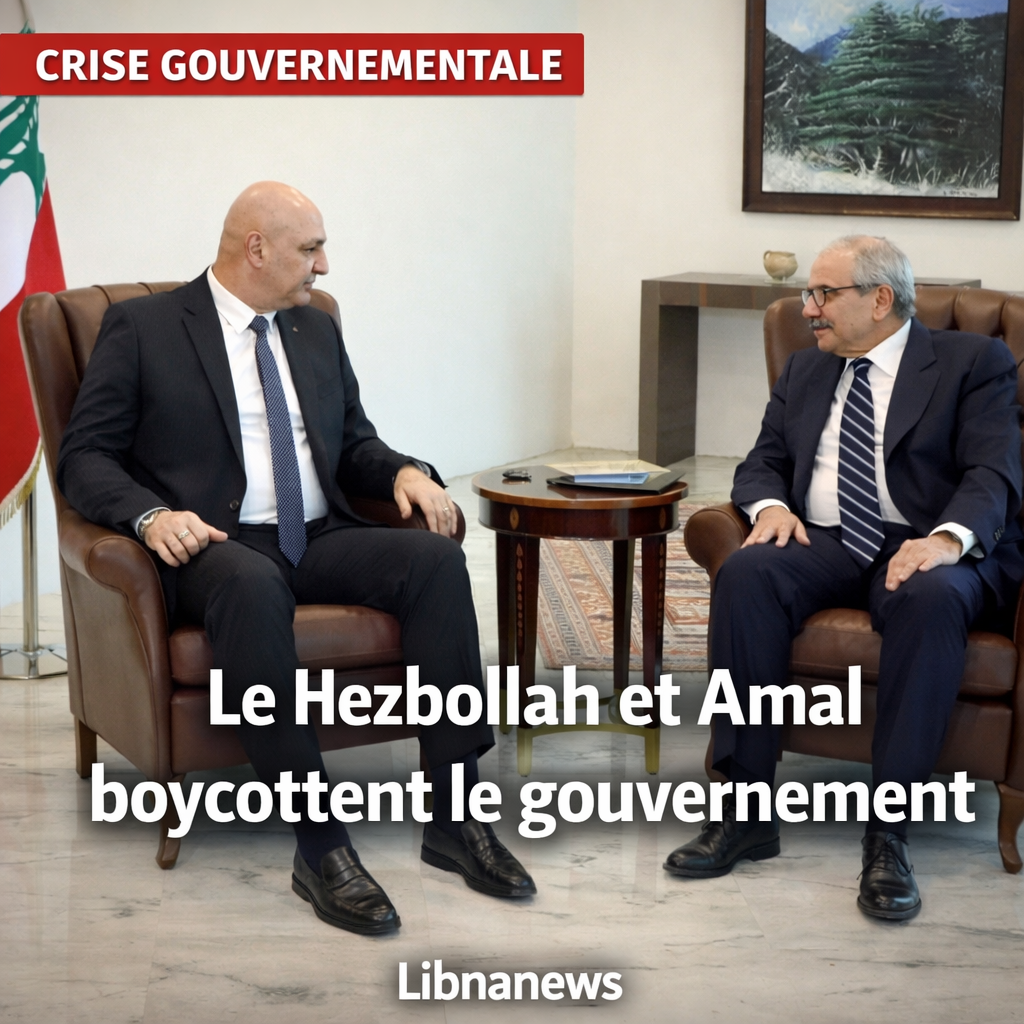
The crisis opened by the withdrawal of the accreditation of the Iranian ambassador to Lebanon is crossing a more serious political threshold. According to consistent information in Beirut, the ministers of Hezbollah and the Amal movement will not participate in the government meeting, transforming a diplomatic dispute into a direct institutional confrontation within the executive. This announced absence comes after the decision of the Lebanese Ministry of Foreign Affairs to declare the Iranian Ambassador Mohammad Reza Shibani persona non grata and to ask him to leave the territory by 29 March.
Originally, the meeting of the Council of Ministers was to be devoted to examining the political, security and social repercussions of the war, in particular the Israeli escalation, massive population displacement and the internal consequences of the conflict. But the Iranian file has suddenly changed the nature of the meeting. The appointment is no longer just a crisis council. It becomes a test of government cohesion, at the very moment when the State tries to assert that it remains the sole custodian of diplomatic decision-making and institutional legitimacy.
A Diplomatic Decision Becomes Political Crisis
The Department of Foreign Affairs justified its decision by violations of diplomatic practices and protocol. Beirut also recalled that this measure did not mean a break in diplomatic relations with Tehran. From a legal point of view, the power relies on the traditional principle of the State’s sovereignty to defend an act presented as falling within its normal prerogatives. But in Lebanon, this institutional reading immediately ran into a diametrically opposite political reading.
For Hezbollah and Amal, the case far exceeds the ambassador’s only person. The Shiite tandem sees it as a hostile measure against Iran, taken in a context of regional war and a clear tightening of power towards Iranian influence. Hezbollah denounced a « unwise » decision that was contrary to Lebanon’s best interests, while high Shiite religious leaders called for its annulment. Amal, for his part, considered that a return to this decision would constitute a « national virtue », stating that he would not allow this matter to pass without reaction.
What, again on Tuesday, could be presented as a diplomatic arm became a low-noise regime crisis. By choosing to boycott the sitting, the Shiite tandem ministers give an institutional translation to their refusal. They no longer merely condemn the decision. They mean that the challenge will now be at the very heart of the government’s functioning.
A direct test for Joseph Aoun and Nawaf Salam
The sequence puts President Joseph Aoun and Prime Minister Nawaf Salam under maximum pressure. According to political sources cited by the Pan-Arab press, contacts have been made between the Head of State and Nabih Berri to try to contain the escalation, guarantee the holding of the session and prevent the fracture from settling in government work on a lasting basis. So far, the Presidency has kept itself from frontal public comment, a sign of the extreme sensitivity of the moment.
For Nawaf Salam, the stake is particularly heavy. The head of government has already accused the Iranian Revolutionary Guards of commanding Hezbollah operations in Lebanon and believed that the country had been dragged into a war he had not chosen. His Government had also banned Hizbullah’s military activities on Lebanese territory on 2 March, claiming that only the State could decide on war and peace, and calling for the handing over of arms to the public authority. In this context, the expulsion of the Iranian ambassador appears less as an isolated episode than as one of the links of a stronger political line towards Tehran and its Lebanese ally.
For Joseph Aoun, the difficulty is another order. It must preserve both State authority, government continuity and civil peace. But each of these priorities shoots in a different direction. If he gives in to the Iranian issue, the presidency will appear weakened. If he keeps the line uncompromising, he exposes himself to deeper stress with the Shiite tandem. This is precisely what gives the crisis its current gravity: it concerns not only a diplomatic decision, but the capacity of the state summit to arbitrate a conflict between institutional sovereignty and internal power.
Shiite tandem connects the Iranian case to everything else
The current voltage cannot be read separately from the rest of the Lebanese sequence. The dispute over the Iranian ambassador overlaps with two other already-open divisions: the issue of negotiations with Israel and the issue of arms monopoly. Asharq Al-Awsat reports that the dispute over the ambassador also reflects the broader rejection by the Shiite tandem of any dynamics of direct negotiations with Israel. At the same time, discussions on state sovereignty and the place of Hezbollah’s weapons have intensified further since the resumption of the war.
Hezbollah also posted a line without concessions. Its secretary general, Naïm Qassem, rejected the idea of negotiating with Israel « under fire », assimilating this perspective to a surrender. In this context, the decision against the Iranian ambassador is not seen as a mere reminder of the protocol, but as an attempt to redefine Lebanon’s strategic orientation at the very moment when the Shiite party intends to continue the confrontation.
This also explains the hardness of the reactions. For the Shiite tandem, returning to the diplomatic decision is not a symbolic gesture. This is to prevent the establishment of a political precedent where the Lebanese state begins to roar, even gradually, the Iranian space of influence in Beirut. Conversely, for the forces in favour of maintaining the decision, to retreat today would be to recognize that the government cannot act sovereignly as soon as a case touches Tehran or Hezbollah.
An internal fracture now assumed
Perhaps the most important thing in the current sequence is the now public and assumed nature of the fracture. The parties opposed to Hezbollah, in particular the Lebanese Forces and the Kataeb, supported the decision against the Iranian ambassador. Conversely, the Shiite tandem requires a step back. In between, the Presidency tries to contain the explosion without losing its hand. The cleavage is no longer felt. It is exposed, structured, and it crosses the entire state apparatus.
The crisis also highlights another political fact: Iranian influence, long treated as an established data of the Lebanese landscape, is now frontally contested by a part of power. The government has stopped Iranians from entering the country without a visa, banned Hezbollah’s military activities and increased the signs of takeover. Opposite, Hezbollah and its allies respond by denouncing a direction aligned with Western and Israeli interests. This confrontation of narratives feeds the crisis of the day.
What the boycott changes
The boycott of Hezbollah and Amal ministers does not automatically bring down the government. But he changes several things at once. First, it establishes the idea that the Council of Ministers can become a permanent field of confrontation on the legitimate issues. Then, it politically weakens the cabinet’s ability to speak with one voice while the country is at war. Finally, it puts the risk of wider paralysis if there is no compromise between Baabda, Serail and Ain al-Tinah.
In the immediate future, therefore, the question is not just whether the meeting will take place. It is to know what will remain of government solidarity after this arm. For the Iranian ambassador’s case has already produced its first lasting effect: it has revealed that behind the facade unit imposed by the war there are intact or even aggravated lines of fracture over sovereignty, regional alliances and the real decision-making centre in Lebanon.






