

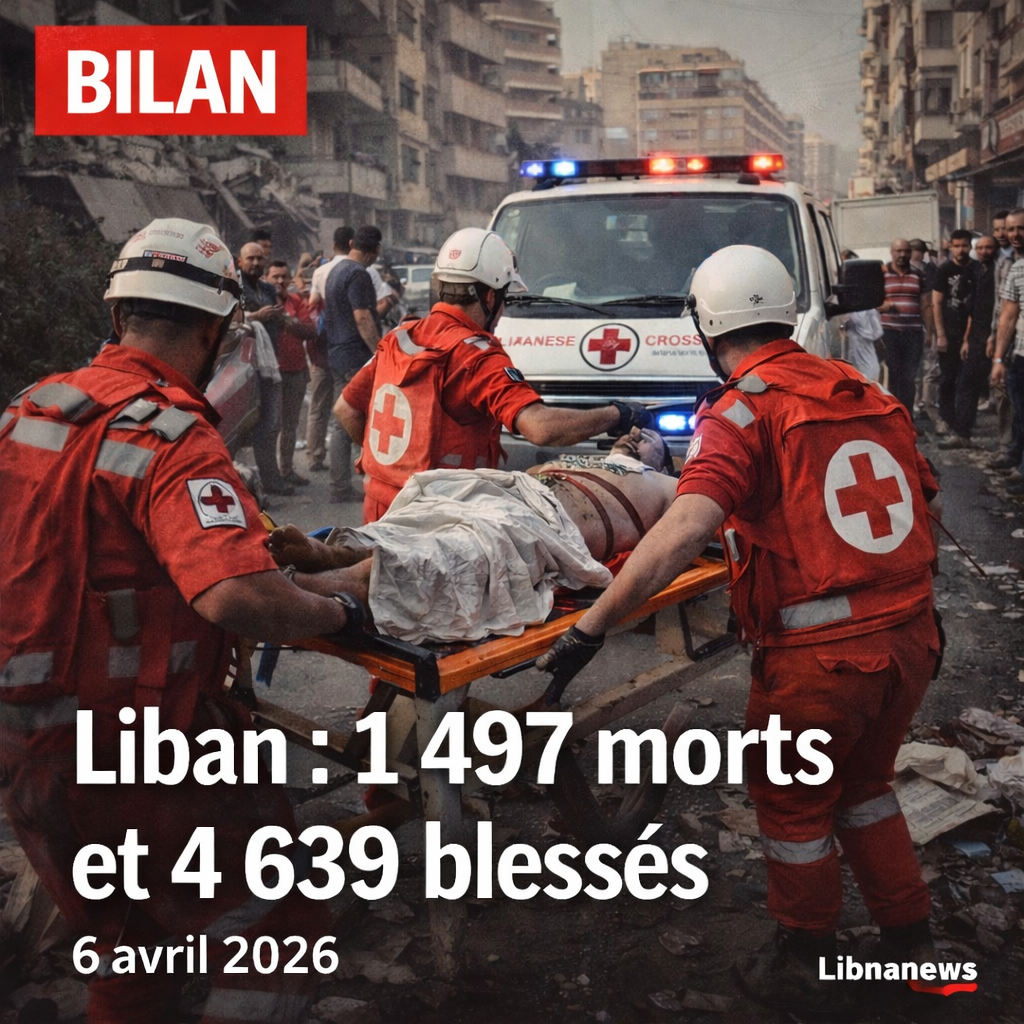
The human impact of the Israeli offensive in Lebanon continues to grow. According to the Lebanese Ministry of Health, reported on Monday, 6 April, the total number of deaths since 2 March reached 1,497, while 4,639 people were injured. On the ground, NNA dispatches describe a sequence marked by sustained shelling in the South, repeated strikes on the southern suburbs of Beirut and increasing pressure on medical services.
The last count reported by the Ministry of Health on Monday marks a further worsening of the NNA’s assessment of 1,461 deaths and 4,430 injuries. The gap shows how the situation continues to evolve, with regular reviews of the situation as the injured are evacuated, hospital deaths and the continuation of relief operations.
Beyond the loss of life, humanitarian pressure remains considerable. The NNA reported on Sunday, via the Great Serail Disaster Management Unit, that the number of internally displaced persons had reached 137,774. This figure gives the measure of the ongoing destabilization: the war is no longer only being read through the daily strikes and assessments, but also through a massive displacement of population that weighs on the host municipalities, schools, collective centres and health structures.
Southern Beirut: repeated strikes and evacuation warnings
Among the most notable developments of the past few hours is the intensification of strikes on the southern suburbs of Beirut. The NNA reported that eight raids had targeted different areas of the area until Sunday, confirming a new sequence of bombings concentrated on the southern periphery of the capital. The Agency also reported the resumption of Israeli flights at low altitude over Beirut and Mount Lebanon, a sign of continued air pressure well beyond the border areas.
The same momentum continued with an evacuation warning targeting several parts of the southern suburbs, according to the NNA. This method, which is now recurrent, combines a preliminary message and then strikes, in densely populated areas where people live, displaced persons and families who welcome relatives from the South. Even when a warning is issued, urban concentration, short deadlines and the saturation of the axes make these departures particularly difficult.
The South remains the epicenter of war
South Lebanon, however, remains the main focus of the bombings. The NNA reported that an Israeli strike on Kfarhatta had killed seven people, including a child. This episode illustrates the particularly high human cost of raids on southern localities, where homes, roads and residential areas remain exposed to repeated attacks.
The official agency also reported this Monday morning a series of raids on villages in Nabatiyah district between midnight and dawn. In the same vein, the NNA reported deaths in a strike on Burj Rahhal as well as Israeli overflights covering the Tyre district. This continuity of night and morning bombardments shows that the war does not observe any real cycle of pause. The strikes followed each other at a steady pace, with cumulative effects on relief, hospitals and residents.
Increasing health pressure
The impact on the health system is becoming increasingly clear. The NNA relayed the appeal of the Rmeish priest for the urgent deployment of a field hospital in the locality. According to the dispatch, the demand is due to the severe deterioration of the humanitarian and health situation in the area. When a local authority comes to demand a field medical structure, this means that the ordinary management capacities are already out of date or very weakened.
The national record of the wounded, now set at 4,639 according to the latest report of the Ministry of Health relayed on Monday, illuminates this tension. It not only reflects the number of direct victims of the bombings. He also says the overload of emergencies, operating units, intensive care units and ambulance networks in a country where hospital supply was already under pressure before this new phase of war.
Risms and continuation of hostilities
At the same time, the NNA also issued Hizbullah communiqués announcing attacks on Israeli infrastructure, two settlements and the Miron surveillance base. This data points out that the conflict remains two-way, although most of the human cost documented in recent hours in Lebanese territory comes from Israeli strikes.
The overall picture that emerges on April 6th is that of a war that is spreading in depth. The southern suburbs of Beirut remain targeted. The South continues to collect the most deadly bombings. There are tens of thousands of internally displaced persons. Local health facilities require exceptional reinforcements. And the national human record continues to rise at a steady pace, with 1,497 dead and 4,639 injured since 2 March.






