

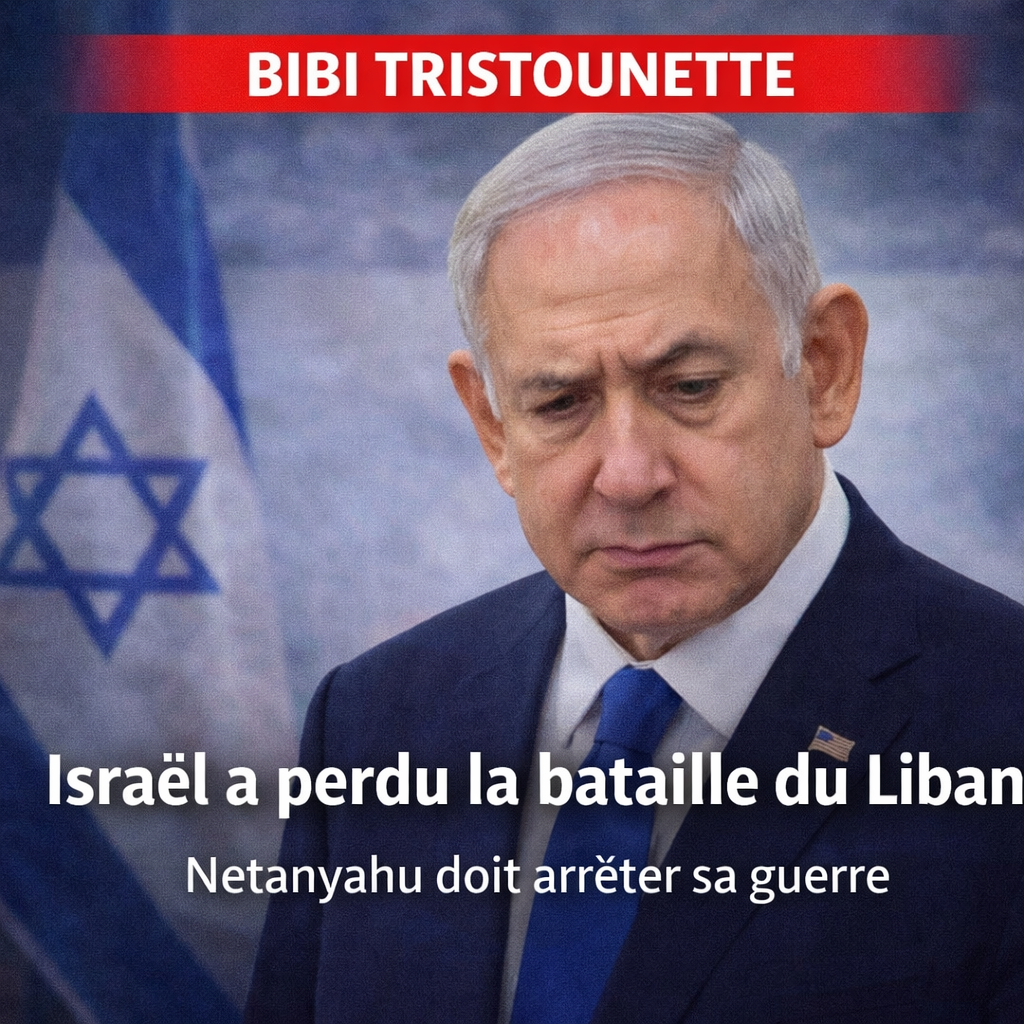
The ceasefire between Washington and Tehran changed the reading of the war in Lebanon. It not only temporarily suspended direct escalation between the United States and Iran. It also revealed a more disturbing reality for Israel: after weeks of war, partial occupation, massive strikes and forced displacement, the Hebrew state did not turn its military superiority into a political victory in Lebanon. The decisive fact is even elsewhere: Donald Trump advanced towards an agreement with Iran despite pressure from Benyamin Netanyahu, Saudi Arabia, the Emirates and Republican allies, while J.D. Vance and Steve Witkoff pushed for acceptance of a settlement. The decisive moment was therefore played without Israel being able to impose its line.
A war waged from a position of strength, ended in a narrower position
Initially, Israel clearly believed that it could expand its policy space in Lebanon. The offensive was intended to meet several objectives at once: to reduce Hezbollah’s military capacity, to create a security depth in southern Lebanon, to push the Shiite movement to a lasting retreat, and to impose a new, more favourable political balance on Beirut. The analyses published in recent days show that logic went far beyond mere punitive strikes. The aim was to reshape the terrain, with the horizon of a safe area up to Litani, i.e. a depth of up to 30 kilometres. At the same time, massive displacements were thought to be a lasting fact, with more than 600,000 Lebanese expelled from their areas of origin in the south.
It is precisely on this point that the battle of Lebanon began to turn politically against Israel. Yes, the Israeli army has advanced on the ground. Yes, it destroyed villages, bridges, logistics and a considerable part of the southern infrastructure. Yes, it has moved the population massively. But the war did not produce the desired final political effect. Hezbollah has not been eliminated. The occupation until the Litani was not consolidated as an irreversible strategic fact. Above all, at the decisive moment, the settlement moved towards a ceasefire negotiated between Washington and Tehran, with Islamabad as mediator, not towards a Lebanese capitulation or hezbollahia dictated by Israel.
The cease-fire was decided without Netanyahu setting out the terms
Perhaps the most humiliating point for Israel is here. According to Axios, Trump’s decision to move towards a settlement with Iran was made despite pressure from Netanyahu, Saudi Arabia, the United Arab Emirates and Republican allies for a tougher line. The same media said that J. D. Vance and Steve Witkoff had pleaded, in the close circle of the president, for acceptance of the agreement. The final sequence therefore did not correspond to Israel’s favourite line or that of several Arab capitals hostile to Tehran.
This data profoundly changes the analysis. A country can continue to strike, continue to threaten, continue to speak of victory; If he no longer controls the central political decision, his room for manoeuvre is reduced. That’s exactly what happened here. Netanyahu then supported Trump’s pause on Iran, but this support was more like a forced rally than a strategic success. He then tried to save what could be achieved by claiming that the ceasefire did not concern Lebanon. This gesture is not that of a fully victorious actor. It is that of a leader who tries to preserve a residual front after losing his hand on the main sequence.
Lebanon becomes proof that Israel has not converted its force into political order
Since 2 March, the Israeli army has waged an extremely intense war in Lebanon. As at 8 April, there were more than 1,500 deaths and 1.2 million internally displaced persons in available records. Whole villages have been emptied, border areas ravaged, bridges destroyed, evacuation orders extended, and a significant part of southern territory has been transformed into a permanent war zone. Israel has therefore exerted considerable military and human pressure. But despite this, the war did not lead to the desired total political effect.
The best sign of this failure is that Israel is now in a defensive position on the ground of the story. He was obliged to reiterate that the ceasefire did not cover Lebanon. It is obliged to maintain pressure by further evacuation warnings, including to Tyre and the southern suburbs of Beirut. He is obliged to show that he remains capable of acting, precisely because the diplomatic framework that has just been created no longer belongs to him completely. A power that gains does not need to remind every hour that it keeps its hand; the simple result speaks for her. When the word becomes so insistent, it is often because the political result is less clear than hoped.
Hezbollah was not destroyed, yet it was the most visible objective.
Israel can argue that it has inflicted heavy losses on Hezbollah, destroyed some of its infrastructure and reduced its freedom of movement in several areas. That is true on the immediate military level. But this is not enough to validate the maximum strategic objective. The most serious analyses published in recent days clearly show Israeli ambiguity: on the one hand, military and political leaders continue to speak of Hezbollah disarmament; On the other hand, some assessments admit that complete disarmament would actually require a much larger and longer occupation, which is considered unrealistic. It is precisely this slip that betrays the limit of the offensive.
Hezbollah, on the other hand, does not appear as a crushed actor to the point of disappearing from the equation. On the contrary, Lebanese sources close to the movement indicated that they had suspended their attacks after the announcement of the ceasefire, allowing them to appear, at least temporarily, as a party that had observed the truce while Israel was continuing its operations. Iran, for its part, insisted that Lebanon be included in the agreement. This dual movement gives Hezbollah a valuable political resource: it can argue that it was not destroyed, that it remains protected by the regional axis, and that Israel did not obtain on Lebanese ground what it promised at the beginning of the offensive.
Iranian influence in Lebanon comes out reinforced, and this is the exact opposite of the Israeli goal
This may be the most important point. The war was also to reduce Iran’s regional influence, including in Lebanon. However, the opposite effect occurs. Not only did Tehran not disappear from the Lebanese file, but he spoke of Lebanon as an element of the ceasefire without visible coordination with the Lebanese authorities. Pakistan confirmed this regional reading of the agreement. And the Lebanese State, however directly concerned, was not at the centre of the definition of the perimeter of the truce. This sequence enshrines a reality unfavourable to Israel: the Lebanese question remains, in fact, treated as a component of strategic negotiations with Iran.
This situation is all the more striking as the official diplomatic channel between Beirut and Tehran has been degraded. At the end of March, Lebanon asked the Iranian ambassador to leave the country, but Tehran refused to comply with it and internal protests showed that the measure had not produced a fully effective diplomatic break. As a result, even with a damaged official relationship, Iranian influence did not recede. On the contrary, it was expressed in the most important sequence of the moment, that of the ceasefire, without Beirut being able to take over. For Israel, which precisely wanted to reduce the Iranian role in Lebanon, it is a structural failure.
Beirut had opened doors that Israel refused to borrow
Another element feeds the idea of a lost battle. In mid-March, a large news agency revealed that Israel had rejected a historic offer of direct negotiations from Lebanon. President Joseph Aoun said he was ready to engage in direct discussions with Israel, and two familiar sources of his position indicated that he was going so far as to consider, in some private conversations, a move towards normalization. The same article stated that Israel considered this offer « too little, too late », even though the Lebanese government shared its objective of disarming Hezbollah, but could not act against it without risking a civil war.
This point is crucial. It shows that Beirut, or at least the Lebanese presidency and some part of the executive, was willing to go much further than in previous sequences. The Lebanese State was ready to open direct channels and put major political concessions on the table. But Israel felt that it could obtain more by force. He therefore challenged the offer, thinking of negotiating later from an even more dominant position. It is precisely this calculation that seems today to have turned against him. By refusing to seize a moment when official Lebanon was ready to move, Israel allowed the war to continue to a point where the decision centre moved to the Washington-Teheran axis. It is no longer Beirut that comes to him; It was Washington that forced him to deal with a truce he had not designed.
The Litani remains an announced horizon, not a consolidated victory
One of Israel’s most visible goals was to transform southern Lebanon into a sustainable strategic depth, moving to the Litani or creating an equivalent security space. Recent analyses show that this ambition varied across sectors, ranging from a few kilometres to a much wider logic according to Israeli officials’ statements. The very fact that this strategic depth remains unclear at this stage shows that Israel has failed to make it a clear political achievement. A front line can be achieved tactically without being strategically consolidated.
Again, the American decision to freeze the Iranian front changes everything. For a military advance that is not immediately converted into a favourable political arrangement becomes vulnerable to the return of diplomacy. But the current diplomacy is not written by Israel. It is structured by Washington, Islamabad and Tehran. The more this diplomacy settles, the more the possibility for Israel to transform its territorial advance into a sustainable order becomes reduced. This justifies the idea that Israel has lost part of its margin of manoeuvre: it still has military means, but less political freedom to decide on its own.
Israeli wear and tear now weighs on the countryside
We must also look at the war on the Israeli side. One of the clearest signs of a strategic shortness of breath is the military’s human wear and tear. At the end of March, European reference sources reported a shortage of approximately 15,000 soldiers in the Israeli army, including 8,000 combatants, with increasing pressure on reservists, requests for early departure among career soldiers, and internal alerts about the overload of an aircraft engaged simultaneously on several fronts. This tension does not mean collapse. It means that the duration of the war itself becomes a military and political problem for Israel.
To this human wear adds material wear. Several reports published in recent days show that Iranian attacks have energized interceptor stocks and, more broadly, regional air defence architectures. US media reported that Israel had approved a plan to accelerate the production of Arrow interceptors as stocks decreased. Other reports point to a recurring debate about the pressure of war on interception systems and the cost of a confrontation where relatively cheap weapons can force extremely costly defensive responses. Again, it is not a question of saying that Israel is helpless. It must be noted that a long war also has the technological advantage when it requires the long-term consumption of rare, expensive and complex systems to produce.
Israel believed in negotiating in a position of force; he now negotiates in a more constrained position
The heart of analysis stands there. For weeks, Israel acted as if it had unlimited political time: time to strike, time to move, time to impose a security depth, time to wait for the collapse of the Lebanese margin or Hezbollah. But this time was closed. It closed down because the Gulf War eventually imposed on Washington a logic of de-escalation with Iran. It closed because this de-escalation was decided despite Netanyahu and several Arab allies. It closed because Iran managed to put Lebanon back in the regional equation, with the support of Pakistan. Result: Israel has not negotiated since the highest point of its campaign. He’s been negotiating since his American ally wanted to avoid general fire.
That is why the expression« Israel lost the battle of Lebanon »makes sense, provided that it clearly defines what is meant by it. It is not a question of saying that Israel has lost every tactical confrontation or that it has been militarily pushed back everywhere. It is to say that he did not obtain the political product of his military superiority. He destroyed without fully converting. He moved without stabilizing. He struck without imposing a new order. And at the decisive moment, the settlement was partially out of his hands. In a war, this is a political defeat.
The attempt to keep Lebanon out of the truce looks like a catch-up manoeuvre
The Israeli choice to explicitly exclude Lebanon from the ceasefire must be read as an attempt to preserve a residual margin. Netanyahu and the Israeli army know that stopping escalation with Iran mechanically reduces their ability to enshrine the Lebanese war in a wider regional context of confrontation. To compensate, they claim that the campaign against Hezbollah continues, threatens the southern suburbs of Beirut, targets Tyre, and repeat that « the battle continues ». But this insistence also has something defensive: it aims to prevent Iran from politically winning a deal that implicitly includes Lebanon.
The problem for Israel is that this dissociation is no longer entirely credible to all actors. For Tehran, Lebanon is part of the same strategic system. For Islamabad, the truce was also Lebanese in scope. For Paris, Lebanon must be fully included. And for some of the regional opinion, the simple fact that Israel must justify so vigorously the exclusion of Lebanon already shows that this exclusion was not self-evident. Again, the country is not in a position of net strength; It is in a defensive argumentation position.
Iranian gain is also Israeli loss
All this leads to a final observation. If Iran appears today to be geopolitically winning, it is also because Israel has failed to prevent this revival into diplomatic power. Tehran obtained its proposal as a basis for discussion. He got an American strike stop for two weeks. He obtained that the reopening of Ormuz was through negotiation. And he got Lebanon back in the ceasefire debate, even though Israel continues to challenge its inclusion. In this game, each Iranian gain symmetrically reduces the Israeli ability to claim to have remodeled only the regional order.
That is why the battle of Lebanon cannot be read only through the won kilometres or the destruction inflicted. It must be read through the final sequence: a Lebanon that remains disputed, a Hezbollah that is not destroyed, a Lebanese state that had opened doors that Israel refused to borrow, a cease-fire decided without Netanyahu setting the terms of it, an Iranian influence that came out reinforced in Lebanon, and an Israeli army that was more worn out than at the beginning of the offensive. From there the diagnosis becomes clearer: Israel has not only used its strength in Lebanon; He also lost the opportunity to turn this force into a decisive political victory.






