

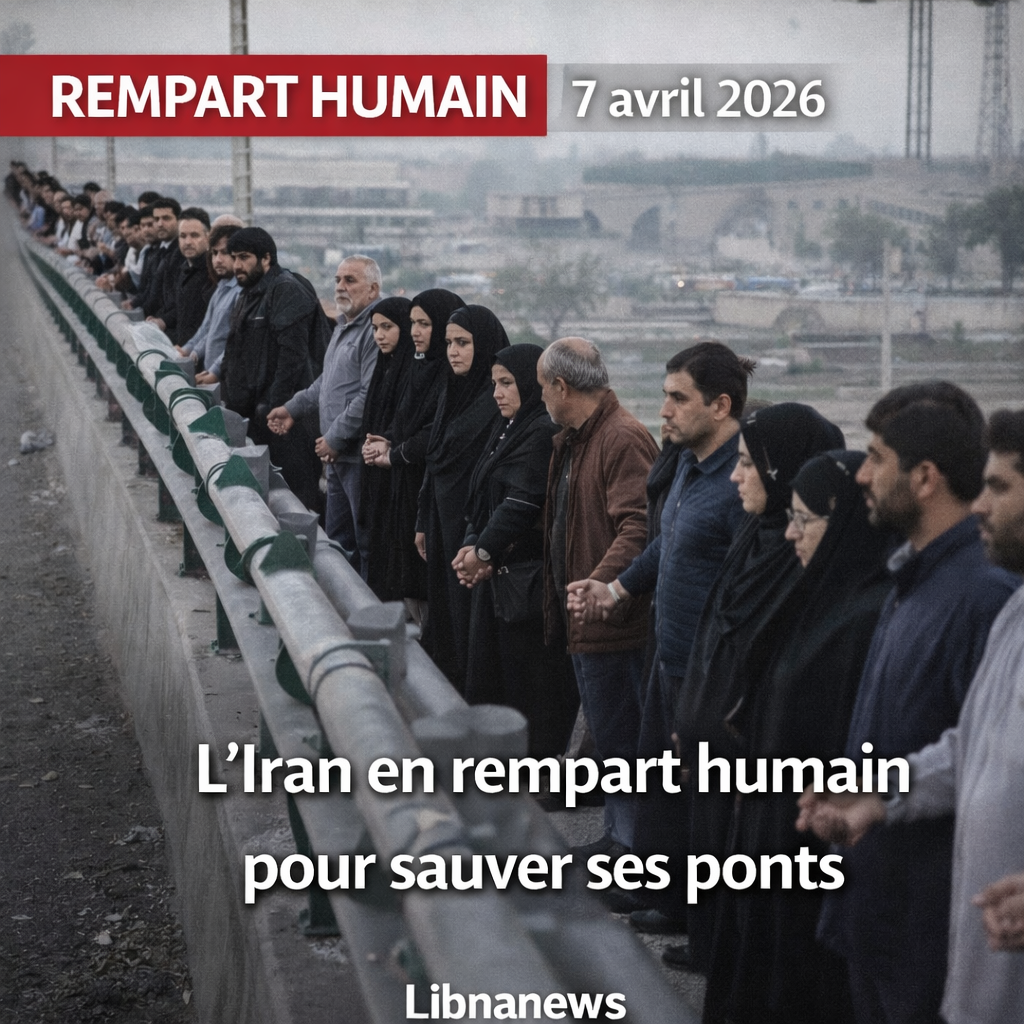
In Iran, war has moved to the most ordinary and, at the same time, the most vital infrastructure. On Tuesday, a few hours before the deadline set by Donald Trump, Iranian officials called on the people, especially young people, to form human chains around bridges, power plants and other essential equipment. According to news agencies and several international media, this appeal was launched after American threats explicitly targeting the country’s bridges and power stations, while strikes have already hit at least two bridges, a station and military targets on Kharg Island. The image that is needed is that of a country where civilians are no longer only spectators of the bombings: they are invited to become the last line of protection of a vital network.
The slogan came from Alireza Rahimi, presented by several media as an official of the National Council for Youth and Adolescents. In an intervention relayed by state television, he called on young people, students, artists and athletes to gather around power stations to protect the country’s « light future ». Media also reported that the Iranian embassy in Pakistan had broadcast images or messages on social media suggesting that gatherings were already taking place around certain infrastructures, while noting that these scenes had not yet been independently verified. In other words, what has so far been a threat to bridges and power plants is beginning to produce a popular mobilization, at least symbolic, and perhaps already physical, around the most exposed installations.
This call does not only say something about the military moment. He also says something about the state of the country. When a power comes to ask its young people to protect by their presence from power stations and bridges, this means that the border between civil defence, patriotic demonstration and direct exposure of populations is being dissolved. Iran does not only mobilize soldiers or specialized units. He now mobilizes the social body around its material nerves. The bridge is no longer just a traffic structure. The plant is no longer just a technical site. Both become places where the country’s continuity is played under the threat of announced strikes against infrastructure.
Mobilization from an explicit threat
The chain of events illuminates the logic of this mobilization. For several days, Donald Trump has publicly threatened to destroy Iranian bridges and power plants if Tehran did not yield to its demands. In a particularly violent message published on Tuesday, he said that « an entire civilization will die tonight » if no agreement is reached before the deadline set by Washington. Several media also reported that the US President assumed the idea of hitting Iran’s strategic civilian infrastructure, while rejecting concern about possible war crimes. In this context, Iran’s call to protect bridges and power stations appears to be an immediate political response to a threat that no longer hides behind traditional military objectives alone.
What such a development represents must be measured. In many wars, infrastructure is damaged as collateral effects, or intended to be used as military functions. Here, the peculiarity is different: bridges and electricity have become objects named in the American political discourse. This appointment changes everything. It turns power plants into anticipated targets and bridges into national survival symbols. Therefore, calling on the population to surround them is not just a defence reflex. It is also a way to publicly re-qualify these sites as civilian property, visible, inhabited, politically charged, so more costly to strike in terms of law and image.
The choice of power plants is particularly revealing. In Iran, as in any modern country, electricity does not only support industrial production. It conditions water, hospitals, transport, telecommunications, the conservation of medicines and the functioning of urban life. For this reason, several organizations and observers have warned that attacks on critical infrastructure would have catastrophic consequences for millions of civilians. The debate is therefore no longer only strategic. He becomes humanitarian. When the Iranian government calls on young people to form human chains around power stations, it also seeks to remind that destroying electricity is not just hitting a state. It’s a blow to everyday life.
A mobilization that goes beyond the regime’s supporters
This mobilisation around bridges and power stations cannot be read only as a demonstration of membership of the regime. In Iran, a large part of the population severely critical of the Islamic Republic, its repression, economic stalemate and political lockdown. But this does not mean that it accepts external threats or plans to change the regime imposed by the war.
Among many Iranians, including those who reject the power in place, the idea of foreign intervention arouses deep mistrust. This mistrust is also explained by regional precedents. Iraq and Afghanistan remain, for many, the most immediate examples of countries that foreign powers have claimed to save, reorganize or free, before leaving them in destruction, instability and fragmentation.
It is this memory that weighs today in the Iranian reaction. The regime can be opposed without the country being subjected to a scenario of total war, institutional collapse or destruction of vital infrastructure. In this context, protecting a bridge or power plant does not necessarily mean defending power. This can also mean refusing to punish, dismantle or precipitate an entire country in a chaos similar to that experienced in Iraq or Afghanistan.
The presence of civilians around vital infrastructure therefore says as much as a classic patriotic reflex. It reveals that in times of external threat, the divide between society and regime does not automatically translate into an availability for interference. On the contrary, foreign pressure often tends to resolve, at least temporarily, segments of the population around a common rejection of destruction from the outside.
The bridge as the last sign of a country still holding
Bridges occupy a particular place in this sequence. They are material targets, of course. But they are also crossing points, so signs of continuity. In a war, destroying a bridge means cutting off a flow, slowing down an evacuation, complicating a supply, isolating a city or a neighbourhood. In Iran, where several strikes have already hit bridges according to news agencies, the call to protect these works takes on a highly symbolic charge. He says that traffic is no longer guaranteed, that mobility itself becomes fragile, and that what allows a territory to remain connected can be turned into a target. A threatened bridge is never just a piece of infrastructure. It’s an attack.
It is precisely for this reason that the scene of civilians standing near bridges or power plants, if confirmed on a larger scale, will have considerable visual power. The Iranian message is clear: if you hit, you will not only hit concrete, steel or pylons; You will also strike citizens who come to defend what still keeps them together. This strategy is based on a twofold logic. On one side, she’s trying to dissuade. On the other hand, it already prepares the ground of the story if strikes take place despite everything. An attack on a bridge surrounded by civilians or a plant protected by a human chain would be immediately presented as an attack on society itself.
However, this mobilization cannot be read only as a heroic or patriotic gesture. It also bears a share of despair. When a state calls upon its youth to physically deploy around vital infrastructure, it also means that it recognizes the extreme vulnerability of these sites. Human presence then becomes a substitute for other forms of protection. It serves as a moral, media and political shield more than a real material shield. In the face of air strikes or missiles, a human chain does not technically protect a power plant. It transforms the political cost of an attack. This nuance is essential for understanding the Iranian scene: it is not a defence in the military sense, but an attempt to make the attack more difficult to assume.
Between patriotic mobilization and danger to civilians
This is where the most sensitive area begins. While the image of a population defending its bridges and power stations may appear as an act of civil resistance, it also raises a serious issue: the voluntary exposure of civilians around potentially targeted sites. Several foreign media have used the terms « human chains » or even « human shields » to describe the appeal to Iranian youth. Words matter. A human chain can be read as a symbolic gesture of national solidarity. The idea of a human shield immediately introduces a legal and moral problem: that of a population placed, even with its consent, in the direct orbit of an expected strike.
The Iranian power, for its part, presents this mobilization as a defence of the national future and vital services. But the concrete effect is the same: civilians are invited to stand close to targets that the opponent has already identified as possible targets. This shows how war has changed its nature. It is no longer just a matter of protecting borders, bases or fighting units. It is about protecting the material fabric of the country with the very presence of society. The infrastructure thus becomes a place of fusion between civil and political, between daily survival and the demonstration of sovereignty.
This logic is also a confession about the centrality of energy in the current phase of the conflict. For weeks, the war around Iran has expanded to include networks, flows, oil sites, terminals, transport facilities. Kharg, for example, was targeted at military targets according to Washington, when it is the country’s main oil export point. The Darmuz Strait also remains at the heart of the confrontation. In this context, power plants and bridges are not peripheral targets. They are at the heart of a strategy in which we seek to give up a country by threatening its operating conditions. The call for popular mobilization around these sites confirms that Tehran fully understood it.
A population called to protect what the army cannot sanctify
The deployment of civilians around vital infrastructure finally says something about the relationship between the Iranian state and its population in this sequence. The army, the Revolutionary Guards, the anti-aircraft defence systems and the security services are no longer enough to produce an image of Sanctuary. Then the regime turns to another register: that of the mobilized society. He asks young people, students, artists and athletes to make visible a popular defense of the vital network. This choice is as much a gesture of propaganda as a strategic symptom. It means that the infrastructure must be protected not only by technical means, but by a collective presence capable of turning the attack into a scandal.
The scene is therefore deeply new. For a long time, in contemporary wars, the population was hit on infrastructure. Here, it is called to interpose even before they take place. This anticipation changes the relationship to danger. It transforms young people into witnesses to possible violence, and sometimes into living ramparts. It also gives bridges and power plants a new emotional value. They are no longer only useful; they become the concrete places where the promise of standing is felt. Protecting a bridge or a power plant in a country that is threatened by its energy and transport networks will protect the possibility of the next day.
There is, of course, some uncertainty about the real extent of the movement. Calls have been launched, rallies have been relayed, some official or semi-official publications have shown or claimed mobilizations, but all these elements have not yet been fully confirmed by independent country-wide audits. This caution is necessary. But it does not remove anything from the essential: even before knowing how many human chains actually form, the mere fact that a power publicly appeals to its youth to surround bridges and power stations is enough to mark a turning point. This means that in Iran infrastructure has become a front, and that the front now calls the population itself.
This Tuesday, the strongest image of Iran is perhaps neither a missile nor a bunker nor a diplomatic meeting. It is the still fragmentary but already powerful one of a society invited to place itself around its most vital works to say that the war has reached this point: that where one no longer defends only one territory, but bridges to continue to circulate, power stations to continue to live, and the very matter of a country threatened to fall into the dark.






