

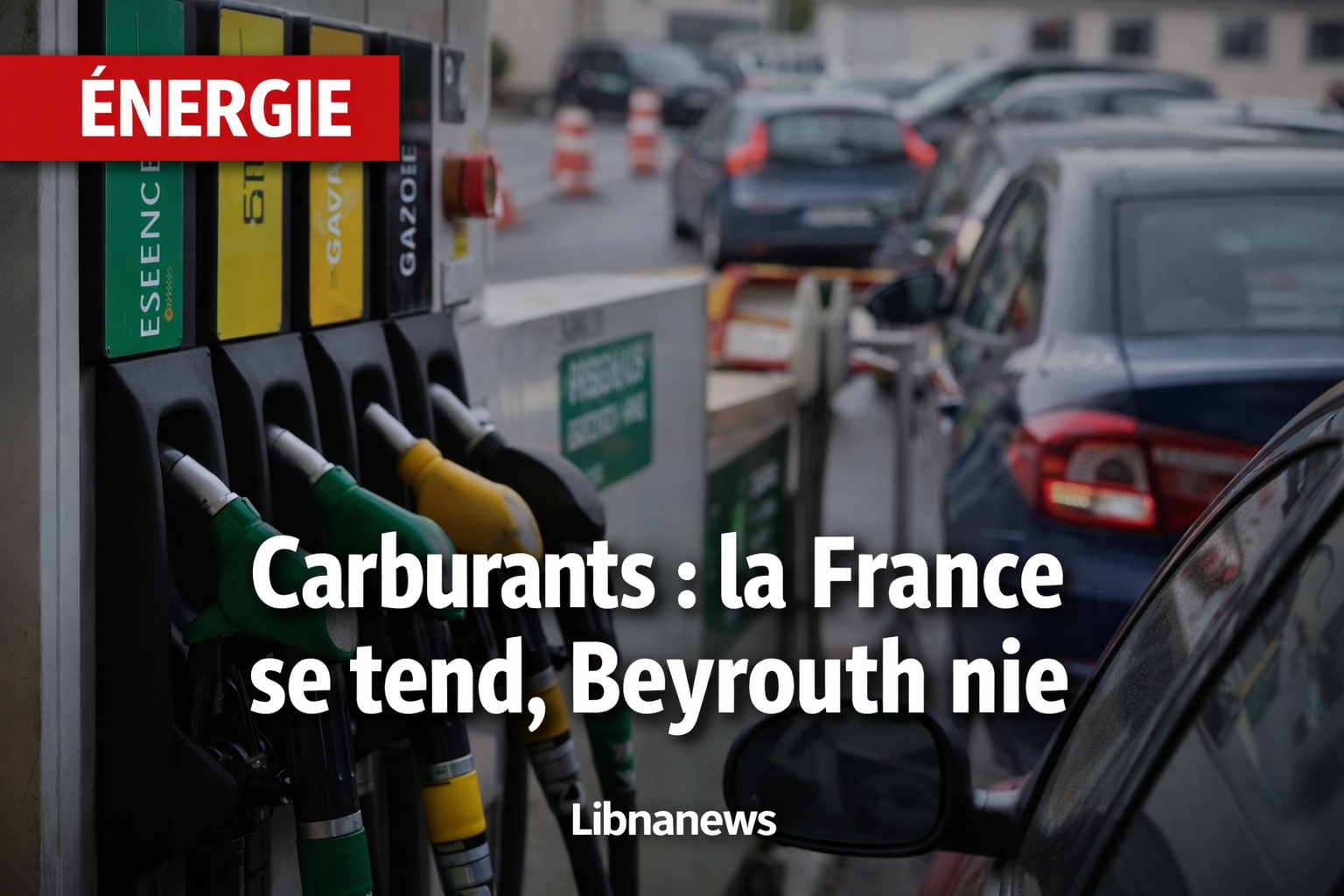
In France, tension is immediately apparent. After the extended Easter weekend, motorists encounter incomplete pumps, look for another point of sale, compare prices and extend their journeys to fill up. On Tuesday, 7 April, the Minister Delegate for Energy Maud Brégeon stated that approximately 18% of gas stations lacked at least one fuel. It added that 83% of the stations in difficulty were under the TotalEnergy network, whose capped prices attracted a higher than normal flow. In Paris, the government thus describes a crisis of distribution, transport and logistics. The word shortage is avoided, but tension is recognized.
In Beirut, the decor seems calmer. Distributor representatives ensure that supplies continue, raw materials are available and there is no reason to move to service stations. Taken in isolation, this speech may seem reassuring. Taken in its context, it looks above all like a panic management word. For Lebanon does not have a return to normal. He’s going through an energy crisis that just changed his face. It is not always the empty pump that best tells the fragility of the country. These are price increases, private generators’ bills, the cost of alternative electricity and the spread of these additional costs throughout the economy.
The right angle is therefore not to juxtapose a France under tension and a Lebanon officially serene. We have to go further. In France, the executive admits a concrete problem, localised but visible. In Lebanon, official communication appears to be closer. It reduces the crisis to a single question: is there any product in the tanks? This question is no longer enough. Fuel available but increasingly expensive remains a crisis. An open station does not mean that a household can still absorb the cost of filling, generator, transport and air conditioning. Denial begins precisely there, when material availability serves as an alibi not to talk about the real cost of energy.
In France, the partial break reveals a market under pressure
The 18% figure put forward by Maud Brégeon marks a marked hardening. On April 7, the Minister explained on RMC and BFMTV that one in five stations lacked at least one fuel. It also stated that, apart from TotalEnergys, the rate of rupture was only around 4%. This means that the French difficulty is not uniform. It concentrates where the tariff attraction has moved demand. Earlier in the morning, Ufip’s president, Olivier Gantois, had even estimated that one in four stations were breaking down at least one fuel, highlighting the extreme nervousness of the market after several days of reduced truck traffic.
This tension does not come from a sudden loss of fuel across the country. It results from a more precise mechanism. TotalEnergies extended the cap on gasoline prices to EUR 1.99 per litre and diesel prices to EUR 2.09 in 3,300 stations in metropolitan France until April 7. In a context of rising prices and geopolitical concern, this decision has concentrated the clientele on part of the network. Motorists have moved to the cheapest stations, sometimes anticipating future increases. As a result, ruptures have increased where queues are growing, even if national supply has not collapsed. The price signal redistributed the demand faster than the logistics could follow.
The French case shows something important. A fuel crisis doesn’t have to be total to disrupt everyday life. It only affects certain territories, networks or products to change behaviour. Motorists advance their way to the pump, extend their routes, prefer to fill their tank completely, and monitor increases hour by hour. This reaction is rational at the individual scale. Collectively, it exacerbates local tensions. The French executive is therefore seeking to prevent a crash, but it cannot deny the phenomenon. The increase in the number of affected stations is sufficient to make the crisis tangible, even if it remains partial.
The figures that summarize the contrast
| Indicator | France | Lebanon |
|---|---|---|
| Stations affected by at least one fuel failure | About 18% on 7 April | No officially announced shortage |
| Share of difficulties concentrated on TotalEnergys | 83 % according to Maud Brégeon | Not applicable |
| Dominating Official Message | Logistics and transport voltages | Supply continues |
| Price/ceiling highlighted | 1,99 €/L for petrol, 2,09 €/L for diesel until 7 April | Repeated increases in petrol and fuel oil |
| Real Fragility | Distribution and deferral of customers | Energy costs, generators, electricity and economy |
These figures summarize two very different situations. In France, the state manages a visible tension. In Lebanon, the official word attempts to prevent fear from turning into a rush. But this strategy has one limit: it hides the deep nature of the problem, which is no longer just the continuity of supply, but its economic and social price.
In Beirut, the reassuring word looks like a denial strategy
The representatives of the fuel distributors assured that supplies continued and raw materials remained available. They even explained that a cargo was waiting to be unloaded, in order to avoid any justification for precaution purchases. This speech fulfils a clear function: avoid panic. In Lebanon, everyone knows that a rush to the stations can be enough to create the shortage that it fears. The problem is that a word of stabilization becomes misleading when it presents itself as a faithful photograph of the energy situation. It then describes only a fraction of reality.
At the same time, fuel prices continue to rise. On 24 March, the National Information Agency reported an increase of 25,000 Lebanese pounds for gasoline and 72,000 pounds for fuel oil. Three days later, it announced a further increase of 50,000 pounds for both types of gasoline and 101,000 pounds for fuel oil. These amounts are not anecdotal. They mean that the system may still hold up physically, but at an increasing cost for households, artisans, carriers, businesses and all those dependent on daily mobility or alternative power supply.
This is where the word denial becomes relevant. The authorities or actors in the sector do not necessarily challenge the increases. They treat them as a background noise, while they have become the heart of the problem. The official communication suggests that the absence of closed pumps would suffice to prove that the situation remains under control. An energy-importing country, which is financially fragile and dependent on a failing electricity utility, cannot define normality by the mere presence of the product. Normality also requires accessible, sustainable and predictable energy. Lebanon is not there.
The increase in diesel directly affects private generators
In Lebanon, talking about fuel, not to mention electricity, means missing the essential. Diesel not only supplies vehicles. It also supplies private generators, which remain, in fact, a central pillar of electricity supply. The Directorate-General of the French Treasury recalls that the electricity supply of Lebanon is currently only 6 to 8 hours of electricity per day, while the diesel used by private generators has increased sharply. The oil crisis, therefore, is not just about increasing the price of cars. It increases the price of the kilowatthour of substitution paid each month by millions of users.
This completely changes the reading of the crisis. When the diesel goes up, the generator bill follows. And when the generator bill follows, it’s not just the households that are laughing. Buildings, local shops, restaurants, medical offices, workshops, bakeries, small factories and service providers must also absorb or pass on this additional cost. The increase in fuel then becomes an increase in private electricity, then an increase in operating costs, then a new pressure on the prices charged to customers. In Beirut, the pump often masks the bill. Yet it is on the bill that the crisis becomes the heaviest.
World Bank documents measure this structural drift. In its emergency plan for the electricity sector, the institution already recalled that private diesel generators could cost up to 30 cents per kilowatt hour, and that the combined cost paid by consumers between EDL and generators was about 16.8 cents per kilowatt hour. Another World Bank report points out that at the average price of approximately 9 cents per kilowatt hour for EDL, compared to around 30 cents for private generators, the potential savings for the Lebanese public would reach about $800 million per year if these generators were gradually replaced. This differential shows how much the Lebanese economy pays for the failure of the public service.
The same ratio also shows the extent of this « generator economy ». The market for fuel imports, distribution, sales and maintenance of generators is estimated at approximately $2 billion, with a workforce of approximately 13,200 people. The formula is illuminating: Lebanon is not only suffering from a lack of public electricity. He let install a huge, expensive, low-transparent parallel system, dependent on imported diesel. When the price of fuel rises, this system becomes even more expensive for those who do not have the possibility to pass.
The cost to the economy does not stop at household bills
The extra energy cost ends up going through the entire economy. The merchant who pays more for his subscription to the generator adjusts his prices or reduces his margin. The restaurateur passes part of the increase on his card. The production workshop integrates diesel into its cost. The carrier raises its tariffs. The delivery guy gets more expensive. The building charges more. Each increase seems limited when viewed in isolation. Added, they produce a diffuse energy tax, without a vote, without a budget debate and without a real safety net. This dynamic is consistent with the central role of private generators in the country’s daily power supply.
The Treasury Branch also notes that this situation degrades all macroeconomic indicators and public finances. According to a recent World Bank note, the paper mentions a fall in government revenues in March compared to January, as well as a possible contraction in GDP in 2026 between 12% and 16%. The link with energy is direct: a country that pays more for diesel, provides little public electricity and depends on an expensive private system becomes mechanically less productive, less competitive and more vulnerable to inflation.
The old reform documents of the Lebanese Ministry of Energy are similar. They stress that an increase in the price of LEDL could theoretically reduce the overall bill of citizens if, in return, dependence on private generators decreased. The department even mentioned an indirect cost of several billion dollars to the economy associated with the inability of EDL to provide a continuous diet. This point does not describe the situation of April 2026 alone, but it sheds light on the underlying mechanism: the more public electricity remains insufficient, the more the company pays a diesel premium, and the more each oil shock spreads throughout the country.
In France, a distribution crisis; in Lebanon, a crisis of sustainability
The comparison with France then becomes very eloquent. In Paris, the government can be criticized for its language elements, but it recognizes partial breaks, names the logistics cause and identifies the most exposed network. The French crisis is a crisis of distribution under stress, aggravated by a low rate effect. It hinders everyday life, provokes anxiety of the full and exposes the executive to the anger of motorists. But it does not yet transform the whole economy into an energy superpaying machine.
In Beirut, the crisis is less dramatic at the pump and more destructive in depth. It is not first an image crisis. It is a crisis of sustainability. The country is not just wondering if the fuel will arrive. He wondered how much the next increase would cost, what effect it would have on the building generator, on the bill for neighbouring trade, on the transport costs and on the survival capacities of already weakened households. To say that « everything is fine » because a cargo is en route therefore amounts to confusing logistical continuity with economic health. These are two very different things.
What the official speech does not say
- he talks about cargoes, but little about the final price paid by households;
- it reassures on opening stations, but not on the generator bill;
- avoid linking the increase in diesel to the cost of private electricity;
- it reduces a structural crisis to a simple problem of availability;
- It treats the fear of shortage, but it does not treat the cost of energy.
This dissociation explains why public speaking seems increasingly out of step. In Lebanon, the absence of a frank shortage does not mean that the situation is good. It only means that the crisis continues in a less photogenic and more expensive form.
The International Monetary Fund has warned this week that the war in the Middle East will lead to lower growth and higher inflation on a global scale, with heavier effects for energy-importing countries with reduced financial margins. Lebanon fully falls into this category. Again, the presence of fuel in the stations is not enough to neutralize the shock. When a country depends on expensive imports to drive its cars and power its generators, each regional outbreak becomes a multiplier of fragility.
Fuels: Denial begins when pump hides invoice
In essence, the contrast between France and Lebanon lies in how to name the crisis. In France, the state wants to avoid the word shortage, but it cannot deny the existence of a tension. The figures, queues and TotalEnergy effect make the phenomenon concrete. In Lebanon, the official communication still stands because it is based on an too narrow criterion: as long as the fuel arrives, the situation would be under control. This definition is insufficient in a country where energy is not only used to circulate, but also to compensate for the prolonged bankruptcy of the electricity sector.
So the real scandal is not just the prospect of an empty pump. This is the fact that an entire country continues to buy very expensive electricity, via private generators, which a public service unable to provide continuously does not deliver enough. As long as this mechanism remains, each increase in diesel becomes an increase in the cost of living, the cost of trade, the cost of services and the cost of production. To present this reality as a mere supply affair is to minimize the crisis at the very moment when it spreads most widely.
The right word is probably not a lie. It is colder and more political: denial. A practical, almost administrative denial is to look at the condition of the tanks rather than the status of the invoices. A convenient denial, because it allows to announce continuity without recognizing degradation. But the more the increases accumulate on gasoline, fuel oil, generators and alternative electricity, the more this official story loses credibility. The calm at the pump can still exist. Economic calm no longer really exists.






