

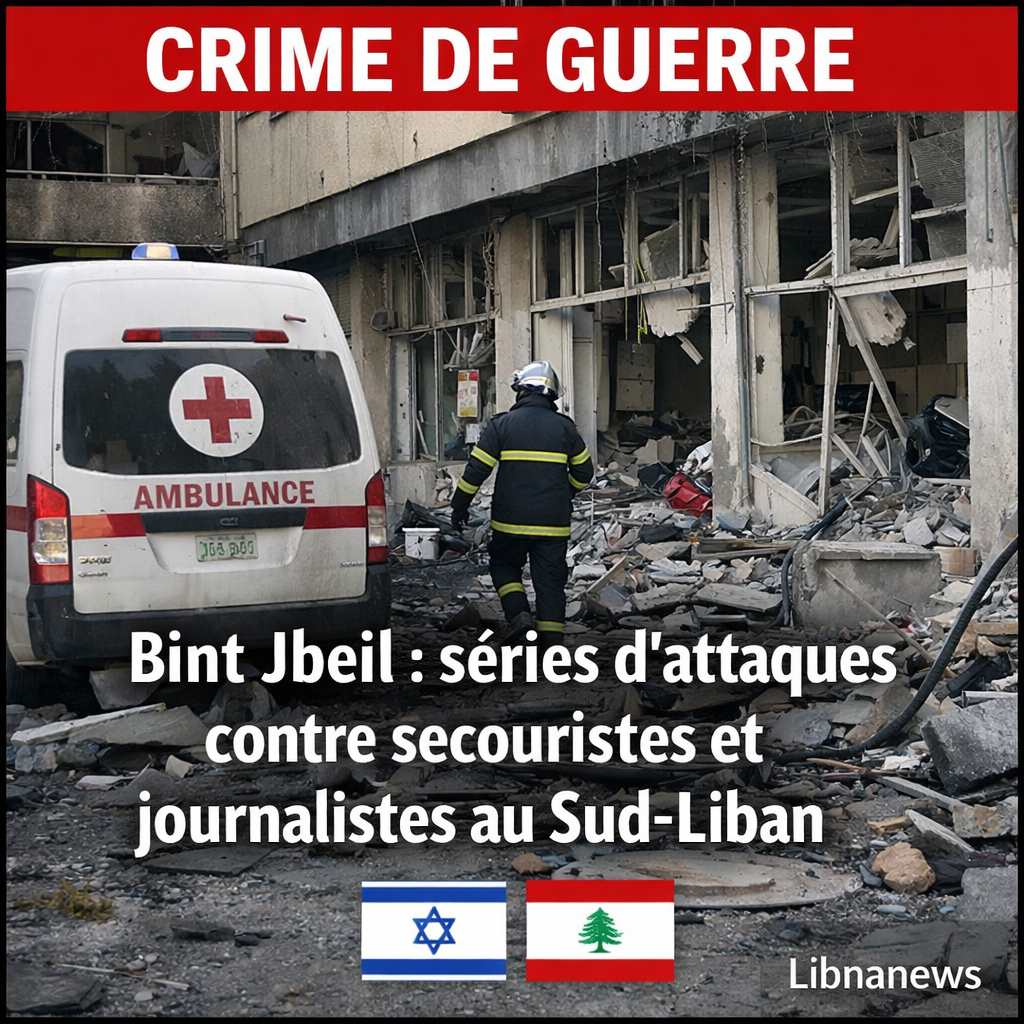
On Sunday, 29 March, the National News Agency confirmed that Israeli strikes targeted an Islamic Health Authority centre near Bint Jbeil Hospital. In a first dispatch issued in the morning, the Lebanese official agency reported that two drone strikes had hit the centre, with reports of deaths and injuries. A second dispatch, published shortly thereafter, confirmed the death of two rescuers in this attack. NNA also reported that another centre of the same structure had been targeted in Deir Kifa, in the same caza, without causing any casualties according to the initial information.
The central fact is therefore established: a rescue site was struck in the immediate environment of a hospital, and two paramedics were killed. But this episode is not an isolated case. He intervened in the aftermath of a day already marked by attacks against journalists, first aid workers and Lebanese soldiers, in a context where the most basic protections seemed to be reduced by an hour in southern Lebanon.
This is not the first attack of this type
It must be said clearly: Bint Jbeil’s strike does not fall into a vacuum. On Saturday, 28 March, an Israeli strike in southern Lebanon killed three Lebanese journalists, according to Reuters and the Associated Press. They included Ali Shoeib, a correspondent for Al-Manar, and Fatima Ftouni and Mohammed Ftouni, linked to Al-Mayadeen. In the same sequence, Reuters also reported that rescue workers sent to the scene had been affected. For its part, the World Health Organization reported that nine paramedics had been killed and seven injured in five separate attacks on health facilities in southern Lebanon.
In other words, Bint Jbeil’s attack is part of a documented series of attacks targeting or affecting protected personnel. The journalists were beaten in the middle of work. The first aid workers paid a particularly heavy price. And the pressure didn’t stop there. Reuters also reported the death of two Lebanese army soldiers in the south of the country the day before, even though Beirut denounced an extension of the war far beyond the clashes between Israel and Hezbollah.
This accumulation changes the reading of the event. In Bint Jbeil, it is not just an additional emergency centre. This is a new episode in a sequence where health workers, journalists and even members of the Lebanese army are among the victims. That is precisely what gives this strike a greater political and legal significance than its only immediate assessment.
NNA confirmation is clear
The timing of NNA dispatches is clear. First, the agency reports two strikes against a centre of the Islamic Health Authority near Bint Jbeil Hospital, with a still provisional assessment. Then it updates the information and confirms that two rescuers were killed in this attack. For a situational article, this double publication makes it clear that rescue personnel have been affected, and that the confirmed record is two dead.
The mention of a second site referred to in Deir Kifa adds an important dimension. It shows that Bint Jbeil’s event is not just an isolated impact on a specific point, but is part of a series of strikes affecting at least two relief centres in the same area. Even without casualties in Deir Kifa, the simultaneousity of these strikes illuminates a wider reality: the space of relief itself is now under direct threat.
This precision is all the more important because the NNA remains the Lebanese official source of reference on the ground. In a conflict of competing narratives, this official confirmation gives a solid basis to the central observation: first aid workers have been struck near a hospital, and this is not an isolated fact in the sequence of these last 48 hours.
A strike in the perimeter of a hospital
The location of the attack gives the case particular gravity. The NNA explicitly refers to a centre near Bint Jbeil Hospital. In a context of war, this immediate proximity to a hospital institution places it in an extremely sensitive legal and political field. The International Committee of the Red Cross recalls that medical units, medical personnel and health transport must be respected and protected in all circumstances.
Bint Jbeil is not a locality. The city occupies a central place in the history of the clashes in southern Lebanon and remains one of the most exposed areas of the border area. When a rescue centre is struck in the immediate vicinity of a hospital, the effect is double. Operationally, the ability to evacuate and treat the injured decreases. On the symbolic level, this feeds the idea that even the areas most directly associated with rescue no longer enjoy any safety margin.
This type of attack also worsens fear among field teams. When paramedics are killed at their intervention site or in their centres, every move becomes more risky, every evacuation slows down, every intervention becomes more uncertain. And when these attacks occur after the death of nine other first aid workers the day before, the cumulative effect becomes overwhelming for the entire local care system.
A War Crime Attack
In international law, the framework is specific. Medical personnel, medical units, ambulances and hospitals are given special protection. The intentional targeting of protected medical personnel or units may constitute a war crime. The same logic applies to civilian journalists, who are also protected as long as they are not directly involved in hostilities.
In the case of Bint Jbeil, the attack on a rescue centre near a hospital, having killed two rescue workers, thus raises an accusation of extreme seriousness under international humanitarian law. And this qualification becomes even more important when it is placed in the sequence of the last 24 hours: three journalists killed, nine paramedics killed in five separate attacks according to WHO, and Lebanese soldiers also affected in the South.
It is no coincidence that Lebanese officials have started talking openly about war crimes. In recent days, the NNA has relayed official convictions denouncing the targeting of rescuers, journalists and Lebanese army soldiers as a serious violation of international law. Again, Bint Jbeil is no exception. It’s an extra room in a larger file.
A day of strikes on several points in the South
The attack on the rescuers of Bint Jbeil is part of a larger day of strikes in southern Lebanon. The NNA reported in the morning a night strike on a house in Aba, completely destroyed, and then a death toll of two in the same town, with extensive damage to a shopping centre in Nabatiyah. She also reported the day before the dead to Maarake and Aichiye. This dispersion of strikes confirms that military pressure does not focus on a single front line, but extends to a much wider local fabric.
This geography of strikes counts to understand Bint Jbeil’s attack. In an environment where several locations are affected in the same sequence, relief centres become even more vital. They absorb not only the consequences of their own strikes, but also those of the bombings of neighbouring localities. This makes the loss of two rescue workers particularly heavy. It occurs at a time when the demand for relief does not diminish.
The situation thus draws a logic of saturation. The inhabitants are struck at home, service structures are damaged, journalists are targeted, and the teams supposed to intervene are themselves affected. At the end of this chain, it is not only the immediate human balance that increases. It is the collective capacity of a territory to cash in the war that takes place in stages.






