

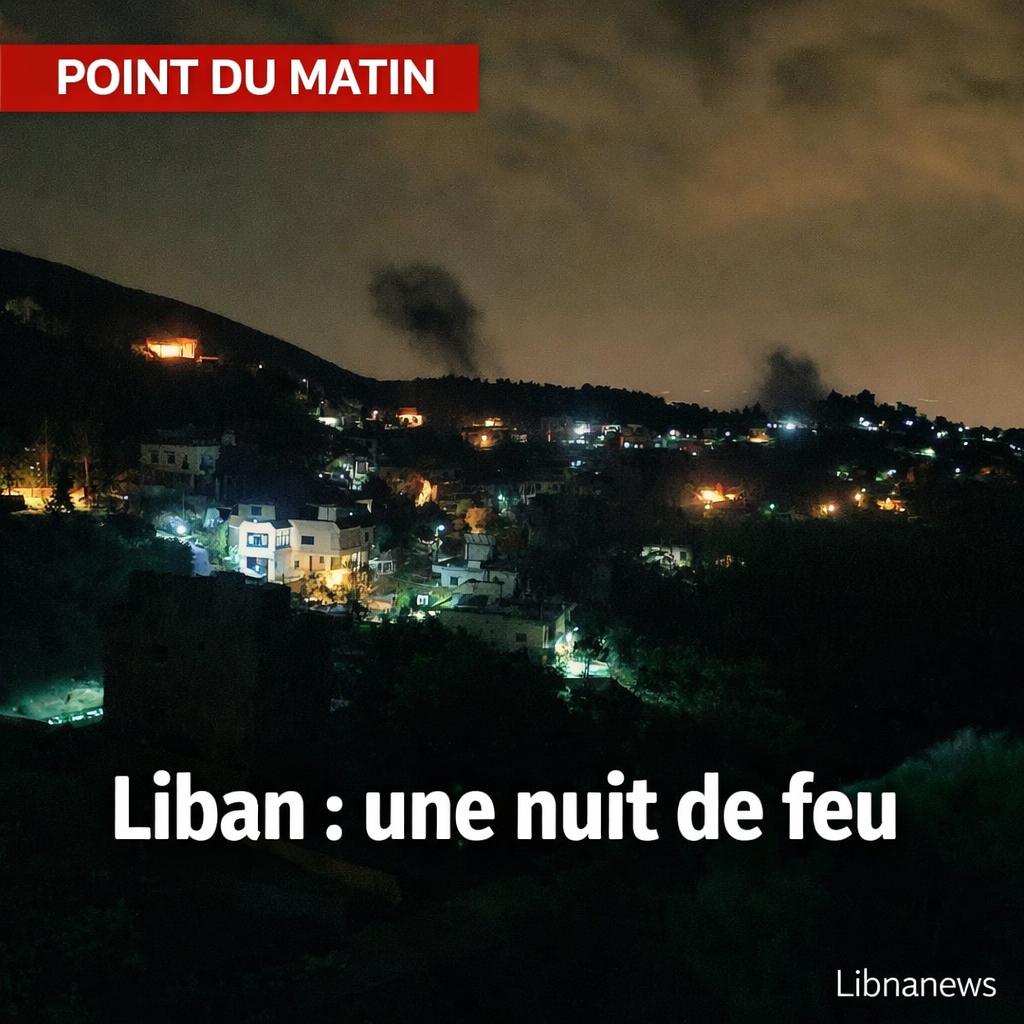
From Beirut to Tehran, from Gaza to the Strait of Ormuz, the night of Friday 20 to Saturday 21 March 2026 confirmed a sharp acceleration of the regional crisis. Israeli strikes targeted new targets in Lebanon and Iran, Washington announced the dispatch of military reinforcements, French diplomacy recognized the lack of a quick outcome, while world markets have again responded to the prospect of a sustainable energy shock. For Lebanon, already weakened by years of economic collapse, this sequence opens up an even more dangerous phase: that of a war that no longer merely borders its borders, but re-designs its priorities, balances and daily life.
Beirut wakes up under threat
In the early morning, the dominant information remains the announcement by the Israeli army of new strikes against Hezbollah targets in the southern suburbs of Beirut. According to Reuters, the army reported targeting seven neighbourhoods after issuing evacuation warnings. This point is central because it shows that the logic of military pressure is no longer limited to the border areas of southern Lebanon. It now settles in the capital and its agglomeration, with a major psychological effect on population, displacement and economic activity. The sequence also confirms that Lebanon entered the third week of a gear directly linked to the war launched against Iran on 28 February.
Pressure is not only measured by the number of strikes. It is also read in the human scale of the crisis. Reuters reported more than 1,000 deaths in Lebanon and more than one million internally displaced persons since the beginning of this escalation phase, while Associated Press described an expanded Israeli campaign targeting not only Hezbollah’s military apparatus, but also some of its civilian structures, whether they were health centres, financial networks, media or charitable organizations that the Hebrew state presented as linked to the organization. The result for Lebanese civilians is an impression of total war, where the distinction between military, social and political infrastructure is becoming increasingly disputed.
In host cities such as Beirut, Saida or other urban centres, the daily lives of internally displaced persons already weigh on local capacities. Reuters showed, on the eve of Eid al-Fitr, families housed in buses, tents or makeshift shelters, in a climate of fatigue and anguish. This dimension counts as much as the military aspect: it recalls that Lebanon does not approach this new war with solid social reserves. The country remains undermined by the banking crisis, weak public services and dependence on aid. Every night of bombing adds a layer of insecurity to a country that has not yet completed its exit from previous disasters.
What was played between this night and this morning goes beyond a simple exchange of strikes. First, because the articulation between the Lebanese front and the Iranian front is now assumed. Israel hit targets almost simultaneously in Beirut and Tehran, while Washington confirmed the dispatch of an additional 2,500 Marines to the Middle East. This synchronization reflects a complete regionalization of the conflict. For Lebanon, this means that the escalation schedule no longer depends solely on the southern border, nor even on Hezbollah’s internal calculations, but on a much larger theatre involving Israel, Iran, the United States and several Gulf monarchies.
Then, this night confirms the failure, at least temporary, of attempts at diplomatic restraint. French Foreign Minister Jean-Noël Barrot acknowledged after his talks in Israel that there was no short-term solution. Before that, he had gone through Lebanon to call for a ceasefire and to recall the expected role of the Lebanese army. The French message is double. On one side, Paris continues to pose as an active mediator. On the other hand, it publicly notes that diplomatic channels are currently unable to change the balance of power. For Beirut, this is a heavy observation: the international scene remains mobilized, but without immediate decisive leverage.
Finally, this night establishes a new hierarchy of risks within the country. The question is no longer just whether Lebanon can avoid burning. It is now about how the state, municipalities, hospitals and self-help networks will hold if the strikes continue to intensify in densely populated areas. The extension of operations to Hezbollah-affiliated structures, including their social dimension, adds a layer of inner tension. It feeds both the fear of a general weakening of the Shia civil fabric and that of a national political hardening around the conduct of war.
From Lebanese front to regional front, the domino effect is now visible
The novelty of this sequence is the gradual disappearance of the compartments. The Lebanese front, the Iranian front, tensions in the Gulf and the Gaza file are now seen as components of the same crisis. Reuters recalls that this night’s strikes against Beirut are part of the continuation of the war that began on 28 February against Iran. Associated Press notes that Hezbollah presents this struggle as an existential battle, while Israel claims to want to dismantle not only its military capabilities, but also its influential ecosystem. This convergence of fronts mechanically increases the risk of calculation errors and uncontrolled overflows.
In Gaza, the crisis did not disappear, even though it was relegated behind the Iranian-Israeli shock. Reuters reports that the outgoing head of UNRWA, Philippe Lazzarini, warned the UN General Assembly that a collapse of the Agency would permanently undermine assistance to the Palestinians and could de facto transfer a considerable humanitarian and political burden to Israel. This reminder is important in reading the past night: at the same time as the capitals focus on Iran, the Gaza war remains an active home of destabilization, with a fragile humanitarian administration and an uncertain institutional future.
In the Gulf, the other swing is about energy. Reuters and several other media outlets describe a deeply disturbed Strait of Ormuz, affected oil and gas facilities in several countries, and threatened global flows. The Director of the International Energy Agency even mentioned, in the columns ofWorld, the most serious global energy threat in history. For Lebanon, a net importing country that is highly vulnerable to price changes, this shock is not theoretical. A sustained rise in oil and gas prices would affect transport, electricity production, the cost of private generators and overall consumer prices.
Key facts from night to morning
| Axis | Highlights | What it changes |
|---|---|---|
| Lebanon | New Israeli strikes announced on the southern suburbs of Beirut | War is more visible in Lebanese urban space |
| Iran | New Israeli strikes on Tehran and further reprisals | The main front remains regional, not just border |
| United States | Announced deployment of an additional 2,500 Marines | Washington is preparing for a longer or wider crisis |
| Diplomacy | Paris does not see a quick exit | Mediation efforts have not yet had a concrete effect |
| Energy | Ormuz remains disturbed, oil climbs | The conflict already weighs on the Lebanese and global economy |
The consequences are also beginning to be seen far beyond the Middle East. Reuters reports that world markets are struggling to integrate the real magnitude of the shock, even though energy prices are rising sharply. The rise in the Brent, the tension on the European gas and the anticipation of further inflationary surges fuel a mood change in the market rooms. In the United Kingdom, rising borrowing costs and market correction have already erased year-on-year gains on FTSE 100. In the United States, nervousness has resulted in a further weekly decline in major indices. This global fragility gives Lebanon a paradoxical importance: a very weak country on a financial scale, it finds itself at the heart of a shock that now affects the entire planet.
Lebanon faces three simultaneous emergencies
The first emergency is humanitarian. With more than one million people displaced according to Reuters, the immediate issue is not only accommodation, but also access to water, care, education and a minimum of psychological stability. The recent history of the country shows that prolonged displacement is rapidly creating neighbourhood tensions, unforeseen budgetary needs and new inequalities between municipalities. In the current context, the Lebanese State lacks the means to absorb such a shock alone. This increases the role of associations, municipalities, international organisations and community solidarity, with all the risks of fragmentation that this implies.
The second emergency is political. The war inevitably pushes Lebanese actors to clarify their line on Hezbollah, on negotiations with Israel and on the place of the army. Reuters reports that President Joseph Aoun has reported an opening to direct discussions with Israel, while Hezbollah opposes it. This divergence illustrates an old Lebanese flaw: that of a State seeking diplomatic margin while a major armed actor puts its action on a regional agenda. The stronger the strikes around Beirut, the more visible this contradiction becomes, the more likely it is to affect internal cohesion.
The third emergency is economic. Lebanon does not need a $150 barrel to suffer. It needs only a tight oil market, disturbed regional logistics and rising maritime insurance to see its import costs rise. Reuters is already seeing a surge in energy prices and a major disruption of regional infrastructure following the strikes on gas and oil sites. In a country where public electricity is still weak and private generators still structure the daily lives of many households, the energy bill can quickly become a social asphyxiation again.
The three immediate risks for Beirut
- Geographic expansion of strikeswhich would make urban life much more unstable.
- Humanitarian saturation, if the movements continue or accelerate.
- A new price shock, carried by oil, transport and generators.
Washington, Paris, Tehran: The Battle of the Narrative Swells
Last night did not only produce strikes. She also produced messages. In Washington, Donald Trump suggested that a slowdown in operations could be envisaged while announcing, in parallel, new military reinforcements. This double language is not trivial. It translates an executive who wants to show strategic firmness without politically assuming the image of an open and lasting war. The Associated Press also notes growing concern in the United States about the hypothesis of a deeper gear. For Washington allies as for regional actors, this mix of displayed power and tactical ambiguity complicates reading American intentions.
In Paris, the tone is more sober, but the message is also harsh. Jean-Noël Barrot acknowledged that no rapid exit from the crisis was visible. This formula, apparently conservative, amounts to admitting that European mediations remain defensive for the moment: they try to limit the break-up more than to produce an agreement. For Lebanon, the French diplomatic presence retains a real symbolic and operational value. But the sequence of this night also shows the limits of this influence when decisive choices are made between Jerusalem, Washington and Tehran.
On the Iranian side, the story remains that of resistance and the expanded response. Reuters points out that the new supreme guide, Mojtaba Khamenei, adopted a tone of challenge as the strikes continued. At the same time, Iran continued to exert pressure on energy roads and project its nuisance capacity to the regional level. This posture has a direct effect on Lebanon. It strengthens the role of Hezbollah in a regional confrontational architecture, but it also increases the cost paid locally by Lebanese society, which suffers the consequences of a far greater balance of power.
Why the world now looks at Lebanon differently
For a long time, the Lebanese crisis was treated by markets and many chanceries as a chronic, serious but contained frailty. The night of 20-21 March changes the perception scale. Lebanon no longer appears only as a country in crisis. It becomes a visible node to a war that affects energy, maritime routes, transatlantic diplomacy and global inflationary expectations. When Reuters, AP and other major media outlets open their editions on Beirut, Tehran and Ormuz in the same movement, they report that the Lebanese file has changed its category.
This change of view can produce contradictory effects. On the one hand, it can bring more diplomatic attention, pressure for a ceasefire and humanitarian aid. On the other hand, it can further lock Lebanon in a secure reading, where the social issue, institutional reconstruction and economic agenda move into the background. It is precisely this displacement that worries. A country that has not yet resolved its banking, monetary and administrative flaws cannot indefinitely absorb an active regional front status. Each hour of war reduces a little more space for recovery, return of investment and even partial normalization of daily life.
In the end, most of this night may be based on this simple idea: Lebanon no longer lives in the shadow of the crises in the Middle East, it is again one of their most observed combustion points. And as the strikes spread, the displacements accumulate, the mediations skate and the oil climbs, another question arises in the capitals as well as in the Lebanese homes: how far can the region still rise in intensity without blowing up the last political, social and economic safeguards that still stand?



