

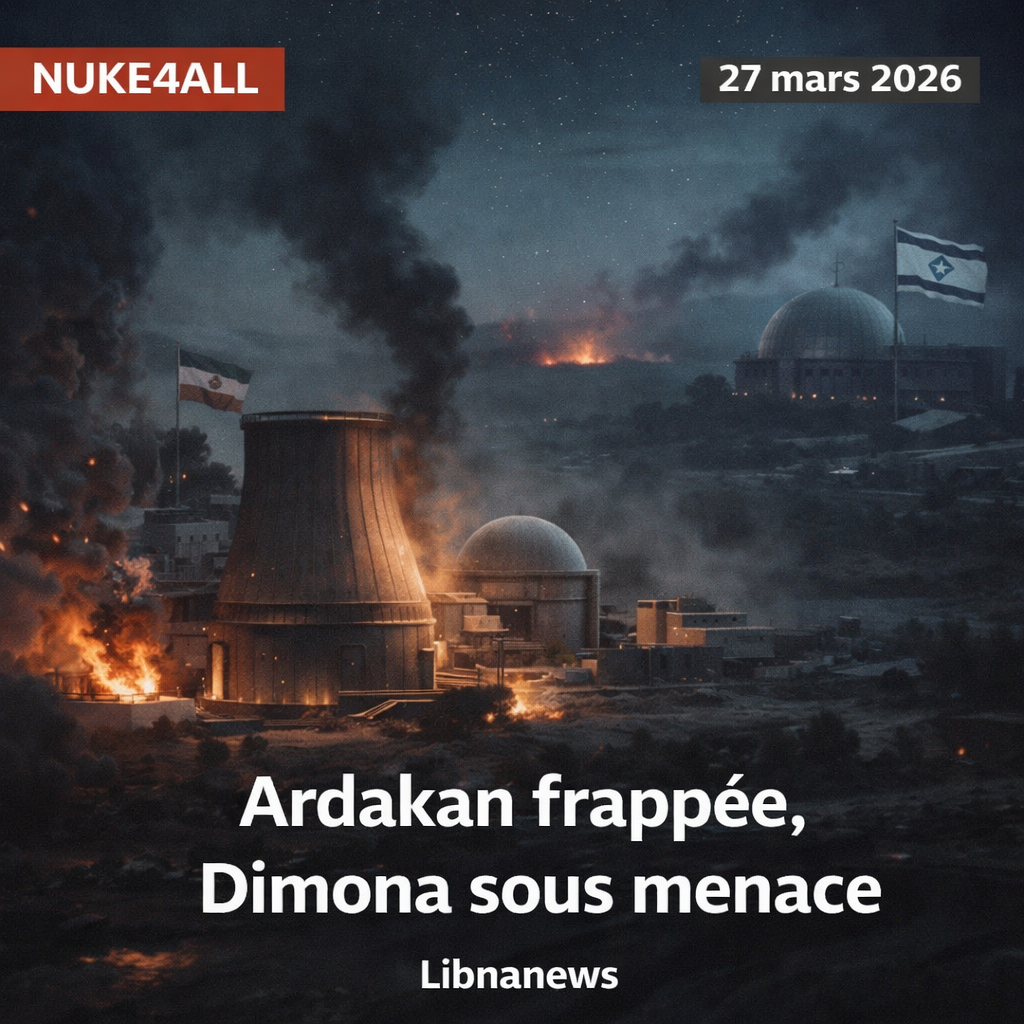
Friday’s strikes at the Ardakan site in the Iranian province of Yazd mark a new stage in the expansion of the war to include the infrastructure of Iran’s nuclear programme. The Iranian Atomic Energy Organization claimed that the facility had been affected by an attack by US-Zionist enemy, while stating that no radioactive leakage had been detected.
Tehran confirms a strike on a sensitive link in the nuclear cycle
The Ardakan site is not annoyed. It is presented by several sources as a facility related to the production of yellowcake, i.e. a concentrated form of uranium used upstream of the nuclear cycle. Associated Press also reported that the Ardakan facility, as well as the Khondab heavy water complex near Arak, had been targeted on Friday, with no casualties or contamination reported at this stage.
This sequence comes a few hours after new Israeli statements announcing an intensification of operations against Iran. At the same time, Israeli media reported attacks on other military and industrial installations in the Yazd region, indicating that the campaign no longer targets ballistic capabilities alone, but also affects segments of Iran’s nuclear and logistical apparatus.
An escalation that changes the nature of the conflict
By striking Ardakan, the United States and Israel crossed an additional political and strategic threshold. So far, most of the communication has focused on missiles, bases, command centres or energy infrastructure. Targeting a site associated with uranium treatment reinforces the idea of a campaign to degrade Iran’s structural capacities over the long term, not just to contain an immediate threat.
For the time being, the absence of reported radioactive leakage limits the risk of an immediate accident. But politically, the effect is quite different: Tehran can now present the attack as a strike against a sensitive component of its strategic sovereignty, which increases the likelihood of a calibrated but symbolically strong response.
Dimona returns to the centre of reprisal scenarios
In this context, Dimona becomes a central name again. The city of southern Israel, associated with the Negev nuclear centre, has already been targeted in recent days by Iranian missiles. Reuters reported that Iranian strikes hit Dimona and Arad on 21 March, causing dozens of injuries. AP also indicated that these shots were in retaliation for previous strikes against Iranian nuclear sites.
It is therefore necessary to be precise: Dimona is not only a theoretical target, but already a reference point in the logic of Iranian response. To say that it could be the subject of new strikes is not a certainty, but a credible hypothesis given the recent sequence and the strategic and symbolic value of the site for both sides.
A nuclear mirror logic
The current dynamic follows a mirror logic. When an Iranian nuclear site is hit, Iran seeks to show that Israel too has exposed sensitive points. Dimona performs exactly this function in Iran’s strategic narrative: striking or threatening Dimona allows to respond to Natanz, Arak or Ardakan on the ground of psychological deterrence. The available information does not at this time show that an attack on the reactor itself has caused nuclear damage, but it confirms that the Dimona area has already been targeted and remains within the range of Iranian options.
A region closer to a sustainable gear
The strike on Ardakan finally illustrates a broader shift: the war is no longer limited to peripheral trade via Lebanon, Syria, Iraq or the Gulf. It is now more directly affecting Iran’s nerve centres, while reprisals are targeting high-value sites in Israel and the region. AP stresses that this simultaneous extension of strikes, threats and counter-attacks is fuelling growing international concern, between nuclear risk, oil flares and regional expansion.
By striking Ardakan, Washington and Tel-Aviv opened an even more dangerous sequence. And in this new phase, Dimona is no longer just a distant symbol: it is a target of reprisals already mentioned by recent events, and potentially reactivated by every new strike against Iran’s nuclear program.






