

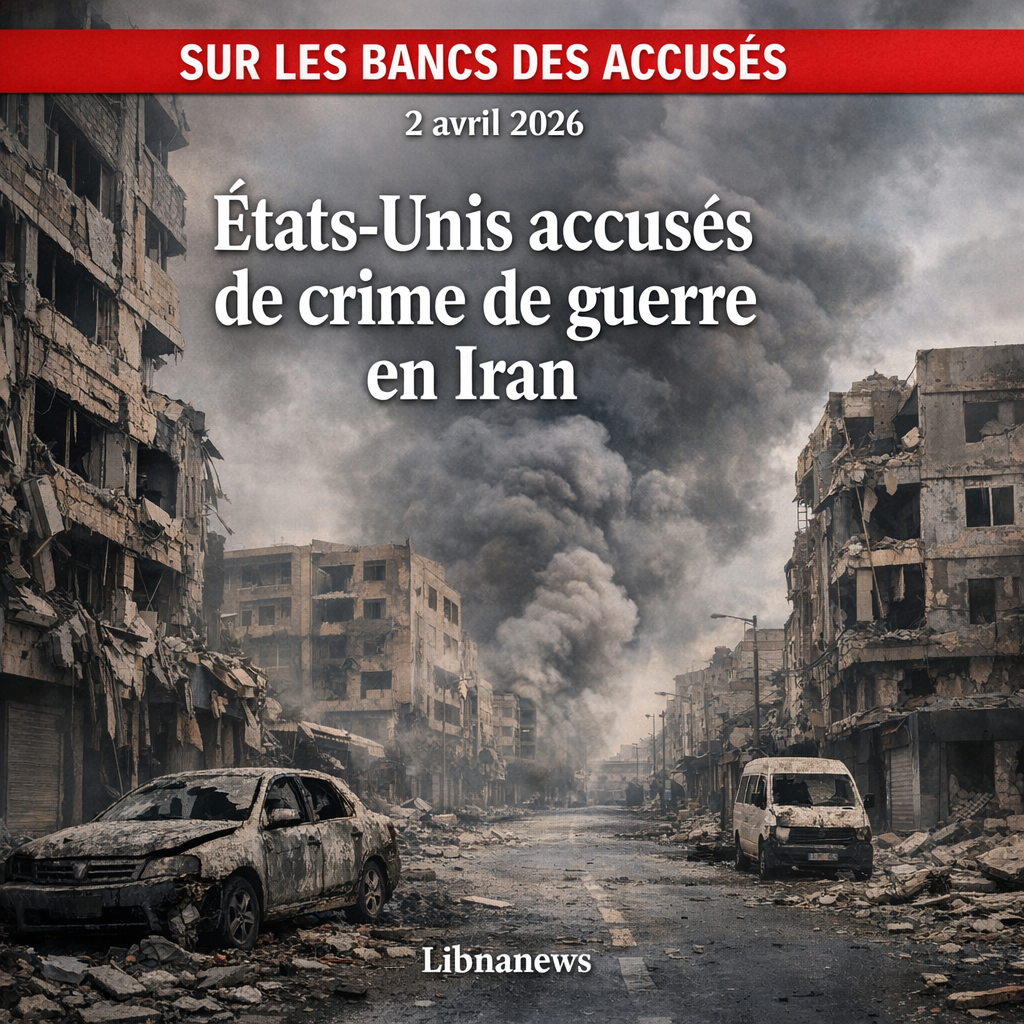
The accusations of war crimes against the United States have increased since the outbreak of the American-Israeli campaign against Iran on 28 February. They took on new relief following Iranian strikes on United States Gulf bases and reports that United States soldiers were dispersed in hotels and other civilian buildings in the area. But, legally, not everything is worth it. Hosting troops in a hotel does not automatically constitute a war crime. On the other hand, attacks on schools, hospitals, networks essential for the survival of civilians or sites with no military advantage are at the heart of the grievances raised for more than a month by the United Nations, Human Rights Watch and several capitals.
The most recent charge concerns hotels
The controversy of the moment arose from repeated Iranian strikes against American positions in the Middle East. On 27 March, twelve United States military personnel were wounded, including two seriously, in an Iranian strike against the Prince Sultan airbase in Saudi Arabia, according to an American official quoted by Reuters. More broadly, Reuters reported that the Iranian attacks had targeted US bases and diplomatic missions in the Arab Gulf States, as well as hotels, causing airport closures and damage to oil infrastructure.
It was in this context that stories emerged about the movement of American soldiers from damaged bases to hotels, offices or other temporary accommodation. The information available in the research results point mainly to second-rate media or agency recaptures, not to a detailed confirmation of the Pentagon or Reuters on the exact extent of these relocations. We must therefore remain cautious on this specific point. What is established, however, is that Tehran has publicly threatened to consider as targets hotels housing US soldiers, on the grounds that these sites have become military locations.
Legally, the stake is very clear. International humanitarian law protects civilian property, but a hotel may lose this protection if it is used to house troops or for military functions. The International Committee of the Red Cross’s comment on article 52 of Additional Protocol I explicitly states that a hotel, such as a school, is in principle a civilian property, but that it can become a military objective if it is used to house soldiers or a staff. The ICRC also recalls that direct attacks on civilian property are prohibited unless such property actually contributes to military action and its destruction provides a specific military advantage.
Hosting troops in civilian buildings is not an automatic war crime
This is where the political slogan must be distinguished from legal reasoning. To say that the United States commits a war crime because soldiers would sleep in hotels is, in the state, an excessive claim. The law of armed conflict does not block the ad hoc military use of a civilian building. However, this usage changes the status of the site. It may expose the building to becoming a legal military target, provided that the attack then respects the rules of distinction, proportionality and precaution.
In other words, the real risk is not first where the public debate places it. He is not in an automatic war crime qualification attached to simply moving soldiers to a hotel. It is in the increased danger of civilians in the vicinity, employees, families and other potential occupants. The more military functions are inserted into ordinary spaces, the more blurred the boundary between military objectives and the civilian environment. And the more this border becomes blurred, the more the risk of deadly strikes against previously protected places increases. This logic applies not only to hotels but also to schools, hospitals or administrative buildings.
Moreover, humanitarian law imposes obligations on both sides. The attacker must distinguish between military objectives and civilian property and renounce a disproportionate strike. But the party controlling the ground must also, as far as possible, remove military objectives from densely populated areas and take precautions against the effects of attacks. On this ground, the idea that an army can spread to very frequent civilian places raises a real question of protecting the population, even if it alone is not sufficient to characterize a war crime.
The heavyest charges have been directed primarily against civilians since 28 February.
The heart of the case, since the beginning of the war, is therefore not located in the Gulf hotels. He is in Iran itself, where the American and Israeli strikes triggered an avalanche of accusations against civilian targets. On 27 March, G7 Foreign Ministers called for an immediate halt to attacks on civilians and civilian infrastructure in the war in Iran. Washington’s endorsement of such a text underscores how central the issue has become, including for Western allies.
The most serious case is that of Shajareh Tayyebeh primary school in Minab, southern Iran. Reuters revealed as early as 5 March that US military investigators believed it likely that US forces would be responsible for a strike on a girls’ school that killed dozens of children, without a final conclusion yet being made public. On 27 March, the United Nations High Commissioner for Human Rights, Volker Türk, called on Washington to quickly conclude its investigation and publish its results. According to Iran, more than 175 children and teachers were killed in this attack on the first day of war.
Human Rights Watch has gone further. On 7 March, the organization stated that the 28 February attack on this primary school appeared to be an illegal attack and should be considered a possible war crime. The NGO recalls that the law of war prohibits strikes when the expected damage to civilians and civilian property is disproportionate to the expected military gain. This position is not a judicial decision, but it shows that potential criminalization is no longer confined to Iranian propaganda.
Schools are at the centre of the file
The Minab case alone concentrates almost all the current legal debate. A school is, by definition, a protected civilian property. The ICRC recalls that the laws of war prohibit direct attacks on schools, unless they contribute to specific military operations and their destruction offers a definite military advantage. In the Iranian case, no public evidence has so far been provided in the sources consulted that the school in Minab met this condition. This is precisely why the attack is the subject of an American investigation, a UN call for transparency and a request for a war crime investigation by Human Rights Watch.
The case is all the more burdensome as it is part of a wider sequence of reports of strikes involving densely populated areas, civilian neighbourhoods and non-obviously military buildings. The Washington Post, citing a consortium of civil defence organizations, reported on 27 March that approximately 1,443 Iranian civilians, including at least 217 children, had been killed since the start of operations, and that schools, hospitals and other non-military infrastructure were among the sites affected. This estimate should be read as that of NGOs and not as an established judicial review, but it provides a measure of the level of humanitarian alarm that now surrounds the conflict.
This is politically important. The accusations of war crimes are not only the result of a destroyed school, but also the terrible case of Minab. They emerge from a beam: density of strikes, scale of civilian casualties, repeated targeting or damage of sensitive infrastructure, and American statements that sometimes explicitly threaten vital civilian networks. It is this beam that explains why the legal debate has settled so quickly.
Hospitals and medical centres were also affected
Second explosive dossier: health structures. On 2 March, the World Health Organization reported that a hospital in Tehran, the Gandhi Hospital, had been evacuated after nearby explosions, while seeking to verify reports of attacks on three other medical facilities in Iran since the start of the American-Israeli air campaign. Witnesses told Reuters that the hospital had been hit by Israeli strikes. WHO, faithful to its method, did not attribute responsibility, but confirmed collateral damage and patient displacement.
Hospitals benefit from enhanced protection under international humanitarian law. The ICRC recalls that they can only be attacked under very limited circumstances, when used for specific military purposes, and still under strict conditions. In practice, when a hospital is hit, even indirectly, the political and legal burden becomes immediately heavy for the attacker, as the loss of protection of a medical institution is not presumed. It must be demonstrated. However, in the sources consulted here, no such public demonstration has been provided concerning Gandhi Hospital.
The medical record doesn’t stop in Tehran. Reuters also reported that WHO was verifying damage to Motahari Hospital and emergency centres in Sarab and Hamadan provinces. Again, law does not mechanically describe these acts as war crimes. But the accumulation of strikes or impacts on health-care settings reinforces suspicions of serious violations, especially if the required precautions have not been taken or if the military objectives invoked remain undemonstrated.
Threats to electricity, water and vital infrastructure increase suspicion
Since the end of March, the controversy has not only focused on what has already been struck, but also on what Washington is still threatening to destroy. Reuters recalled on 31 March that strikes on infrastructure essential for the survival of civilians, such as water, electricity or desalination facilities, may constitute war crimes if conducted in violation of the rules of distinction and military necessity. The Agency cites the Geneva Conventions, which prohibit attacks on property essential for the survival of the civilian population when such actions can cause famine, forced displacement or extreme suffering.
The problem became concrete when Donald Trump threatened to target Iranian power plants and, in other statements relayed by the press, energy or hydraulic installations. In law, an electrical infrastructure can sometimes be considered a military objective if it actually contributes to the opposing military action. But this does not remove the obligation to prove a specific military advantage or the prohibition of disproportionate strikes on networks on which millions of civilians depend. Reuters recalls in this regard that recent international jurisprudence has already included attacks on electrical networks in war crimes cases, particularly in Ukraine.
Here the expression « war crime » is most widely circulated among experts. Not because any strike on a power plant or energy facility would be illegal in nature, but because the potential humanitarian impact of such attacks is immense. The precedents cited by Reuters, whether these are Ukraine-related mandates or the reasoning in the Gaza case on the goods essential for survival, show that international law now looks at these issues much more severely than before.
Why charges also target police stations and other urban sites
The photographs published by Reuters on 2 and 4 March also show the aftermath of strikes at a police station in Tehran and other damaged urban buildings. A Reuters image of March 4 explicitly shows the damage after a strike at a Tehran police station. Again, the legal status of a police station depends on the context: a police building may be under the security apparatus of the State and perform internal security or defence functions, distinguishing it from a school or hospital. But in a dense urban area, any strike on such an objective requires strict respect for proportionality and precautions to avoid civilian casualties.
This is often misunderstood. A war crime charge does not only assume that a civilian site has been hit. It may also result from an attack on a real military objective if the foreseeable civilian damage was clearly excessive in relation to the expected military advantage. Thus, the law of war does not function in any way or in the absolute prohibition. It is based on a series of very demanding filters: nature of the target, actual use, concrete military gain, expected damage, precautions taken. This is why surveys, where they exist, are so decisive.
In the current conflict, the problem is that some of these elements are still missing. The United States has not published a detailed public record in the sources consulted justifying each controversial strike. This opacity feeds the accusations and feeds the reading that the protection of civilians has been relegated to the logic of military crushing.
The legal debate is real, but the judicial process remains narrow
The word « war crime » is today ubiquitous in the debate on Iran. However, Reuters points out that a case about this conflict is unlikely, in the short term, to reach an international court. Neither Iran, Israel nor the Gulf States concerned are members of the International Criminal Court. The United States is not a member either. And a referral to the Security Council to The Hague seems unlikely in a context of major divisions between major Powers.
This does not mean that the charges are empty. This means that between the political accusation, the NGO assessment, the expert qualification and the final criminal conviction, the gap remains immense. Today, we can say this rigorously: there are credible and serious allegations of violations of international humanitarian law by the United States and its allies since 28 February, notably because of strikes on a school, attacks on health structures and threats to vital infrastructure. It can also be said that Minab’s case has become the most symbolic case, as American investigators themselves have considered a US responsibility probable. But it cannot be said in positive law that a court has already established American guilt for war crimes in this conflict.
On hotels, caution is even more important. Yes, their possible use to house soldiers can turn these buildings into military targets. Yes, this practice can seriously increase the risk to civilians. Yes, it can be denounced as irresponsible or even contrary to the precautionary obligation against the effects of attacks. But at this point, the strongest case against Washington is not there. It is located in schools, hospitals, civilian neighbourhoods and critical infrastructure already affected or threatened since the beginning of the war.






