

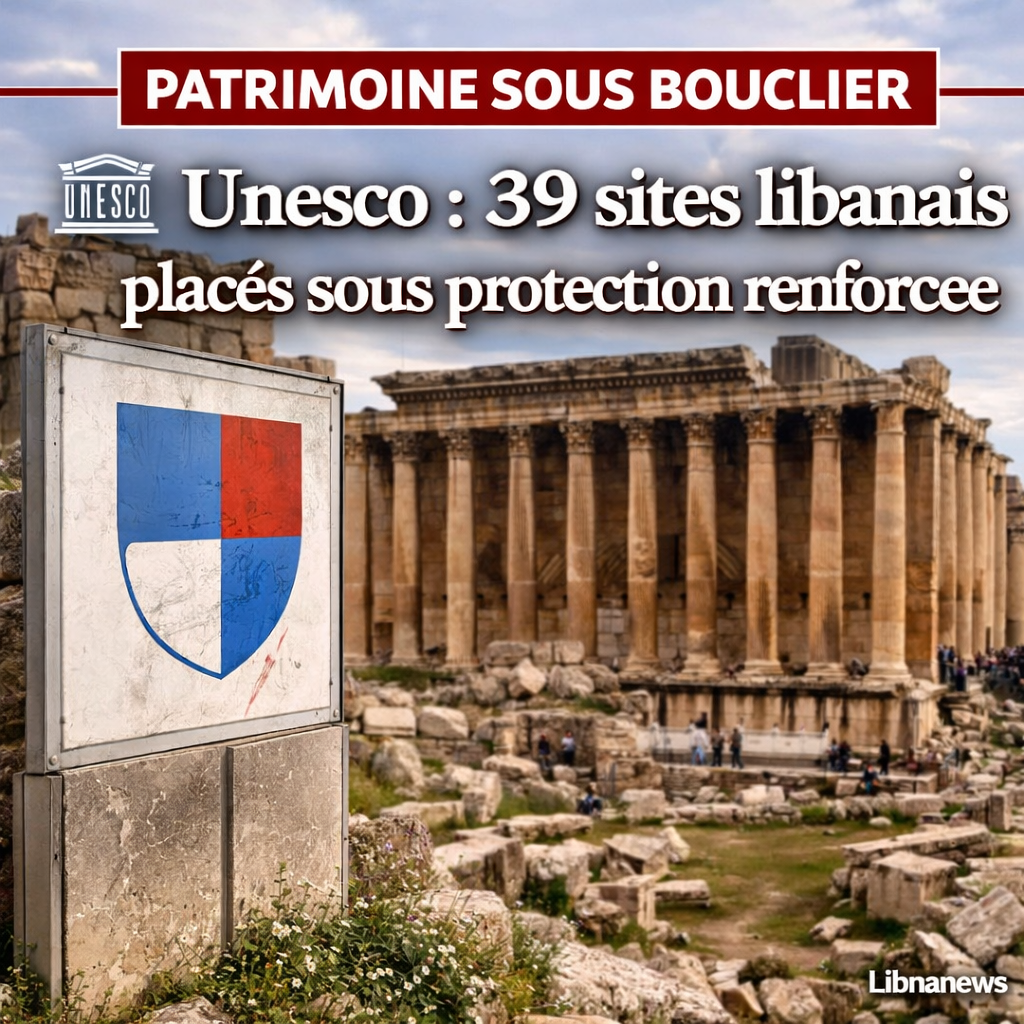
Lebanon obtained on Wednesday in Paris a major heritage advance in a context of war that continues to threaten its cities, villages and places of memory. The Commission for the Protection of Cultural Property in the Event of Armed Conflict, meeting in special session at Unesco headquarters, approved in one decision the placement of 39 new Lebanese archaeological and cultural sites under enhanced protection. These new rankings add to the 34 sites already protected since 2024, bringing the total to 73. According to the National Information Agency and Unesco, Lebanon thus becomes the country with the largest enhanced protection mechanism for its cultural sites.
This result goes beyond the technical framework. He spoke at a time when the war had placed the issue of heritage at the heart of the Lebanese debate. For months, cultural leaders, diplomats and heritage experts have been alerting to the extreme vulnerability of several historic sites, sometimes in the immediate vicinity of bombed areas. Unesco itself stressed that these sites will now benefit from technical and financial support to strengthen their legal protection, improve risk anticipation and to train more heritage professionals and military personnel on these issues. The decision does not erase the danger, but it raises the level of international protection and sends a strong political signal: Lebanese heritage is not a secondary issue of war, it is part of the heritage of humanity.
The Paris session had been requested by the Permanent Mission of Lebanon to Unesco. It was held under the Brazilian presidency, with the participation of the twelve member states of the Commission, as well as ambassadors and representatives accredited to the organisation as observers, according to the National Information Agency. The Lebanese delegation included Ambassador Hind Darwich, Permanent Delegate of Lebanon to Unesco, the Director General of Antiquities Sarkis Khoury, architect Jad Tabet and several members of the mission. The fact that the 39 sites were adopted in one decision highlights the level of consensus reached around the Lebanese demand.
A Heritage Decision in Time of War
First, we need to measure what enhanced protection means in Unesco’s vocabulary. This is not just an honorary label. This mechanism, provided for in the Second Protocol of 1999 to the Hague Convention of 1954, aims at giving increased international protection to cultural property of exceptional importance when exposed to serious threats related to armed conflict. Unesco states that this status improves the legal protection of sites, strengthens risk preparedness, and opens access to technical and financial assistance for protection measures.
In the Lebanese case, the scope of this decision is all the greater as the country has already been in a first phase of accelerated classification since 2024. Thirty-four sites were then placed under enhanced protection, including several major World Heritage sites. The addition of 39 new locations brings the total number of Lebanese sites covered by the regime to 73. This very rapid expansion reflects both the magnitude of the threats and the diplomatic mobilization of Beirut with Unesco. It also shows that the current conflict has changed the hierarchy of emergencies: saving lives remains the top priority, but saving the traces of history becomes a parallel battle, led with the idea that cultural destruction is also part of the ravages of war.
Lebanon has been seeking to internationalize this concern for several days. Prior to the meeting, UNesco preparatory documents and several diplomatic announcements already indicated that a special session should address Lebanese requests for enhanced protection and emergency assistance. The organization had also published a document on an application for international assistance filed by Lebanon on 24 March 2026 for the marking of cultural property placed under enhanced protection with the blue Shield emblem. The request was for a total amount of $20,034 and was to be managed by the Unesco office in Beirut in coordination with the Directorate-General for Antiquities.
Lebanon becomes the most widely covered country
The most significant point of the Paris meeting was the final figure. With 73 sites now under enhanced protection, according to the National Information Agency and Unesco, Lebanon is the country with the widest coverage in this area. This status is not only symbolic. It reflects a form of international recognition of the country’s heritage density and current vulnerability. Few territories combine, on such a small area, such diverse historical layers, ranging from Phoenician cities to Roman remains, from medieval urban complexes to modern architectures.
This density of heritage makes Lebanon fragile. Historical sites are not isolated from the urban and human fabric. In Tyre, Baalbeck, Byblos or other areas, ancient remains coexist with inhabited neighbourhoods, roads, infrastructure and areas directly or indirectly affected by hostilities. Unesco stresses that enhanced protection also serves to alert the international community to the urgency of preserving these sites. In other words, the Paris decision acts as a form of warning: attacking or endangering these places entails increased responsibility for the law applicable to cultural property in times of armed conflict.
This is crucial for the Lebanese reading of the meeting. The country was not only seeking recognition of principle. He sought to bring these sites into a regime where their damage would become more explicitly visible on the international scene. In a war where collateral damage, strikes near historic areas and destruction of the urban fabric are recurrent, the international designation of sites becomes an instrument of legal and diplomatic protection. It does not guarantee inviolability, but it makes it more difficult to trivialize the risks to them.
Paris, diplomatic showcase of a Lebanese mobilisation
Lebanese diplomacy played a central role in this sequence. The National Information Agency reports that the session was convened on the initiative of the Permanent Mission of Lebanon to Unesco. Ambassador Hind Darwich defended the Lebanese demand by insisting that these sites are part of humanity’s heritage and a reservoir of values, history and memory. It also recalled that some sites had already been directly threatened, citing, inter alia, the site of Al-Bass in Tyre, exposed to nearby strikes.
This reference to Tyre is far from abstract. Recent reports have shown that the ancient site, one of Lebanon’s most emblematic sites, is in an environment where war is never distant. Strikes have hit neighbouring areas, reminding us of how much heritage can be caught within the immediate reach of military operations. The case of Tyre illustrates the particular nature of the threat in Lebanon: it is not always an attack on a monument, but a context in which the proximity of the strikes is sufficient to endanger the integrity of the sites and to install permanent anxiety around their preservation.
The role played by the Lebanese mission in Paris also shows that the heritage battle is now taking place on several fronts. There is the material front, with physical marking of the sites and emergency measures. There is the technical front, with the preparation of files, maps and requests for assistance. And there is the diplomatic front, with the mobilization of Member States, the search for consensus and the willingness to have the scale of the risk recognised. The success achieved in Paris on Wednesday belongs to this third dimension: making Lebanese heritage an immediate international issue, not a subject of heritage reserved for specialists.
The Blue and Red Shield, an essential marking
One important aspect of the meeting was the assistance granted to the Lebanese request to implement the decision. The National Information Agency states that the Member States have approved Lebanon’s request for aid to carry out the ranking and to install the enhanced blue and red protective emblem on all registered sites. The Unesco preparatory documents specify that this assistance concerns the marking of goods under enhanced protection with the relevant emblem of the Blue Shield.
This marking is not a graphic detail. It constitutes a codified visual signal to the parties to the conflict. It recalls that the site is a protected cultural property and must be spared. In Lebanon, this signal has already begun to appear at several sites since the first steps taken in 2024 and in recent weeks. Reports on Tyre and other places have shown these white and blue emblems, sometimes surrounded by red in the context of enhanced protection, fixed near the remains to recall the obligations imposed by international law in time of war.
The choice of extending this marking to all new sites highlights a change in the way heritage protection is thought. It is no longer a matter of simply inventorying and documenting, but of acting physically on the ground, even in an emergency. Setting an emblem means making the site visible in its protected quality. It also means that the Lebanese State, with the support of Unesco, refuses to dissolve these places in the anonymity of the war landscape. In the current context, this materiality counts. It gives heritage an active presence in the space of conflict.
Between cultural emergency and total war
The interest of the decision taken in Paris is also due to the moment it occurs. Lebanon is going through a phase where priorities seem to be fully absorbed by the war: security, displacement, refuelling, hospitals, state structures. In such a context, talking about archaeological or cultural sites may seem secondary. However, the Unesco meeting recalls exactly the opposite. War destroys lives, but it also threatens collective memory, the historical thickness of the territory and the symbolic landmarks around which a society is told.
This explains the tone of the Lebanese officials involved in this case. Heritage is not defended as a luxury or as a concern of calm time. It is defended as an element of national continuity in a moment of rupture. To preserve a site is to preserve part of the country’s narrative. It is to keep a record of what the conflict could otherwise erase. In the Lebanese case, this issue is all the more acute because the country has a stratified history, where the heritage is not concentrated in a few large reserves distant from the population, but dispersed in the very heart of the territory lived.
Unesco’s support and the extension of enhanced protection obviously do not remove the risk. No Parisian decision can put a site in absolute shelter from a strike, fire or collapse. But the meeting still has three real effects. It increases the international visibility of threatened Lebanese heritage. It strengthens the legal and technical tools for its protection. And it gives Lebanon an additional diplomatic leverage to denounce possible future attacks. In a war where so many lines are blurred, this triptych has concrete importance.
A diplomatic victory, not an end of the alert
Basically, the extraordinary meeting in Paris can be read as a diplomatic victory for Lebanon. Obtaining the simultaneous ranking of 39 new sites, bringing the total to 73, and obtaining the approval of assistance in marking and implementing the device, all this is a rare success in a period when the country is most often in a defensive position on the international scene. The consensus reached in a single decision further reinforces this impression of success.
But this victory does not erase the alarm. She formalizes it. If Lebanon had to mobilize Unesco at this level, it was precisely because the war had rendered the immediate danger. Heritage is not better protected because it would be less threatened; It is because it is more threatened. This distinction is essential. It avoids reading the Paris decision as a mere success of prestige. This is a success achieved in an emergency, to respond to a vulnerability that has become more acute.
So the Wednesday open sequence says two things at once. On the one hand, Lebanon has succeeded in having the universal value and vulnerability of its sites widely recognized. On the other hand, this recognition confirms that Lebanese heritage has now fully entered the field of goods threatened by contemporary war. Between these two realities, there is no contradiction. On the contrary, there is the very logic of the Parisian decision: to protect more because the risk has become greater.






