

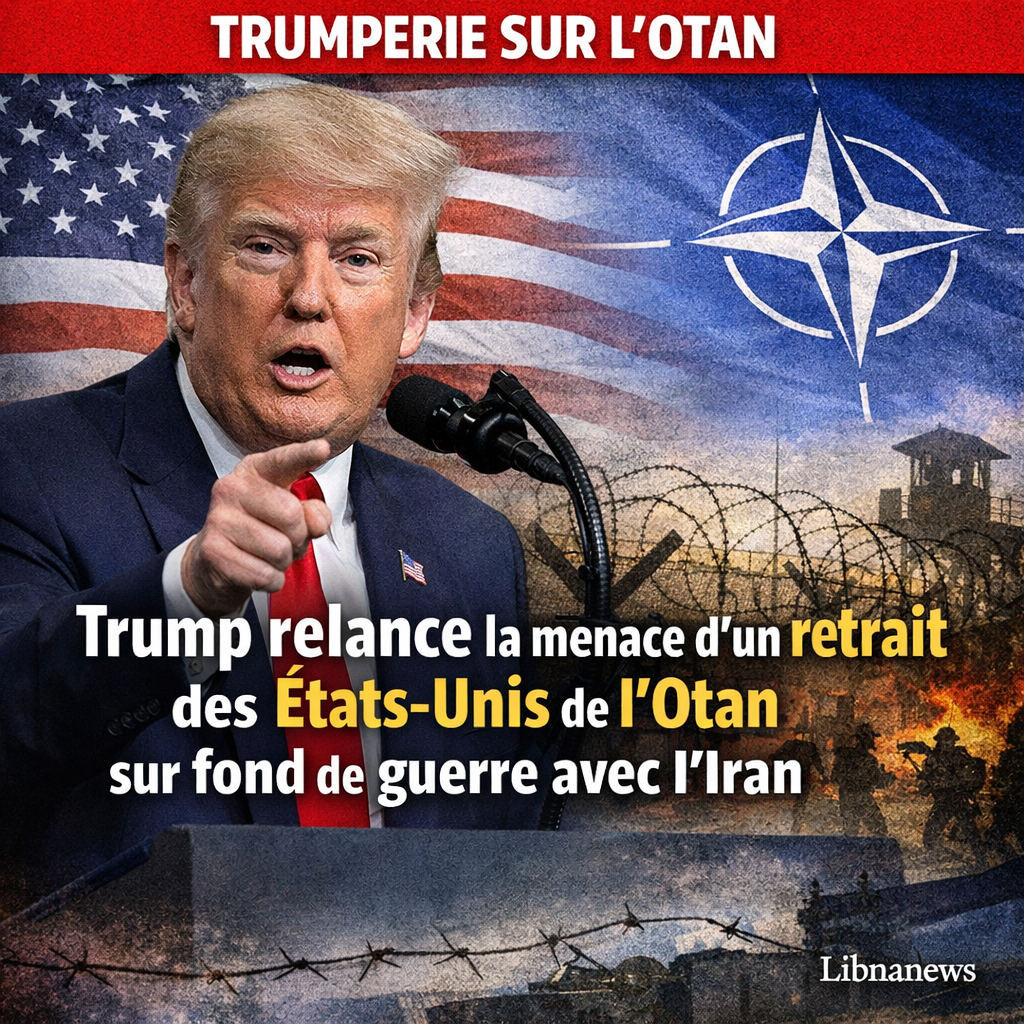
The war with Iran opened a new political front at the very heart of the Atlantic Alliance. Donald Trump said he was seriously considering withdrawing the United States from NATO, after accusing his European allies of not supporting his offensive against Tehran. The US President called the Alliance a « paper tiger, » a formula that marks a verbal rupture of a rare brutality towards an organization long presented as the foundation of Western security. This exit came when several European capitals refused to be associated militarily with the conflict, while recalling that they had not been consulted before its outbreak.
The episode is not just a presidential event. It reveals a deeper strategic divide between Washington and several European allies, already weakened by trade disputes, tensions over Ukraine and disagreements over the relationship with Moscow. This time, the crisis is about the Middle East and how the United States has chosen to launch its war against Iran. On the American side, the administration blames Europeans for not providing logistical and political support to the operation. On the European side, several governments recall that they were not involved in the original decision and that they do not consider this war to be theirs.
Trump’s formula on NATO is all the more far-reaching as it has been accompanied by other converging signals. The leader of the Pentagon refused to clearly reaffirm the American commitment to the collective defence principle of Article 5, explaining that this decision was the responsibility of the President. Secretary of State Marco Rubio also mentioned the possibility of « reviewing » the United States’ relationship with the Alliance at the end of the war. In other words, the threat is no longer carried by Trump’s style alone. It begins to enroll in the American executive language.
A war with Iran that revives transatlantic divides
The conflict with Iran served as a brutal revelation. For several days, Trump has been trying to convince the US that the military campaign will be short and will help neutralize Iranian offensive and nuclear capabilities. But this narrative has come up against unexpected resistance in Europe. Not only have several governments refused to join the war, but some have taken concrete steps to prevent their territory from serving as a platform for American operations. This refusal provoked the anger of the White House, which believes that Europe is taking advantage of the US strategic protection while disintegrating itself when it comes to supporting an operation decided by Washington.
In Trump’s logic, NATO should function as an alliance available when American interests are engaged. Yet several Europeans oppose this vision with a very different reading. For them, Article 5 has nothing to do with the obligation to participate in a preventive war or to join a campaign decided without consultation. This fundamental disagreement explains the magnitude of the current crisis. Washington is reasoning in terms of strategic loyalty. European capitals respond in terms of national sovereignty, international legality and parliamentary control over the use of force.
The war with Iran has thus led to an old ambiguity. NATO is a collective defence alliance, but it is not designed as an automatic mechanism for alignment with all United States external operations. Speaking of « paper tiger, » Trump actually blames the Alliance for not becoming what it never officially was: an expeditionary coalition that can be mobilized at will to serve unilateral American decisions. This is where the dispute becomes explosive, because it affects the very definition of NATO.
Europeans who say they have not been consulted
One of the most repeated arguments in Europe is simple: the allies were not consulted before the outbreak of the conflict. Several European officials have explained in recent days that Washington had acted without proper prior consultation, and then asked for political, logistical or military support once the war began. This sequence fuelled a strong diplomatic resentment. It gives Europeans the feeling of being called upon to bear the consequences of a decision that they are neither prepared nor validated.
This grievance is not secondary. In Western alliances, consultation counts as much as the action itself. It builds political legitimacy, shares risk assessment and reduces shocks between allies. By freeing itself from this logic, the Trump administration has taken the risk of turning a strategic disagreement into a crisis of confidence. Several European governments then chose to draw a clear line: they will not militarily support a war that has not been debated with them and which they do not consider to be in their interests.
In the French, British and German case, prudence took the form of a discourse focusing on diplomacy, the protection of civilians and post-conflict maritime security. In the Spanish and Italian case, it has resulted in more concrete restrictions. This variety of responses shows that Europe is not a homogeneous bloc. But all converge on one point: no major European capital has agreed to turn its territory into a launching pad for the American war against Iran.
Spain and Italy set clear limits
The Spanish example was one of the most commented. Madrid closed its airspace to US military aircraft involved in the conflict with Iran and also banned the use of Rota and Morón bases for operations related to the war. The Spanish Government has justified this decision by its opposition to a war deemed illegal and by its unwillingness to be led into an escalation which it does not support. This measure had an immediate effect: it deprived Washington of an important logistics corridor between Europe and the Middle East.
Italy has adopted a similar line, although its argument has been more procedurally focused. Rome refused the use of Sigonella base in Sicily to American aircraft carrying weapons for Iranian theatre. The Italian Government has explained that the existing agreements allow the use of this infrastructure for logistical or training missions, but not for direct support to war operations without specific parliamentary authorization, except in cases of emergency. This decision confirmed that even close allies of the United States intended to preserve their legal and political autonomy.
These restrictions have deeply irritated the US administration, as they affect the nerve of a modern operation: logistical support. Denying access to bases or airspace does not mean opposing only in words. This complicates refuelling, rotations, routes and regional projection. For Trump, these decisions are evidence that some allies want the benefits of the Alliance without paying the costs when Washington waits for their help. For Madrid and Rome, on the contrary, they are a simple principle: membership of NATO does not oblige a decided war to be condoned without any consultation.
London, Paris, Berlin: strategic support for NATO, not war
The other major European powers have adopted a more hushed tone, but not fundamentally different in substance. The United Kingdom defended NATO’s value while stressing that war with Iran did not automatically fall within its national interests. France insisted that this war was not its own and favoured a discourse of diplomatic predictability in the face of American exits. Germany, for its part, expressed its concern at the economic and energy consequences of the conflict. None of these countries agreed to fully endorse Washington’s military logic.
This European restraint does not mean a complete break with the United States. Rather, it means refusing automatic alignment. European governments know that NATO remains indispensable for their security, especially in the face of Russia. But they refuse that this strategic dependency becomes an obligation to accompany all Washington’s external initiatives. This is precisely what Trump is less and less supporting: a Europe that wants to maintain American protection without giving up its right to say no.
The paradox is also striking. The more Trump threatens NATO, the more Europeans reaffirm the importance of the Alliance. But this reaffirmation is accompanied by an equally clear refusal to be drawn into the Iranian war. In other words, Europe defends NATO as an instrument of continental security, while challenging its transformation into an auxiliary to American war choices in the Middle East.
A NATO crisis fuelled by a transactional vision of the alliance
The current sequence is part of an older Trump Presidency logic. For years he has considered NATO less as a strategic community than a transactional arrangement. If the allies do not pay enough, if they do not support enough, if they do not directly serve American interests, their usefulness becomes in his eyes questionable. The war with Iran has simply radicalized this approach. It provides him with a concrete case to argue that the Alliance does not meet American expectations at a time he considers decisive.
The problem for Europeans is that such a vision destabilises the very heart of the Alliance. NATO is not solely based on immediate interests. It is also based on predictability, trust and certainty that no one-time disagreement will jeopardize its existence. When the US president suggests that a European refusal on Iran could justify an exit from the US, it turns a cyclical divergence into a structural threat. It is this disproportion that today worries European chancelleries.
The consequences could be considerable. Even without effective withdrawal, the mere doubt about the strength of the US commitment weakens NATO’s deterrent effect. It can encourage Alliance opponents to test its cohesion. It also obliges Europeans to speed up their reflection on strategic autonomy, their own military capabilities and their continuing dependence on US resources. The war with Iran thus acts as a catalyst for an old European debate, but never decided.
Iran as a trigger for a broader debate on the place of the United States
Maybe the Iranian case is just a trigger. In reality, the current crisis puts on the table a more fundamental question: what place do the United States still want to occupy in the Euro-Atlantic security architecture? If they expect NATO to follow their external wars without prior consultation, then the transatlantic relationship enters a zone of lasting instability. If, on the contrary, Europeans continue to point out that the Alliance is not intended to legitimize all US offensives, the strategic gap may widen further.
Trump’s statement on the « paper tiger » aims to put pressure on Europeans. But it also has another effect: it weakens the image of cohesion that the Alliance is trying to project against Russia, against China and against the crises in the Middle East. For European allies, the challenge is not just to respond to Washington. It is also necessary to preserve the collective credibility of a mechanism which they still consider vital. Hence their verbal prudence, their rejection of direct escalation and their effort to distinguish their loyalty to NATO from their opposition to the war against Iran.
What the current sequence shows, basically, is that an alliance can survive disagreements, but much less easily a divergence in its raison d’être. For Trump, the Iranian test would prove that NATO no longer serves American interests enough. For many Europeans, it proves on the contrary that the Alliance must remain a collective defence structure, not a machine to follow the wars unilaterally decided by Washington. Between these two visions, the fracture is not only political. She’s doctrinal.






