

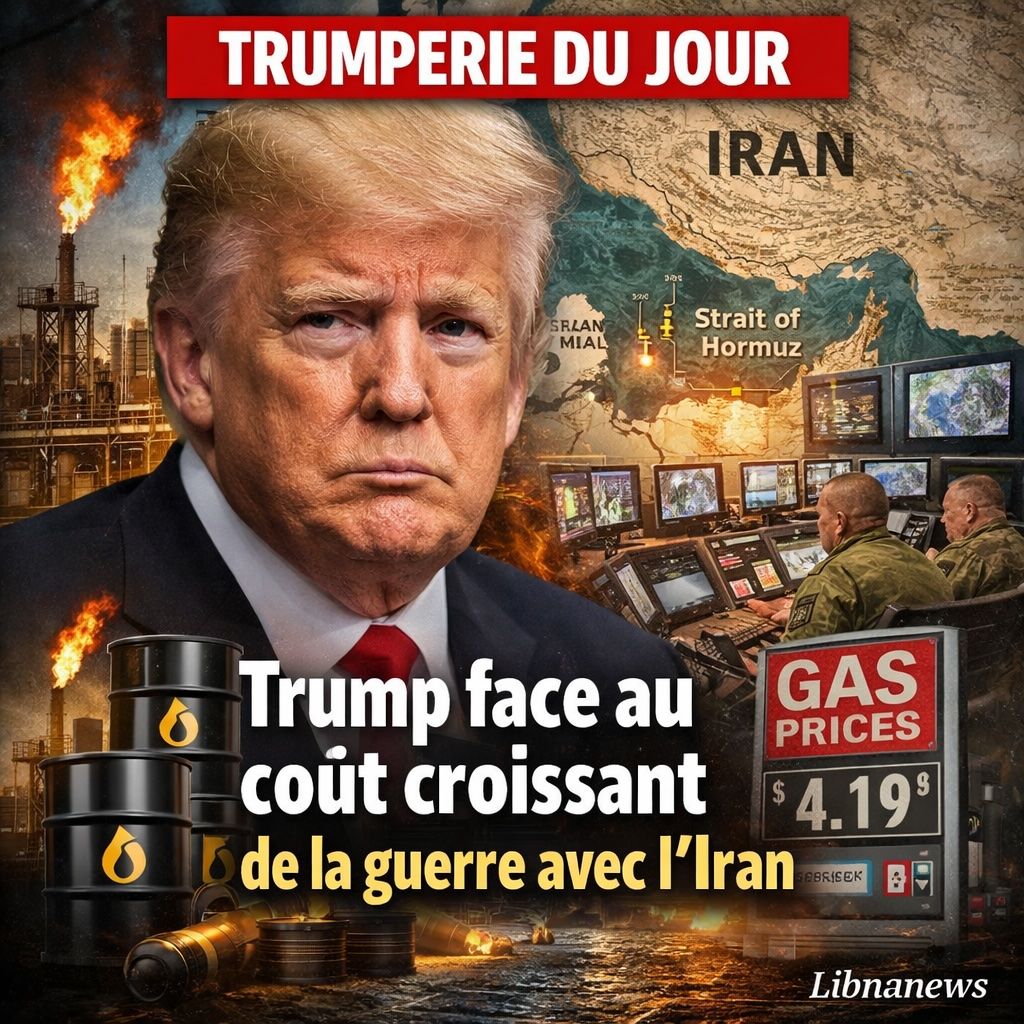
Donald Trump wanted to impose military tempo. It now faces a more prosaic reality, but often more decisive: money. Over the days, the war with Iran is no longer limited to strikes, threats to Iranian energy infrastructure or an arm of fire around the Strait of Ormuz. It also becomes a battle of financing, political support and internal credibility. In Washington, the White House already suggests that Arab allies should contribute to the war effort. In the Capitol, the Senate is still plagued by growing reluctance about the cost, duration and real purpose of this campaign. Between the desire to make the Gulf monarchies pay and the difficulty of securing sustainable budget support for Congress, Donald Trump discovers that a war is not only winning on the ground. It must also be financed, sold politically and justified in the face of an American opinion that begins to look at the price at the pump as much as military press releases.
The problem is not secondary. It touches the heart of the American political system. A president can trigger an escalation, expand strikes, send reinforcements and display his firmness. But then he must convince that there is a sustainable strategy. In the Iranian case, however, doubt is already emerging. The Trump administration pointed out its interest in Arab countries’ financial participation in the war. This idea is not anecdotal. On the contrary, it reveals that the White House knows that the political cost of a prolonged conflict can quickly become heavier than the diplomatic cost of a request to Riyadh, Abu Dhabi or Kuwait City. As soon as an American president asks partners to share the bill, he implicitly acknowledges that the campaign no longer has the profile of a short and limited operation. It falls into another category: that of a commitment that begins to weigh on public finances, on budgetary arbitrations and on the presidential discourse itself.
Why Trump Wants to Pay Arab Countries
Donald Trump’s logic is simple, almost instinctive. The Gulf States have a direct interest in Iran’s weakening. They depend on maritime security in the region, fear Tehran’s nuisance capacity and already host US military infrastructure. From the White House point of view, therefore, they should contribute more. Spokesperson Karoline Leavitt confirmed on 30 March that the President was interested in this option, without detailing the mechanism or amounts mentioned. This formula, however, is enough to shed light on the Trump method: turning war into a strategic transaction, asking allies to pay for a security they benefit directly, and presenting it as a firm defence of American interests.
This approach is part of Trump’s old political continuity. For years, he has reiterated that the US allies have to bear a greater share of the cost of their own security. He said about NATO. He said it about Asia. He says it today about the Gulf. In his account, America must no longer be the power that protects everyone for free. The war with Iran thus gives him a new opportunity to return to this transactional software: you want a hard line against Tehran, so you pay. From a rhetorical point of view, the argument is dreadfully effective in speaking at its base. It allows us to defend the war without assuming the political charge alone.
But regional reality is more complex than this pattern. The Arab allies of the United States are not aligned in the same way. Some clearly support the pressure against Iran. Others prefer rapid de-escalation. The Associated Press reported in recent days that Saudi Arabia, the United Arab Emirates, Kuwait and Bahrain were pushing Trump to maintain pressure, while Oman and Qatar favoured a diplomatic outcome. This simple cleavage shows that there is no homogeneous Arab bloc, ready to sign a common cheque for the American war. Each capital reason according to its own interests, vulnerabilities, channels of dialogue with Tehran and its exposure to the risk of reprisals.
The Gulf wants pressure, not necessarily addition
That’s where Trump’s strategy lies. The Gulf monarchies may wish Iran to weaken without openly funding an American campaign whose outcome remains uncertain. They can encourage firmness while avoiding public involvement to become co-financial partners. Such participation would expose them more diplomatically, safely and internally. It would make them not mere partners in Washington, but visible actors in a potentially long regional war. For regimes that seek to preserve their infrastructure, exports and stability, the bet is far from obvious.
The regional economic context reinforces this prudence. The closure of the Strait of Ormuz and attacks on oil flows are already destabilizing markets. Reuters reported that a Kuwaiti oil tanker loaded with about two million barrels of crude oil had been struck off Dubai, at a time when regional tensions were still rising. At the same time, oil prices have jumped. The Brent briefly exceeded 113 dollars a barrel on March 31, after a month of March marked by a spectacular flight. As a result, the Gulf countries already have a direct cost to absorb: increased insurance premiums, pressure on shipping routes, market volatility and threats to their infrastructure. In these circumstances, asking them to pay in addition part of the American war amounts to asking them to finance a crisis they are already suffering from.
Egyptian President Abdel Fattah al-Sissi has also issued a warning that sheds light on the regional state of mind. He estimated that the war could push oil beyond $200 a barrel and cause a global shock, both energy and food. Although Egypt is not a Gulf lessor comparable to Saudi Arabia or the United Arab Emirates, this message reveals a wider concern in the region: a prolonged war does not only weaken Iran, it also threatens the entire regional economic balance. In other words, the Arab countries may find it useful for Washington to exert military pressure. At the same time, they may feel that it would be absurd to finance a spiral that could weaken them themselves.
In Washington, money becomes a political problem
Trump’s second front is inside. And maybe he’s more dangerous to him than the first. In the United States, the question of funding is never an abstract one. It always amounts to a simple question: how much does it cost, and who pays? But the war with Iran is taking place in an already tense political context, marked by difficult budget debates, competing domestic priorities and extreme sensitivity to energy prices. Reuters reported on Tuesday that the price of gasoline had exceeded $4 per gallon in several regions. For a president who wants to defend US purchasing power, this data weighs heavily. From the moment the war raises the price of fuel, it ceases to be a distant subject of national security. It enters the daily life of households.
This economic pressure complicates the White House’s work. American presidents can often get a reflex of unity at the beginning of a crisis. On the other hand, they struggle much more to maintain support when the bill becomes visible. Iran offers precisely this scenario. The Strait of Ormuz transports about a fifth of the world’s oil, and its disruption is enough to cause lasting tremors in markets. Although Trump continues to assert that military pressure serves the energy and security interests of the United States, the opinion will retain one thing: since the war intensified, gasoline costs more. Politically, it’s a slow poison.
The administration must also answer a heavier question: what is the actual duration of the campaign? The longer the conflict spreads, the more difficult it becomes to avoid the need for additional funding. Reuters reported that the debate in Washington was already about a massive need for additional funding to support the war effort. Such a perspective changes the landscape. It obliges elected officials to decide not only on the principle of firmness vis-à-vis Iran, but on concrete arbitrations: what expenses should be reduced, what deficits should be accepted, what part of the cost should be borne by the American taxpayer? A war becomes increasingly politically fragile when it moves from strategic to accounting.
The Senate does not want to sign a blank cheque
The Senate remains at the centre of this equation. Of course, a resolution to limit the President’s war powers against Iran has recently failed, allowing Trump to claim some form of political latitude. But this vote does not solve anything on the substance. Refusing to obstruct a president in time of war does not mean accepting without discussion all the funding he could then ask for. It is often the opposite. Senators are reluctant to appear weak on the national security front, but they become much more cautious when it comes to enduring budgetary costs before their constituents.
This caution applies to both sides, even if it is expressed differently. The Democrats denounce the escalation, challenge the strategic coherence of the administration and worry about the human impact of the conflict. Several elected officials called for investigations following strikes on civilians in Iran. This challenge does not automatically block funding, but it fosters a climate of distrust that makes any budgetary vote more difficult. The Democrats can hardly support massive credits without asking for an account of the real objectives of the war, its rules of engagement and its humanitarian consequences.
Among Republicans, malaise is more discreet but real. Part of the party instinctively supports any hard line against Iran. Another fear is that a long war will break the Trumpist electorate, especially if it involves more spending, more soldiers and less visible results. The tension is classic: the hawks want to push the strategic advantage, the supporters of a more isolationist reflex fear a stalemate in a new Middle East conflict. Trump must therefore hold together sensitivities that do not have the same tolerance for risk, nor the same budgetary patience. On this point, the Senate is not just an institutional obstacle. It reflects the contradictions of the political coalition that brought Trump back to power.
Gulf financing is also an internal message
That is why the idea of charging Arab countries is far more political than financial. Of course, the White House would like to reduce the share of the US budget. But this approach is also used to produce a narrative. Trump could tell his constituents that he has imposed a useful war without putting all the burden on US taxpayers. He could present the Gulf monarchies as partners finally forced to bear the cost of American protection. In other words, seeking external funding would also protect the President from domestic criticism of fiscal irresponsibility.
Still, this must be credible. Now there is no guarantee that Riyadh or Abu Dhabi will agree to formalize such a commitment. The Gulf leaders know that explicit financial support would place them more in the Iranian line of sight. They also know that a financially assumed war becomes, sooner or later, a politically assumed war. From then on, it’s not just about helping Washington. It is about identifying with its strategy, risks and possible failures. Many capitals in the region will probably prefer to stay in a grey area: to encourage pressure against Tehran, to facilitate certain American operations, but to avoid too much exposure to the issue of financing.
This ambiguity already weakens Trump. For if the Arab countries refuse to pay, or delay, the White House is faced with a brutal contradiction. It acknowledged that it was seeking external assistance, so that it was anticipating a high cost, without obtaining the desired solution. The president will then have to return to Congress with a more difficult demand to defend. And the longer the war lasts, the greater the difficulty. A poorly funded war often ends up appearing as a misconceived war. It is precisely this risk that is emerging.
Oil reminds us every day of the real balance of power
In this crisis, energy markets play a role as a daily judge. They brutally recall that war with Iran is not a peripheral operation. It affects one of the nerve centres of the world economy. The Strait of Ormuz, the Gulf Sea Routes, crude exports, ship insurance and the price of gallons in the United States are becoming such important policy variables as staff charts. When the Brent leaps and the essence crosses a psychological threshold, the debate changes in nature. It stops turning around the only security. It also addresses the social cost of the presidential strategy.
Trump knows that. This is probably one of the reasons Reuters reported, citing the Wall Street Journal, that the president would have told his relatives that he was prepared to consider an end to war without immediate reopening of the Strait of Ormuz. This inflection is revealing. She suggests that as the campaign moves forward, the White House is already reviewing its exit conditions. When a power begins to adjust its objectives during conflict, this rarely translates into simple tactical flexibility. This often indicates that military or political costs are rising faster than expected. Here, the two dimensions seem to combine.
This evolution also weakens the absolute speech of force that Trump seeks to maintain. The President continues to threaten Iran, including its energy infrastructure, while allowing signs of relaxation to filter out the conditions of a halt to the war. This oscillation between military maximism and fiscal pragmatism blurs the message. It feeds the idea that the administration is looking less for a clearly defined victory than a politically saleable exit door. The Senate, Arab allies and markets all test the same thing: the strength of the American plan. The more uncertain this solidity seems, the more difficult it becomes to obtain funding.
A war Trump wants to wage without paying the price alone
In essence, Donald Trump’s difficulty lies in this contradiction. He wants to appear as the leader who strikes hard, imposes his conditions and refuses weakness. But it does not want the United States alone to bear the financial, economic and political costs of this demonstration of strength. He is therefore looking for an intermediate formula: to maintain pressure on Iran, to involve Arab partners, to avoid a sling in the Senate and to contain the anger of American consumers at rising energy prices. This formula exists in theory. In practice, it remains unobtainable.
The war with Iran thus reveals an old American truth. The launch of an operation depends on the President. Its duration depends very quickly on the entire system: allies, congresses, markets, public opinion. Trump can still impose the pace of statements. He has less control over the bill. And the deeper the conflict, the more political this bill becomes. The Arab countries want to contain Tehran without assuming the entire war. The Senate wants to show firmness without giving a blank budget. Voters can support the idea of power, but much less easily the direct cost of an energy crisis and an emerging conflict. Trump’s real difficulty now lies in this tension: not entering the war, but finding out who will pay for it with him.






