

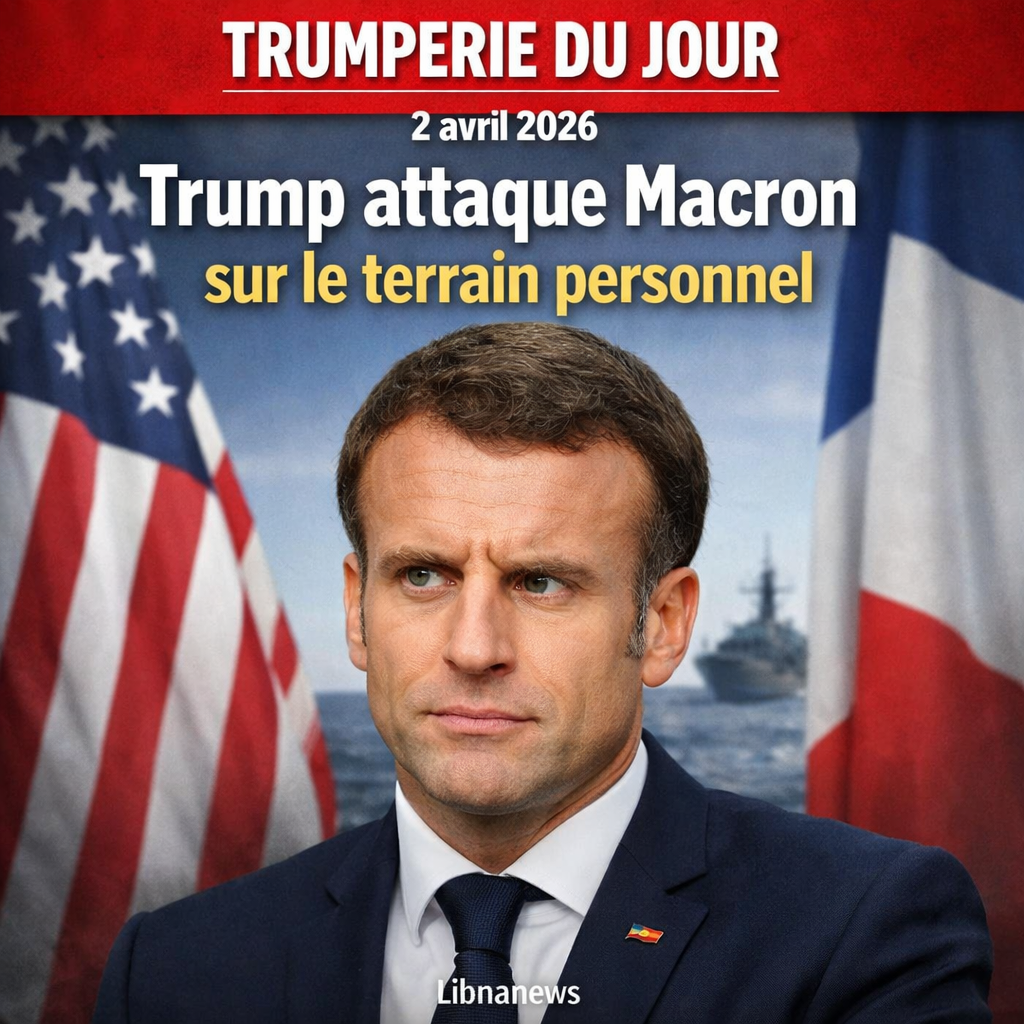
Donald Trump once again crossed a level in his verbal confrontation with Emmanuel Macron. On Wednesday 1 April, the US President did not content himself with criticizing France for its refusal to engage further with Washington in the crisis in the Strait of Ormuz. He also personally targeted his French counterpart, publicly mocking his relationship with Brigitte Macron. This exit mixes intimate provocation, diplomatic pressure and wider criticism of European allies, accused by the White House of not supporting enough the American effort in the war against Iran.
Personal attack grafted into strategic litigation
The sentence which immediately drew attention did not concern Iran, NATO or Ormuz. Donald Trump claimed that Emmanuel Macron was « mistreated by his wife » and that he was barely recovering from a blow received « in the jaw », according to reports from several accounts of his speech on Wednesday. This allusion refers directly to the footage filmed in May 2025 in Vietnam, when Brigitte Macron had been seen pushing the face of the French president at the exit of the presidential plane, an episode that Elysée and Emmanuel Macron had then presented as a moment of play between spouses.
At Trump, this type of formula is never totally detached from the political background. The personal attack here is used to degrade the stature of his interlocutor at the same time as he seeks diplomatic isolation. The American president is not only critical of the French decision. He’s trying to make a public fool of anyone who’s incarnate. This shift is central to understanding the sequence: the dispute between Washington and Paris is no longer merely a matter of strategic disagreement over the Gulf, it takes the form of a staging of political domination where verbal humiliation becomes an assumed instrument.
This choice is not new in the Trump method, but it is notable to an allied head of state. By targeting Emmanuel Macron with an understatement about his marital life, Donald Trump emerged from the classic record of transatlantic quarrel. It turns a divergence between governments into a personal confrontation. And it does so in a context of very strong international tension, as the White House tries to rally its allies to a tougher posture against Iran and around the Strait of Ormuz.
What Trump accuses Emmanuel Macron
Behind the invective, the American grievance is clearer. Donald Trump blames France for not responding favourably to his requests for support in the Gulf. According to his statements, he would have sought more visible participation from the allies, in particular to secure maritime traffic in the Strait of Ormuz, a vital passage for the world trade in hydrocarbons. His irritation is therefore aimed at an operational refusal, but also at what he considers a general lack of European solidarity in a crisis that Washington considers decisive.
The French response was clear. Paris recalled that NATO had as its mission the security of the Euro-Atlantic zone and not offensive operations in the Strait of Ormuz. The Minister for the Armed Forces, Alice Rufo, reiterated that the alliance was not designed to participate in a unilateral foreign war. Emmanuel Macron, for his part, argued for an approach under the aegis of the United Nations, with Iranian participation, rather than an extension of Washington’s war logic.
In other words, France did not limit itself to saying no. She opposed another reading of the crisis. Where Donald Trump wants to quickly mobilize allies around a demonstration of strength in the Gulf, Paris defends a more legally framed and diplomatic response. This divergence explains the brutality of the American reaction. For the White House, this is not just a French prudence, but a political refusal that weakens the credibility of the effort against Iran.
A new step in the deterioration of the tone between Washington and Paris
The relations between Donald Trump and Emmanuel Macron had already gone through a number of tensions since the US president returned to the White House. But the current sequence marks a visible worsening. Two days earlier, Paris had already said « surprised » by American critics of the French decision not to allow certain military overflights related to the conflict with Iran. The Elysée stressed that the French position had not changed since the beginning of the war.
This reminder is important because it shows that Wednesday night’s attack does not come out of nowhere. It is part of a gradual rise in American criticism of several European allies, but France occupies a special place in this scheme. Donald Trump regularly cites her among those countries deemed insufficiently engaged. Criticism therefore goes beyond Ormuz’s only question. It affects more broadly the sharing of the military burden, Europe’s place in external crises and the very conception of the Atlantic alliance.
The evolution of the tone is also revealing a change in the way Washington talks to its partners. Instead of exerting mainly diplomatic pressure, Donald Trump personified the disagreement and staged it in front of the cameras. The strategic reproach is then reinforced by personal mockery. This method allows him to occupy the media space, but it makes it more difficult to de-escalate discreetly. Once the line conflict has been transformed into a confrontation between the two, the margin of compromise is reduced.
The May 2025 precedent returns to the debate
The other key element of this case is the explicit reference to the May 2025 episode. At the time, images shot at the arrival of the French presidential couple in Vietnam showed Brigitte Macron pushing her husband’s face. Emmanuel Macron had quickly downplayed the scene, explaining that it was a joke and denouncing it all over the video. The incident then entered the now classic cycle of viral controversy, between irony, political comments and online speculation.
Donald Trump had already seized this scene a few days later. When questioned in May 2025, he had said about Macron: « Make sure the door stays closed, » how to mock a private episode that has become globally commented. Reuters noted that the U.S. president presented this as a « conjugal council » in the manner of jokes. So Wednesday’s release is not a first, but a recidivism. The difference is that it intervenes this time in a more tense and structuring context of diplomatic breakdown.
This reminder of the 2025 precedent shows how Donald Trump recycles an old sequence to fuel a new quarrel. It is not just a repeated trait of humor. By remobilizing this image, he seeks to personally weaken Emmanuel Macron as he accuses him of not being up to the level on the strategic terrain. The desired effect is twofold: make your own camp laugh and symbolically weaken a partner that has become embarrassing.
Ormuz and NATO, the real bottom of the case
Nevertheless, the heart of the confrontation remains geopolitical. Donald Trump believes that European allies should contribute more to securing the Strait of Ormuz, while the war against Iran is already causing major tensions on maritime trade and energy prices. His criticism is based on an old logic: the United States would bear only the bulk of the military cost while Europeans would benefit indirectly from the stability produced by Washington.
France opposes this reading of a more restrictive doctrine. For Paris, it does not belong to NATO to be trained in an offensive operation in the Middle East on the sole ground that the United States wishes to do so. It is precisely on this point that the gap has widened. Donald Trump even suggested that he was seriously considering challenging the American commitment to the Atlantic alliance, judging some partners to be failing. This threat has rekindled concerns in Europe about Washington’s strategic reliability.
Emmanuel Macron responded indirectly during his trip to Japan. He praised Europe’s « predictability » in the face of countries that, according to him, « do you harm without even warning ». Without mentioning Donald Trump directly, the message was transparent to observers. The French president sought to return the argument of strategic solidity: the real force, he suggested, lies not in the chin blows, but in consistency and readability.
A revealing sequence of Trump diplomacy
This new episode says a lot about how Donald Trump exerts international pressure. First, it constantly mixes the registers. The military, diplomatic, personnel and media are in the same verbal sequence. He then seeks to place his partners in a defensive position by forcing them to respond both on the bottom of their policy and on the ground of public humiliation. Finally, it turns a dispute between states into a story of loyalty or betrayal, where allies are called upon to prove their immediate usefulness.
In this diagram, Emmanuel Macron is an almost ideal target. It embodies both a Europe that claims strategic autonomy, an ally that refuses to follow Washington automatically, and a leader with whom Donald Trump maintains a relationship made of alternations between closeness and deep annoyance. Wednesday’s personal burden does not erase this framework. On the contrary, it is the most brutal expression. By taking on the supposed privacy of the French President, Trump is trying to delegitimize politically those who challenge his approach to the conflict.
The incident occurs mainly at a time when the question of Western engagement in the Middle East is becoming central again. The more the crisis around Iran and Ormuz spreads, the more Donald Trump wants visible support. And the longer these supporters go, the stronger the American president gets. The remark about Brigitte Macron may seem peripheral. In reality, it reveals a deeper mechanism: at Trump, strategic impatience often leads to the personalization of the quarrel.
What this attack is politically changing
In substance, this output does not change the French position. Paris did not give any sign of alignment with American demand, and nothing indicates for the hour a French inflection on the role of NATO or on the type of action to be taken in the Gulf. On the other hand, the episode may increase the political climate between the two capitals. It complicates any attempt at discreet coordination, as it places the bilateral relationship in a highly exposed personal confrontation register.
He also set an embarrassing precedent in the transatlantic relationship. When an American president publicly attacks the supposed conjugal life of an allied head of state to accuse him of a strategic divergence, the disagreement goes beyond the usual diplomatic framework. The signal sent to other European partners is clear: refusal to join the American line can now be punished not only by political pressure but also by a personal challenge from the leader concerned.
This Thursday morning, therefore, the sequence appears less like a simple provocation than a revealing one. Donald Trump did not just « tacle » Emmanuel Macron. He linked an old viral scene to a major strategic crisis to express a real diplomatic anger. Behind the insult, there is a political message: Washington demands more, and those who refuse are exposed to increasingly unbridled public hostility.






