

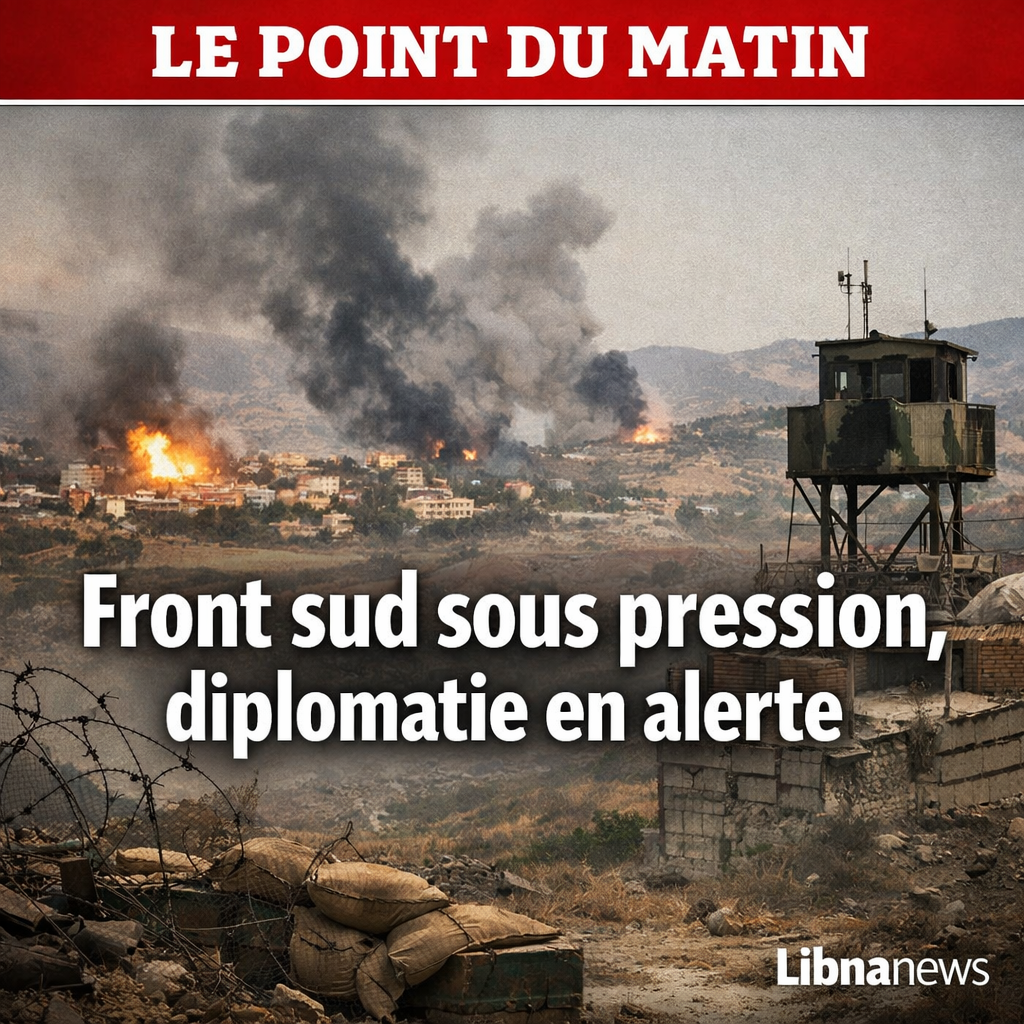
Lebanon wakes up this Tuesday, March 31, 2026 in a very tense climate. The night was marked by new strikes in the South, a growing human balance, attacks on UNIFIL, fighting on several border lines, but also political and economic signals that the crisis is far beyond the military field. Between the evacuation warnings, the reaction of the Lebanese authorities, the diplomatic mobilization around the peacekeepers and the increase in fuel, the country begins the day under multiple pressure.
Killing strikes in the south and southern suburbs
On the ground, South Lebanon remains the epicenter of violence. The NNA reported that a strike on Shaqra in Bint Jbeil district killed five people and injured two people according to the Ministry of Health. MTV also reported in the morning another violent strike on Al-Qleileh, south of Tyre, indicating that the air pressure continued at dawn. In addition, there are other raids reported by the Lebanese media over the night on several locations in the South and in the West Bekaa.
The sequence was not limited to the immediate border line. According to earlier NNA reports, a strike in the Al-Rihab area in the southern suburbs of Beirut also caused casualties and injuries. Together, it confirms an extension of the danger far beyond the border villages, with strikes affecting both direct combat zones and densely populated urban areas.
UNIFIL again affected, crisis taking on an international dimension
The most serious fact of the past 24 hours, however, remains the series of UNIFIL incidents. MTV reported on Monday a new episode in Beni Hayyan, Marjayoun district, where a UN force patrol was hit, with two Indonesian soldiers killed and several injured. A few hours later, the channel relayed Indonesia’s official condemnation, which denounced a second consecutive attack on peacekeepers in southern Lebanon.
The diplomatic reaction accelerated. MTV relayed the condemnation of the Indonesian Ministry of Foreign Affairs, which found that these attacks reflected a rapid deterioration of security in southern Lebanon. At the same time, the head of French diplomacy announced that an urgent meeting of the Security Council had been requested after those incidents involving UNIFIL. The NNA also reported that Lebanese Foreign Minister Youssef Raggi had contacted Jeanine Hennis-Plasschaert to offer Lebanon’s official condolences after the death of a Blue Helmet.
Lebanese Army directly targeted
Another sensitive development was the impact of the Lebanese army. MTV reported on Tuesday morning that a soldier had been killed and others injured in an Israeli strike at the Al-Aimriya checkpoint. LBCI states in its news reports associated with this morning’s direct that five other soldiers were injured in this attack. This point marks a new step in the gravity of the events: it is no longer merely a matter of exchanges between Israel and Hezbollah, but of a fire having reached a position of the Lebanese regular army.
At the domestic political level, this type of incident increases pressure on the state. According to the NNA, President Joseph Aoun assured that there was « no reason to fear for civil peace » while intensifying his diplomatic efforts. Since Baabda, politicians relayed by MTV have also insisted on the need to refocus the response around the state, the army and institutions, in a context where the risk of widening the conflict is increasingly worrying.
Military operations that remain intense
Military operations remain particularly strong on the southern front. LBCI relayed on Tuesday morning the announcement by the Israeli army of four Israeli soldiers killed in combat in southern Lebanon, as well as a serious wounded and a slightly wounded reservist. For its part, MTV issued a statement by the Israeli army claiming to have targeted dozens of fighters who, according to MTV, had attempted to ambush in the last 24 hours.
At the same time, the NNA relayed Hizbullah ‘ s statements of rocket and drone fire against Israeli troop groups and military sites. Al Manar, a media outlet close to Hezbollah, has also highlighted several operations claimed, including a strike against a Merkava tank on the road between Qantara and Taybeh, as well as other attacks in Ainata, Beit Lif, Quzah and the Bayyada area. These elements shed light on the intensity of the fighting, but they are part of partisan demands and do not all have independent confirmation at this stage.
Civilians still under threat
Beyond the balance sheets and operations, the morning is also marked by new evacuation messages. LBCI and MTV relayed an Israeli warning calling on residents south of the Zahrani River to leave immediately north, citing ongoing strikes and intense military operations. Such a message does not only affect combat zones: it weighs on internal displacement, roads, families already weakened by weeks of tension and the organisation of relief.
In this context, the morning point in Lebanon cannot be reduced to the count of strikes alone. It also says something about a country where uncertainty is gaining every floor of public life, from border villages to institutions, from UNIFIL patrols to the inhabitants who are urged to leave their localities in an emergency.
Economic pressure continues to add to the crisis
As often in Lebanon, the day also opens up to a very concrete constraint for households. On Tuesday morning, LBCI reported an increase in fuel prices: petrol 95 and 98 octane increased by 17,000 Lebanese pounds, diesel by 58,000 pounds, and gas can prices decreased by 14,000 pounds. The new rates posted are £2,381,000 for 95 gasoline, £2,422,000 for 98, £2,353,000 for diesel and £1,854,000 for gas can. In a country already affected by war and displacement, this development reminds us that security pressure is coupled with continued economic fatigue.
In total, this Tuesday morning, Lebanon is facing an increasingly heavy equation: a South under bombardment, two-time blue helmets, a Lebanese soldier killed, fighting claimed on both sides, a diplomacy placed on alert and a civilian population again ordered to move. The front remains the heart of the news, but it is the state, the security of civilians and the stability of the entire country that are now engaged in this new sequence.






