

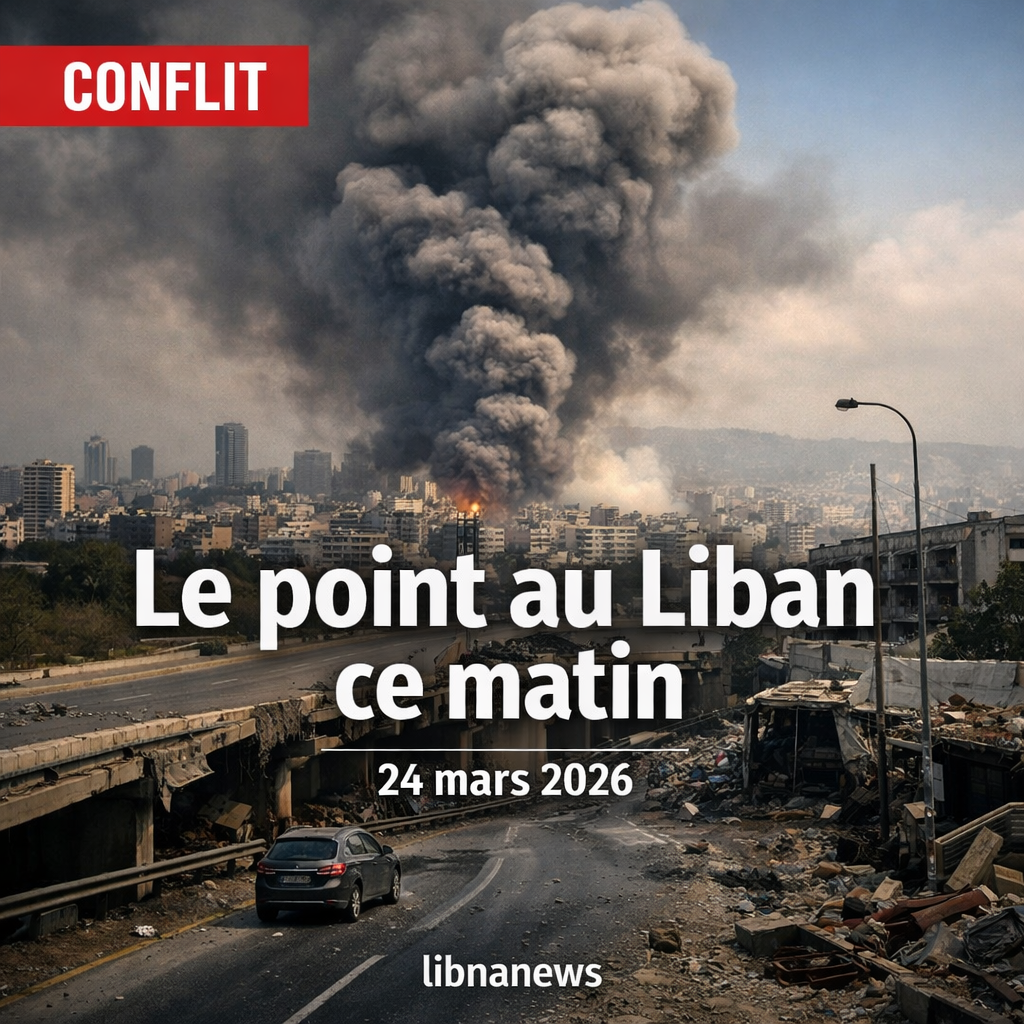
The point in Lebanon this morning is first read in a series of raw facts. A strike targetedBchamounat dawn, after that ofHazmiehthe day before. The southern suburbs of Beirut were again bombed during the night. To the south,Rashidiehwas affected, while the bridges ofLitaniremain at the heart of the Israeli campaign. Politically,Bezalel Smotrichcalled for the annexation of southern Lebanon to the Litani. And on the human level, the official record continues to rise:1,039 deathsand2,876 injuredsince 2 March, with10 deathsand90 injuredon 23 March. It is from this core that we must read in the morning: the strikes are approaching and dispersing around Beirut, the South remains the epicenter of the war, the vital roads are targeted, and the Israeli political discourse is further hardening the sense of offensive.
The most striking development this morning remainsBchamoun. The strike hit a residential apartment in this area of the Aley District, about ten kilometres south-east of Beirut. The first review shows thatat least two dead and five injured. Most importantly, the attack was reportedwithout prior public warningin an area outside the usual perimeter of evacuation notices targeting the southern suburbs. This data changes the perception of the threat around the capital. So far, some of the inhabitants continued to reason in risk circles, with a distinction, even fragile, between the Dahiyé and the peripheral sectors. Bchamoun is jamming that border. War is no longer read only through the map of already designated bastions; It extends to residential areas which, until now, seemed less directly exposed.
This strike comes after that ofHazmieh, announced the previous day with a first review ofat least one deathIn a targeted apartment. The Hazmieh-Bchamoun succession counts as much as each raid taken separately. It draws wider pressure on the east and south-east flank of Beirut, beyond the heart of the southern suburbs. For families, this poses a simple and distressing question: where to go when supposedly secondary areas cease to appear as credible refuges? In a city and a Mont-Lebanon already requested by the reception of displaced persons, this extension of the risk disorganizes the choices of withdrawal, increases the tension on the housing available and feeds a collective fatigue that is no longer due only to the violence of the images, but to the uncertainty on the very map of the danger. The last two sentences refer to a journalistic reading based on the sequence of strikes and the pressure of displacement.
The night did not spare the southern suburbs of Beirut. The strikes again targeted several urban areas, following Israeli warnings. The most important point here is not only the exact number of points covered. It’s the pattern repeat. Warning, panic movement, engulfed streets, improvised evacuation, knocks, and then new expectations under tension: this sequence settles in the daily life of a very dense periphery where civilian time is now rhythmized by military messages and explosions. When this cycle repeats itself several nights in a row, it no longer causes only a shock; It permanently alters the way the city lives. This last sentence is an inference from the documented repetition of evacuation orders and strikes.
Bchamoun and Hazmieh move the risk card
This displacement of the threat around Beirut is one of the major events of the morning. In times of war, the inhabitants quickly built a practical geography of danger: such a neighborhood becomes to flee, such a road to avoid, such a commune to favor for a temporary withdrawal. Now Bchamoun and Hazmieh blur this geography. The strike on an apartment in Bchamoun, outside the southern suburbs, after Hazmieh, broadens the feeling of exposure to more mixed residential spaces. It complicates the hierarchy of possible shelters. For the host municipalities, this also means more pressure, as households hesitate longer, move later and sometimes retreat to already saturated areas. The last sentences are a field analysis consistent with the timing of strikes and the extent of displacement observed since the beginning of the month.
This extension of risk does not replace the centrality of Dahiyé. She adds to it. The southern suburbs remain the main urban area under repeated warnings and bombardment around Beirut. But when strikes also affect Hazmieh and Bchamoun, the psychological effect changes scale. There is no longer just a question of living near a front. It is about living in a capital whose margins are also becoming vulnerable. Traffic, rushed departures, precaution purchases, temporary closures and family anxiety are already part of this new routine. Again, the last sentence proceeds from a journalistic interpretation from the sequence of strikes and evacuations.
The strikes recorded since yesterday afternoon
To stick to the immediate essential, here is the sequence of the most striking strikes and attacks recorded between yesterday afternoon and this morning:
- Hazmieh: a hit on an apartment madeat least one deathAccording to an initial official health report.
- Bchamoun: a hit on a residential apartment madeat least two dead and five injuredearly this Tuesday.
- Southern BeirutSeveral sectors were again targeted after Israeli warnings.
- Rashidieh, near Tyre : a strike hit theAmana service station, without a human balance sheet immediately consolidated in the first reports.
- Litani Bridges: theQasmiyeh Bridgewas affected andat least two other bridgeson the Litani were destroyed in the same sequence, according to publicly reported Israeli statements.
This list does not purport to exhaust all night’s incidents. It is used to reveal the logic of the moment: the strikes spread from the Beirut periphery to the southern coast, mix residential, infrastructure and economic networks, and draw a fan campaign rather than a simple front line. The last proposal is a synthesis from the above-documented strikes.
Broken bridges become a central issue
The destroyed bridges must be placed at the centre of this morning’s story. TheQasmiyeh Bridge, on the Litani, was named among the works hit. Its deactivation cuts a major link betweenTyre and Saidaand complicates civilian movements south of the river. The Israeli authorities then claimed the destruction ofat least two other bridgeson the Litani, without publicly specifying the names, and announced want to hitAll bridgeson this river. It is therefore known precisely that a key bridge, Qasmiyeh, was hit, and that at least two other Litani crossings were also destroyed along the same lines. It would be risky to cite more without public nominative confirmation. But even so, the observation is clear: the Litani bridges become a strategic target in their own right.
Why are these bridges so essential in Lebanon this morning? Because they are much more than infrastructure works. They are the concrete joints of the southern territory. When a bridge is destroyed, ambulances extend their roads, aid convoys waste time, displaced families face further detours, and entire villages become more isolated. Israel claims to want to prevent arms and combatants from being transferred to the south of the river. But the immediate effect also affects civilians, municipalities, hospitals and all those who depend on them to live or to help. The destruction of bridges thus brings war into a territorial asphyxiation phase. She doesn’t just kill; It immobilizes, cuts and disorganizes. The concrete effects described here are a direct inference based on the role of these bridges and humanitarian alerts related to the infrastructure concerned.
The Qasmiyeh bridge has become, for this reason, a broader symbol than its only road function. It summarizes how the Israeli campaign is sliding from conventional military pressure to pressure on the material conditions of life. When a vital axis is targeted, it is not only a passing point that disappears. It is an entire chain of displacements, refuelling, medical evacuations and deregulated local services. In the case of the Litani, this scope is further reinforced by the Israeli political debate itself. These destructions occur at a time when Israeli officials speak of the river as a new security line or even a new border. Strikes on bridges can no longer be read only as tactical operations. They are also part of a battle in the sense of territory. The last sentence is a journalistic reading based on the concomitance between the Litani strikes and Israeli political statements.
Smotrich gives the offensive a greater political reach
This is where the declaration ofBezalel Smotrich. Israeli Minister of Finance called forannexation from southern Lebanon to Litani, saying that this river should become Israel’s new border. At this stage, this position does not constitute a formal State decision. But it marks a major political hardening. So far, the bombings, the destruction of houses near the border and the strike on bridges could be justified by Israel in the register of the fight against Hezbollah and the creation of a depth of security. Smotrich’s call adds another dimension: that of an assumed territorial redefinition. For Lebanon, this slide is central. It transforms the interpretation of the current sequence. War no longer appears merely as an attempt to neutralize the military, but also as the possibility of a fait accompli on the map.
This tightening of the discourse is all the more important as military activity on the ground seems to give it a concrete background. On one side, the Litani bridges are targeted. On the other hand, house demolitions in border villages are accelerated. At the same time, a key minister of the Israeli government explicitly speaks of annexation to the Litani. We must not go beyond what the facts confirm. But their concomitance is enough to feed Lebanon a very serious concern: that of a war that would seek not only to repel Hezbollah, but to change the reality of the South in a lasting way. In this morning’s climate, this assumption weighs as much as the figures, as it gives the ongoing destruction a political depth that simple military communiqués no longer summarize. The last sentence is an inference based on the simultaneity of the documented facts.
The South remains the epicenter despite the extension to Beirut
In the south of the country, war remains its centre of gravity. At dawn a strike hit the gas station of Amana atRashidieh, near Tyre. No definitive human assessment was yet consolidated in the initial reports. But the event is part of a logic already documented for several days: the Israeli campaign targets not only alleged fighters or deposits, but also civilian, economic or logistical networks presented as linked to Hezbollah. This is because it mechanically expands visible damage to the population. When a gas station, health centre, financial institution or road is hit, the effect exceeds the target claimed. These are civilian uses that are disorganized, sometimes far from the immediate front line.
The South, despite the extension to Beirut, also remains the area where pressure on border villages remains the strongest. The destruction of houses, repeated strikes and Israeli military orders reported in recent days reinforce the idea that a rapid return of the inhabitants becomes more uncertain every day. In some areas, the question is no longer when families will return, but in what condition they will eventually find roads, houses, clinics and essential networks. A war can move people through fear. It prevents them from returning when it destroys the minimum material conditions of a local life. The last sentence is a logical deduction from documented destruction in the South.
Human performance continues to structure in the morning
The official human assessment gives the magnitude of this sequence. The daily report for 23 March states that1,039 deathsand2,876 injuredsince March 2. For the only last day listed,10 deathsand90 injuredhave been registered. To this is added another figure, more discreet but crucial:133,678 displaced personsOfficially recorded in the last risk management unit statement. The broader humanitarian estimates speak ofmore than 1.2 million people who left their homesSince the climb. Both counts do not measure exactly the same thing, but they say the same reality: the country has moved on a very large scale. Families are located in collective centres, in relatives’ homes, in makeshift rentals or in shared housing. War therefore not only devastates places; It redistributes entire populations.
Finally, we must go back to what the figures say without letting them crush the real. The1,039 deathsand2,876 injuredare not only a cumulative balance sheet. They refer to hospitals under pressure, relief services slowed down by the cut-off roads, families that switch in seconds, municipalities that manage the emergency with limited means and a society that absorbs a new shock after years of economic and institutional collapse. The current war does not strike a stable country. It strikes an already exhausted country. That’s what makes every hit on an apartment, gas station or bridge even heavier. Each time, the human cost adds to a pre-existing fragility that reduces the resilience of the entire civil system. The analytical phrases of this paragraph are a synthesis based on official balance sheets, infrastructure destruction and the extent of displacement.
The point in Lebanon this morning, without detour
The point in Lebanon this morning can therefore be summed up in a straightforward way, but without oversimplification.Bchamounis the newest signal around Beirut.Hazmiehconfirms that this strike does not happen alone. TheDahiyéremains bombed night after night.Rashidiehshows that the South continues to be affected through its service networks. The bridges of theLitani, starting withQasmiyeh, are now at the centre of a strategy that also targets civil traffic.Smotrich, by calling to annex southern Lebanon to the Litani, gives this military sequence an even greater political significance. And the official balance sheet, with1,039 deathsand2,876 injured, recalls that every additional hour of this campaign aggravates an already national crisis, in a country where massive displacements, roads cut off and uncertainty on the danger map re-design the morning much more than the declarations of facade.



