

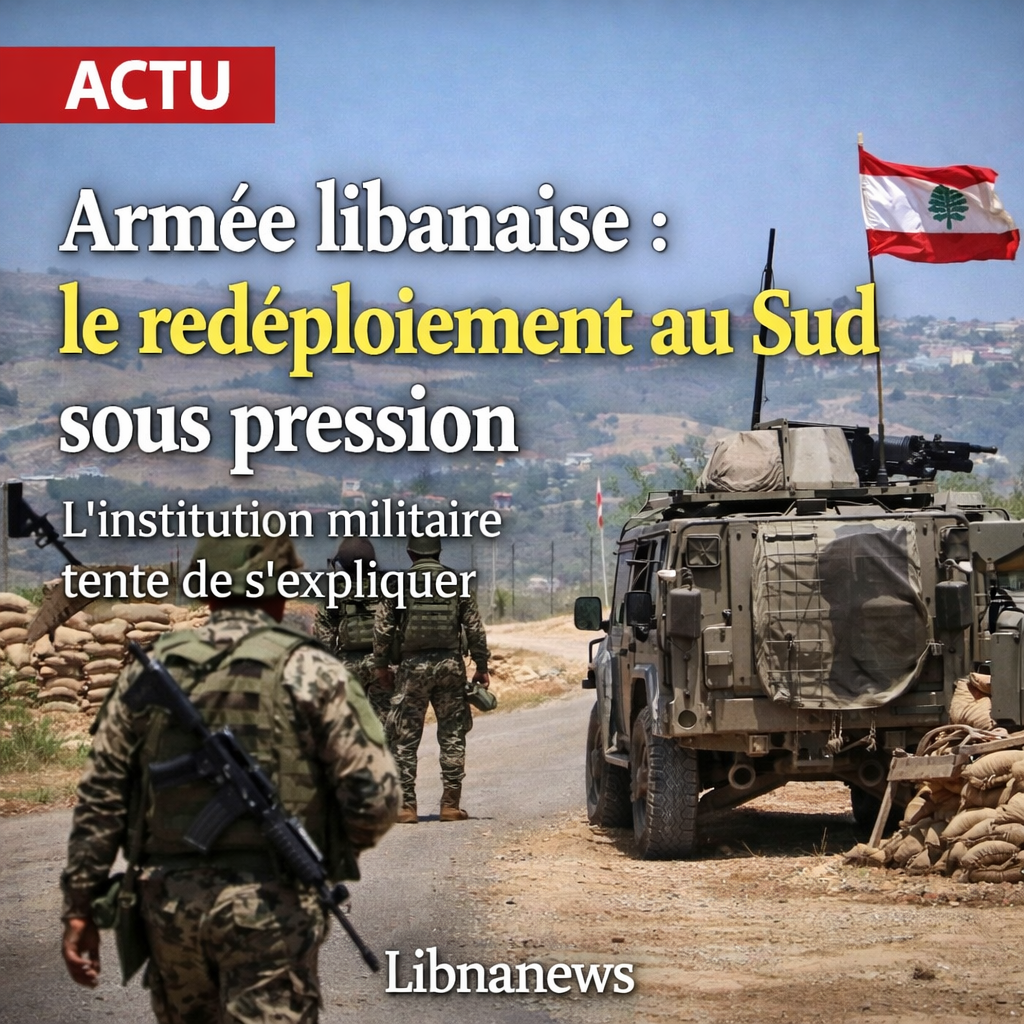
The Lebanese Army announced on Wednesday morning an operation to redeploy and reorganize several of its units in the southern border localities, explaining that this decision was in response to the intensification of the Israeli offensive, the encircling of certain positions, the isolation of soldiers deployed on the ground and the closure of their supply lines. In its communiqué, the command presented this movement as an adaptation imposed by the deterioration of the military situation, while affirming that it maintained a limited presence with the inhabitants in certain localities.
Presented from a strictly operational perspective, however, this text cannot be read in isolation. Over the past several hours, there have been reports of an actual withdrawal of the army from several villages in the South, includingRmeish, locality became the most sensitive symbol of this sequence. In border villages, the question is no longer just whether the army has « redeployment » or « retired ». It is to understand what is meant, politically and symbolically, by the visible reduction of the state’s presence in sectors at a time when Israel has increasingly explicit territorial ambitions over southern Lebanon.
Rmeish, the missing fact that had to be named
The point to be added to the previous text is central:Army left Rmeish, like other border localities exposed to Israeli advance. This fact gives a much more concrete meaning to the communiqué of the command. Without Rmeish, the redeployment formula remains abstract. With Rmeish, it takes on a much heavier dimension. We are no longer talking about a simple adjustment of positions on a military map, but about a decline in the regular state presence in a highly sensitive border city.
Rmeish occupies a special place in the balance of the South. A Christian city close to the border, it carries a strong political, community and territorial burden. The departure of the army is never seen as a purely technical gesture. It is read as a signal. For part of the opinion, it means that the State’s ability to physically hold the ground in certain areas weakens. For others, it feeds the idea that the army only follows a balance of power that has become impossible to contain. In any case, Rmeish transforms the reading of the communiqué: the institution no longer clarifies only a tactical movement, it also tries to justify a reality already visible on the ground.
The command insists that it continues to stand alongside the inhabitants « as far as possible », maintaining military groups in certain localities. But this politically important precision also confirms in hollow that the presence is no longer the one before. It suggests a logic of minimal presence, of preserved link, of state signal maintained as much as possible, rather than full control of the terrain. In the current context, this nuance is essential, as it feeds both the institutional defence of the army and the concern of a part of the population of the South.
Rumours of coordination via Washington
The other element that needed to be included concernsrumours of coordination of withdrawals with Israel via Washington. We must be rigorous here. At this stage, it is a matter ofrumoursand not publicly confirmed facts. There is no official statement by the Lebanese command, nor any verified American or Israeli announcement, that such a mechanism has been openly recognized. On the other hand, these rumours circulate strongly, precisely because the withdrawals observed on the ground coincide with a phase in which mediation and external pressure are pervasive in the Lebanese case.
The very fact that this hypothesis is spreading speaks volumes about the current climate. When the army withdraws from sensitive areas like Rmeish, while the adversary announces that it wants to control the South sustainably, some of the opinion immediately suspects the existence of indirect arrangements. This mechanism is classic in asymmetric wars: as soon as a military movement appears too clear, too fast or poorly explained, it opens a narrative vacuum filled with secret coordination, forced mediation or forced compromise stories. The military communiqué denounced the campaigns of suspicion and doubting its role, but without explicitly answering this specific question, leaving a grey area in the public debate.
Two ideas must therefore be held together. The first is that there is nothing at this stage to present this coordination via Washington as an established fact. The second is that the very existence of this rumour is of political importance, as it reveals the level of mistrust in the country and the anguish caused by the visible decline of the army in border localities. In a time when the battle of the narrative counts almost as much as the battle of the field, this rumour itself becomes a political fact, even without official confirmation.
Lebanese redeployment against an Israeli project on the Litani
The previous text should also recall a fundamental element of the context:Israel announced its intention to occupy southern Lebanon until the Litani, including after the current conflict. This declaration radically alters the reading of the redeployment of the Lebanese army. It is no longer just a tactical movement dictated by the encircling of certain units. It is part of a moment when the adversary no longer speaks of a simple one-off operation, but of a lasting presence in a large part of Lebanese territory.
According to consistent agency reports, Israeli Defense Minister Israel Katz said that Israel intended to establish a control zone south of the Litani after the ongoing war. He said that the Israeli army would control the area, including the bridges to the Litani River, and that displaced inhabitants would not be able to return south of the river until Israeli security was considered secure. He also claimed that houses in villages near the border would be destroyed. These statements give a completely different meaning to the withdrawal of the Lebanese army from sectors such as Rmeish. They raise fears that every step back from the Lebanese State will open up space for an Israeli grip that will last.
In this context, the question posed by the army communiqué changes in nature. It is no longer just a question of whether the redeployment is militarily rational. It is also a question of knowing what happens to the spaces that the army can no longer hold in the same way, when Israel assumes that it wants to transform the South beyond the logic of immediate war. The vacuum is no longer just a tactical vacuum. It risks becoming a territorial and political vacuum. It was this dimension that needed to be added for the analysis to be complete.
When some Israeli ministers talk about annexation
Finally, we had to recall a third element, which is even heavier politically:Some Israeli ministers called for annexation of southern Lebanon. Again, this is not an extrapolation but a recent public statement. On 23 March, Israeli Finance Minister Bezalel Smotrich claimed that Israel should extend its border with Lebanon to Litani. This position was one of the clearest formulations of a sustainable territorial seizure project in southern Lebanon.
This point is essential because it shifts the sense of conflict. When Israeli officials refer to the Litani as a new border, they no longer speak of a temporary security depth. They outline a political and territorial ambition. Even though not all Israeli officials use exactly the same vocabulary, the mere fact that the word annexation appears at this level of power transforms the Lebanese perception of war. The risk is no longer only that of prolonged occupation. It becomes that of an attempt to redefine the limits and status of the South.
In this perspective, the withdrawal or redeployment of the Lebanese army is far more serious. It is no longer just the security of the soldiers or the continuity of the military mission that is at stake. It is also the ability of the Lebanese State to remain physically present in a territory that some Israeli officials already speak of as a space to control, to empty part of its inhabitants or to annex. Without this reminder, the previous text was incomplete, as it separated the military communiqué from the much larger political horizon in which it now fits.
A statement that can no longer be read as a simple technical note
Once these elements are reintegrated, the military communiqué appears in another light. Of course, there is still a piece of tactical clarification. He explained that some units were surrounded, isolated and cut off from their supply lines. He insists on maintaining a limited presence with the inhabitants. He also denounces campaigns of denigration and suspicion on social networks. All this remains true in the internal logic of the text. But this is no longer enough to exhaust its meaning.
At the same time, the army left Rmeish and other border localities according to several field reports. Rumors of indirect coordination via Washington have settled in public space. Above all, Israel no longer hides its will to occupy the South until the Litani after the war, while some of its ministers go so far as to claim annexation. Taken together, these three elements change the interpretation of redeployment. They pass it from the register of tactical necessity to that of a question of sovereignty.
The army wanted to explain that it was retreating so as not to let its units be encircled and cut off their supports. This is a solid military argument. But on the political front, the question becomes more brutal: what remains of the state presence in border villages when the army withdraws, even partially, while the adversary announces that he wants to stay in the south of the Litani? That’s where Rmeish becomes more than a city. It becomes the name of a national doubt about Lebanon’s ability to defend its territorial presence in the South.






