

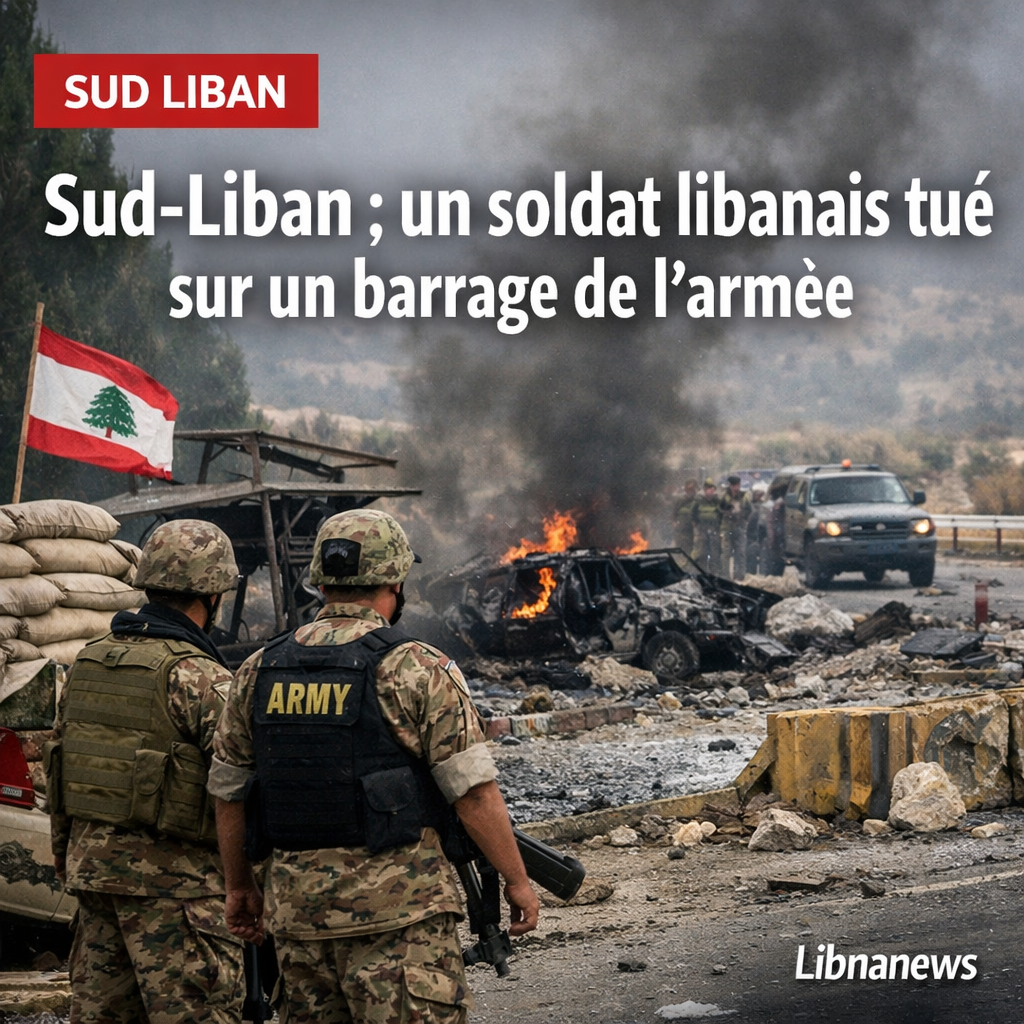
The Lebanese army announced on Monday the death of one of its soldiers in an Israeli strike that targeted a military checkpoint in the south of the country, on the coastal road at the level ofal-Amriyeh, betweenTyreandNaqoura. According to the press release issued by the National Information Agency, the attack also resulted in several injuries among the soldiers present on the scene.
The episode marks an additional threshold in the ongoing war in South Lebanon. Since the beginning of the new military sequence, Israeli strikes have affected villages, roads, bridges, ambulances, journalists and Finul positions. But the fact thatLebanese Army Damis reached in this way gives the incident a particular scope. According to consistent reports from several media on Monday, this would be thefirst strike directly targeting a Lebanese Army checkpoint since the beginning of the war.
A dam hit on the southern coastal axis
NNA dispatch puts the attack in the area of dal-Amriyehsouth of Tyre. This point is not trivial. The coastal axis between Tyre and Naqurah is one of the most sensitive corridors in southern Lebanon. It links regularly hit communities, serves areas close to the front line and remains crucial for relief movements, civilian displacement and military links. When an army dam is hit, it is not just a checkpoint that is hit. It is also a link in the presence of the State in an area where the public authority is already under very high pressure.
The military communiqué, relayed by the NNA, remains brief. He confirmed one death and several injuries, without immediately detailing the exact number of soldiers affected. Other media reportedat least four to five injured, but this point still needs to be formally consolidated. In the context of active war, this caution remains necessary. Early assessments often change over time as the injured are evacuated and the authorities summarize the losses.
A new red line in the war in Lebanon
The strike occurred as the situation in South Lebanon deteriorated further in the last 24 hours. During the night, the Finul announced that a projectile had exploded near one of its positions atAdshit al-Qusayrkilling one Blue Helmet and seriously wounding another. Jakarta then specified that the killed soldier wasIndonesiaand thatthree other membersof the contingent had also been injured. In other words, in less than a day, the violence affected both international forces and the regular Lebanese army.
This double signal weighs heavy. The Lebanese army is not supposed to be a warring party comparable to Hezbollah in this war. It represents the State institution responsible for national security, territorial control and, eventually, a return to a form of public authority in the South. When an army dam is struck, it further blurs the boundaries between theatre of combat, civil space and sovereign institutions. It also feeds a broader question: how far can war spread without questioning the already fragile framework of the Lebanese state?
Increasing pressure on official institutions
The attack of al-Amriyeh occurs in a landscape already marked by the erosion of the capacity of the state in the South. The destruction of bridges, damaged roads and repeated bombings have complicated the work of relief workers, municipalities and official units. The destruction of infrastructure around Tyre has already increased the isolation of certain sectors. The fact that a military dam on the coastal axis is now being targeted underlines how vulnerable Lebanon’s institutional presence is itself becoming on the ground.
On the symbolic level, the impact is just as strong. The army remains, in the eyes of a large part of the Lebanese, one of the few national institutions still able to embody a state continuity beyond the political divide. A loss in his ranks, on an official dam, does not therefore read as a mere military fact. It also reads as an attack on what remains of visible sovereignty south of the Litani. This dimension explains why the announcement immediately took on national political significance well beyond the mere human balance.






