

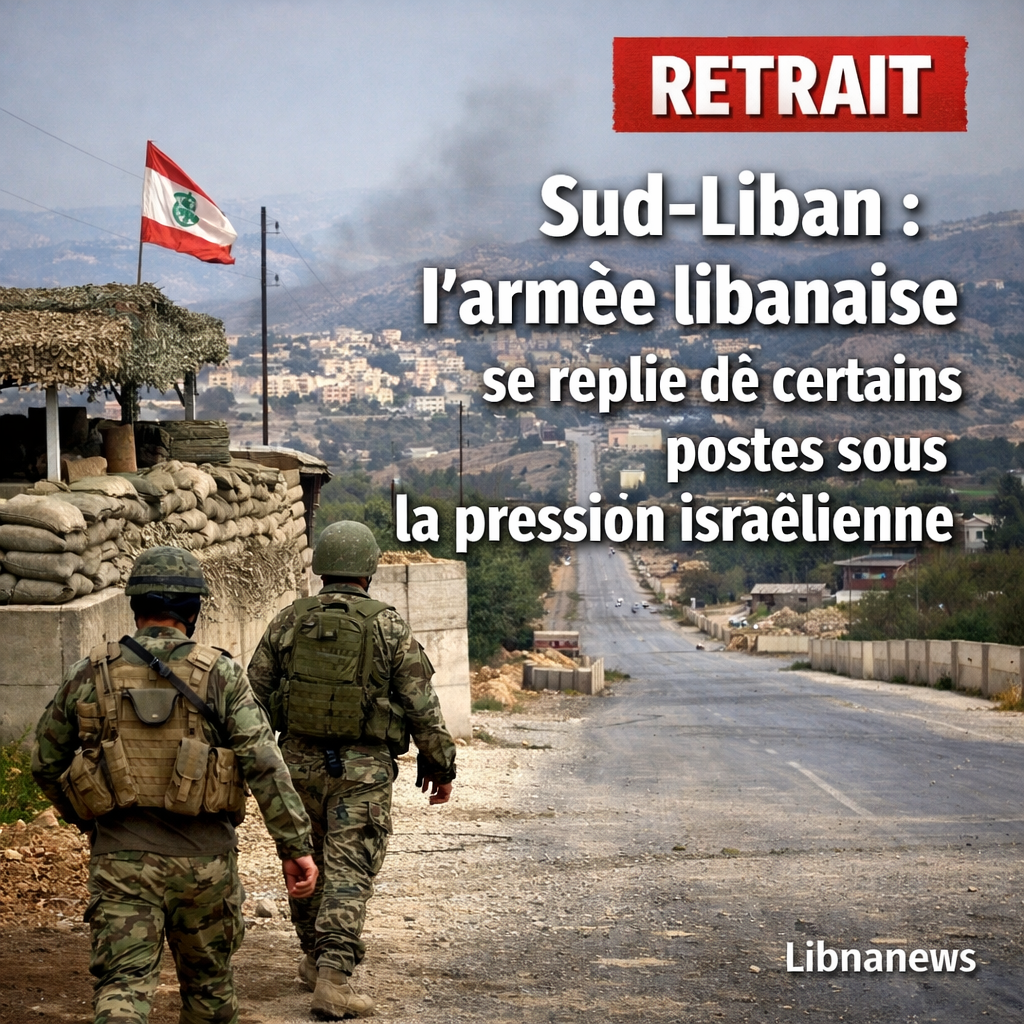
In southern Lebanon, the movement is now clear: the Lebanese army reduces or reorganizes its presence in several advanced positions, while Israel no longer hides its intention to impose long-term control over a wide range of territory to Litani. This dual movement, which is military on the ground and political in the statements, feeds the same reading in Lebanon: it is no longer just one-off operations, but an Israeli attempt to establish a fait accompli in the South.
Forward posts evacuated or redeployed
The redeployment of the Lebanese army is not new, but it has accelerated with increased incursions and strikes. As early as 3 March, Reuters reported that the army had redeployed troops from certain border positions due to Israeli advances in southern Lebanon. On the same day, LBCI reported that temporary positions along the Blue Line had been abandoned in favour of stronger bases within border villages.
This logic continued the following days. On 22 March, MTV and NNA reported that the Lebanese Army had evacuated its Qasmiyeh post following Israeli threats against the coastal axis in the area. This withdrawal was not presented as a global strategic abandonment, but as a measure imposed by the direct risk of strike. However, it illustrates a heavy reality: in several areas, the Lebanese army no longer operates under normal conditions of deployment, but under Israel’s immediate threat.
Rmeish, symbol of increasing pressure on border villages
Rmeish occupies a particular place in this sequence. LBCI reported on 10 March that the local mayor had received Israeli calls demanding the departure of internally displaced persons from neighbouring villages, otherwise the entire city would be threatened with evacuation. Although the open sources consulted do not document, on their own, an official news release detailing a military withdrawal by post in Rmeish, they show that this area is one of the areas under direct and repeated pressure.
This is politically important. Rmeish, a Christian village in the South, has often been described as a fragile civilian space, caught between proximity to the border, displacement of population and Israeli injunctions. When communities such as Rmeish are subjected to intimidation calls, evacuation threats or an untenable military environment, the message goes beyond the tactical dimension. It affects the very capacity of the Lebanese State to maintain a regular presence as close to the border as possible.
Israel now assumes a territorial project
Perhaps the most serious novelty comes from Tel Aviv. On 24 March, and again on 31 March, Reuters reported statements by Israel’s Defense Minister, Israel Katz, stating that Israel intended to control the entire area south of the Litani as a « security zone ». On 31 March, he said that the Israeli army would maintain that control, prevent the return of more than 600,000 Lebanese people south of the river, and that all houses in villages close to the border would be destroyed according to a model inspired by Rafah and Beit Hanoun in Gaza.
This is no longer a military ambiguity. They describe an assumed territorial objective. The Israeli minister is not just talking about neutralizing an immediate threat. It refers to sustainable control of space, the systematic destruction of border villages and the prevention of the return of displaced inhabitants. For Beirut, such a doctrine corresponds to an attempt to forcefully reshape southern Lebanon, and thus to a de facto occupation logic.
The retreat of the Lebanese army does not mean the disappearance of the State
However, we must distinguish between withdrawal, redeployment and collapse. The evidence shows that the Lebanese army is repositioning itself from positions that are too exposed to bases that are considered more tenable, rather than a total withdrawal from the South. LBCI referred to a movement from points recently established on the Blue Line to more stable military installations within frontline villages. Reuters also spoke of a redeployment against Israeli incursions, not of a complete disappearance of the Lebanese apparatus.
But this redeployment remains a political concern. For on the ground, the result is visible: as Israel bombed, threatened and advanced, the Lebanese army lost latitude to hold certain positions exposed. At the same time, however, Israel asserts its desire to move to the Litani. Even if the words used differ from one camp to another, asymmetry is brutal: on one side, a national army forced to adjust its positions to avoid strikes; on the other, a military power which announces that it wants to control almost a tenth of Lebanese territory.
Pressure beyond the military front
This dynamic is not just about soldiers. Reuters reported on 13 March that approximately 14 per cent of Lebanese territory was then affected by Israeli evacuation orders, while UNIFIL reported Israeli ground incursions and the installation of dams. According to the same dispatch, more than 800,000 people had already been displaced by that date. Since then, the situation has worsened with new warnings, new strikes and intensified fighting.
In other words, the retreat or reorganization of certain military positions is part of a broader environment of widespread pressure on southern Lebanon. The villages are emptying, the roads are becoming targets or threatened axes, the bridges are destroyed, and the inhabitants understand that the battle no longer only opposes Israel to Hezbollah: it actually redraws the human and military map of the South.
The risk of a fait accompli south of Litani
This is where the central issue lies. When Israel announces that it wants to control the territory to Litani, destroy the border houses and prevent the return of civilians, it does not mention a flash operation. He speaks of a new order imposed by force. And when, at the same time, the Lebanese army evacuates or redeploys certain positions that are too exposed, particularly in sensitive areas of the South, many in Lebanon see the risk of a relative vacuum that the Israeli army is trying to exploit.
In this context, Rmeish, Qasmiyeh and other southern points are no longer mere names on a military map. They become the markers of a wider shift: that of a Lebanese territory under pressure, where the state tries to preserve what it can still hold, while Israel is increasingly openly displaying its ambition to reshape the border with weapons.






