

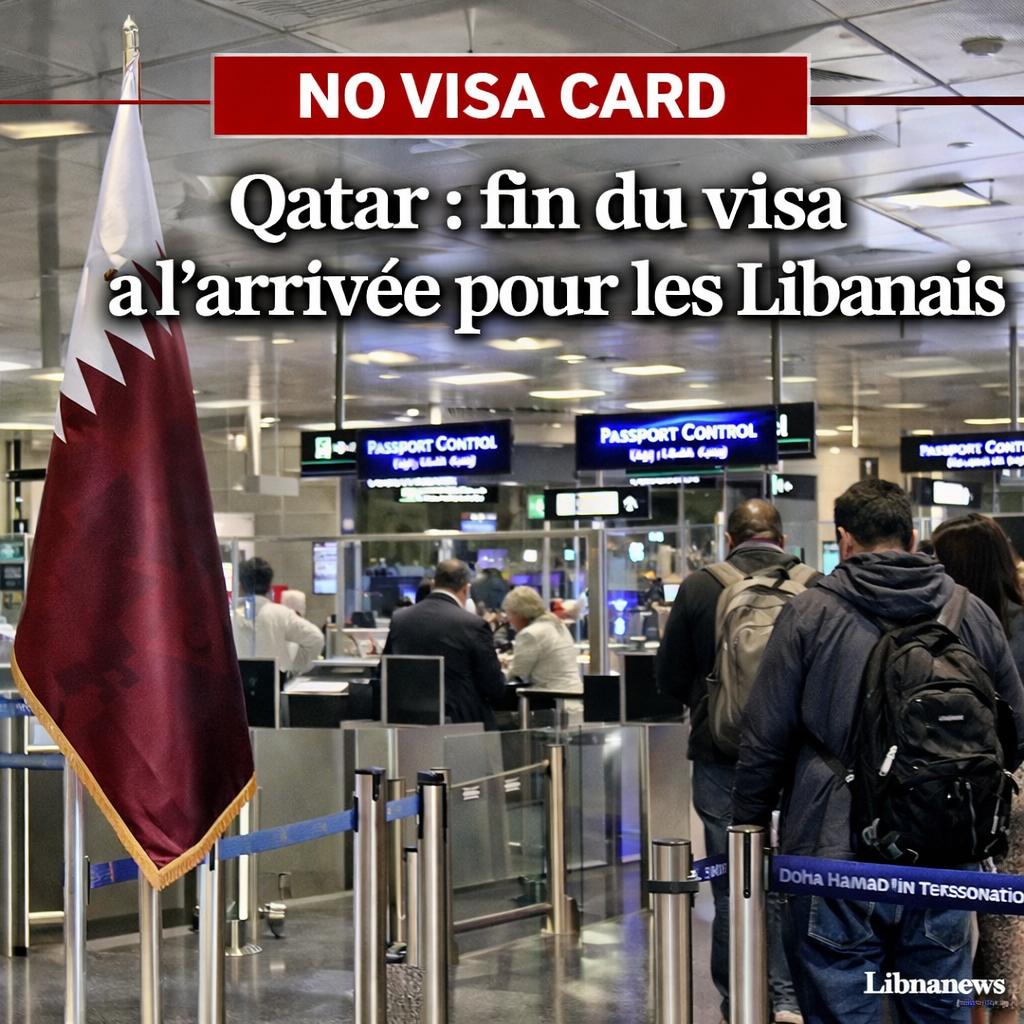
Qatar had suspended the visa system on arrival for Lebanese nationals, a decision that now required any Lebanese traveller to obtain a valid visa prior to departure for Doha. The change, relayed on Wednesday by several Lebanese media, marks a sharp inflection in the conditions of entry previously applied to Lebanese at Hamad airport. No official explanation was made public at this stage on the reasons for this measure. In practice, the passengers concerned are now invited to go through the official Hayya platform, used by Qatar for visa applications, instead of relying on regularization upon arrival.
This decision is taking place in an extremely tense regional context, where the Gulf countries have tightened their security reading of the crisis caused by the war between the United States, Israel and Iran. It also occurs a few hours after a visit by the Qatari ambassador to Lebanon, Saud bin Abdulrahman Al Thani, to President Joseph Aoun. At the end of the meeting, the Lebanese Presidency stated that the Head of State had reaffirmed his condemnation of the attacks against Qatar and his solidarity with the emirate and with all the Gulf countries. Telescoping between these two events does not in itself make it possible to establish a causal link. But it is enough to set up a heavy political climate around a consular measure that directly affects the Lebanese’ movements to one of the few Gulf countries still relatively accessible to them in recent years.
The most important fact, for the moment, is therefore simple: the arrival visa is no longer available for Lebanese, without a detailed public justification being provided. In a Middle East where war quickly recomposes circulation policies, this lack of official explanation immediately feeds speculation. The Qatari decision does not fall into a regional vacuum. It is part of a sequence in which several Gulf States have increased alerts about threats related to Iran and Hezbollah-related networks, against the backdrop of Iranian strikes against Gulf territories and the general rise of security tension.
A consular measure that changes the situation
In practical terms, the suspension of the visa upon arrival immediately changes the course of Lebanese travellers. So far, entry into Qatar could be done with a simplified procedure at the airport for certain profiles. A permit issued by the Qatari authorities must now be available upstream. The Hayya platform, already at the heart of the e-visa Qatari ecosystem, is now presented as the reference channel for tourist visa applications. The Qatari official services and the tourism and visa portals confirm that Hayya serves as a digital platform for entry applications, especially for the tourist visa, with a cost usually displayed around 100 Qatari riyals, or approximately $27.
This change is not only administrative. For many Lebanese, the arrival visa was a valuable flexibility in an increasingly closed regional environment. The transition to prior authorisation means more anticipation, more time, more uncertainty about the outcome of the application, and an additional obstacle for those travelling for family, professional or medical reasons. In a country such as Lebanon, where a significant part of the economic and human ties are played with the Gulf monarchies, every change in the regime of entry is seen far beyond its technical dimension. It affects mobility, employment, family networks and Lebanon’s relationship to its Arab environment.
The lack of official justification further reinforces the policy scope of the measure. When a State announces a hardening without accompanying a public argument, the decision is often interpreted in the light of the immediate regional context. Here, this context is dominated by the war with Iran, by the security concerns of the Gulf States and by their demonstrated willingness to tighten the surveillance of networks linked to Tehran or Hezbollah. In this context, even a consular decision can be read as a political signal, even though Doha has not, for the time being, publicly formulated this reading.
A delicate timing after the ambassador’s visit to Baabda
The announcement schedule adds to its sensitivity. On Wednesday, the Qatari Ambassador to Lebanon was received by President Joseph Aoun. According to the National Information Agency, the Head of State took advantage of this meeting to condemn the attacks against Qatar and to reaffirm Lebanon’s solidarity with Doha and all the Gulf States. This formulation is politically significant. It shows that the Lebanese Presidency is seeking a clear line of support for the Gulf monarchies as they feel directly threatened by the regional spillovers of the war with Iran.
This reminder of solidarity is not annoyed in the current Lebanese context. Beirut has been trying for several months to restore its relations with the Gulf capitals after a long period of mistrust linked to Hezbollah’s influence and Iran’s place in the Lebanese political landscape. The Aoun Presidency seeks to project the image of an institutional Lebanon, committed to its Arab partnerships and decided to reaffirm its sovereignty. In this perspective, the meeting with the Ambassador of Qatar had a strong diplomatic value. The fact that the suspension of the visa on arrival takes place a few hours later is sufficient to increase its resonance, even in the absence of an official explanation on the Qatari side.
However, we must remain rigorous. There is no evidence that the diplomatic visit and consular decision are directly related. The most accurate is that the Qatari measure was announced at a time when Beirut had just reaffirmed its solidarity with Doha. This parallelism creates a political effect, but not evidence on the motivations of the emirate. In a factual article, this distinction counts. It avoids turning a chronological coincidence into unestablished causality.
The Gulf context weighs heavily on the decision
To understand the scope of this hardening, it must be placed in the regional sequence of the last two weeks. Several Gulf states have publicly announced the dismantling of cells or networks they say are linked to Iran, the Islamic Revolutionary Guard Corps or Hezbollah. In the United Arab Emirates, the authorities reported that they had dismantled a « terrorist network », which they said were financed and led by Hezbollah and Iran, which they believed were involved in money laundering, terrorist financing and threats to national security.
At the same time, a joint statement issued by the Emirates showed that Qatar, Kuwait, Bahrain, Saudi Arabia and Jordan had aligned themselves to condemn direct or proxy Iranian attacks against States in the region. This common position illuminates the strategic atmosphere of the moment: the Gulf countries no longer read the war as a distant confrontation between Washington, Israel and Tehran. They see it as a direct threat to their own security, infrastructure and internal stability.
Press analyses also reported that Kuwait, Bahrain, the United Arab Emirates and Qatar had, to varying degrees, announced or reported actions against cells linked to Iran or Hezbollah. Even when they are not all documented with the same level of official detail, these announcements draw a climate of regional hardening. The general message is clear: the Gulf monarchies fear not only missiles and drones, but also the activation of dormant networks on their own territory. In this environment, visa, transit and entry policies are naturally becoming more restrictive.
Lebanon still pays the weight of its security image
For Lebanese, the difficulty lies in the fact that any regional precautionary measure ends up being read also through the question of the country’s image. Official Lebanon can show solidarity with Qatar and the Gulf countries, but it remains, in many Arab capitals, associated with the political and military presence of Hezbollah and, beyond that, with the influence of Iran. It is this gap that makes every Gulf decision particularly sensitive. It does not only affect travellers. It also refers to Lebanon as a space of risk, porosity or strategic ambiguity.
The suspension of the visa upon arrival is not a total closure of the Qatari borders to the Lebanese. It is neither a general prohibition nor a diplomatic break. But it is a signal of procedural mistrust. It means that Doha wants to regain more upstream control over the entry of Lebanese nationals, rather than leaving a margin of appreciation upon arrival. This difference is important. A State that maintains access but hardens the procedure often sends the following message: the relationship is not broken, but the level of vigilance has changed.
That is precisely what makes the measure politically cumbersome. It does not close the door, but it makes it narrower. In the Lebanese context, this is enough to produce a cooling effect. Moreover, Qatar was one of the Gulf States perceived to be relatively open to the Lebanese, based on investment, diplomatic mediation and Qatari economic presence in Lebanon. Any restrictions coming from Doha therefore take on a particular resonance, as they affect a partner who often appeared more flexible than others in the region.
A decision that also says something about regional war
In essence, the Qatari measure tells less of a classical bilateral problem than a change of atmosphere at the regional level. Since the outbreak of the war between the United States, Israel and Iran, the lines have moved throughout the Gulf. Security concerns have shifted to the very interior of states: infrastructure, financial networks, clandestine cells, populations to be monitored more closely, and enhanced control of entry flows. In this context, migration and consular policies become instruments of crisis management in the same way as diplomatic declarations or defence measures.
Qatar did not give any public motive. It’s a fact. But official silence does not mean no context. Everything in the current strategic environment is driving Gulf states to reduce grey areas, filter more and minimize perceived risks. The arrival visa, by definition, leaves more flexibility and less prior control than an authorisation obtained before the trip. Its suspension for Lebanese is therefore logically part of a phase where upstream control becomes the norm again.
For Beirut, the challenge is twofold. The first is to protect the immediate interests of Lebanese travellers to Doha. The aim is then, more broadly, to convince the Gulf States that official Lebanon is clearly in a register of solidarity, stability and security cooperation, not in a sense of ambivalence. The meeting between Joseph Aoun and the Qatari ambassador was already in line. However, the Doha decision shows that, in the current sequence, Lebanese political actions are not yet sufficient to address regional concerns.






