

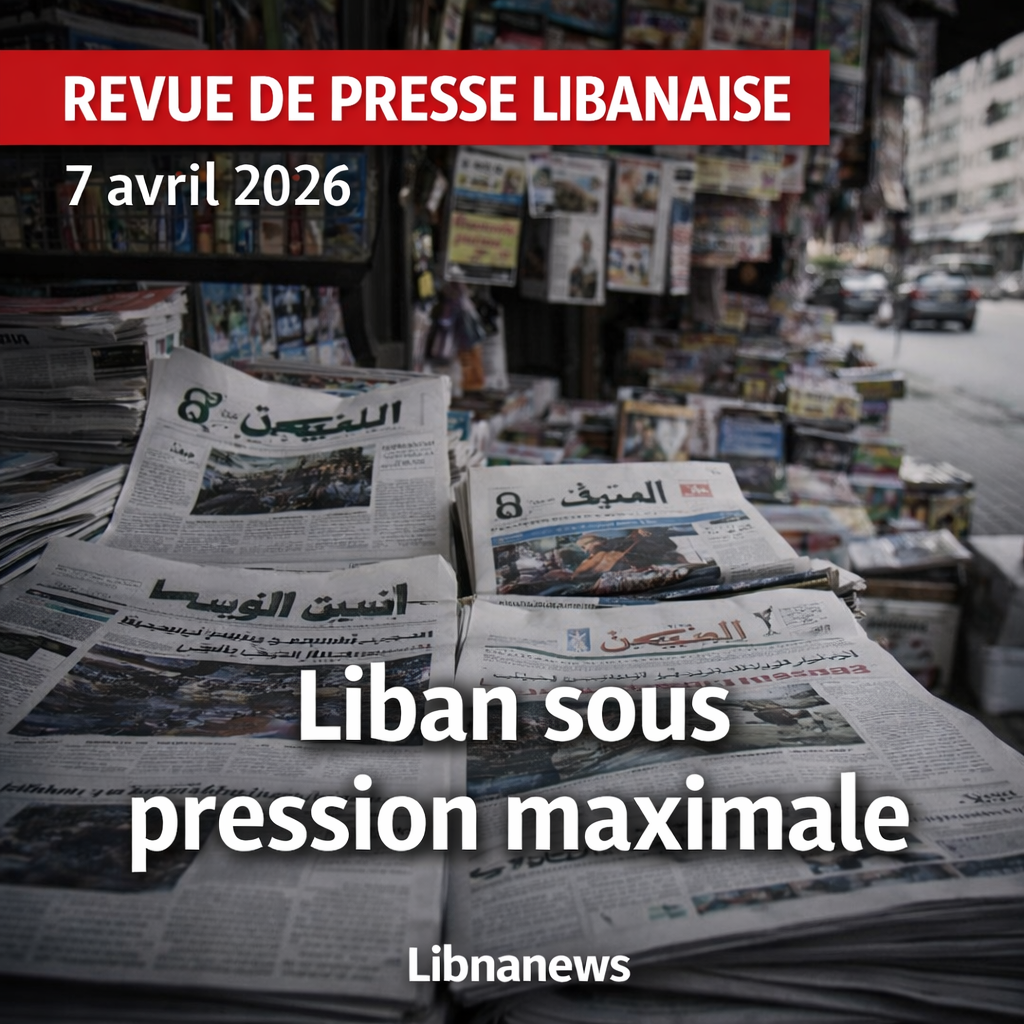
A war spilling over from the South and re-drawing the map of pressure on Lebanon
Al Quds Al Arabi, Al Araby Al Jadid and Asharq Al Awsat converge in their 7 April 2026 editions. Lebanon is no longer merely an annex front. It becomes a central space in the regional extension of the war. Al Quds Al Arabi describes a day marked by Israeli strikes on the south, the southern suburbs of Beirut and the Bekaa, with a new evacuation warning to inhabitants of the suburbs before a raid presented by the Israeli army as targeting Hezbollah-related positions. The same newspaper also reports a deadly strike in Jnah, south of Beirut, as well as attacks in Kfarraman and the Nabatiyah area. For its part, Al Araby Al Jadid insists on the continuity of the bombings against civilian areas, relief workers, the media, infrastructure and public facilities. The newspaper also points out that the Israeli army has strengthened its system, with an additional committed division, while avoiding for the moment, according to its sources, a deeper advance beyond a line of about ten kilometres from the border. This idea is echoed by Asharq Al Awsat, who cites Israeli leaks according to which the device deployed in South Lebanon is fixed for the hour around villages at a depth of about ten kilometres, without any decision to go further north. At the same time, the attempt to enter Bint Jbeil, reported by Al Araby Al Jadid in its 7 April 2026 edition, shows that this limit does not mean de-escalation, but rather calculated management of military pressure.
This pressure is also being exerted by the multiplication of political strikes. Al Quds Al Arabi, in its 7 April 2026 edition, reports that after the strike of Ain Saadé, east of Beirut, the Israeli army allegedly missed its main target, presented by the Israeli military radio as a member of the Palestinian corps of the Iranian Al-Quds force. But the failure of the operation did not prevent a heavy human balance. The daily refers to the death of Pierre Moawad, local leader of the Lebanese Forces in Yahchush, his wife and another woman. Al Araby Al Jadid confirms this assessment in its 7 April 2026 edition and presents the episode as one of the clearest signs of a war that now reaches residential areas far from the classic front line. At the same time, Al-Quds Al-Arabi reported on operations claimed by Hizbullah against Merkava tanks, concentrations of soldiers and localities in northern Israel, with fire reaching the Hadera area, approximately 75 kilometres from the Lebanese border. This dynamic of action and response feeds a double movement. On one side, Israel seeks to show that it can strike everywhere. On the other hand, Hezbollah seeks to demonstrate that it retains a large nuisance capacity. Asharq Al Awsat adds that the Israeli statements on the need to remove the threat to northerners and the objective of disarmament south of the Litani state this campaign in a long-term logic. On 7 April 2026, the three newspapers described less a one-off sequence than an attempt at a lasting overhaul of the balance of power on Lebanese territory.
The Masnaa Pass, a new diplomatic red line and sovereignty test
The most revealing record of this sequence is probably that of Masnaa’s passage. In its 7 April 2026 edition, Al Quds Al Arabi explains that after the Israeli threat of hitting this border post with Syria, under the pretext of military use and arms transfers, General Security Director Hassan Choucair went there with officers. The newspaper states that an international guarantee to freeze the strike was expected in the following hours, following Egypt’s diplomatic efforts with the United States and Israel. The same article states that Syria was also conducting its own efforts to preserve the functioning of the passage. Al Quds Al Arabi adds that President Joseph Aoun and Prime Minister Nawaf Salam have asked US Ambassador Michel Issa to intervene in Washington to have the Israeli warning withdrawn, contesting the argument of an arms trafficking through this crossing point. Al Araby Al Jadid confirmed in its 7 April 2026 edition that Lebanese contacts had so far prevented the strike, while stressing that there was no firm guarantee against Israel. The newspaper also states that the exceptional security measures remain in place around the passage and that Israeli accusations are deemed false by the Lebanese sources cited. In all three newspapers, Masnaa appears less like a simple road than a strategic nerve. Touching it would hit the movement of people, goods, relief and territorial continuity of Lebanon with its immediate terrestrial environment.
Asharq Al Awsat goes further in its 7 April 2026 edition. The newspaper claims that Washington stopped the project of bombing the passage and thus prevented an Israeli attempt to drag Syria into a direct confrontation linked to Hezbollah. According to sources quoted by the daily newspaper, the United States reportedly asked Benyamin Netanyahu to suspend the attack for political reasons, in order to avoid further expansion of the war. This reading gives the Masnaa dossier an immediate regional dimension. It is no longer just about protecting a border. It is a question of blocking a mechanism of widening the conflict. Al Araby Al Jadid, in the same edition of 7 April 2026, quotes security researcher Naji Malaeb, who sees the threat to Masnaa and the strikes against bridges as a strategy to cut the country’s joints, to control the conditions for a possible return of the displaced and to impose pressure not only on Hezbollah but on Lebanon as a whole. This analysis echoes the concerns expressed in Al Quds Al Arabi, where Nawaf Salam reiterates to Pedro Sanchez that any Israeli attempt to impose a buffer zone or seat belt in Lebanon is totally rejected. The newspaper states that the head of the Spanish government, in his exchange with Nawaf Salam on 7 April 2026, reiterated his support for the territorial integrity of Lebanon, the Lebanese government’s decisions, including the ban on Hezbollah’s military activity, and announced an additional €9 million in humanitarian aid. So the Masnaa file crystallises several questions into one. It concentrates the issue of sovereignty, diplomatic battle, fear of economic encirclement and the risk of an even wider regionalisation of the conflict.
The human cost, internal tension and wear and tear of the real country
The human report published on 7 April 2026 by Al Quds Al Arabi shows the extent of this wear and tear. Based on the report of the Emergency Operations Centre of the Lebanese Ministry of Health, 1,497 people were killed and 4,639 injured between 2 March and 6 April 2026. In the last 24 hours alone, he reported 36 deaths and 209 injuries. The newspaper added that 130 children were among the dead and 457 among the injured. It also highlights the direct attack on the medical sector, with 57 deaths and 154 injuries in the health professions, 92 attacks on relief associations and 6 hospitals forced to close as a result of strikes or threats. Al Araby Al Jadid confirms the continuation of the attacks against rescue workers in the South in its 7 April 2026 edition. The newspaper cites the death of two paramedics in Hariss and insists on extending the strikes to a large rosary of localities, from Kfara to Chiyah, from Burj Al Barajneh to Bir Al Abed. The recurrence of these attacks not only causes losses. It disorganizes the very chains of survival. Help is more difficult to move. Hospitals are closing. The inhabitants receive successive evacuation orders. Roads become areas of uncertainty. Human costs are not simply an accounting balance sheet. It changes the daily architecture of the country and weighs on all remaining institutions.
This pressure also nourishes a visible internal discomfort in several passages of Al Quds Al Arabi. In its 7 April 2026 edition, the newspaper describes the anger that followed the strike of Ain Saadé and the questions posed about the presence of Iran-related targets in residential areas. He cites local officials and figures who denounce the danger imposed on the inhabitants of so-called reception areas. The same newspaper also reports calls broadcast after the strike to chase displaced people from certain neighbourhoods, indicating a possible shift towards an internal fracture. On the other hand, Al Araby Al Jadid, in its 7 April 2026 edition, presents an opposite image from Deir Al Ahmar. The newspaper reports that, at a time when the discourse against the displaced is rising in several regions, this locality of the Bekaa is home to more than 10,000 displaced persons, divided between houses and shelters. The president of the Union of Municipalities, Henry Fakhry, told the newspaper that approximately 780 internally displaced persons are in Deir Al Ahmar’s public high school, that another 1,700 to 1,800 are in other centres, and that more than 7,700 live in the home, without tangible state support. This coexistence of two scenes, one marked by suspicion and the other by reception, says a lot of Lebanon on 7 April 2026. The country is not only struck. He is tested in his social contract. This tension is also political. Al Quds Al Arabi narrated the words of the Maronite Patriarch Bechara Rai, who on 7 April 2026 claimed that Lebanon was not meant for death but for life, and that it could only rise up by a form of active neutrality. The same newspaper notes that Joseph Aoun also used the Paschal framework to address Israeli aggression, the issue of Hezbollah disarmament and the prospect of negotiations. In the climate described by the three newspapers, the debate on war is no longer confined to the front. It crosses churches, reception areas, security institutions and coexistence choices.
War economy reaches land, roads and food security
Finally, the economic dimension confirms that the battle is not only about weapons. In its 7 April 2026 edition, Al Araby Al Jadid publishes an interview with the Minister of Agriculture Nizar Hani. The newspaper states that 22 per cent of Lebanon’s agricultural area was affected by Israeli attacks. It estimates the cumulative area damaged to 49,564 hectares, including 47,000 in the South and Nabatiyah, and 2,564 outside those areas. He also said that 76.7 per cent of farmers in the South had been displaced, that 2,503 farmers had declared that they needed financial support because of the shift and decline in production, and that the most affected crops were olive trees, citrus fruits and bananas. The same article recalls that losses in the agricultural sector have already been estimated at around $800 million and that a three-year rehabilitation plan had been prepared with the Food and Agriculture Organisation of the United Nations. To this is added logistical vulnerability. Also in Al Araby Al Jadid of 7 April 2026, Nizar Hani insists on the vital character of Masnaa for the import and export of fresh products, especially as the season of citrus fruits, avocados, grapes and honeymoon approaches. Therefore, the threat to this border crossing does not only affect traffic. It threatens food security, export earnings, rural incomes and market supply. The real country appears here in all its fragility. A closed road becomes an agricultural shock. An affected bridge becomes a commercial crisis. An evacuation becomes a break in the economic chain.
This shift from war to the material conditions of life is also seen in the articulation between the front, the roads and the reception of the displaced. Al Araby Al Jadid, in its 7 April 2026 edition, shows how Deir Al Ahmar absorbs part of the human shock without public support. Al Quds Al Arabi’s picture of the deaths, injuries, targeted paramedics and closed hospitals is also shared by the daily newspaper. Together, these elements describe a country that still holds, but by dispersed points of resistance. They also joined the reading proposed by Asharq Al Awsat on 7 April 2026, when the newspaper pointed out that the Lebanese question was no longer reduced to an exchange of fire with Israel. It affects the nature of territorial control, the refusal of a safety belt, border management, the status of Hezbollah, the role of foreign partners and the ability of institutions to remain present. The real news of one, this 7 April 2026, is therefore not only the intensity of the strikes. It is the simultaneous attempt to break a national space by military force, logistic asphyxiation, diplomatic pressure and social exhaustion. Today’s newspapers show a Lebanon caught between several lines of fracture, but still able, through its local networks, diplomatic approaches and pockets of solidarity, to refuse that war alone decides its future form.
Diplomacy: Lebanon seeks support to block escalation while war turns every mediation into a credibility test
Masnaa becomes the visible heart of the diplomatic battle
The most revealing diplomatic record in the newspapers of 7 April 2026 is that of Masnaa’s passage. It is no longer just a border crossing. He became a focus of the Lebanese crisis. Al Quds Al Arabi reports that, two days after the Israeli threat of striking the passage on the pretext that it would be used to transfer weapons to Hezbollah from Syria, General Security Director Hassan Choucair went to the scene with officers for an inspection tour. The daily added that an international guarantee had to be obtained in order to freeze the strike, following Egyptian diplomatic efforts with the United States and Israel. The newspaper also points out that Syria, for its part, was taking steps to preserve the functioning of the passage and to allow the continuity of traffic. In the same article, Al Quds Al Arabi notes that President Joseph Aoun and Prime Minister Nawaf Salam asked American Ambassador Michel Issa, present in Washington, to intervene against the Israeli warning, claiming that the charge of military use of the passage was unfounded. This sequence already shows several levels of diplomacy in action. There is the official Lebanese level, which tries to defend sovereignty. There is the Egyptian level, which plays an intermediate role. And there is the American level, perceived as the only power capable of weighing directly on Israel.
Asharq Al Awsat, in its 7 April 2026 edition, goes even further in the political interpretation of this episode. The newspaper claims that Washington stopped the Israeli bombing of Masnaa and thus prevented an attempt to drag Syria towards a more direct involvement in the war in Lebanon. According to the sources cited, the United States reportedly requested Benyamin Netanyahu to suspend the attack for political reasons, in order to avoid further expansion of the conflict. This presentation is important because it transforms the reading of the file. It’s not just about saving a road. The aim is to prevent a regional reconfiguration of the war from a Lebanese point. Al Araby Al Jadid, in his 7 April 2026 edition, joins this reading when he quotes Lebanese sources saying that the contacts carried out so far have prevented the strike, even if there is no firm guarantee against Israel. The newspaper also points out that the threat to Masnaa is part of a broader strategy of pressure on infrastructure, bridges and roads. Diplomacy thus appears to be an instrument of immediate protection, but also a response to an attempt to remodel Lebanese territory through war.
Nawaf Salam mobilizes European support without obtaining a full political umbrella
In Al Quds Al Arabi of 7 April 2026, the conversation between Nawaf Salam and Pedro Sanchez occupies a revealing place. The Lebanese Prime Minister affirms his total rejection of any Israeli attempt to impose a buffer zone or security cordon on Lebanese territory. The Spanish Head of Government responded by reiterating its support for the unity, integrity and sovereignty of Lebanon. The newspaper adds that it also supported the Lebanese government’s decisions, in particular those concerning the ban on Hezbollah’s military activity, while announcing an additional humanitarian aid of €9 million. The wording is diplomatically dense. On the one hand, Madrid is clearly on the side of Lebanese sovereignty against any redefinition imposed by Israel. On the other hand, this support is accompanied by recognition of the government’s policy on the monopoly of military action. This articulation shows that European support for Lebanon is not purely humanitarian. It is also linked to the executive’s ability to appear as a legitimate authority over non-State weapons.
This exchange also speaks of the limits of Lebanese diplomacy. Nawaf Salam gets support, clear words and financial support. But it does not get a concrete protection mechanism capable of deterring Israel alone. The newspapers of 7 April 2026 portray an active but asymmetric Lebanese diplomacy. It is increasing calls, seeking to broaden the circle of supporters, trying to include its positions in international law and in the defence of recognized borders. Yet, at the decisive moment, the central variable often remains the American pressure. This does not mean that the European channel is marginal. It serves to legitimize the Lebanese position, to politically isolate Israeli security belt projects and to reinforce the executive’s discourse. But it does not replace the Washington-Tel-Aviv axis, which remains the main location for stopping, delaying or continuing the most sensitive strikes. Lebanese diplomacy therefore operates at two speeds. It accumulates political and moral support in Europe, while knowing that the coercive effect is being played elsewhere.
Egypt, Syria and regional intermediaries return to the forefront
One of the highlights of the three newspapers is the return of regional actors to the daily management of the Lebanese file. Al Quds Al Arabi insists on Egypt’s role in the efforts to avoid the attack on Masnaa. The same newspaper also points out that Syria has undertaken its own diplomatic efforts to neutralize the threat and keep the passage open. This point deserves attention. In other regional sequences, Syria appears mainly as a space for military projection or circulation of weapons. Here it also appears to be a diplomatic actor anxious to avoid further closure between the two countries. This is not just a matter for the neighbourhood. It responds to a broader political logic. To preserve Masnaa is to preserve a vital axis for Lebanon, but also to prevent the Syrian-Lebanese border from becoming a new scene of direct confrontation.
Al Araby Al Jadid adds an important dimension to this reading. In its 7 April 2026 edition, the daily reports that the Lebanese officials regard the Israeli accusations about the military use of the passage as false and see these threats as an attempt to cut off the country’s logistical ties to its terrestrial environment. The newspaper also mentions the risk of a campaign targeting bridges and traffic infrastructure. As a result, regional mediation takes on strategic value. They are not only seeking a local truce or a punctual respite. They aim to prevent Lebanon from being progressively isolated by the destruction or paralysis of its access. With this in mind, Egypt acts as a credible mediator, Syria as a party concerned with border stability, and Arab States as a potential reservoir of political support, even when their capacity for direct action remains uneven. Diplomacy around Lebanon thus becomes a diplomacy of thresholds. Each actor tries to prevent the crossing of a new red line, without however succeeding in imposing a global de-escalation.
Diplomatic channels remain active despite the logic of total war in the region
The major problem, however, is that the Lebanese question is no longer dealt with in isolation. In the three dailies of 7 April 2026, it was encrusted in a much wider regional war between Israel, Iran, Tehran’s allies and Western powers. Al Araby Al Jadid devotes its one to the war in the region, to discussions on a Pakistani proposal for a ceasefire between Washington and Tehran, and to the continuation of clashes around the Strait of Ormuz. Al Quds Al Arabi describes the same sequence, emphasizing Iran’s rejection of a temporary ceasefire and Donald Trump’s threats against Iran. Asharq Al Awsat also presents a regional landscape dominated by the rise of strikes against Iran, the end of an American ultimatum and the proliferation of attacks by allied groups in Tehran. In this context, Lebanese diplomacy faces structural difficulties. Lebanon wants to defend its own red lines, but it is evolving in a crisis where its margins are absorbed by a much wider confrontation.
This explains the intense and fragile nature of the diplomatic efforts concerning Lebanon. They are intense because the contacts are constant, the messages are circulating, the mediations are active and foreign capitals are constantly solicited. They are fragile because they depend on an environment that largely escapes Beirut. The fate of Masnaa, for example, does not depend solely on the Lebanese conviction or their arguments. It also depends on the American interest to avoid an extension of the war to Syria. Similarly, the Lebanese rejection of a buffer zone has a concrete scope only if it finds external relays ready to oppose it. Thus, Lebanese diplomacy, in this sequence, is not a diplomacy of power. It’s a safeguard diplomacy. It seeks less to redraw regional order than to prevent the country from being crushed further by it.
Lebanon’s international credibility also depends on its internal coherence
Another element is clear from the articles of 7 April 2026. Lebanon’s external diplomacy is linked to the way its partners read its internal political coherence. When Pedro Sanchez supports, according to Al Quds Al Arabi, the Lebanese government’s decisions to ban Hezbollah’s military activity, he is not only delivering a message to Israel. It also sends a signal on the implicit conditionality of international support. The more the Lebanese government appears to carry a state line, the more diplomatic recognition and support it can obtain. Conversely, the more the image of a country with fragmented sovereignty becomes, the more likely Lebanese diplomacy is to be treated as secondary to real military power relations. This point is confirmed indirectly by the internal debates relayed in Al Quds Al Arabi and Asharq Al Awsat, around the presence of Hezbollah in civilian areas, the protection of internally displaced persons and the State monopoly on security.
Diplomacy is therefore not separated from local politics. It is the external extension. When Lebanon asks for help to prevent a border crossing, to reject a safety belt or to protect its civilians, it must also convince that there is still a unified political subject. This is the whole difficulty of the period. The government of Nawaf Salam is trying to produce this image. Joseph Aoun defends sovereignty. European relays respond positively. Arab mediations are active. However, the war continues to expose the fragility of a country where the issue of military decision-making remains disputed. Lebanese diplomacy of 7 April 2026 thus appears as a struggle on two fronts. Outside, it seeks to mobilize support against Israeli escalation and the challenge of borders. Inside, it needs a minimum of national cohesion in order not to talk in a vacuum. It is this cross between internal vulnerability and seeking external support that gives this diplomatic sequence its particular tension.
International Policy: Climbing against Iran reshapes power relations and exposes the region to a war without clear limits
Washington and Tehran move away from compromise despite mediation activism
The international scene of 7 April 2026 is dominated by a simultaneous tightening of American discourse and Iranian refusal. In Asharq Al Awsat of 7 April 2026, Donald Trump reaffirms that the reopening of the Strait of Ormuz is a major priority and hardens its ultimatum to Tehran, while the newspaper highlights the intensification of Israeli strikes against Iranian infrastructure, airports and industrial sites. The daily also states that a Pakistani proposal for an immediate ceasefire, followed by negotiations on a comprehensive agreement within 15 to 20 days, has been hit by American and Iranian reservations. Al Quds Al Arabi of 7 April 2026 describes the same sequence by insisting on Iran’s refusal to temporarily stop fighting, on the grounds that a limited truce does not guarantee a real end to the war. The newspaper also reports that Trump threatened to destroy Iran if it did not yield, while suggesting that a negotiating window still existed. Al Araby Al Jadid of 7 April 2026 also places in one the implicit Iranian and American refusal of the Pakistani plan, recalling that Tehran requires a lasting end to the war, the lifting of sanctions and a broader framework for regional security.
This dynamic shows that the central problem is no longer just the existence of mediation, but the very definition of what an acceptable agreement is. From the American perspective, as reported by Asharq Al Awsat and Al Quds Al Arabi on 7 April 2026, a truce can be used to reopen Ormuz, reduce pressure on energy markets and create a more favourable negotiating framework. From the Iranian point of view, this formula appears instead to be a risk of a strategic respite offered to the adversary, without guarantee on the cessation of the strikes, the security of Iranian territory and the lifting of the economic constraint. This divergence of logic explains the difficulty of mediators. Pakistan may submit proposals. Egyptian, Pakistani and Turkish intermediaries can circulate options. But none of these initiatives is enough to bridge the gap between a tactical approach to the ceasefire and a structural approach to the settlement. The international policy described in the three daily newspapers is therefore not that of an absence of diplomacy. It is that of active diplomacy but powerless to bring together objectives that have become almost incompatible.
Ormuz Strait becomes the strategic hub of the global crisis
The Ormuz dossier concentrates the shift between regional crisis and international shock. Asharq Al Awsat of 7 April 2026 insists that Donald Trump places the reopening of the Strait at the top of his priorities and considers the freedom of passage of oil as a central component of any future agreement. Al Quds Al Arabi, in its 7 April 2026 edition, recalls that almost 20 per cent of the world’s energy resources transit through the area and reports that Iran has linked its position on traffic in the Strait to a broader end-of-war framework. The newspaper also points out that Iran’s closure or control of the passage surprised despite the expectations of Western services, and that Arab economies would be heavily affected if the war continued or expanded. Al Araby Al Jadid of 7 April 2026 also treats the issue as a turning point in the war, showing that the battle is no longer only on military installations but on the economic arteries on which the world market depends.
This shift to Ormuz alters the international reading of the conflict. As long as the war remains confined to bilateral strikes or peripheral fronts, the external powers can try to manage escalation through selective declarations, sanctions or mediation. But when the strait is directly concerned, the business becomes global. It affects oil exports, maritime insurance, logistics costs, public finances of producer states and the stability of Asian and European partners. This is also why the President of the European Council, Antonio Costa, calls on Asharq Al Awsat of 7 April 2026 Iran to follow the diplomatic path, to guarantee freedom of navigation and to stop attacks against the states of the region. This intervention is not just a result of a security concern. It reflects a fear of systemic rupture. Ormuz is not just a passage. This is the key to transforming a regional conflict into a global energy crisis.
Israel seeks to broaden the political effect of its strikes far beyond Iran
In the newspapers of 7 April 2026, the Israeli strategy appears as a strategy of widening the political effect more than just military theatre. Asharq Al Awsat explains that Israel has intensified its attacks on airports, air infrastructure, industrial facilities and sites linked to Iranian strategic capabilities. The newspaper adds that Benyamin Netanyahu wants to continue the war, even though he would not oppose Trump’s intended arrest, indicating a link between Israeli tactical autonomy and political dependence on Washington. The same daily also notes that Israel is seeking to exclude Lebanon, Gaza and the West Bank from any possible agreement with Iran, proof that the objective is not limited to bilateral de-escalation but is aimed at reconfiguring several fronts at once. Al Araby Al Jadid, in its 7 April 2026 edition, argues that the war already goes beyond the mere framework of a classical confrontation and takes part in a deeper regional recomposition.
This Israeli line has several international effects. First, it complicates the task of mediators, because it multiplies the files instead of reducing them. Then it feeds the Iranian argument that a partial truce would only freeze an unfavourable balance of power without responding to the real war. Finally, it encourages other regional actors to reposition themselves. The case of the Houthis, mentioned by Al Quds Al Arabi of 7 April 2026, is revealing. The newspaper reports that they claimed attacks on targets in Eilat as part of an operation with the Revolutionary Guard Corps and Hezbollah, while brandishing the Bab al-Mandeb map. This means that the broader front logic is not theoretical. It results in the activation of additional maritime and military axes. International policy in this sequence, therefore, is not merely to prevent a total direct confrontation between Israel and Iran. It is to prevent a network of allied actors and strategic passages from transforming the entire region into an interlocking war zone.
Moscow, Beijing and Europe seek to contain the fire without changing the balance of power
Asharq Al Awsat of 7 April 2026 shows that Russia is closely following the deterioration of the situation. The newspaper reports that the Kremlin is concerned about regional fire and is coordinating multilateral action with China, particularly at the United Nations. The same article points out that Moscow does not, however, directly comment Trump’s ultimatum in Tehran, which reflects calculated caution. Russia wants to appear as an actor of stability and diplomatic coordination, without letting itself be trapped in a posture that would oblige it to a frontal verbal confrontation with Washington on every stage of the crisis. This restraint reveals an important feature of current international policy. The great outside powers are working to limit the fire, but they do not want to bear the political or military cost alone.
Europe acts in a comparable way, but with even more limited instruments. An example is the call by Antonio Costa, reported by Asharq Al Awsat on 7 April 2026. He called for calm, the protection of civilians, respect for international law and the guarantee of freedom of navigation. Language is clear from the normative point of view, but it is not accompanied by a proper mechanism of constraint. The European Union therefore continues to exist as an area of diplomatic speech, reminder of the law and moderate political pressure, without becoming a decisive player in stopping the fighting. This situation reinforces the central role of the United States, even when it is itself involved in the rise in tensions. The international policy of 7 April 2026 is thus marked by a paradox. All the big actors say they fear fire. But none outside Washington seems to have a strong enough leverage over the immediate course of the crisis.
The Iraqi front and the Gulf confirm the extension of the conflict in network
One of the clearest lessons of the day’s articles is that war is now working in a network. Asharq Al Awsat of 7 April 2026 reports that Iraqi factions close to Iran have expanded their attacks on American interests and that the siege of the Peshmerga command was targeted by drones. The newspaper also states that officials of the coordination framework are seeking to reduce escalation, but that the Iraqi authorities seem unable to stop the attacks. Al Quds Al Arabi also refers to the attack on the siege of the peshmergas and insists on increasing tensions in Iraqi space. At the same time, Asharq Al Awsat points out that the Gulf States continue to intercept Iranian missiles and drones, while Bahrain announces the dismantling of a cell accused of links with Iranian services and revolution guards.
These developments profoundly change the nature of the crisis. It is no longer a linear confrontation between two capitals. It is a conflict with multiple ramifications, which activates both direct fronts, allied forces, maritime spaces, logistics corridors and internal political terrain. The more this network logic is required, the more the prospects for a global agreement are removed. A ceasefire between Washington and Tehran might not be enough to automatically defuse the allies’ initiatives, local reprisals or the peripheral fronts already open. For this reason, several analytical texts, notably in Al Quds Al Arabi of 7 April 2026, insist that a large single agreement seems unrealistic in the short term. Rather, the most likely scenario would be partial, progressive arrangements accumulated over time, provided that the actors recognized the limits of their power. But this hypothesis remains fragile as long as military dynamics retain the advantage over diplomatic logic.
A regional war whose political outcome remains more blurred than the military outcome
In total, the three daily newspapers of 7 April 2026 draw an international landscape where the capacity for destruction progresses faster than the ability to order a settlement. Asharq Al Awsat shows an America that sets ultimatums but does not get Iranian membership in its framework. Al Quds Al Arabi depicts an Iran determined to reject transitional solutions while under increasing military and economic pressure. Al Araby Al Jadid insists that this war is part of a broader change in regional and global order. In other words, each of the actors thinks of acting in an immediate battle, but also in a broader historical sequence, where the hierarchy of powers, energy security, the role of regional allies and the definition of the red lines accepted by the international community are played.
That’s what makes the situation so unstable. Militaryly, everyone can still produce visible effects, destroy, intercept, strike or threaten. Politically, however, no actor seems able to turn these tactical gains into stabilization horizons. The mediators speak, the great powers warn, the markets monitor Ormuz, the allies mobilize, but the architecture of a post-war no appears anywhere. The international policy of 7 April 2026 is therefore not only marked by the danger of escalation. It is marked by an exit vacuum. It is this vacuum, even more so than the intensity of the strikes, which makes this sequence a particularly dangerous moment for the whole region.
Economy: Offensive on land, roads and export routes turns war into a productive shock for Lebanon
Agriculture becomes one of the first indicators of the extent of damage
In the sources of 7 April 2026, the agricultural sector appears to be the best indicator of the immediate economic cost of the war in Lebanon. Al Araby Al Jadid of 7 April 2026 publishes very precise data communicated by the Minister of Agriculture Nizar Hani. The newspaper claims that 22 per cent of the agricultural land in Lebanon was affected by the Israeli attacks, a total of 49,564 hectares. He said that 47,000 hectares were located in the South and Nabatiyah, while 2,564 hectares were located in other regions. The same file adds that 76.7 per cent of farmers in the South have left their land, while 23.3 per cent still live in their communities, including 1,987 farmers who remain in hazardous areas. This photograph draws a rural economy that is both hit, displaced and partially immobilized. Damage does not only affect production. It also reaches the very continuity of agricultural work, the presence on farms, the maintenance of orchards and the ability to prepare the following crops.
The value of these figures is that they allow us to emerge from an abstract reading of the crisis. They show that war is not just a security shock. It results in measurable destruction of the productive apparatus. Al Araby Al Jadid of 7 April 2026 also specifies the distribution of the most affected crops. Olive groves come first with 16,054 hectares affected. They are followed by citrus fruits with 6,783 hectares, then banana groves with 1,968 hectares. The newspaper also recalls that southern Lebanon alone produces about 70 percent of the country’s citrus fruit. This data changes the scale of the problem. These are no longer just local losses. It is an entire sector whose national function is compromised. Therefore, the expected effects relate to both farmers’ incomes, seasonal employment, domestic market supply and Lebanon’s export capacity. The war thus ceases to be an event outside the economy. It becomes a mechanism of direct disorganization of one of its most identifiable productive bases.
Agricultural destruction produces an income crisis even before the harvest crisis
Al Araby Al Jadid of 7 April 2026 does not merely identify damaged surfaces. Daily life also gives an essential social indicator. According to Minister Nizar Hani, 2,503 farmers and farmers have already declared that they need financial support because of the displacement and damage to production. This is a major point. It shows that the crisis is not just a stock or yield crisis to come. It is already a crisis of cash flow and survival for entire households. A displaced farmer, whose land is inaccessible or partially destroyed, loses not only the future harvest but also the ability to invest in maintenance, irrigation, plant renewal, plant protection and labour recruitment. The Lebanese agricultural economy is therefore entering a circle of fragility where war losses are likely to continue well beyond the weeks of bombing.
The same interview in Al Araby Al Jadid of 7 April 2026 estimated losses in the agricultural sector at approximately $800 million. The newspaper also reports that a three-year rehabilitation plan has been prepared in conjunction with the Food and Agriculture Organisation of the United Nations. This information is twofold. On the one hand, it gives an order of magnitude of economic damage in a country already weakened by a long-term financial and monetary crisis. On the other hand, it shows that the state anticipates slow reconstruction, which means that the present war will not be treated as an isolated accident, but as a structural shock. In a fragile economy, such an amount is not absorbable without massive external support. The logic of humanitarian emergency then joins that of economic reconstruction. Repairing homes won’t be enough. There is also a need to restore productive capacity, the flow of goods and the livelihoods of agricultural regions.
Masnaa concentrates logistic and commercial risk
Masnaa’s passage appears in the three newspapers as a major strategic issue, but its economic weight is particularly strong in Al Araby Al Jadid of 7 April 2026. The newspaper reports that the Minister of Agriculture insists on the vital nature of this crossing point for imports and exports of fresh products. In particular, he mentions citrus fruit, avocado, grapes and treasure, products for which logistical continuity is decisive. This clarification reveals a central aspect of the Lebanese economy in times of war. Roads, bridges and border crossings are not secondary technical elements. They form the material structure of trade. When this link is threatened, it is the whole agricultural value chain that fluctuates, from the producer to the wholesaler, carrier and exporter.
Asharq Al Awsat of 7 April 2026 claims that Washington prevented an Israeli strike against the Masnaa passage. The newspaper presents this intervention as a means of blocking a wider shift in the conflict towards Syria. But for the Lebanese economy, the concrete effect is immediate. To preserve Masnaa is to preserve one of the few land accesses still capable of ensuring the movement of goods and passengers in a time when regional airports are disrupted and commercial routes are more uncertain. Al Araby Al Jadid adds that the threat on bridges and access roads is part of pressure against the whole country. Risk is therefore not just a loss of infrastructure. It’s a possible logistical asphyxiation. In Lebanon, which is already subject to high transport costs, low reserves and high import dependence, each break in circulation is rapidly reflected in higher costs, delayed delivery and lower income for the exporting sectors.
Forced displacement also produces a widespread but massive economic cost
One of the most useful angles of Al Araby Al Jadid of 7 April 2026 is the report dedicated to Deir Al Ahmar. The daily explains that the locality is home to more than ten thousand displaced persons, divided between homes and accommodation centres. It also notes that, despite the scarcity of support and the weakness of official initiatives, the inhabitants must cover a significant part of the basic and food needs of displaced families. This information belongs to society, but it is also economic. It shows that the cost of war is shifting to households, municipalities, local networks and neighbourhood solidarity. When the state does not finance or finance little, the host communities themselves absorb a part of the shock. This means additional expenditure, pressure on rents, increased needs for food, health, energy and transport, with often limited local resources.
This downward shift in cost changes the structure of the crisis. The war economy is not limited to visible destruction. It also produces widespread impoverishment, resulting in small repeated burdens and uncompensated income losses. The case of Deir Al Ahmar illustrates this logic. The inhabitants receive, lodge and feed in an environment where institutional support remains insufficient. There is therefore an informal economy of social resistance, but also a weakening of local balances. When a municipality has to support thousands of displaced people without sufficient support, it weighs on its services, networks and consumption. The war then creates a double effect. It destroys directly where it strikes. And it gradually uses where it moves people. For the Lebanese economy, this means that the damage is not concentrated on the South alone. It is distributed in host territories, local businesses, family budgets and municipal capacities.
External aid is still needed but more prudent and more complicated to mobilise
Asharq Al Awsat of 7 April 2026 provides an important element on the general climate of aid. The newspaper notes that international support is now more cautious and less spontaneous than before, due to regional complications, logistical constraints and difficulties in delivering airport closures and insecurity of access to Lebanon. This remark has a direct economic impact. In previous crises, Lebanon could rely on a relatively rapid international support reflex, at least for emergency relief. The current context seems different. Donors are more cautious, the regional environment is more unstable, and the delivery of aid is itself more expensive and risky. This means that reconstruction could be slower, more selective and more conditioned.
This climate weighs on any prospect of recovery. If external support becomes more cautious, the affected sectors risk staying longer without full repair. Agriculture, local infrastructure, distribution channels and essential services can then enter a slump phase. The problem is not just the volume of aid. It is also its timing, regularity and ability to reach the most exposed areas. In an economy already marked by weak public investment, dependence on external aid is becoming even stronger at a time when aid seems more difficult to mobilize. War therefore introduces a severe contradiction. Needs are increasing rapidly, while logistical and political availability of support is decreasing.
War transforms traffic routes into price and competitiveness variables
Another lesson from the sources of 7 April 2026 is that traffic infrastructure has become first-rate economic variables. Al Araby Al Jadid, through his dossier on travellers and new routes taken during periods of air closure, shows more widely that the region is entering a phase where displacement becomes longer, more expensive and more uncertain. Even if this issue goes beyond Lebanon alone, it sheds light on the context in which the Lebanese economy is evolving. When routes are changed, when airports close or reduce their operations, and when land transport becomes more congested, logistics costs increase mechanically. For a fragile net importing and exporting country, this affects prices, deadlines and competitiveness.
In the Lebanese case, this trend is further aggravated by the possible targeting of bridges, roads and the Masnaa crossing. It is sufficient that a vital axis is interrupted so that the cost of freight increases, some cargo is delayed or lost, and perishable produce becomes unsold. The logistical shock then turns into a commercial shock. It affects the agricultural and food sectors first, but it also affects all activities dependent on a minimum of regional fluidity. The Lebanese economy, already hampered by the banking crisis, de facto dollarisation and the weakening of the state, is thus facing a new layer of vulnerability. It is no longer just the funding that is lacking. It is the very movement of goods that becomes random.
The Lebanese economy is entering a phase of productive survival more than just resilience
The three daily newspapers of 7 April 2026 finally draw a Lebanese economy that is no longer content to absorb a security shock. It must defend its lands, its roads, its passages, its crops and its income. Al Araby Al Jadid provides the most accurate material on agricultural damage, farmers’ financial needs and Masnaa’s importance for exports. Asharq Al Awsat shows that access to aid is more difficult and that logistical stabilization sometimes depends on direct foreign intervention. Together, these elements show that the issue is not just to repair after the fact. It is to keep alive, despite the war, entire segments of production and circulation.
The economy of Lebanon, as of 7 April 2026, is therefore not described as a fully halted economy. It continues to work, but under constant threat of rupture. Farmers remain partially on site. The reception areas absorb an increasing human and material cost. Exports are trying to maintain themselves. Terrestrial passages become lifelines. This situation produces an important shift. The immediate objective is no longer growth or even stabilization in the usual sense. It’s productive survival. As long as the war continues to hit land, roads and circuits, every day without major cuts becomes an economic gain in itself. It is this economy of endurance, much more than that of revival, that the sources of April 7, 2026 give to see.
Justice: The bombing of civilians, the attacks on aid and the fear of total impunity place the issue of law at the centre of the Lebanese tragedy
Justice begins with the characterization of the facts, and the facts accumulate
In the newspapers of 7 April 2026, the Justice section does not first take the classical form of follow-up to courts or hearings. First, it appears to be a question of characterization, accountability and impunity. The information published that day by Al Quds Al Arabi and Al Araby Al Jadid shows a Lebanon where civilian deaths are accumulating, ambulances are targeted, whole families are hit in their cars or homes, and the border between military action, indiscriminate violence and serious violations of law is becoming increasingly difficult to deny. Al Quds Al Arabi of 7 April 2026 reports from the Emergency Operations Centre of the Lebanese Ministry of Health that the total number of deaths between 2 March and 6 April reached 1,497, for 4,639 injured. The same daily details specific episodes, such as the hit on a car in Kfarraman that killed four people, the hit on the Jnah area in Beirut that killed five and wounded fifty-two, or the attack near Toul, in Nabatiyah, which killed a father and a mother while injuring their two children aged 9 and 15.
These data are not limited to humanitarian findings. They pose a very concrete question of justice. When a civilian vehicle is hit, when a family is wiped out while travelling, when housing quarters are targeted after evacuation orders that do not guarantee any real protection, the debate comes out of the military register alone. It includes the law of war, proportionality, the distinction between combatants and civilians, and the responsibility of decision-makers. Al Araby Al Jadid of 7 April 2026 also inscribed this reading in his regional one, stressing that attacks on bridges, rescue workers and civilian spaces are part of a broad strategy of pressure against societies. Al Quds Al Arabi, for his part, in several articles in his 7 April 2026 edition, uses a vocabulary that directly refers to the legal gravity of the facts, especially when he refers to the repetition of violations against civilians and the violation of medical facilities. Justice in this context cannot be reduced to an ordinary criminal response. It involves first naming the facts for what they are, or at least refusing that they be dissolved in the vague language of collateral damage.
First aid workers and caregivers become victims themselves, which increases the legal scope of attacks
One of the most serious points, from the point of view of justice, is the repeated violation of relief and the health sector. Al Quds Al Arabi of 7 April 2026 recorded 57 deaths and 154 injuries in the health sector since the beginning of the reporting period, as well as 92 attacks on relief associations and the closure of six hospitals. The same newspaper also reports the death of two paramedics in a strike in Haris, in southern Lebanon, while Al Araby Al Jadid, in his 7 April 2026 edition, also insists on the targeting of paramedics as part of the continuation of Israeli strikes. These elements are not secondary. They affect one of the most protected cores of humanitarian law. A war does not abolish law. It makes it even more demanding when it comes to health personnel, ambulances, hospitals and rescue teams.
The problem for Lebanon is that this legal gravity is accompanied by a sense of institutional impotence. There are reports, press releases, reports of attacks and political protests. But the April 7, 2026 newspapers do not describe any immediate accountability mechanism that can deter the repetition of these acts. That is where the question of justice becomes political. An attack on a hospital or a rescue team is not only a possible crime to be documented later. It is also a present signal sent to the population. It means that even the professions of protection and care can be struck. In other words, the attack produces both the dead and the disorganization of relief, thus aggravating all other injustices. When an ambulance no longer dares to approach, when a hospital closes, when an injured person arrives too late because the road is dangerous, the legal and human damage continues well beyond the initial impact. It is this chain of consequences that the figures published by Al Quds Al Arabi on 7 April 2026 allow to grasp.
Ain Saadé opens another issue of justice: the danger of civilians and the truth about targets
Ain Saadé’s strike, reported by Al Quds Al Arabi and Al Araby Al Jadid on 7 April 2026, led to another dimension of justice. It concerns not only the act of war from outside, but also the truth about the presence of potential targets in residential areas and the responsibility of those who expose the population. Al Quds Al Arabi reports that the Israeli army radio described the raid as an attempt to assassinate a member of the Palestinian body of the Iranian Al-Quds force, an operation that reportedly failed while killing Pierre Moawad, the Lebanese Forces local leader in Yahchush, his wife and another woman. The newspaper points out that this tragedy provoked a wave of anger and many questions about the exact nature of the target and why a residential area could be transformed into a maximum danger zone. Al Araby Al Jadid also insists, in its 7 April 2026 edition, on the vagueness of the circumstances and the absence of clear evidence of the presence of Hezbollah cadres or elements on the spot.
In a logic of justice, this episode raises two sets of questions. The first is aimed at the attack itself. Who was targeted exactly, on what basis, with what degree of certainty, and on what assessment of the risk to civilians present. The second concerns the local context. If armed, wanted or related individuals move or reside in ordinary residential areas, which assumes the moral and political responsibility for the exhibition. This is precisely what Al Quds Al Arabi’s reactions of 7 April 2026 show. MP Chawki Daccache speaks of a legitimate anger at the violation of house security. Ghiyath Yazbek sees in the drama the failure of the state, law and civic protection. Fouad Makhzoumi recalled that he had already proposed measures for the identification of empty apartments and for the regulation of rentals after previous incidents, without any concrete action being taken. Maroun Helou asks until when Hezbollah executives will continue to hide in so-called safe areas. Justice here, therefore, is not limited to the search for an external author. It also becomes a requirement of internal truth on the conditions that endanger civilians.
The state is ordered to protect, but it appears above all as a body which finds after the blow
What political reactions to Ain Saade reveal is a crisis of confidence in the state’s preventive capacity. Al Quds Al Arabi of 7 April 2026 quotes Samir Geagea claiming that there will be no civil war if the state does its job. He added that it was not for municipalities to determine which presences represented a danger, but for the official security services, which must have precise information and act to protect citizens. This formulation is revealing. She says that justice is not just punitive. She’s also protective. It presupposes the capacity of the State to identify risks, prevent the use of civilians as involuntary screens, and enforce a border between armed activity and residential space. What the newspapers of 7 April 2026 describe, however, is a state that documents, protestes and demands foreign intervention, but struggles to impose a coherent internal security framework.
This weakness has a direct effect on the sense of justice. When institutions cannot prevent the external attack or neutralize inside the risk factors, the population shifts into a sense of abandonment. This is also suggested by the language used around the death of Pierre Moawad. Several officials cited in Al Quds Al Arabi on 7 April 2026 speak of the collapse of the state, the disappearance of security and the failure of law. This vocabulary is not just an excess of circumstance. It refers to a deeper reality. In a functioning State, justice is based on a minimum chain of prevention, investigation, protection and punishment. In Lebanon, described by today’s sources, this chain is broken at several levels. The consequence is heavy. The victims no longer expect a judgement. They are already waiting for an authority to name responsibilities and reduce the likelihood of the next tragedy.
The question of international law enters into the Lebanese public debate more forcefully
Al Araby Al Jadid of 7 April 2026 not only deals with Lebanon in terms of local losses. The daily also devotes its regional one to the war around Iran and explicitly uses the war crimes register about targeting civilian infrastructure such as bridges, power plants or vital facilities. Even if this framework goes beyond the Lebanese issue, it sheds light on how the issue of law comes back into the local debate. Lebanon is not struck in a normative vacuum. It is at a time when the categories of international humanitarian law, war crimes and attacks on civilians are increasingly circulating in newspapers and speeches. This development is important. It means that the battle is not just military or diplomatic. It is also narrative and legal. The ability to document, qualify and link facts to recognized standards becomes a key political resource for a country that does not have the means to force its own protection.
Al Quds Al Arabi of 7 April 2026 feeds this same reading when it lists the number of children killed or injured, the number of attacks on rescue structures and destructions affecting inhabited areas. Taken together, these elements build a material that is not just informative. She’s potentially probationary. A Justice section should therefore raise this point from these sources. The work of justice often begins very early, well before a court. It starts when dead are named, when dates are set, when types of attacks are identified, when locations and categories of victims are clearly established. The newspapers of 7 April 2026, in particular Al Quds Al Arabi and Al Araby Al Jadid, are already producing part of this brief.
The real case of justice may be the announced impunity, even more so than the crime already committed.
At this stage, the most striking feature of the sources is not just violence of facts. This is the visible absence of a credible chain of accountability. The balance sheets are multiplying. Political leaders speak out. Diplomacies sometimes intervene to prevent further bombardment, as in the case of Masnaa. But no restraint structure appears to be able to immediately turn these violations into a procedure and then a sanction. This has a major psychological and political effect. The victims, relatives and residents do not only live in fear of being beaten. They live in the idea that even if this happens, almost nothing will follow. Justice then becomes an active absence, almost as heavy as violence itself.
That is probably why the demand for protection comes back so strongly in the reactions received by Al Quds Al Arabi on 7 April 2026. There is less talk of revenge than state, less revenge than security, less exception than rule. This vocabulary is indicative of a deep need for legal normality. The Lebanese affected by this sequence of war do not only demand that the dead be wept. They call for the country to become a home again, an ambulance, an ambulance, a family, and not interchangeable elements of a boundless battlefield. Justice, in the sources of April 7, 2026, took a very clear form. It is the name of a lack. A lack of protection, a lack of shared truth, a lack of capacity to prevent, and, above all, a lack of punishment for the violations described. It is this lack, as much as the crimes themselves, that goes through the Lebanese reality of the day.
Society: the test of displacement, fear and solidarity reveals a Lebanon socially fractured but still capable of holding
Displacement becomes the central social experience of the country
In the sources of 7 April 2026, Lebanese society first appears to be a displaced company. The phenomenon is not presented as a mere collateral effect of war. It becomes one of the most structuring realities of everyday life. Al Araby Al Jadid of 7 April 2026 devotes a long report to Deir Al Ahmar, in the Bekaa, showing how this locality receives more than 10,000 displaced persons. According to the newspaper, according to figures provided by the president of the Union of Municipalities, Henry Fakhry, about 780 displaced persons are in the city’s public high school, another 1,700 to 1,800 are in other accommodation centres, and more than 7,700 live in the home. This detail is fundamental. It shows that displacement does not only involve formal structures. It is based primarily on homes, families, local networks, concrete solidarity and the absorption capacity of host communities. Lebanese society is therefore directly mobilized as a relief infrastructure.
This data changes the reading of the moment. A war does not affect only those living under the strikes. It also recomposes the territories supposed to be relatively safe. When thousands of people arrive in a locality, school rhythms, rents, basic consumption, neighbourhood relations, health services and municipal organization are transformed. Al Araby Al Jadid shows well, in its 7 April 2026 edition, that Deir Al Ahmar does not receive a marginal flow. It absorbs a human mass that changes its ordinary balance. This situation is probably not unique. It gives a local view of what a larger part of the country is experiencing. Lebanon becomes a space where the front line produces a second geography, that of reception, temporary refuge and forced settlement. Society is being redeployed through this new map, made up of forced departures, family reunifications and improvised coexistences.
Deir Al Ahmar embodies a solidarity that contradicts the most expected reflexes
The interest of Al Arabian Al Jadid’s report of 7 April 2026 is also due to the political and community profile of Deir Al Ahmar. The newspaper points out that this city of the Bekaa offers a model of welcome away from confessional reflexes, even though a majority of its inhabitants are politically close to the Lebanese Forces and therefore far from Hezbollah. This is crucial for social reading. It shows that solidarity does not erase political differences, but that it can partially suspend them when human emergency is needed. In a Lebanon often described through its communal divisions, this fact deserves to be pointed out with precision. A locality identified as a camp hostile to Hezbollah is a massive host of internally displaced persons from areas associated with its environment. This does not mean that tensions disappear. But this means that the social fabric retains a capacity for moral resistance that is not explained by political reading alone.
The same text of Al Araby Al Jadid of 7 April 2026, however, reveals the limit of this solidarity. It is based primarily on the inhabitants and not on solid public support. Families receive, feed, shelter and share their resources in a context where official aid remains insufficient. This social reality is decisive. It shows that Lebanese solidarity is not only a value. It is often a substitute for the absence of the state. The longer the displacement, the heavier this substitution becomes. It uses household resources, increases pressure on host communities, and risks eventually feeding irritation or resentment. The company holds, but it holds on to its own nerves. This gives solidarity an ambivalent dimension. It is admirable in the moment, but fragile in the long term, especially when it has to compensate for failing institutions.
Fear of a fracture between internally displaced and host communities settles in the public debate
This fragility appears even more clearly in Al Quds Al Arabi on 7 April 2026, following the strike by Ain Saadé. The newspaper reports that the raid, which killed Pierre Moawad, his wife and another woman, caused a wave of political and social shock far beyond the target. Very quickly, the question was not limited to the human balance. It has been overburdened by a debate about the possible presence of elements related to Iran or Hezbollah in residential areas, and the danger this would pose to the inhabitants. The newspaper also refers to the circulation of speeches calling for the removal or even expulsion of some displaced persons following the attack. This point is crucial for the Society section. It shows that war does not just move people. She also moves suspicion. Civilians fleeing bombardment can quickly become, in some speeches, threat bearers by political or geographical association.
Lebanese society was then caught between two contradictory impulses. The first pushes to reception, because the victims are perceived as civilians in distress. The second pushes distrust, because war gives rise to the idea that the enemy will follow its targets even in so-called safe areas. Al Quds Al Arabi clearly shows in its 7 April 2026 edition that this tension has become explicit. Political leaders call for the protection of the inhabitants without sinking into the hatred of the displaced. Others question the presence of armed cadres in residential areas. At the social level, this means that part of the country lives in fear of contamination of the front. There are no longer just displaced people. We also welcome, sometimes, the anguish that comes with them a war that had to remain elsewhere. This is one of the most corrosive effects of the conflict on the social fabric. It turns hospitality into a threat exercise of trust.
Local communities become ramparts against the collapse of civic ties
In the face of this risk, local communities play an essential dampening role. Al Araby Al Jadid of 7 April 2026 presents Deir Al Ahmar as an example of continued coexistence despite the weight of displacement and political divergence. This image almost responds point by point to the concerns visible in Al Quds Al Arabi after Ain Saadé. In other words, today’s newspapers do not tell a single Lebanese society. They show two simultaneous movements. The first one is centrifugal. It pushes to fear, to retreat, to the distinction between protected areas and populations suspected of endangering them. The second one is centripetal. It is based on daily gestures of welcoming, sharing and maintaining the link between groups that all could push to separate. The real Lebanese society of 7 April 2026 is probably in this tension.
This social dimension deserves to be taken seriously because it conditions the country’s future almost as much as military developments. A society that continues to welcome, even under duress, retains a chance not to let war produce a lasting internal rupture. On the other hand, a society that began to treat internally displaced persons as a threat could turn the geography of external conflict into a domestic divide. Lebanon has already experienced in its history the devastating effects of the entanglement between war, displacement and community identities. The sources of April 7, 2026 show that this memory remains present. That is also why every example of solidarity takes on an implicit political significance. Welcoming becomes a way of refusing that the conflict alone decides the moral boundaries between Lebanese.
Social suffering is also reflected in health figures
The Lebanese company is not only working through displacement. It is also marked by the accumulation of losses, injuries and damage to the care professions. Al Quds Al Arabi of 7 April 2026 reports from the Emergency Operations Centre of the Lebanese Ministry of Health 1,497 deaths and 4,639 injuries between 2 March and 6 April. The newspaper states that 130 children are among the dead and 457 among the wounded. He adds that 57 health personnel were killed, 154 injured, 92 attacks targeted relief groups and six hospitals closed after strikes or threats. These figures are health and justice, but they are also deeply social. They describe a society in which vulnerability gains up to the professions responsible for protecting life.
Such a situation produces effects that exceed the injured themselves. When hospitals close, when first aid workers become targets, when families learn that an ordinary journey can be fatal, the whole social life changes. Parents limit travel. The inhabitants continually reassess what they thought was safe places. Routines disappear. The feeling of insecurity even gains those who are not directly affected. A company is not only made of houses and institutions. It is also based on ordinary expectations, on the minimum confidence in the ability to move, to care, to send children to school or to reach their loved ones. The figures reported by Al Quds Al Arabi on 7 April 2026 show that part of this ordinary confidence is being eroded.
Children and families become the clearest mirror of collective wear and tear
The weight of the children in the balance sheet reported by Al Quds Al Arabi of 7 April 2026 gives a special depth to this wear. One hundred and thirty deaths and four hundred and fifty-seven injuries among minors are not only a humanitarian indicator. They show that war is part of the bodies, fears and memory of the youngest. At the social level, this is very important. A society can absorb material destruction. It is more difficult to rebuild when children grow up in displacement, the noise of strikes, the closure of schools, the fear of roads and the vision of broken families. The attacks reported by the newspaper on civilian cars, housing and inhabited areas show that the family world itself is becoming unstable.
This point also joins, by another way, the report by Al Arabian Al Jadid on Deir Al Ahmar. When thousands of internally displaced persons live in the home, they are whole families who have to recompose their daily lives in restricted spaces, with limited resources and indefinite uncertainty. Children are at the crossroads of several frailties. They suffer the trauma of departure, adaptation to a new environment, possible promiscuity, dependence on irregular aids and anxiety of the adults surrounding them. The Lebanese society of 7 April 2026 is therefore also child-friendly. It reads in what families must invent to continue living when the home ceases to be a stable place and the reception itself becomes precarious.
Society still holds, but at the cost of growing civic fatigue
In total, what emerges from the sources of 7 April 2026 is the image of a Lebanese company that has not collapsed, but is exhausting itself to prevent its own break-up. Al Araby Al Jadid shows the ability of some territories to accommodate massively without yielding to confessional logic. Al Quds Al Arabi shows in parallel the emergence of a discourse of mistrust and the temptation to make displaced persons bear an imported danger. The health and human record further reinforces this picture by recalling that the war affects children, families and caregivers, and thus the very cores of social reproduction.
Social Lebanon of 7 April 2026 is neither heroic without flaw nor at the edge of a total rupture. He’s in between. It resists by residents, host families, municipalities, local networks, self-help reflexes. But it is weakened by the absence of a state, by the length of the crisis, by the fear that the areas of refuge will become targets, and by the idea that war can blow up the link between victims and host communities. It is this coexistence between endurance and fatigue, between generosity and suspicion, which gives the Lebanese society its most just form in the daily newspapers. She still holds. But it keeps more and more by effort, and less and less by normality.






