

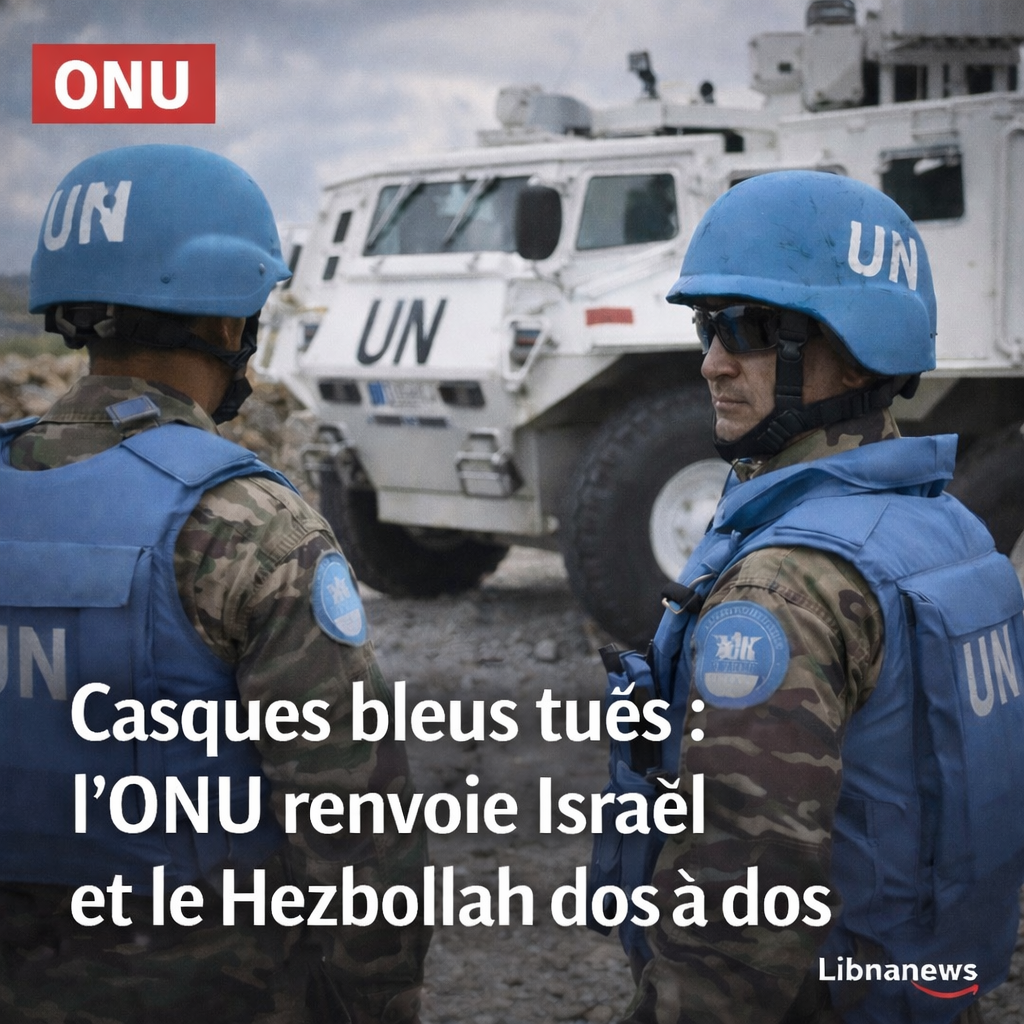
The provisional conclusions of the United Nations investigation into the death of three Indonesian peacekeepers in Lebanon at the end of March point to a shared responsibility on both Israel and Hezbollah. According to UN Secretary-General Stéphane Dujarric’s spokesman, an Israeli army fire killed a first UNIFIL soldier, while an explosive device attributed to Hezbollah is responsible for the other two deaths in a second incident. Presenting these results to the press, he said that the United Nations had requested the parties concerned to investigate and prosecute these cases by national authorities in order to bring the perpetrators to justice and establish criminal responsibility for crimes against peacekeepers.
This formulation is politically cumbersome. It means that, on one of the most sensitive issues of recent weeks in South Lebanon, the United Nations does not validate a single reading imputing all of the facts to Israel, nor does it validate the opposite of a responsibility exclusively related to Hezbollah. The organization refers the two armed actors to distinct but converging responsibilities: three peacekeepers were killed within a few days in an area supposed to be part of an international stabilization framework. For UNIFIL, which has already seen its role weakened by the intensification of the war, these conclusions also constitute a major security failure.
The first incident concerned the death of Indonesian Corporal Farizal Rhomadhon, 28, who was killed. Information received in recent days from United Nations sources and relayed by several media already indicated that a projectile had exploded near its position in southern Lebanon. The Israeli army, more specifically a tank fire, was attributed by the international press to this fire, which the provisional results presented on Tuesday confirm in their general logic. The United Nations immediately condemned this episode and recalled that the positions of peacekeepers should never be targeted.
The second incident is separate. It concerns the death of two other Indonesian peacekeepers killed when an explosion struck a UNIFIL logistics convoy in southern Lebanon. As early as 31 March, the first UN conclusions referred to an improvised explosive device along the road. The preliminary investigation now presented links this device to Hezbollah. This is in line, at least in part, with earlier Israeli statements that the two soldiers were not killed by direct IDF action, but by a non-Israeli explosive device. In particular, it deals with the initial expectation of Jakarta, which had requested an in-depth United Nations investigation after expressing doubts about the versions available in the first few hours.
The fact that the United Nations thus distinguishes two incidents of a different nature is central. It avoids amalgam, but it produces a politically devastating result for both sides. Israel is called into question in the death of a Blue Helmet by direct fire. Hezbollah is implicated in the death of two other soldiers by an explosive device. Neither of the two actors can now claim to leave this sequence intact. For the United Nations, the conclusion is clear: the three deaths are separate acts, but together they reflect an operational environment in which the protection of international forces is no longer ensured.
This equation also sheds light on the rapid deterioration of the situation in South Lebanon since the end of March. Incidents involving or affecting UNIFIL are no longer limited to indirect pressures or proximity threats. They are now leading to deaths within the international contingent. Reuters reported on 1 April that Indonesia had called for a UN investigation into these deaths, while tension was already rising around other incidents involving French soldiers and UN positions. At the same time, France denounced acts of « absolutely unacceptable intimidation » against its contingent. As a result, the Indonesian soldiers’ file is becoming part of a wider deterioration in the security of peacekeepers.
For Indonesia, which is one of the main contributors to UNIFIL, the shock is particularly strong. The country lost three of its peacekeepers in a few days, then welcomed their remains in a climate of national emotion. Regional media have emphasized the symbolic weight of these losses in a country that has long participated in UN missions and considers its contingents as instruments of stability, not as war forces. The provisional conclusions of the United Nations partly meet Jakarta’s demand for truth, but they do not dispel the fundamental political concern: the peacekeeping mission now operates in a theatre where its soldiers can be killed by both Israeli and Hezbollah-related devices.
The scope of the reminder formulated by Stéphane Dujarric is also legal. Speaking of prosecution, prosecution and criminal responsibility for crimes committed against peacekeepers, the Secretary-General’s spokesman is not content with moral denunciation. It explicitly lists the case in the Register of International Law. Peacekeepers enjoy special protection, and attacks against them, when they are entitled to the protection afforded to civilians or personnel protected by international humanitarian law, may be subject to heavy criminal qualifications. The United Nations is therefore asking not only for explanations but also for national investigations and judicial treatment.
This requirement comes as each side is already seeking to impose its own narrative. On the Israeli side, the army had promptly denied responsibility for the deaths of the two peacekeepers killed by the convoy explosion, claiming that it had neither placed explosive devices in the area nor deployed troops at the time of the incident. On the Hezbollah side, communication requires more of a global challenge to the Israeli story and the denunciation of the ongoing offensive, without public recognition of any role in the explosive device referred to by the United Nations. The provisional conclusions thus break the temptation of simplified partisan readings: they do not innocent Israel, but neither do they whiten Hezbollah.
The result is all the more important as it affects the very credibility of UNIFIL. Over the past several weeks, the mission has been increasingly unable to fulfil its buffer function in southern Lebanon. Fighting, strikes, ground advances and repeated incidents around its positions have transformed its operating areas into high-risk spaces. The UN had already made it clear by condemning in late March the deadly incidents affecting its soldiers. With this new stage point, it takes another course: it documents not only the dangerousness of the ground, but the responsibility of two major actors in the conflict in the death of its own men.
In essence, the provisional conclusions presented on Tuesday have a clear political effect: they refer Israel and Hezbollah back to back on the issue of the security of peacekeepers. The responsibilities are not identical in their mechanism, but they converge in their outcome. An Israeli fire killed a first soldier. A device attributed to Hezbollah killed two others. For the United Nations, these are no longer just tragic incidents in the fog of war. These are cases for investigation, prosecution and criminal responsibility. In a South Lebanon where the international mission is no longer able to impose its protective neutrality, this fact weighs heavily: even peacekeepers are no longer sheltered, and their deaths in turn become a front of the conflict.






