

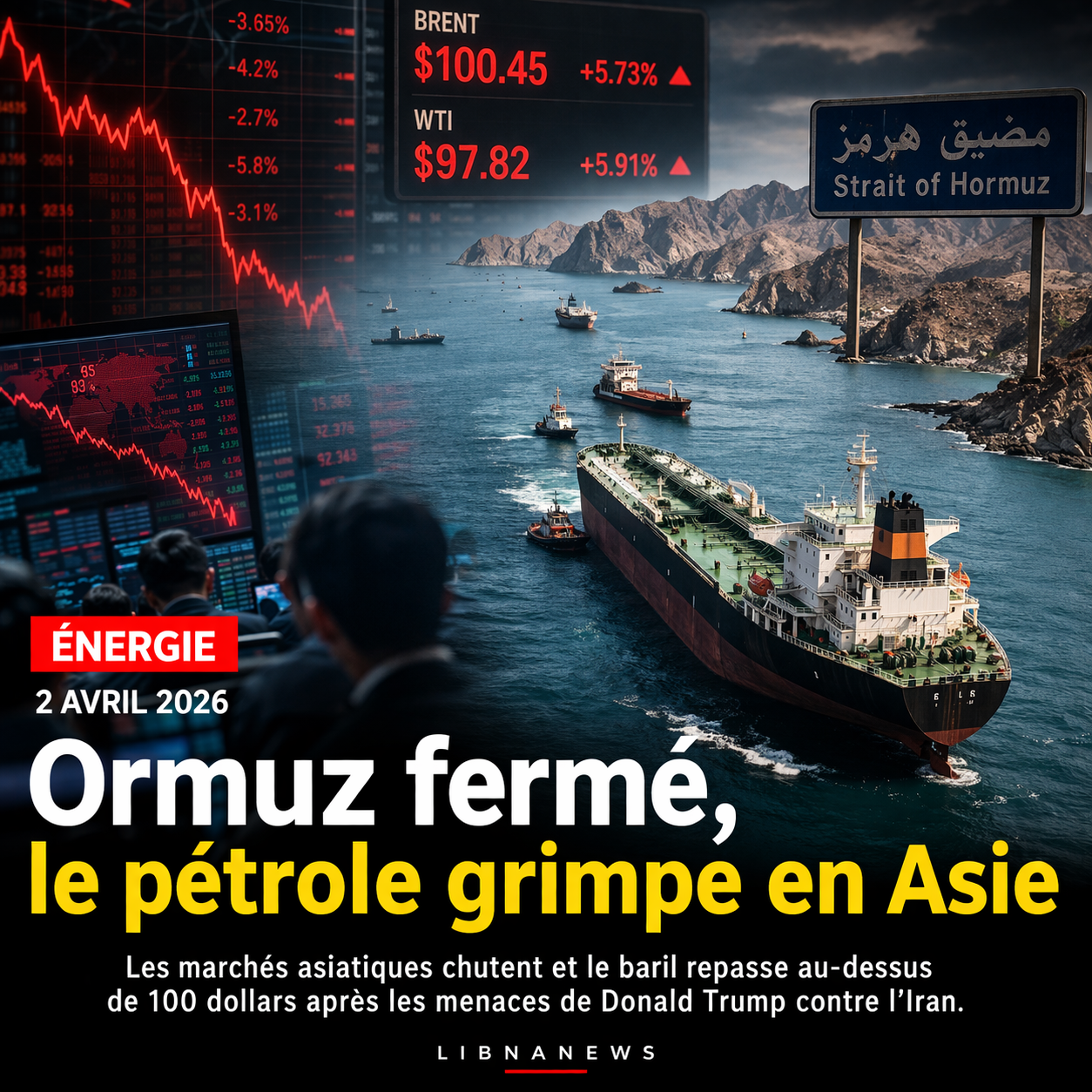
Following Donald Trump’s speech, which promised to hit Iran « very hard » again and bring it back to « stone age » in the absence of agreement, the immediate economic consequences already dominate the sequence. The Strait of Ormuz remains closed, Asian markets have opened in sharp decline and oil has again crossed the $100 threshold. This shock is not just a stock market. It highlights the fragility of global energy supply, Asia’s continued dependence on Gulf crude oil and the White House’s bet that the crisis will remain brief.
Ormuz lock remains at the centre of the crisis
The most important data this Thursday, April 2nd is not one more sentence of Donald Trump, but the absence of evolution on the sea ground. The Strait of Ormuz, a strategic passage between the Persian Gulf and the Arabian Sea, remains closed or severely paralysed according to market assessments. This corridor concentrates an essential part of world trade in hydrocarbons. As long as it does not reopen, financial actors consider that the main risk remains intact: that of a lasting disruption of oil and gas flows from the Gulf.
Although the US President said that the United States was close to its military objectives and that an agreement was still possible, investors retained more than anything else. No credible reopening schedule was given. No mechanism for securing traffic was presented. And there is no tangible sign at this stage that Tehran is about to reopen the traffic freely. In this context, the Strait continues to dictate prices, shipowners’ arbitrations and the prudence of large financial centres.
For several days, Washington has reiterated that Iran must restore navigation. Donald Trump even set a political deadline on April 6 for a change. But his speech on Wednesday did not lift the blur on how to achieve it. He referred part of the responsibility to Europeans and Asian countries, explaining that these economies depended more on oil transiting through Ormuz than the United States. This shift in strategic burden has not reassured markets. Instead, he reinforced the idea that the strait crisis could last longer than expected.
Why the closure of Ormuz worries so much
Ormuz Strait is not just a regional crossing point. It is one of the most sensitive logistics nodes in the world economy. A considerable proportion of the oil consumed in Asia is transported there, as well as a major fraction of the liquefied natural gas exported by Qatar. Every day of blockage, even partial, disrupts cargo planning, increases insurance costs and feeds speculation on futures contracts. Prices therefore respond not only to the physical reality of the flows, but also to uncertainty about the duration of the shock.
The countries most at risk are those that import their energy massively from the Gulf. This is the case for several large Asian economies, which cannot quickly replace these volumes at stable cost. For them, the closure of Ormuz means two simultaneous risks: paying more for the available crude and having to face supply tensions if the paralysis settles. Refiners, carriers and industrialists follow every political statement, every maritime attack and every index of negotiation with extreme attention.
This vulnerability explains the sharp reaction of Asian markets this morning. Investors know that the energy shock, if prolonged, can quickly contaminate other sectors. A sustained increase in oil prices increases transport, weighs on industrial margins, feeds imported inflation and complicates the task of central banks. The dreaded scenario is not only that of a more expensive barrel for a few days. This is the case for growth slowed down by energy costs, which again became central at a time when several economies were already fragile.
Asian markets opened up in sharp decline
The first visible reaction came from the Asian Stock Exchanges, opened a few hours after Donald Trump’s speech. The White House message was first read as a disappointment. Part of the market hoped to hear an early exit from the crisis, or at least a more precise timetable. Instead, the US President confirmed the continued strikes and threatened Iran with further major destruction. Investors immediately reassessed the risk of escalation and reduced their exposure to assets deemed most vulnerable.
In Tokyo, Nikkei fell sharply in early trade. In Seoul, Kospi suffered an even greater decline. Hong Kong has also opened in the red, indicating that nervousness exceeds the only markets directly dependent on energy imports. Futures contracts on the US and European indices have also declined, showing that the Asian reaction is not a local anomaly but an extension of a global concern about the conflict and its effects on world trade.
This movement translates a classic mechanics into a period of geopolitical shock. Investors sell risky assets, refer to the dollar and reassess inflation prospects. They know that if oil settles over $100 in a sustainable way, the pressure on consumer prices could increase in many importing economies. This repositioning is all the faster as Donald Trump’s speech offered no credible ceasefire, no clear diplomatic framework, no firm assurance of a forthcoming reopening of Ormuz.
Oil goes back over $100
On the oil market, the reaction was immediate and spectacular. Both the Brent and the WTI went up after the American speech. On Thursday, April 2, prices were again increasing above $100 per barrel, with gains of more than 5% depending on the timing of quotations. This level is not only symbolic. It marks the return of a major energy risk in the anticipations of financial actors, after several sessions where some still hoped for a lull.
The logic is simple. As long as Ormuz Strait remains closed and Washington announces a continuation of the air campaign, the market incorporates a high probability of prolonged disruption. Although not all flows are immediately interrupted in full, the overall cost of the crisis is already increasing: more expensive maritime insurance, modified routes, longer delays, uncertain availability of certain cargoes. The price of the barrel reflects both this increasing cost and the fear of an additional accident involving a ship, inshore facility or oil terminal.
The market is also looking beyond Iran. When the crude rises sharply, it is not only because Iranian supply seems threatened. This is because the entire Gulf is entering a risk zone. Operators estimate what could happen to exports from Saudi Arabia, the United Arab Emirates, Kuwait, Qatar or Iraq if the maritime crisis continued to worsen. In other words, the closure of Ormuz acts as a multiplier of tension: it turns an already serious war into a potential shock for the entire global energy system.
An immediate shock wave for Asia
Asia is on the front line. The continent imports a massive share of its energy and several of its large economies remain structurally dependent on Gulf cargo. Japan, South Korea, India and China are therefore following the situation with particular concern. In the short term, the problem is not just finding oil elsewhere. We must also transport it, refine it, buy it at a bearable price and absorb logistical delays. No complete and rapid replacement exists at constant cost.
This exhibition explains why Asian markets react before others with such intensity. The more expensive barrel immediately weighs on the margins of airlines, transport groups, energy-intensive industrialists and very import-intensive economies. It can also complicate monetary policies. If inflation starts again because of oil, several central banks may delay monetary easing or remain more cautious than expected. A less flexible monetary policy, in turn, hinders investment and demand.
Psychological shock also counts. Markets had begun to bet on the idea that Donald Trump was preparing for a relatively rapid exit from the military operation. His speech destroyed this hypothesis. Instead of a clear disengagement, he promised to « finish the job » and evoked new strikes within two to three weeks. For Asian investors, this sentence means something concrete: the risk window does not close, it expands.
The White House’s risky bet
In his speech, Donald Trump tried to dissociate the global energy situation from immediate American interests. He argued that the United States, a major oil producer, would be less vulnerable than Europe or Asia to a lasting disruption of Ormuz. This reading contains some economic truth, but it is not enough to isolate Washington from global consequences. A prolonged oil shock continues to affect the United States, if only through inflation, pump prices, financial volatility and the slowdown in global demand.
The political bet of the White House is therefore based on a very precise hypothesis: the crisis will be short enough not to turn into a sustainable global energy shock. That’s what allows Donald Trump to promise both military victory and a rapid decline in gasoline prices. But this bet depends on variables that it does not control entirely. It depends on Iranian reaction, maritime security in the Gulf, the attitude of the allies and market perception. But these markets, this Thursday morning, send the exact opposite signal.
Investors do not yet believe in a rapid normalization scenario. They buy protection, run away from risk and pay more for the crude. This behavior does not prove that the crisis will last months. It means, however, that the presidential speech is not enough, for the time being, to convince. Operators want facts: ships that iron, insurances that relax, volumes that circulate, visible diplomatic guarantees. As long as these elements are missing, markets operate in alert mode.
Beyond oil, the risk of an inflationary shock
The stake is not limited to the price of the barrel. A prolonged closure of Ormuz may affect an entire cost chain. Shipping becomes more expensive. Insurance premiums are rising. Logistical delays are increasing. Companies that consume a lot of energy are seeing their spending increase. From a certain threshold, oil growth can therefore spread to the whole economy, well beyond the energy sector. It is this perspective that worries investors and central banks.
For Asia, the danger is even greater. Several economies in the region import heavily not only oil but also Gulf gas. If flows remain disrupted, governments will have to balance budget support, the use of strategic stocks, accelerated diversification of procurement and acceptance of higher inflation. None of these choices are simple. All have a political or economic cost. This is why this morning’s stock market reactions are far beyond market screens: they signal the fear of a broader macroeconomic problem.
The central risk is a chain. First time: oil is rising. Second, production and transport prices follow. Third time: inflation starts again or remains too high. Fourth, central banks are reluctant to loosen their policies. Fifth: growth slows down. Markets do not say that this scenario is certain. They indicate that it has become plausible again, which is enough to trigger massive sales of shares and a decline in asset shelters.
A crisis now considered longer than expected
Perhaps the most revealing point of the morning is this: markets not only sanction war, but lack of visibility. A short, even violent, war can sometimes be absorbed if operators see a credible exit door. This is not the case today. Donald Trump promised additional strikes without detailing the terms of a possible agreement. Iran, for its part, did not give any clear signal of reopening the Strait as long as the bombings continued. Between these two positions, world maritime trade is still taking shape.
This lack of a clear path pushes markets to prolong the crisis mentally. A week of closure does not have the same consequences as a month. Two or three weeks of military uncertainty do not have the same effect as a campaign that nobody really knows what political conditions it will end. The American discourse, which was intended to demonstrate control, therefore had the opposite effect on financial markets: it broadened the risk horizon instead of closing it.
At this point, the sequence is clear. The Strait of Ormuz remains closed. Asian markets have opened up in sharp decline. Oil jumped above $100. And the White House continues to promise a quick outcome without providing concrete proof that it can get it. For investors, energy importers and Asian governments, it is less the brutality of the presidential vocabulary than this combination of military escalation and strategic vacuum that now acts as an alarm signal.






