

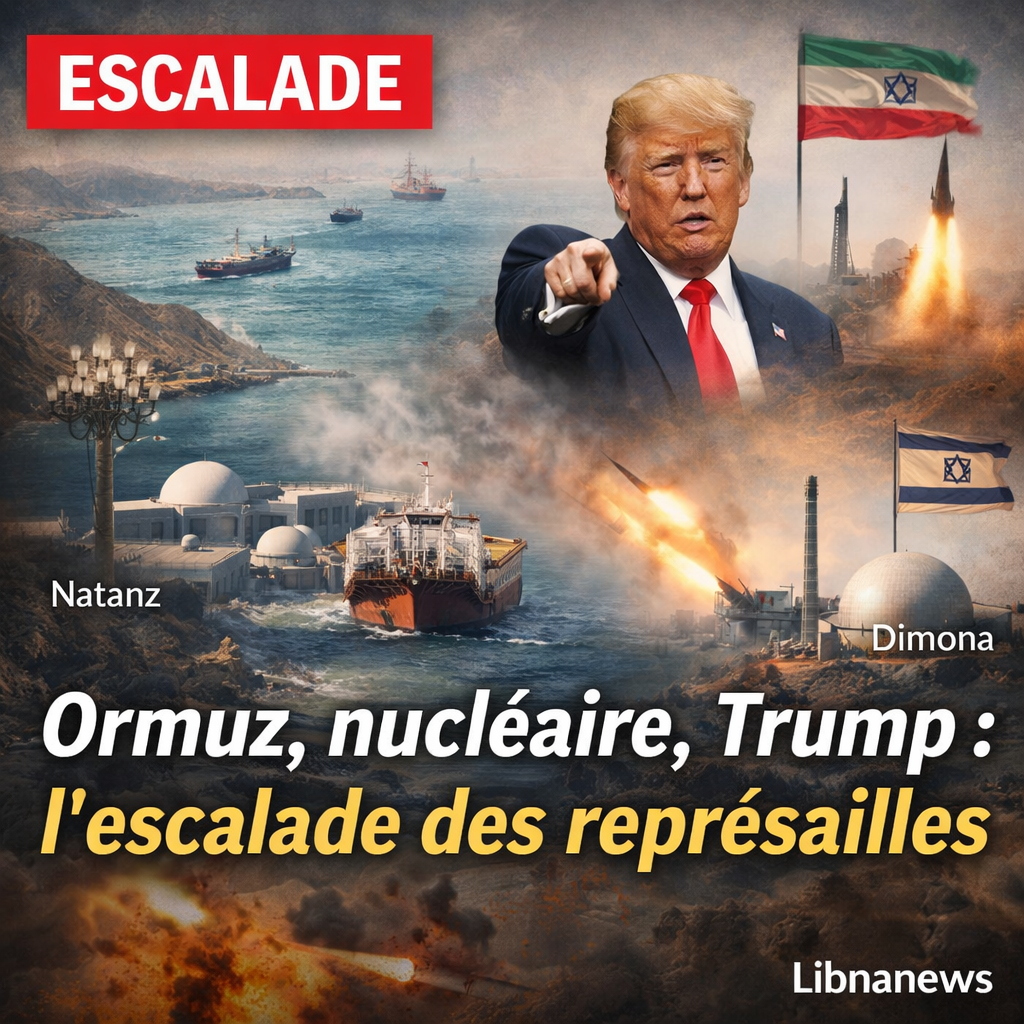
The Strait of Ormuz has again, within hours, become the centre of gravity of a crisis that is no longer just a matter of a conventional military confrontation between Israel, Iran and the United States. Donald Trump launched a 48-hour ultimatum in Tehran to completely reopen the sea lane, otherwise Washington would threaten to hit Iranian power plants. Iran responded by promising to target energy, technology and desalination infrastructure in the Gulf if its own facilities were affected. At the same time, the Natanz nuclear site was targeted, while Iranian missiles reached the Dimona and Arad areas in southern Israel. The chain says everything about a shift: the war no longer revolves around the armies, it approaches the networks that make societies live.
This slide immediately imposes an essential precision, too often relegated to the background by military dramaturgy. Under international humanitarian law, civilian property cannot be targeted. The objects essential for the survival of the population, particularly those linked to water, are given enhanced protection. Intentionally directing an attack on a civilian object, or launching a disproportionate strike against the foreseeable human cost, may constitute a war crime. This applies to all actors, including when they invoke strategic urgency, national security or the sensitivity of an infrastructure. Applyed to the current sequence, it means one simple thing: threatening Iranian power plants or Gulf desalination units is not an anomalous rhetoric. This already puts the conflict on the edge of an area where the law of war is directly tested.
Ormuz, the real centre of gravity
The first risk of error is to believe that Natanz or Dimona alone summarize the crisis of the moment. In reality, the breaking point is in Ormuz. This narrow gully connects the Gulf with the rest of the world and concentrates a decisive part of the oil flows. The International Energy Agency recalls that this passage remains one of the main energy arteries on the planet. As soon as it ceases to be a safe corridor, the tremor immediately exceeds the near-eastern theatre. It affects oil, gas, marine insurance, freight, industrial costs and then consumer prices. Ormuz is therefore not only a naval issue. This is where a regional war can become a global crisis.
This is precisely what Tehran is trying to exploit. Iran does not always say that the strait is closed to everyone. Rather, he claims that he remains accessible to ships unrelated to his enemies, provided they coordinate their passage. This formulation is crucial because it allows the regime to avoid the word blockade while producing its effects. It is enough to make the crossing politically filtered, militarily uncertain and assuringly risky to slow down traffic. The Iranian power thus transforms the strait into an instrument of selective coercion. It does not need to sink massive tankers to weigh on the world market. Suffice it to introduce enough fear for private actors to arbitrate against normality themselves.
In Washington, this reality explains Donald Trump’s annoyance. The U.S. ultimatum is not only a demonstration of strength to Tehran. It also responds to wider political anguish. When oil climbs, when gas follows, when supply chains grow, war ceases to be a matter of chanceries and generals. It enters service stations, invoices, supermarkets and, very quickly, into the American domestic debate. The U.S. administration knows that a long-term closure of Ormuz, even partial, can cost the world economy a great deal and, in turn, power. Trump’s anger is therefore in line with this dual logic: restoring freedom of navigation and preventing the military crisis from turning into economic punishment.
When Washington threatens Iranian electricity
This is where climbing changes in nature. Threatening power plants does not mean targeting an ammunition depot, air base or armored column. A power plant is a core of ordinary life. It feeds hospitals, pumps, transportation, communications, cold chains, housing, industrial networks. In strategic language, some will say that it is a dual-use target. In human language, this means that such a strike can plunge entire cities into an immediate vulnerability regime. That is precisely why the law of war imposes strict criteria of distinction, necessity and proportionality. The fact that a target is important does not automatically make it legitimate. The fact that it is central to a regime does not remove the protection afforded to civilians dependent on it.
So you have to write things without any false appearances. If the United States carried out its threat against an Iranian civilian infrastructure without a rigorous demonstration of a concrete military objective and without respect for proportionality, the definition of war crime would inevitably be raised. The American military power doesn’t change anything. The status of great power does not offer any immunity in principle. This point deserves to be recalled with even greater clarity as contemporary conflicts suffer from a reading often with variable geometry: the right would be invoked against opponents, but softened when it comes to Western allies. A serious article cannot reproduce this bias. While the Iranian threat against hydraulic installations must be legally qualified, the American threat against power plants must also be qualified with the same requirement.
Iran responds by designating water
The Iranian response is, in substance, just as serious. By promising to target not only energy infrastructure but also desalination units, Tehran is not only threatening its neighbours’ oil revenues or technological comfort. It threatens their daily survival. Desalination occupies a vital place in the Gulf monarchies. Drinking water depends largely on these coastal facilities, often located near major industrial axes. To strike them, or even brandish the possibility, is to introduce water into the war. And when water enters the war, we pass a moral, legal and strategic threshold that is otherwise heavier than that of mere energy intimidation.
This choice has nothing to do with accident. It reflects a fine understanding of regional vulnerability. The Gulf States have long thought of their security around oil, ports, pipelines, terminals and bases. Iran brutally recalls that there is another addiction, less commented but at least as sensitive: water. In very hot urban societies, largely dependent on continuous technical devices, touching desalination would mean moving the war from markets to taps. It would be an infinitely more political form of pressure, because it would make conflict felt not only to elites or traders, but to the population in its most elementary daily. Again, the scope of war crime is not theoretical. It approaches as warring parties speak of vital infrastructure as ordinary targets.
Natanz, or the entry of the nuclear into the battle of perceptions
Natanz bombing adds an additional dimension to the case. Natanz is not any website. It is one of the most sensitive places in Iran’s nuclear programme, therefore one of the most symbolically charged points of regional confrontation. That it is struck, even without radioactive leakage confirmed off-site, suffices to raise the crisis with a cran. A war can absorb missile exchanges on conventional military infrastructure. It becomes of another nature when it approaches nuclear installations, although the exact material balance remains partially uncertain. From then on, the risk is no longer limited to the damage that has been found. He also wants everyone to imagine that the other might then try.
The most interesting element is not only the strike itself. It lies in the following political sequence. After the Iranian strikes on Dimona, Israel denied having led the attack on Natanz. This denial is notable. It comes at the very moment when the escalation approaches the most sensitive places on both sides. We can see, and this is a reading, the outline of late restraint, as if the Israeli authorities had suddenly measured what is involved in a war that begins to be written around nuclear power, even indirectly. To recognize a strike on Natanz was to risk assuming a logic of symmetry that the attack on Dimona precisely came to make explosive. To deny, on the other hand, is to try to reopen a plausible negation space, so a small margin of manoeuvre in a crisis that is increasingly lacking.
This denial does not prove innocence. It reveals above all the sensitivity of the moment. In high-intensity conflicts, war is also played in words that a state accepts or refuses to accept publicly. A government may want to strike, test, report, but refuse to officially endorse the strike if the political cost of a claim becomes too high. This is exactly what seems to be emerging here. As soon as Dimona enters the table, even indirectly, the narrative changes. The conflict is no longer just a campaign against enemy capabilities. It starts to take the form of a face-to-face where the most sensitive sites in the region are caught in a mirror logic. And this mirror logic is always one of the most difficult to master.
Dimona, or the end of the absolute sanctuary
The Iranian strike on the Dimona area did not need to have destroyed the heart of the Negev nuclear centre to constitute a strategic shock. The main thing is elsewhere. Missiles reached the Dimona and Arad areas, causing many injuries. Israeli interception systems have not stopped at least part of the projectiles. The mere fact that this region, long perceived as highly protected, can be affected already alters the perception of the balance of forces. In a confrontation based on deterrence, proximity is sometimes worth almost as much as direct impact. What Iran has demonstrated is its ability to project the threat to the vicinity of a site that condenses Israeli nuclear ambiguity. And this demonstration is enough to crack the idea of an absolute sanctuary.
In Dimona, the symbol therefore prevails, for the moment, over the known technical balance sheet. There is no public evidence to conclude that the core of the complex has been damaged. But this lack of confirmation does not lessen the scope of the episode. She’s moving it. The message is not we destroyed the site. He’s a man we can get him into the threat field. In a region where balance rests as much on nuclear uncertainty as on conventional military superiority, this nuance is immense. It obliges Israel to rethink what it thought might be able to sanctify. It also obliges its allies to admit that the red lines they imagined were stable are blurred at high speed.
A war against systems
The most striking, basically, is neither Trump alone, nor Natanz alone, nor Dimona alone. This is the overall coherence of the shift. Ormuz Strait for global energy. Power plants for the internal continuity of a country. Desalination units for access to water. Nuclear sites for deterrence and fear of an irreversible package. All the pieces of the puzzle tell the same story: the conflict slides towards a war of systems. The armies stay here, of course. But they are no longer the only visible centre. Pressure is shifting towards infrastructure that makes social, economic and political life possible. This changes everything, because in a system war, civilians cease to be only collateral victims. They become, through the networks on which they depend, the real impact of the conflict.
It is also for this reason that the current sequence worries far beyond the Middle East. A crisis built around systems is much more contagious than a war around a front. It affects financial markets, maritime chains, prices, the internal balances of neighbouring States, the diplomacy of external powers, and even the credibility of alliances. As the confrontation expands to include vital infrastructure, each regional actor becomes potentially co-vulnerable, even if it is not yet directly belligerent. The Gulf, in particular, ceases to be a mere peripheral theatre. It is once again becoming the nerve center of instability that combines security, energy, water and global trade in a single crisis.
Most likely is not the most reassuring
Three trajectories are emerging. The first would be a blurred compromise on Ormuz, with a partial reopening presented as sufficient to avoid an immediate US strike. The second would be accelerated regionalization, if Washington hit Iranian power plants and Tehran responded against Gulf infrastructure. The third, perhaps the most dangerous, would be a lasting crisis where the strait would remain energized while strikes would multiply in the vicinity of highly sensitive sites such as Natanz or Dimona. But this last scenario is not improbable. It corresponds to the mode of operation of many contemporary wars: neither decisive explosion, nor rapid return to the status quo, but a slow installation in systemic instability.
This is probably where the real novelty of this sequence lies. The current conflict is no longer simply rising in intensity. He’s changing his language. He now speaks of vital arteries. From the moment that an American president can threaten power plants, where Iran can respond by evoking drinking water, where Natanz enters the narrative of war, and where Dimona ceases to appear as an untouchable horizon, the Middle East moves into an area where the distinction between military pressure and the danger of societies becomes thinner every day. And when this distinction effaces, law is no longer a soul supplement: it becomes the last line of separation between war and barbarism.



