

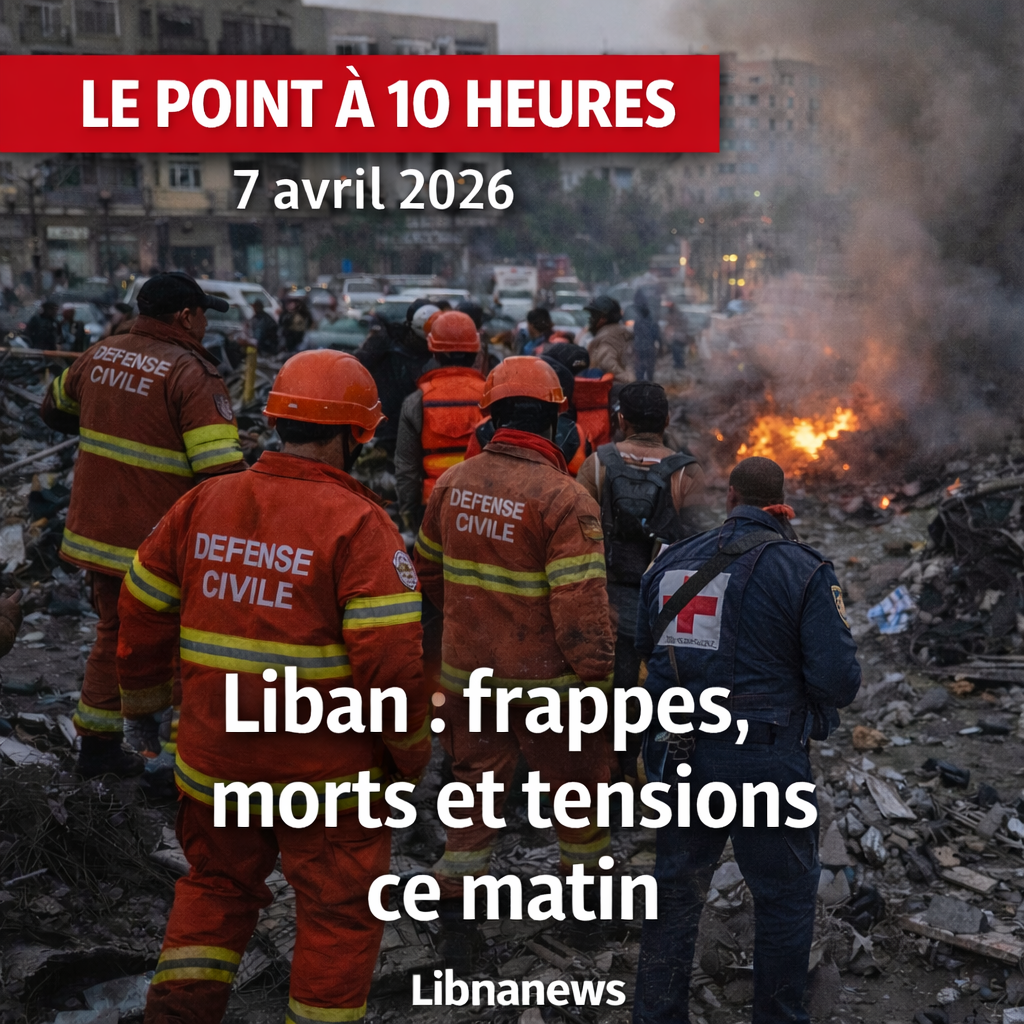
In Lebanon, the morning of Tuesday, April 7, opens up to a war that continues to increase in density, geographical dispersion and political power. In the space of twenty-four hours, the country added another strike in the southern suburbs of Beirut, raids and bombardments in the South, additional casualties among the relief workers, civilian injuries, and a wave of persistent political shock around the strike of Ain Saadé in Metn. This situation point at 10.30 a.m., Beirut time, not only draws a map of the places hit. It also tells of a climate: that of a country where military front lines, civilian refuge areas and political divides are dangerously approaching each other.
Over the past few hours, the information provided by the National Information Agency, LBCI, MTV Lebanon and Al Manar confirms an intensification on several axes. The southern suburbs of Beirut were again targeted Monday night. The South experienced new night and morning bombardments, including around Maaraké, Ayn Baal, Sultaniyah, Majdal Zun and the area between Smaiyah, Deir Qanoun and Ras al-Ain. At the same time, the issue of evacuations and population movements is no longer limited to directly border villages. The case of Ain Saadé, east of Beirut, moved anguish to areas that were still living as in the shelter.
Beirut and its periphery remain under pressure
The most significant military event outside the immediate South remains the continuation of strikes in the Beirut metropolitan area. LBCI reported on Monday night an Israeli strike on the southern suburb of the capital, indicating that pressure on the Dahiyé did not ease despite the parallel expansion of operations to other parts of the country. The channel did not, at this time, detail a comprehensive human assessment for this precise strike, but its importance is firstly political and psychological: it recalls that the southern periphery of Beirut remains an active target, even when media attention is focused on the southern front or regional developments.
To this tension is added the shock caused by the attack on Ain Saadé, which occurred on Sunday evening but whose political, security and social replicas still dominate the last 24 hours. According to the Lebanese Army, relayed by LBCI and Al Manar, a Metn apartment was hit on 5 April at around 9 p.m. by two GBU-39 bombs that could be fired from a war plane or a war building. The field investigation found that the projectiles crossed the roof and then the fourth floor before exploding on the third floor, causing the death of three inhabitants of the target floor and injury. The army also reported that the initial investigations had not revealed new tenants in the building, calling for restraint and refusal of speculation.
This precision of the army is central, because the strike of Ain Saadé immediately fed a confrontation of stories. MTV relayed information from the local press referring to the motorcycle leak of a suspect after the attack, while LBCI published evidence attributed to sources close to the investigation saying that there were no new residents in the building. Clearly, the case remains politically inflammable: on one side, suspicions of infiltration or use of civilian buildings; on the other, an institutional call not to turn the case into an improvised public trial. This shift feeds a new tension in areas where displaced persons are also vulnerable.
In the South, strikes continue from the coast inside
On military ground, the night and early morning were again marked by a series of strikes on the South. MTV reported early this morning Israeli raids on uninhabited houses in Sultaniyah and Ain Baal. The chain also reported a record of three injured in the midnight strike on Maaraké, with extensive destruction in houses and clearing operations to reopen the roads. A few hours later, at 1019 hours, MTV reported that Israeli helicopters had fired two missiles at the area between Smaiyah, Deir Qanoun and Ras al-Ain, while warplanes also targeted Majdal Zun in the Tyre district.
Al Manar, for its part, reported at 0959 hours new bombardments and fire on several southern localities, including Shabaa, Sidiqin, Wadi al-Hujeir, Toulin, Aytaroun and the outskirts of Wadi al-Slouqi. The chain, very aligned with the story of resistance, gives a broader picture of the pressure exerted on the southern band, from the eastern sector to the western sector. This survey does not provide a consolidated human assessment for each of these sites, but it confirms that the morning of 7 April does not correspond to a lull: the strikes continue, the target localities multiply, and the pace of the incidents makes it more difficult to stabilize accurate balance sheets in the very short term.
One of the most striking features of the last few hours is precisely this geography that has broken out of violence. We are no longer talking only about the most exposed villages on the border. Strikes affect roads, the vicinity of localities, areas of habitat, crossing points and areas where relief is provided after a first attack. This fragmentation of the battlefield produces a powerful political effect: it uses local response capabilities, it maintains uncertainty about the next points of impact, and it gradually expands the mental map of areas deemed threatened.
Relief pays a growing price
The last 24 hours have also been marked by another attack on rescue workers. MTV relayed a communiqué from the Ministry of Health Emergency Operations Centre indicating that rescue teams in Sidiqin, Tyre District, to evacuate wounded persons and bodies after a previous strike, were targeted by another Israeli attack. The report states that an Al-Risala relief worker was killed, two injured in the same team, two injured in the Islamic Health Authority, and a damaged ambulance. The Ministry notes that this is the second direct targeting of first aid workers in less than 12 hours, after a previous incident in Haris.
This point is crucial, because it changes the reading of the sequence. Strikes do not only affect buildings, suspected areas of armed presence or infrastructure. They also strike those who intervene after the blow. At the local level, this slows down rescue operations, increases the risk for ambulances and increases the time needed to get the victims out or clear the axes. At the political level, this reinforces the argument, already central in the Lebanese official communication, of a war that goes beyond the traditional military categories and affects the very mechanisms of humanitarian response.
Al Manar went in the same direction on his home page, pointing out another attack on an ambulance in Bint Jbeil, which allegedly killed a rescuer and an injured civilian whom he was carrying. Although the full details of this episode were not yet developed in an open article at the time of the scoring, its presence in the latest information of the chain confirms a sequence where medical and ambulance teams also become targets or find themselves directly exposed to fire.
Human balance: still partial figures, but a net worsening
At 10.30 a.m., the consolidated balance sheet of the last 24 hours remains fragmented, as it is built locality by locality. However, what can be established from the information available this morning is clear. Three people were killed in the attack on Ain Saadé, according to the Lebanese army relayed by LBCI and Al Manar. Three other people were injured in the night strike on Maaraké, according to MTV. In Sidiqine, a first aid worker was killed and four other first aid workers injured, with an ambulance hit, according to the Ministry of Health relayed by MTV. Other wounded are mentioned by several media without a single global assessment being stabilized at this time for all the bombings in the South and the southern suburbs of Beirut.
This difficulty in freezing a total balance sheet is not a technical detail. She’s saying something right now. The pace of strikes, the diversity of affected areas and the multiplication of secondary incidents complicate the rapid centralization of figures. The human balance sheet already exists, but it happens in pieces, between local confirmations, military data, health announcements and media coverage. For a point at 10.30 a.m., caution is needed: the dead and wounded mentioned this morning are probably not yet the complete picture of the sequence opened since Monday morning.
Provisional assessment as at 7 April at 10.30 a.m.
| Event | Location | Balance sheet known at 10:30 |
|---|---|---|
| Hit an apartment | Ain Saadé, Metn | 3 dead, several injured |
| Night strike | Maaraké, Tyre District | 3 injured |
| Targeting of rescue teams | Sidiqine, Tyre District | 1 first aid worker killed, 4 first aid workers injured |
| Property damage | Sultaniyah, Ayn Baal, Majdal Zun, Smaiyah–Deir Qanoun–Ras al-Ain | reported destruction, unconsolidated human balance |
| Hit on the southern suburbs | Dahiyé, Beirut | not detailed at this time |
These figures should be read as a provisional statement, not as a final balance sheet. Several areas remain under fire, others are still under inspection or clearance, and some media reports of developing incidents with no consolidated medical total.
Evacuation, displacement and fear of extension of risk areas
The term evacuation covers several realities this morning. First, there are the operational evacuations imposed by the strikes themselves: the extraction of injured persons, the clearing of roads, the intervention of ambulances under threat. There are then preventive evacuations or displacements related to warnings, repeated bombings or fear of further strikes. Finally, there is now a third level: the question of the presence of internally displaced persons or new occupants in civilian buildings outside traditionally considered frontal areas.
That is why the case of Ain Saadé has become far wider than a mere fact of war. MTV reports that, following the strike, MP Elias Estephan called on the residents of Zahlé not to rent their homes to new arrivals for any reason until the security situation was restored. It presents this request as a preventive measure, not as a rejection of the displaced. But politically, the signal is strong: the fear of being hit because a building would host a potential target is beginning to change reception behaviour in areas that have so far been in retreat.
This reaction has far-reaching consequences. It shows that war does not only move people; It also changes the social conditions of their reception. A reflex of suspicion appears between host and displaced communities. It is not yet a state policy, but it is already a powerful symptom of fragmentation. The army, by calling for restraint on the interpretation of the strike of Ain Saadé, is specifically seeking to avoid the file from moving from the security registry to the collective prosecution registry.
Political reactions add up, without calming the climate
In the official political arena, the National Information Agency reported this morning that Prime Minister Nawaf Salam had met with the Ambassadors of the Quintet and stressed Israel’s urgent withdrawal and the reform agenda. NNA also reported that President Joseph Aoun expressed concern that the Israeli army would not withdraw from the South before the 18th. These two positions show that, for the Lebanese authorities, the southern military record remains linked to an urgent diplomatic sequence where security pressure and the credibility of the State are being played out at the same time.
In parallel, MTV also relayed at 0929 hours a statement by Interior Minister Ahmad al-Hajjar announcing a strengthening of security measures and the security presence in various Lebanese regions in order to reassure the population and protect civilians in their homes. This signal is not a military response to the strike campaign, but an attempt to contain its internal effects: fear, rumours, local tensions, treachery around the displaced, and the risk of uncontrolled reactions in reception areas.
At the same time, war continues to be read through antagonistic political grids. Al Manar highlighted military communiqués of resistance to rocket and drone fire against Metula, Kfar Yuval and Kiryat Shmona between night and early morning, as well as attacks on Israeli positions near Khiam. This reading presents the sequence as a continuation of field responses. On the other hand, some of the reactions relayed by MTV around Ain Saadé insists on the risks created, in their view, by the presence of armed or suspected elements in civilian areas. Between these two accounts, the state tries to occupy a space of moderation, but this space remains narrow.
What to remember at 10:30
At this time, the picture is that of a war that is not slowing down and whose effects are shifting. Bombardments continue in the South, with several locations affected since night and again this morning. First aid workers pay a direct human tribute. Beirut and its periphery remain exposed, as Dahiyé was again targeted. The case of Ain Saadé, she, opened an even more dangerous sequence on the inside: the one where fear of strikes begins to change the rules of reception, fuel suspicions and demand of the army a role of narrative arbiter as well as security.
The 10h30 point does not yet make it possible to close the balance sheets. On the other hand, it makes it possible to name the lines of force of the last 24 hours: intensification in the South, continued pressure on Beirut, extension of perceived risk outside border areas, increasing vulnerability of relief and stiffening of political debate around displaced persons, host areas and responsibility for war. As hours pass, the country is not only facing more strikes. It faces a war that also gnaws its civil, territorial and social margins.






