

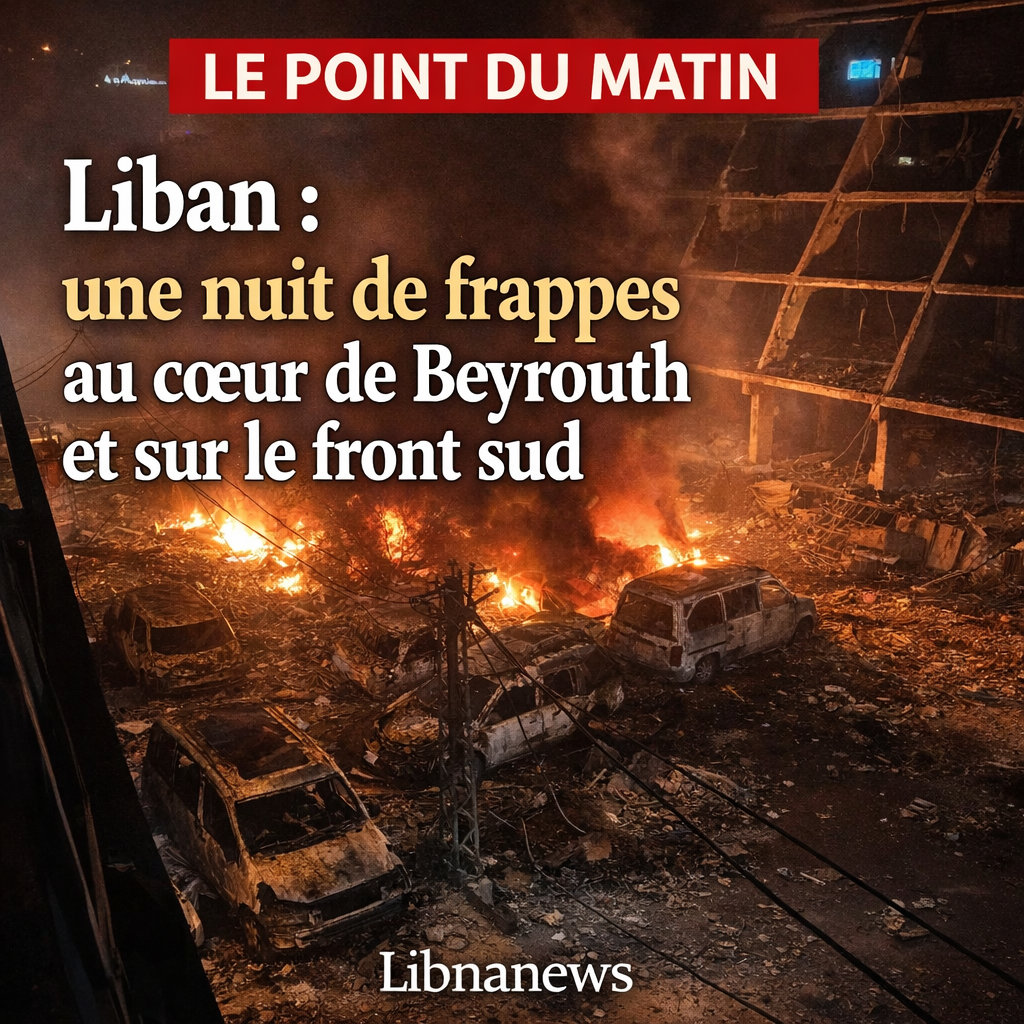
Between Tuesday, 31 March, at 6 p.m. and Wednesday, 1 April, at 10 a.m., Lebanon experienced a particularly heavy night of war, marked by both deadly strikes in the Beirut area and continued shelling on the southern front. The major fact of this sequence lies in the superimposition of two realities. The first concerns the capital and its immediate surroundings, with two separate strikes in Khaldé and then in Jnah. The second hit the South, where Naqoura, Chamaa, Qantara, Ramadiyé, Haniyé and Mansouri remained exposed to artillery fire, raids and clashes. At 10 a.m., the strongest and most consolidated human assessment was in the Beirut area, with at least seven deaths and 24 injuries.
In such a night, sorting becomes almost as important as the narrative itself. Networks, Telegram channels, military communiqués and militant relays produced dozens of sometimes contradictory messages, often incomplete, and sometimes impossible to verify in the moment. To establish a robust chronology, too speculative information must be avoided, claims distinguished from observed facts and what is confirmed through several reliable channels. This filtering reveals a clear line: the central episode was not a single border clash, but a continuous sequence mixing active south front, targeted strikes near Beirut and rising tension in busy urban areas.
The first night teaching thus concerns the geography of climbing. For several hours, the gaze remained fixed on the South, as often since the beginning of this new phase of war. But the rest showed that the metropolitan rear was also exposed. The strikes of Khaldé and Jnah did not affect remote rural areas. They targeted areas within the immediate perimeter of the capital, on roads or in densely inhabited areas. This changes the perception of danger. War is no longer confined to border villages, bombed valleys or disputed hills. It also imposes itself at the entrance to Beirut and in an urban area where traffic, commercial activity and health services structure daily life.
Khaldé, first shaking at the gates of the capital
The first major strike of the night targeted Khaldé, south of Beirut. According to reports from a news agency and Lebanese health authorities, the attack hit a car and resulted in two deaths and three injuries. The scene, with a vehicle calculated on a vital axis of the capital, immediately illustrated the nature of this new phase: targeted, rapid strikes on points where civilians, workers and motorists are constantly circulating in transit between Beirut, the airport and the coast. Khaldé is not just a peripheral suburb. It’s a strategic gateway to the capital. When a vehicle is targeted, the military message far exceeds the immediate target.
Khaldé’s choice also weighs by its symbolic scope. This sector controls one of the major southern accesses of Beirut. It connects the metropolis to the airport, the seaside and the entire southern coastal corridor. A car strike, in this context, acts as a precision operation but also as a demonstration of depth. It means that the most sensitive roads remain on the map of possible targets. For the inhabitants, this feeds a very concrete fear. Risk is no longer only associated with the villages of the South or the military peripheries identified. It manifests itself on a known, familiar road, taken every day to work, return or to the airport.
Narratively, Khaldé opened the night without summarizing it. Very quickly, attention moved, because a second, heavier strike changed the scale of the sequence. But it would be misleading to relegate Khaldé to the rank of secondary episode. The strike first announced that the Beirut area was once again becoming a direct impact area. It then showed that vehicle attacks remain one of the central tools of the present war. Finally, she prepared the climate of panic and uncertainty in which the next strike was to take place. Before Jnah, there was Khaldé. Before the visual shock of the affected neighbourhood, there was this first brutal alert at the gates of the capital.
Jnah, human and urban epicentre of the night
A few moments later, attention moved to Jnah. In this area of south-west Beirut, several missiles hit a parking area with cars. The material damage was significant and the human balance increased very rapidly. The health authorities announced five deaths and twenty-one injuries in this single strike. Concordant field information described ravaged parking, burning vehicles and a difficult emergency response in a dense urban environment. This attack immediately gave Jnah a central place in the narrative of the night, far beyond the southern suburbs in the strict sense. From there, the human epicentre of the sequence was no longer in doubt.
Jnah has concentrated emotion, political attention and diffuse fear that always accompanies the strikes in the Beyruthine area. The neighbourhood is not only close to major axes. It is also situated in an urban fabric where traffic, shops, services, residential buildings and medical establishments intersect. A strike in such a space produces a chain effect. It disrupts access to adjacent streets, slows the arrival of ambulances, increases the risk of secondary fire and poses an immediate threat to people who were not on a front line. This is what distinguishes an attack in Jnah from a bombardment in a clear southern area. Violence is projected here into an ordinary, almost banal urban scene, and that is precisely what makes it even more anxious.
One of the points that fueled rumours during the night concerned Al Zahraa Hospital, located in the area. Several messages suggested evacuation or cessation of activity. However, information disseminated during the night denied this scenario. The establishment confirmed that it continued to operate normally despite the circumstances and that it received injuries. This is important because it allows the narrative to be brought back to verifiable facts. In a context where each explosion generates a wave of speculation, the fact that a neighbouring hospital remains operational helps to measure more accurately the real magnitude of the shock. This does not reduce the severity of the strike, but it corrects one of the fastest exaggerations spread in the first minutes.
At the dawn of the day, Jnah imposed himself as the name that summarized the night. Not because it alone concentrated all the violence in Lebanon, but because it brought together several dimensions: a heavy human balance, a visible urban scene, destroyed vehicles, wounded people sent to hospitals, proximity to sensitive infrastructure and a strong national impact. Jnah illustrates how a war can impact an ordinary living space and transform it into a relief, smoke and sirens setting in seconds. This type of strike is more and more deeply felt than the repeated bombings of the southern front, even when the latter remain more continuous.
Two strikes, one military message
At the military level, the two strikes were presented by Israel as targeted operations against two high-ranking officials in the Beirut area. No names were confirmed in a stable manner immediately, and several identities circulated without solid validation. Under these conditions, the only indisputable issue at dawn remains the human cost on the ground, as well as the urban nature of the affected areas. This gap between the announced objective and the visible reality is at the heart of the sequence. Even when an army claims a precise strike, the images that are first needed are those of destroyed vehicles, wounded, smoke, closed streets and fearful residents. Military reading and civilian perception never coincide completely.
Khaldé and Jnah sum up two complementary faces of the same night. In Khaldé, the strike seems to correspond to the classic logic of mobile targeting, on a vehicle running or parked along a sensitive axis. In Jnah, violence took the heavier form of a multiple impact on a parking area, with a higher human balance and greater visibility in the public space. Both scenes say the same thing: the war is no longer content with using the southern front. It also penetrates the traffic nodes and densely populated areas of the Beyruthine agglomeration. For the inhabitants, this means that uncertainty is no longer solely related to villages near the border. It moves to familiar places in the capital.
This spatial evolution also has a political dimension. As soon as a strike hits the Beirut area, the threshold for perception changes. The bombings of the South, however serious they may be, sometimes end up settling into a form of tragic current affairs routine. An attack on Jnah or Khalde breaks this routine. It recalls that the Lebanese depth is not sheltered and that the capital can once again become a direct theatre of war. This night from March 31 to April 1 played precisely this brutal reminder role. It showed that in a few minutes, the war can go up from the front to the gates of Beirut and impose itself in the heart of the most frequented areas.
The South, permanent front of the same night
While Beirut had much media attention, the South had no respite. There were consistent reports of shelling on the Bayyada-Naqoura axis until dawn, as well as artillery fire on the outskirts of Haniyah and Mansouri. A night strike was also reported against Ramadiyé. There lies the second great fact of the night: the violence did not move from the South to Beirut, it added up. The southern front remained active while the capital suffered two major strikes. This simultaneity makes the sequence heavier than the only balance sheet in the vicinity of Beirut suggests. It shows a war capable of maintaining pressure on several depths of Lebanese territory at the same time.
Naqoura occupied a special place in the night shift. Reports referred to repeated security incidents, heavy fire, flares and heavy military activity in the western border area. Even when not all operational details can be independently confirmed in the instant, Naqoura’s repetition in alerts, field follow-ups and confrontational narratives draws a clear hot spot. The Bayyada-Naqoura axis thus emerges as one of the most sought after areas of the night, confirming that the south coast remains at the heart of military engagement. This sector alone recalls that the border region remains the permanent base of climbing, including when the capital is hit.
Chamaa and Qantara also come back insistently in the news of the night. Press releases reported clashes, rocket fire, drone strikes and fighting around military positions in both sectors. These elements should be read with caution, as they are part of declarations of war and claims. But their accumulation, in conjunction with the reported bombings on the west of the South, confirms at least the operational intensity of these areas. In other words, even without having at 10 o’clock a consolidated human assessment for Chamaa or Qantara, it is already possible to say that the night was active and hard on these axes. The absence of a definitive figure never means no violence.
Khiam appears in the same tension mapping. Several messages referred to violent clashes in or around the locality, while the area remains one of the most observed contact points in several days. Again, caution is required on the losses claimed by each other. On the other hand, the overall picture leaves little room for doubt: the South did not have a strategic break during the night. The different localities mentioned in the alerts do not represent isolated episodes, but fragments of the same continuous front, stretched from the western sector of Naqurah to the more inner axes. This continuity explains why the people of the South live the war not as a succession of distinct events, but as a continuous pressure.
A war that goes beyond the border front
Western Bekaa was not completely absent from this sequence. Field reports have reported a strike towards Sohmor, which shows that the space of war is well beyond the simple southern border. Even when a strike in the Bekaa does not produce the same impact as a raid in Jnah, it participates in the same risk dispersion dynamics in the territory. This extension nourishes an impression of saturation. For the inhabitants, this means that the map of threatened areas remains moving. It is no longer only the deep South that absorbs the war, but a set of corridors, roads and peripheries connected by the logic of targeted strikes and pressure bombardments.
In the morning, however, the night picture remains dominated by a simple figure: seven dead and 24 wounded in the Beirut area. This total includes the two dead and three wounded recorded in Khalde, as well as the five dead and twenty-one wounded recorded in Jnah. This is the most consolidated balance sheet at the time when it stops at 10 a.m. This point deserves to be stressed, because other partial or informal reviews have circulated in parallel without reaching the same level of confirmation. When the night of war produces a continuous flow of images, sirens, alerts and press releases, the first duty of an article is to retain the strongest figures, even if they remain provisional. In this case, Beirut’s balance sheet is the factual core of the sequence.
| Area | Main event | Checked at 10 a.m. |
|---|---|---|
| Khaldé | Hit a vehicle | 2 dead, 3 injured |
| Jnah | Hit a parking area | 5 dead, 21 injured |
| Beirut region | Consolidated total of both strikes | 7 dead, 24 injured |
| Bayyada-Naqoura axis | Bombardments until dawn | Unbound balance sheet |
| Haniyé, Mansouri, Ramadiyé | Artillery fire and night strike | Unbound balance sheet |
| Chamaa, Qantara, Khiam | Challenges and sustained military activity | Unbound balance sheet |
This table does not summarize all the violence of the night. It simply distinguishes what is already consolidated from what remains on hold for a stable balance sheet. It’s an essential shade. An area without a confirmed number is not a saved area. It is often, on the contrary, a space where clashes, bombardments or damage continue while information slowly stabilizes. This difference in pace between the military fact and the consolidation of losses explains why the Beirut region monopolizes the immediate numerical balance, while the South also experienced a very hard night.
What this night reveals of the climbing going on
However, this assessment does not exhaust the meaning of the night. It should be added the considerable material damage observed in Jnah, the vehicle destroyed in Khaldé, the disturbances on essential axes, the tension around health structures and the continuity of the bombings in the South. A war never boils down to dead and wounded, even when these numbers are already overwhelming. It is also measured in the disorganization of the territories, the anguish of the inhabitants, the fragility of public services and the modification of the most ordinary behaviors. In Beirut as in the South, this night imposed the same reflex: to monitor the sky, to check the roads, to wait for news from the relatives and to try to know whether the place where it sleeps is still away from the next impact.
What the time range between 6 p.m. and 10 a.m. reveals is a multi-storey war. The South remains the permanent front, the one where communities return every night in newsletters and alerts. Beirut, for its part, is once again the theatre of the most visible shock, which immediately reactivates the memory of the great phases of escalation. Between the two, other areas such as the Western Bekaa or the major coastal axes recall that the danger line has become mobile. This in-depth structure is essential to understanding the current violence. There is no longer one side a fixed front and the other a protected rear base. There is a territory subject to varying degrees of exposure, where war goes back and down according to its own logics.
The past night finally says something about the relationship between visibility and gravity. A strike in Jnah immediately attracts cameras, telephones and national attention because it touches an identifiable urban area close to the capital. A bombardment on the Bayyada-Naqoura axis, even repeated, remains more easily absorbed by the usual flow of war to the South. Yet the two realities belong to the same process. There’s a shock because it’s coming up in the city. The other uses because it repeats itself in the same localities until it becomes almost routine. The article must hold these two levels together. That night, Beirut carried the clearest human record. But the South, from Naqoura to Chamaa and Qantara, continued to suffer the war in its most constant, settled, tenacious form.






