

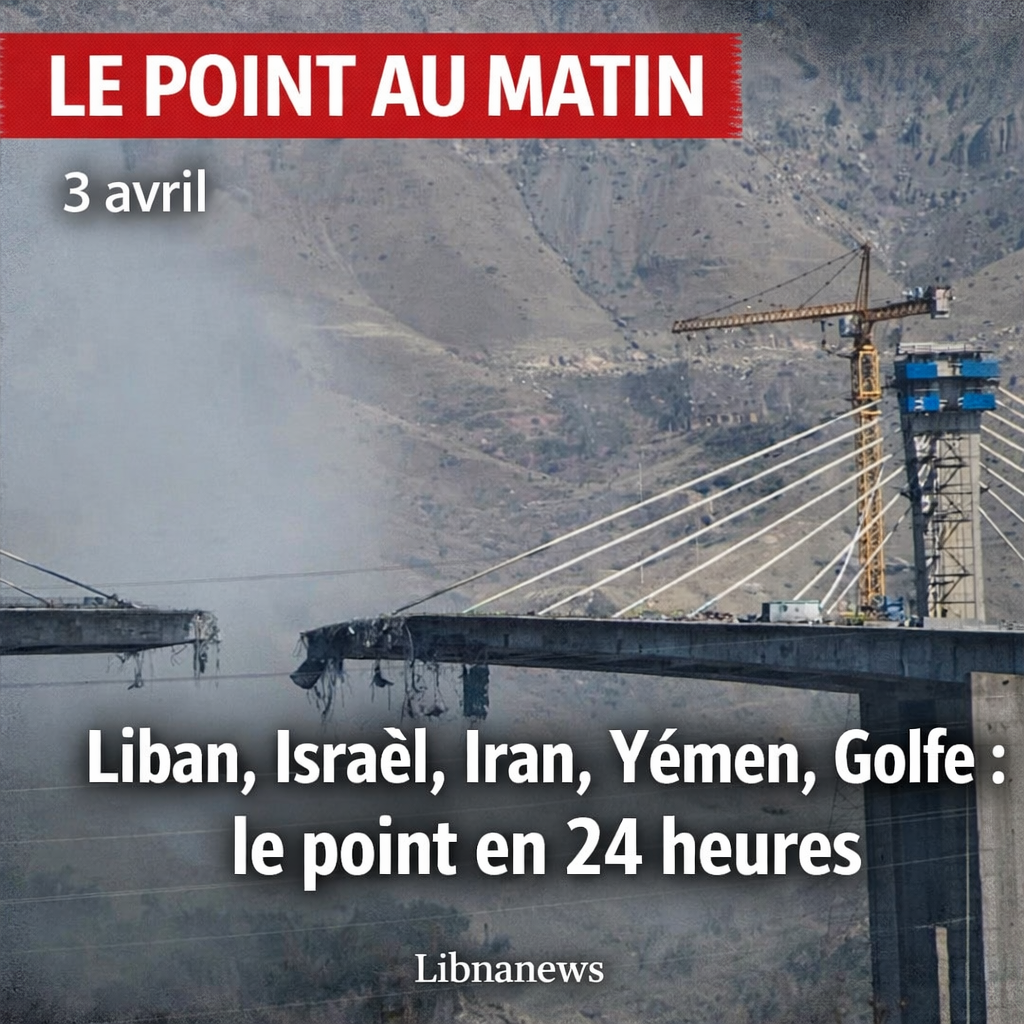
In the space of 24 hours, the regional sequence was further hardened. The Lebanese southern front experienced a new series of Israeli strikes, with reported deaths in several localities and an extension of the bombings to new areas. On the Israeli side, warnings have increased in the north, while firing from Lebanon and a new wave of Iranian strikes have maintained an open climate of war in several theatres. In Iran and the Gulf, the crisis shifted to energy and navigation, with the de facto closure of the Strait of Ormuz at the heart of tensions and further diplomatic discussions on its reopening. In Yemen, the momentum remains linked to the same regional arc, with announcements of attacks against Israeli targets claimed by Yemeni forces relayed by Lebanese media.
Lebanon plunges into a day of strikes and casualties
In South Lebanon, the last few hours have been marked by a sharp increase in raids. NNA reported Israeli strikes on Tibnin, Sultaniyah and Kfardinin after a day already marked by shelling on Mansuri, Khiam and Zawtar. The same agency also reported that a raid on Zebdine had killed three members of the same family, including a municipal elected official, his brother and their mother. The day before, a strike on Kfarsir had killed three people, according to the results reported by the official agency. The chain of these attacks confirms a steady pace, with several affected localities in less than 24 hours and a human impact that continues to grow in the villages of the South.
LBCI, for its part, reported this Friday the continued shelling of several localities in Nabatiyah, as well as the destruction and burning of houses in villages in western and central areas of the Tyre and Bint Jbeil cazas. The channel also highlighted the latest daily report on aggression, which reported 1,345 deaths and over 4,000 injuries. This figure differs from the report published a few days earlier by the NNA Risk Management Unit, which reported 1,238 deaths and 136,147 internally displaced persons. This difference shows that counts are changing very quickly as the strikes, identifications and institutional updates change. In all cases, the situation remains the same: military pressure is increasingly concentrated on border areas and the human cost remains very high.
The Lebanese political side follows the same alert slope. NNA relayed the words of Prime Minister Nawaf Salam calling for an end to the war and to prevent a deepening of Israeli expansion and internal divisions. At the same time, MTV broadcast an Israeli army alert calling on the inhabitants of several parts of the southern suburbs of Beirut to evacuate, including Haret Hreik, Ghobeiry, Laylaki, Hadath, Bourj el-Barajneh, Tahuitet el-Ghadir and Shiyah. This warning, even without immediate impact confirmed in each district cited at the time of its publication, reflects a return of direct pressure on the southern periphery of the capital. It also revives the memory of previous strikes on the suburbs, documented in recent days by NNA.
On the security front, the terrain remains dominated by a double logic. On one side, Israel expands the map of its strikes in South Lebanon and maintains the threat to Beirut. On the other hand, cross-border fire continues north of Israel. MTV reported, citing the Israeli media, that about ten rockets had been launched from Lebanon to northern Israel on Friday morning, some falling into open areas. The same live tracking page also mentions sirens in and around Kiryat Shmona. These data alone are not sufficient to describe the whole balance of power, but they confirm that the Lebanese-Israeli front remains fully active, with no tangible signs of de-escalation in the very short term.
In Israel, the north under alert and the center under Iranian threat
The Israeli front now has two distinct axes. The first is the Lebanese border. The warnings broadcast by the Israeli media and echoed by MTV indicate that the north of the country continues to live at the pace of sirens, fire and interceptions. The second axis is wider: it concerns Iranian strikes on Israeli territory. Al Manar reported this Friday at dawn a new wave of Iranian attacks on central Israel, reporting significant damage to buildings east of Tel Aviv and an attack on a railway station. The media did not provide, in the accessible extract, a consolidated human assessment, which requires careful handling of this information on a costed basis. The point at this stage therefore remains that of a significant material impact as described by this source, in a context of direct escalation between Tehran and Israel.
This expansion of confrontation also has an immediate political effect in Jerusalem. MTV relayed information from Yedioth Ahronoth that Israel would prepare to hit Iranian energy facilities hard if an American green light were obtained. Again, this is information reported by an Israeli media and resumed live, not a decision officially announced by the Israeli government in the content consulted. But the simple fact that such an option is publicly mentioned tells a lot of the level reached by climbing. Israel is no longer merely responding to its immediate borders. Military computing now openly integrates Iranian energy infrastructure, with major regional implications for markets, the Gulf and navigation.
Iran at the heart of regional climbing
Iran remains the centre of gravity of this sequence. The last few hours have involved military demonstration, diplomatic pressure and economic war. According to MTV, Iranian Foreign Minister Abbas Araghchi warned that a provocative step by the Security Council would further complicate the situation in the Strait of Ormuz. This declaration is part of a phase in which Tehran makes shipping and global energy vulnerability a strategic lever. In parallel, Al Manar relayed an announcement from the Iranian naval force that US military sites and infrastructure in the Gulf were targeted by ballistic missiles and drones. On this point, it is necessary to distinguish clearly the established facts from the claims: the advertisement exists and circulates, but its detailed assessment and its actual extent are not independently documented in the extracts consulted.
The other major data is Ormuz. Reuters, via MTV, reports that Iran has effectively closed the Strait, through which approximately one fifth of world oil consumption flows. According to another Reuters dispatch published by MTV in mid-March, and still cited in the current coverage, traffic has dropped 97% since the outbreak of the war in late February. This figure gives the measure of shock: it is no longer a mere theoretical threat to seaways, but an almost complete paralysis of a vital transition to the global economy. It is this point that explains the outbreak of international diplomatic attention around the Gulf.
The information war also plays a full part. MTV relayed information on charges in Israel against two nationals suspected of security activities for the benefit of Iranian entities. LBCI, for its part, resumed Argentina’s decision to expel the Iranian affairs officer and to classify the Revolutionary Guards as terrorist organizations. These developments do not have the same operational weight as a strike or maritime closure, but they signal diplomatic and judicial tightening in Iran’s environment. In the short term, this further tightens Tehran’s isolation at a time when the country is seeking to impose a balance of power through energy and missiles.
Yemen remains committed to regional war
Yemen does not appear, in the Lebanese excerpts consulted in the last 24 hours, as the main theatre of a new offensive comparable to what is happening in Lebanon or the Gulf. However, it remains part of the regional climbing scheme. Al Manar highlighted on Thursday night an announcement by the Yemeni armed forces that they had targeted Israeli targets in Yafa with ballistic missiles, as well as a statement by Abdel Malik al-Houthi that what happened in Gaza, Lebanon, Yemen, Iraq and Iran was a major lesson for the region. These evidences show that the Yemeni front remains politically and militarily linked to the general confrontation, even if the available extracts do not allow an independent numerical assessment of Yemen for the last 24 hours alone.
This shade is important. In a regional monitoring, the absence of a precise balance sheet is also relevant. It states that at least in the consulted coverage of NNA, LBCI, MTV and Al Manar, Yemeni news of the day is mainly read through its function of supporting or strategically extending the conflict, rather than through a new strictly internal turning point in Yemen. In other words, Sanaa remains present in the sequence, but as a component of an expanded confrontation where the media priority of the last few hours has shifted to the South Lebanon, Israel, Iran and the Gulf.
In the Gulf, the economy is at the forefront
The Gulf now focuses on the systemic dimension of the crisis. LBCI shared on Friday the Chinese statements that the Strait of Ormuz will not regain stability as long as the war with Iran continues. The channel also broadcast British positions stressing the urgency of reopening the sea lane. For its part, Reuters, via MTV, announced that a meeting led by London with about 35 countries, including France, Germany, Italy, Canada and the United Arab Emirates, should examine ways of restoring freedom of navigation. The United States was not to participate in that meeting. The major political fact is that the Gulf is no longer just a background to the conflict, it becomes a proper diplomatic theatre, where maritime security structures Western and Arab priorities.
The figures summarize the magnitude of the risk. Reuters recalls, in the MTV report, that about 20% of world oil consumption goes through Ormuz. Such a logistic node, when it blocks, far exceeds the only riparian countries. It reconfigures transport costs, energy prices and, ultimately, global inflation. MTV has already noted in recent days that oil had crossed 100 dollars a barrel for the first time since 2022 in the wake of the war around Iran. Although this data does not belong strictly to the 24-hour window, it helps to understand why governments are multiplying emergency meetings: the issue is no longer solely military, but is commercial, financial and social worldwide.
For Lebanon, this economic dimension is not abstract. On MTV, Nicolas Chambas, secretary general of economic organizations, estimated that the daily cost of the war was about $100 million and that the Lebanese economy had reached the bottom. This figure, put forward in a media statement and not in an official statistical document published in the excerpts consulted, nevertheless gives an idea of the level of pressure that the country is facing at the same time as it confronts strikes, displacements, local destruction and regional rise in energy prices. Thus, the military and economic fronts are now fully united: the South pays in homes and lives, the whole country also pays in liquidity, activity and trust.
A five-point regional balance sheet
The first fact of the last 24 hours is the proven intensification of Israeli strikes in South Lebanon, with several affected localities, at least nine deaths reported from three separate NNA attacks reported between Kfarsir and Zebdine, and a Lebanese overall assessment that continues to rise according to local media and institutions updates. The second is the continued firing from Lebanon into northern Israel, with new warnings and rockets reported on Friday morning. The third is the continuation of Iranian strikes against Israel, with material damage described by Al Manar in the Tel Aviv area. The fourth is the de facto closure of Ormuz, which brings war into a global energy phase. The fifth is the persistence of Yemen in regional mechanics, less by a new internal shift documented in the last few hours than by demands for attacks and political alignment assumed on the ongoing confrontation.
This table does not only indicate a worsening. It also shows a transformation of the crisis. Even yesterday, the focus of attention was on exchanges of fire and human balances. Today, war clearly extends to infrastructure, energy, maritime routes and crisis diplomacy. Lebanon remains one of the most exposed territories, both as a direct military front and as an economy weakened by the consequences. Israel faces a multi-front pressure. Iran assumes a strategy of deterrence through disruption. Yemen remains in the equation. And the Gulf becomes the point where the local conflict turns into a global crisis.






