

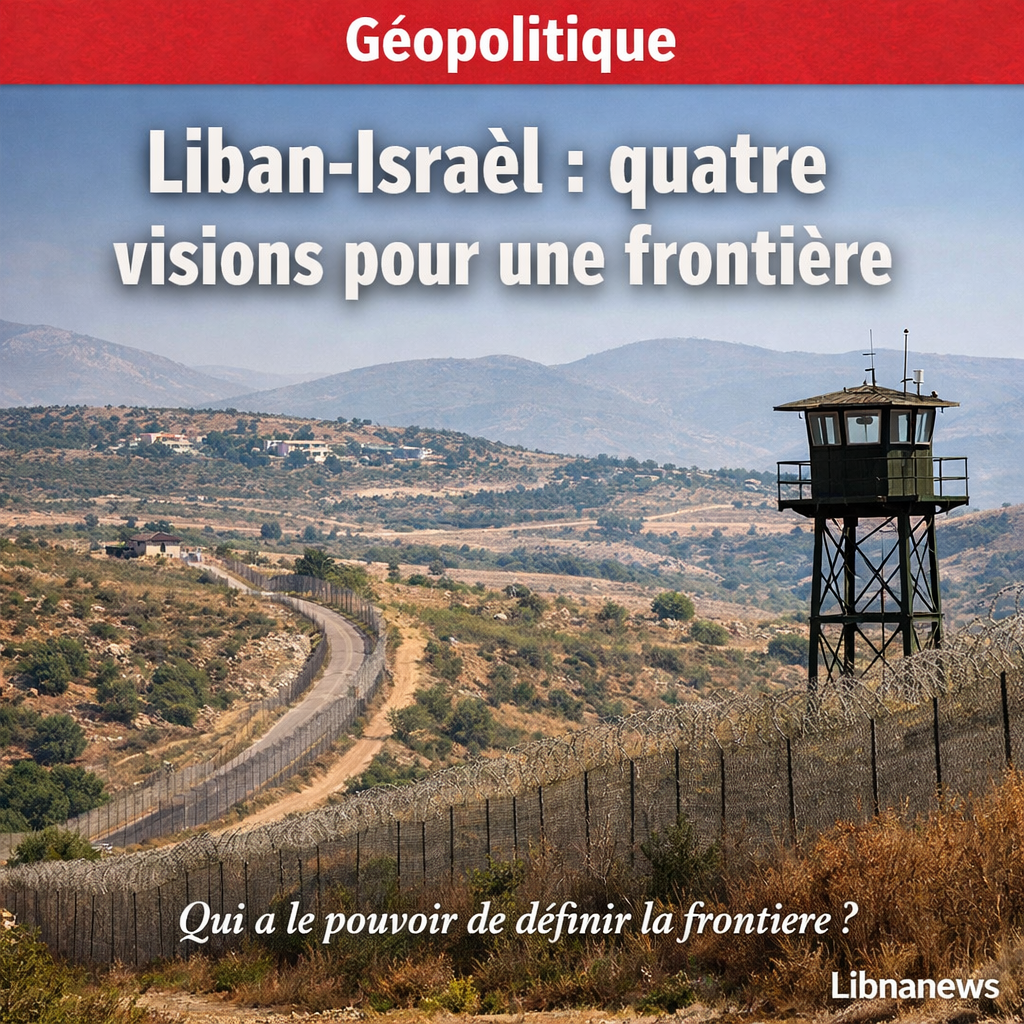
Between rivers, mountains and lines drawn on ancient maps, the Lebanese-Israeli border concentrates more than just a geopolitical issue: it is a mirror of the contradictory visions that cross Israel’s history. From maps of the nations of the Middle East that emerged from the First World War, to myths, religion and biblical references, all these visions are mixed in the head of each Israeli.
The first is pragmatic: a sovereign Lebanon, recognized within its present borders, at peace with Israel. Stability and diplomacy prevail, the line is to be secured, not redesigned.
The second dates back to the early Zionist debates of the 20th century: some wanted to extend the northern border to Litani for its waters and defence. Idea abandoned by colonial powers, but never completely forgotten. It is currently being released by Israel’s Finance Minister Bezall Mostrich.
The third is almost mythical: the Awwali River, which means « the first » in Arabic, north of Saida, considered by some as a symbolic threshold of the Promised Land, or rather considered « the first river of the Promised Land ». Anecdotes, private gestures, intimate memories testify to this link between geography and identity. The testimony of Lebanese friends with Lebanese Jews tells how in the 1960s the Jews of Beirut wanted to be buried at the top of Saida rather than the top of Beirut, because he is in Promised Land and they wanted to be buried in Promised Land (which explains that the Jewish top of Saida is much larger than that of Beirut). The same testimony tells how, every time on Awwali, Lebanese Jews took gold powder to throw it into the river as a sign of sacred passage or exit from Promised Land.
The fourth vision is the most controversial: that of a great Israel, a biblical inspiration, which would encompass all Lebanon and beyond. From Nile to Euphrates as the Old Testament says. Often invoked in political debate, rarely implemented, but always presented as a theoretical and religious horizon.
Added to this is an invisible but tangible dynamic: the fragile balance between a limited Lebanese state and a powerful Hezbollah. Every escalation, every unresolved conflict shapes the ground, reinforces Israeli vigilance and, in effect, redefines Israel’s strategic depth.
These visions coexist, intersect and clash. But at the end of the day, the question goes beyond the cards and the sacred texts: it boils down to a single crucial question – who has the power to define the border?
Between history, memory and strategy, the answer remains suspended. And in this grey area, the border is never really fixed. It depends on the provocations of each other allowing Israel to annex territories, by dialectic effect, to each war against the Arabs or against the Iranians and their proxies like Hezbollah in Lebanon.






