

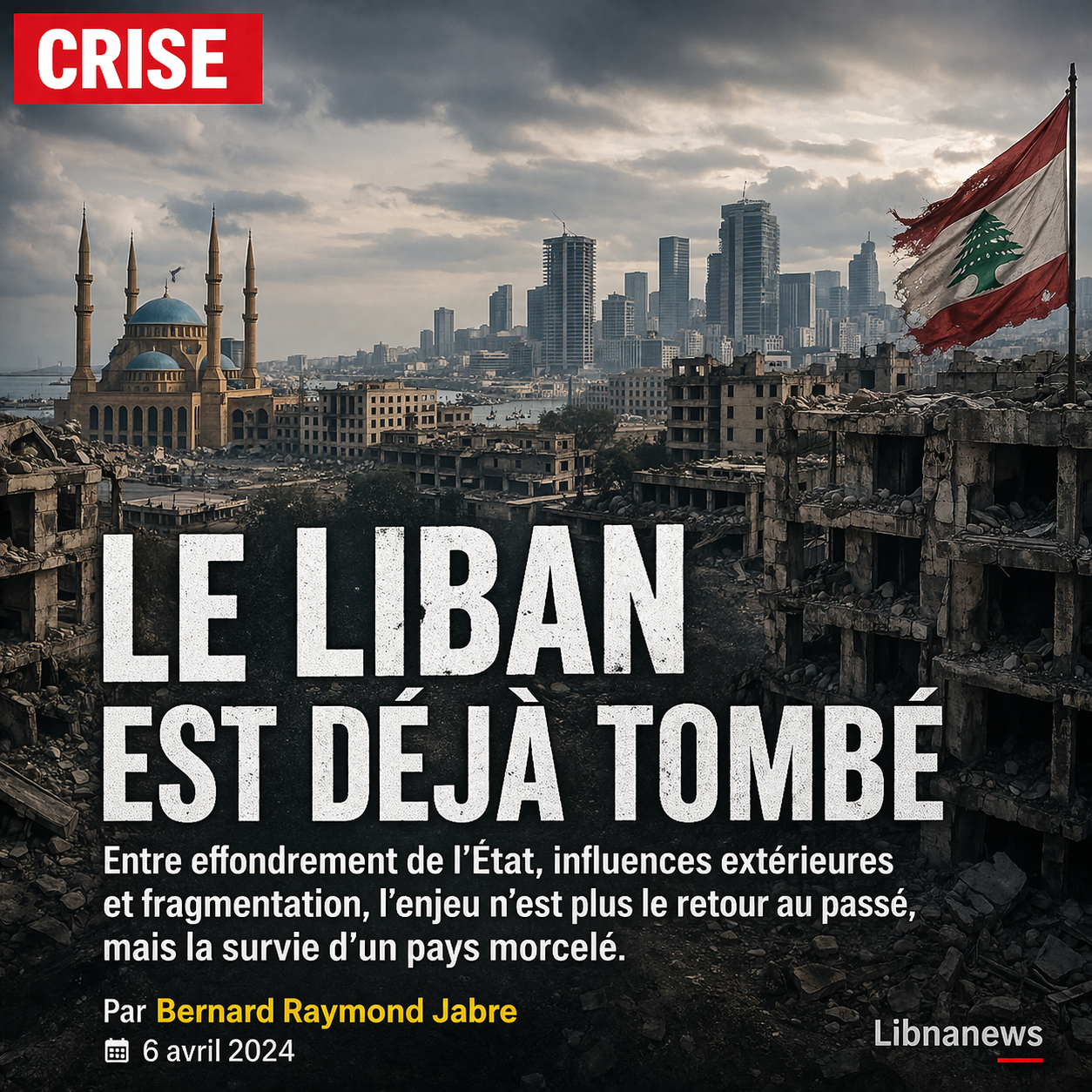
It became almost banal to read that Lebanon would be threatened by collapse. As if the collapse was still coming. As if the country was still standing, flickering but recoverable.
This reading is comfortable. It maintains the idea that a break-up remains possible, that a reform, mediation or political compromise would be sufficient to reverse the trajectory.
But it’s wrong.
Lebanon does not collapse. He’s already collapsed.
Since 2019, the state’s pillars have ceded: money, banks, justice, public services, decision-making capacity. What remains is not a weakened state, but a structure emptied of its substance, crossed by forces that exceed it. The country no longer functions as a sovereign entity, but as a space where external influences, competing affiliations and non-national logic intersect.
In this context, defending the status quo is slowly administering an already consumed collapse.
At the heart of this denial persists a major ambiguity: that of Hezbollah.
Often presented as a Lebanese actor that should be contained or integrated, it is actually a hybrid structure — both rooted locally and embedded in a regional strategy led by Iran. This dual nature places some of the fundamental decisions, particularly those relating to war and peace, outside the framework of national sovereignty.
Recognizing this reality does not mean denying its local anchor. This means admitting that the Lebanese State no longer fully controls its own territory.
However, reducing the situation to one responsibility would be a mistake. Regional dynamics follow a recurring logic: non-state actors trigger sequences that States then exploit to redefine power relations — sometimes to borders.
In this game, Lebanon is not an actor. He’s the field.
Therefore, the question is no longer how to restore a Lebanon as imagined, but in what form it may still exist.
Another illusion persists: that of a unified, neutral and sovereign nation-state capable of absorbing deeply divergent memberships.
The facts say the opposite.
The country is structured by multiple loyalties — Sunni, Shiite, Western, local — that do not converge into a common project. This fragmentation is not accidental. It is constitutive.
Two temptations arise from this.
The first is to artificially maintain unity, at the cost of chronic paralysis.
The second is to consider a net partition, at the risk of violent conflict.
None of these paths are viable.
The first prolongs illusion. The second would open a phase of war, as the populations are intertwined and the balances fragile.
Between the two sets out a third option: organised fragmentation.
A Lebanon that would remain formally unified but operate as an implicit confederation of autonomous areas. A legal unit, a decentralized reality.
This model already exists in germ. The country functions as a mosaic of territories with distinct balances, linked by a weakened centre. The challenge is not to create this reality, but to stabilize it.
This implies clear red lines: no territorial expansion, no internal confrontation, and a form of relative neutrality that prevents Lebanon from becoming a permanent battlefield again.
None of this is guaranteed. But continuing to reason in terms of classical nation-state is even less.
Lebanon has entered an in-between: neither fully sovereign State nor officially fragmented territory. A space where reality has already exceeded the political categories that are supposed to describe it.
To accept does not mean to resign, but to change the frame.
For what is being played is beyond Lebanon itself. The country is a laboratory for a broader transformation: that of weakened states faced with stronger identities and transnational influences.
In this context, rebuilding a central state without treating fractures amounts to masking cracks. Conversely, to endorse a score would be to institutionalize the breakup.
Between these two extremes, a pragmatic organization of the real becomes necessary.
First, it implies a change of language: sovereignty must be effective, concrete neutrality, structured unity — or they are nothing.
It then requires a profound political transformation: real decentralization, implicit recognition of territorial balances, and a central state focused on its essential functions — arbitration, coordination, representation.
Finally, it requires a minimum of common rules: limitation of internal conflicts, shared framework for strategic decisions, economic coordination. Otherwise, fragmentation would turn into dislocation.
For dislocation is not an abstraction. It means violence, displacement, closure of territories.
The choice that Lebanon faces is therefore not between unity and division, but between two forms of division: one organized and contained, the other suffered and destructive.
It’s a difficult choice, but it’s a must.
The country can no longer be defined by what it hopes to become again. It must be built from what it is.
This requires clarity and courage — two scarce but still present resources.
For basically, the question is no longer whether Lebanon can be saved as it was.
The only question is this:
Can he transform himself without destroying himself?
If he fails, others will decide for him.
If he succeeds, he will demonstrate that a country can fall
and yet choose not to disappear.






