

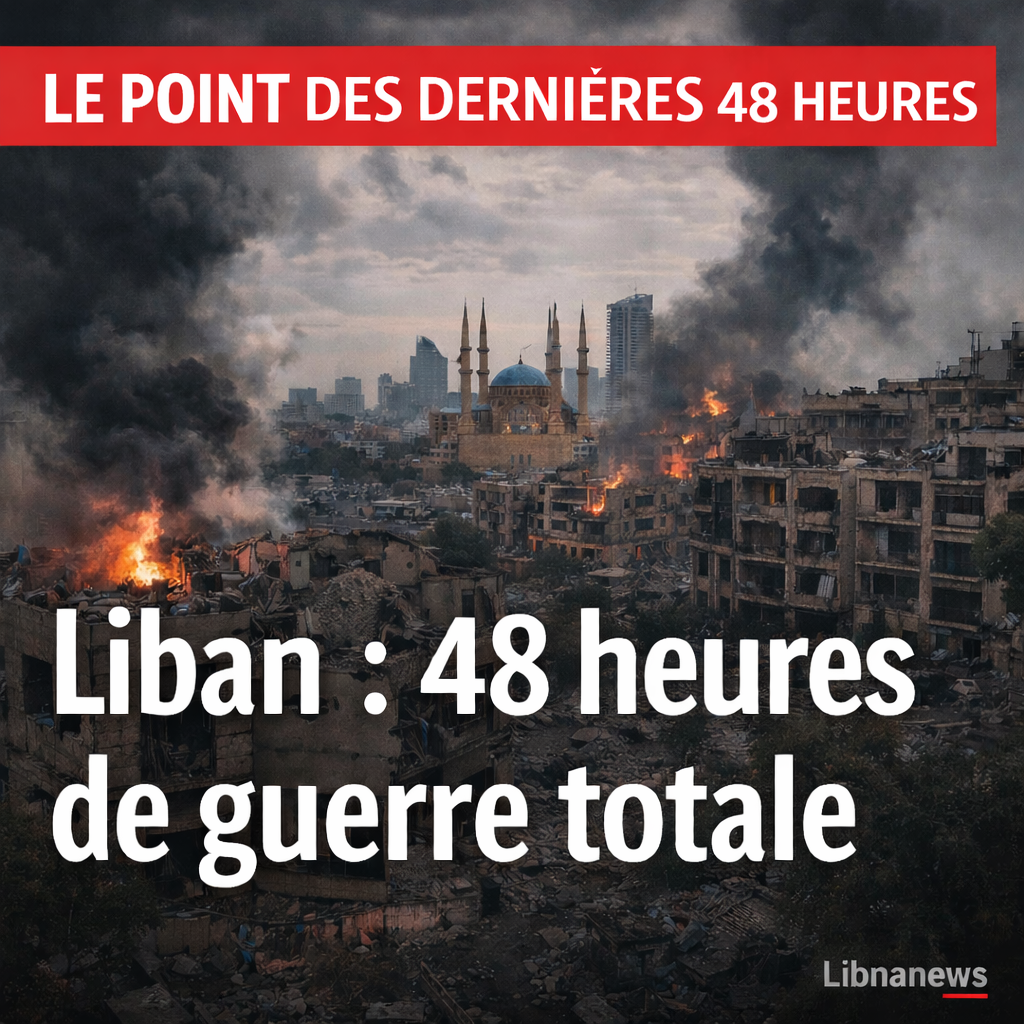
In 48 hours, Lebanon saw several fronts superimposed in the same movement: strikes on the South, bombardments at Jnah and Ghobeiry, a murderous raid on Ain Saadé, new tensions around UNIFIL, responses claimed by Hezbollah and an alarm signal from a Lebanese State that documented the losses without controlling the escalation. The dispatches show a bigger reality than a series of isolated incidents: the war is spreading, getting closer to urban centres and becoming politically more flammable within Lebanon itself.
Since Saturday morning, Lebanon has turned into a new phase of war. In 48 hours, Israeli strikes struck the south, Beirut, its southern suburbs, Jnah, Ghobeiry, Metn with Ain Saadé, but also the West Bekaa. The pace of alerts, evacuations and bombardments has accelerated significantly. This sequence is no longer confined to limited exchanges along the border. It draws a broader, more mobile, deeper front, where civilian areas, local infrastructure, roads and the vicinity of sensitive settlements are directly exposed. NNA, MTV Lebanon, LBCI and Al Manar describe, with sometimes different angles, the same reality: the conflict now strikes several scales of Lebanese territory at the same time. Reuters also notes that this is one of the most intense days since the resumption of hostilities in early March.
The first highlight is the method. On Beirut and its periphery, the Israeli army preceded several strikes by public warnings of evacuation. LBCI reported an alert targeting several areas of the southern suburbs, including Haret Hreik, Ghobeiry, Laylaki, Hadath, Borj el-Brahneh, Tahuitet el-Ghadir and Shiyah. In Ghobeiry, a message relayed by the chain asked the inhabitants to leave the area immediately and to stand at least 300 metres from the target building and nearby structures. Soon after, the strikes followed. This mechanism has become a signature of the ongoing escalation: a public warning, a very short evacuation window, and then a rapid attack in a dense urban fabric. In practice, this does not eliminate civilian risk. On the contrary, it creates panic scenes, crowd movements and extreme pressure on rescue.
Jnah and Ghobeiry, the return of war to the heart of urban space
The strike on Jnah focuses much of the violence of the last few hours. According to the Ministry of Health’s emergency operations centre, relayed by MTV Lebanon and then by LBCI, the bombing resulted in at least four deaths and 39 injuries in its initial assessment. Al Manar located the attack in a residential area opposite the entrance to Beirut’s government hospital, i.e. close to Rafic Hariri Hospital, the country’s main public hospital. LBCI reported that people were leaving the settlement in fear of further strikes, while smoke was rising above the area. The message is heavy: the wave of military and psychological shock not only affects the targeted neighbourhoods, it also reaches the places of care, therefore one of the last remaining areas of stability accessible to civilians.
MTV added an element that illuminates the logic of the raid. The chain reported that Yahya Hussein Mshaimesh, presented as a military official of Hezbollah, had been killed in Jnah’s strike. If this identification is confirmed, the attack would fall into the category of targeted strikes conducted in dense urban areas. This hypothesis explains both the apparent accuracy of fire and the high level of collateral human damage. It shows above all that the war is no longer confined to the rural or border South. It moves to the heart of the beyruthin urban space, where human density makes every operation potentially more lethal and politically sensitive. At the same time, Ghobeiry was again targeted after warning, confirming that the southern suburbs remain a privileged scene of targeted pressure and beheading strikes.
Ain Saadé, the raid that changes the political scope of the conflict
The most destabilizing attack inside is probably that of Ain Saadé, in Metn. LBCI reported that an apartment had been targeted in that town northeast of Beirut. The chain then indicated that the first technical findings appeared to be compatible with two aerial bombs, while noting that the Lebanese Army Engineer Regiment was continuing its verifications. This detail counts. It suggests not a secondary explosion or a mere diffuse impact, but a deliberate operation on a residential building. In a country already crossed by internally displaced persons, temporary rentals and temporary occupied housing, this strike immediately raised a question: who or what was actually targeted in this apartment.
The first information relayed by LBCI and MTV gave this strike a national political dimension. Pierre Moawad, head of the Lebanese Forces in Yahchush, was announced among the dead. MTV then reported that three bodies had been transferred to Dahr el-Bachek Hospital: Pierre Moawad, his wife and Rola Haddad, while two wounded were also taken care of. In another sequence, MTV relayed sources according to which two bodies had first been removed from the rubble, before the balance sheet became clear. The mayor of Ain Saadé, Maurice Asmar, stated on MTV that the apartment concerned was considered unoccupied by the inhabitants of the building, while stressing that the municipality had lists and data on the displaced persons present in the area. This contrast between the apparent target and the supposed use of the site already feeds all the hypotheses.
Politically, Ain Saade crossed a threshold. On MTV, MP Razi El Hajj spoke of a tragedy and a very heavy price paid for a war in which, according to him, Lebanon was led by Hezbollah. Melhem El Riahi also wrote the death of Pierre Moawad in the reading of a country caught up in « wars of others » on his soil. Beyond the formulae, the raid opens a deeper debate on the spread of the conflict in areas that were not considered direct military bastions, on the conditions for renting apartments to unidentified displaced persons or occupants, and on the State’s inability to impose minimum security traceability in residential areas. This dimension explains why Ain Saadé is not perceived as another bombardment, but as an internal political shock.
South Lebanon remains the epicenter, with more widespread violence
If Beirut and Metn have captured attention, the South remains the heart of the drama. NNA reported seven deaths, including one child, in a strike on Kfarhatta. This assessment, also included in the international coverage, summarizes the brutality of the sequence: an evacuation order, an attack, and then a large number of civilian casualties in a southern town. The same agency also reported attacks on Al-Hosh and Al-Bazourieh, while MTV reported two casualties in Borj Rahhal on 6 April in the morning, with aircraft flying over Tyre and also firing at Arzoun and Ghadoorieh. On a single day scale, this geographic dispersion shows that the pressure does not follow a single line. It spreads from village to village, in brief but repeated sequences, making civilian life almost impossible.
Another local episode marked the last hours: the strike on Aabba, relayed by MTV after the NNA, killed Mayor Mohammad Hussein Tarhini, a municipal police officer, a young man of the same surname and a fourth person. A few hours later, MTV was still relaying, still on the basis of NNA dispatches, a series of intense strikes on Mashghara, Sohmor, Qalia and Zellaya in the West Bekaa, with the destruction of several houses. This shift towards the West Bekaa confirms that the depth of the strikes is widening. The conflict is no longer only Southern in its national perception. It extends in successive pockets and affects municipal officials, local agents, families and transit areas. Each new strike adds a civic dimension to the war, as it strikes ordinary fragments of local administration and daily life.
Main facts over the last 48 hours
| Area | Reported | Balance sheet or main detail |
|---|---|---|
| Jnah | Hit near Beirut Government Hospital | 4 dead, 39 injured in initial assessment |
| Ghobeiry | Warning of evacuation and then strike | order to move away at 300 meters |
| Ain Saadé | Apartment targeted in Metn | death of Pierre Moawad and other victims according to MTV |
| Kfarhatta | Hit the South | 7 deaths including 1 child |
| Borj Rahhal | Raid reported on the morning of 6 April | 2 victims according to MTV taking over NNA |
| Western Bekaa | Hits in Mashghara, Sohmor, Qalia, Zellaya | several houses destroyed |
The last 48 hours also show that airspace itself serves as a psychological weapon. NNA reported the resumption of Israeli low-altitude flights over Beirut and Mount Lebanon. This may seem secondary to human balance sheets, but it is not. Permanent overflights maintain a state of continuous alert, exhaust the inhabitants and complicate civilian interventions. The inhabitants no longer live only under the threat of a strike. They live in permanent expectation of the next strike. This aural, visual and nervous war transforms each neighbourhood overflew into an unstable zone, even when no explosion has yet taken place.
UNIFIL raises tone and recalls its right to self-defence
The most commented passage of the past few hours concerns UNIFIL. LBCI relayed a communiqué in which the United Nations force was extremely concerned about the attacks by Israel and Hezbollah in the vicinity of its positions, warning that they could potentially provoke fire in return. This formula has been extensively discussed because it is unusual in its sharpness. It does not mean that UNIFIL changes its nature or adopts an offensive mandate. It means that a UN force, when directly threatened, publicly recalls that it can act in self-defence. In the Lebanese context, this reminder is already sufficient to measure the degree of danger reached around certain positions.
This warning does not happen in the vacuum. Reuters and the NNA recalled the week before that a Blue Helmet had been killed and another seriously injured following the impact of a projectile on a UNIFIL position near Adchit al-Qusayr. Reuters also reported that two other Indonesian peacekeepers had been killed in a separate road explosion. In such an atmosphere, the sentence on the possible « return shot » takes on an operational rather than a theoretical meaning. UNIFIL does not seek to enter the war. She noted that she would not accept being treated as a neutral presence that could be exposed indefinitely to crossfire without consequence. It’s a change of tone, if not of mandate.
Hezbollah displays the response and wants to show that it still holds the front
Faced with the intensification of Israeli raids, Hezbollah seeks to preserve an image of operational continuity. LBCI reported that the movement had claimed to have targeted an Israeli warship 68 nautical miles off the Lebanese coast with a cruise missile. Al Manar, for his part, published a series of military communiqués for 5 April, detailing attacks on military rallies, infrastructure and Meron base, as well as a shooting at Nahariya and other positions. This avalanche of communiqués responds to a well-known political logic: to show that, despite deep strikes, the movement retains the initiative of the response, the ability to reach various targets and a front control discourse.
But this communication also reveals the asymmetry of the moment. Hezbollah claims, publishes, details, while Israel strikes on a much wider territorial perimeter, combining air operations, evacuation warnings, road strikes and pressure on communities. Reuters already noted at the end of March that Israel had the objective of establishing a buffer zone to the Litani. Whether this objective is fully feasible or not, it sheds light on the coherence of the last few hours: the aim is not only to respond to fire, but to re-design a safe depth by force, gradually emptying certain areas, destroying support points and making any military or logistical presence of Hezbollah south of the river more and more expensive.
The affected Lebanese army, the state camped on diplomacy
Another important signal of these 48 hours is the death of a Lebanese Army soldier in an Israeli attack in the south, reported by both LBCI and Reuters. In the Lebanese system, this is politically cumbersome. The army is neither Hezbollah nor a partisan formation. When a military member of the state institution falls under attack, the theoretical distinction between non-state military front, public structure and civilian territory becomes even more blurred. It also reveals the structural weakness of the state: present as an institution, but unable to protect its men, municipalities, axes and localities from regional intensification.
At the same time, President Joseph Aoun maintains a diplomatic line. LBCI relayed its willingness to continue efforts to « save what remains of Lebanon ». Consolidated figures show the scale of the emergency. According to NNA, the total number of deaths since 2 March was 1,461, that of the wounded 4,430, with 137,774 displaced. Reuters reported that 39 people had been killed in the 24 hours prior to his count on 5 April. These numbers do not only describe a humanitarian crisis. They also say that no strictly local response is today at the height of an escalation that clearly exceeds the only Lebanese theatre. The state manages, documents, alerts and negotiates, but it no longer controls military tempo.
What the last 48 hours say about the future
Three trends are evident. First, the bombings expanded in depth and diversity. The South remains the hard core, but Beirut, its suburbs, the Metn and the Western Bekaa were hit in the same sequence. Second, the domestic political cost increases. Ain Saadé has revealed how a strike in a residential area of Mount Lebanon can produce an immediate national shock. Finally, UNIFIL has shown that even alleged actors on the margins of the central duel are now on the verge of direct contact with violence. When peacekeepers publicly recall their right to reply in the event of a threat, this means that the residual security margin has seriously narrowed.
The most immediate concern is the gross number of incidents less than their combination. Targeted attacks in dense areas, attacks on villages in the South, the death of a Lebanese soldier, the death of municipal officials, the extension to the West Bekaa, the raid on Ain Saadé, the tension around UNIFIL, the proliferation of Hezbollah military communiqués: each of these elements would already be serious in isolation. Together, they report a war that ceases to be seen as a limited front to become a national, territorial and political security crisis. Lebanon thus enters a phase in which every new hour can produce not only a heavier human balance, but also a political fact that can defeat the country’s internal lines.






