

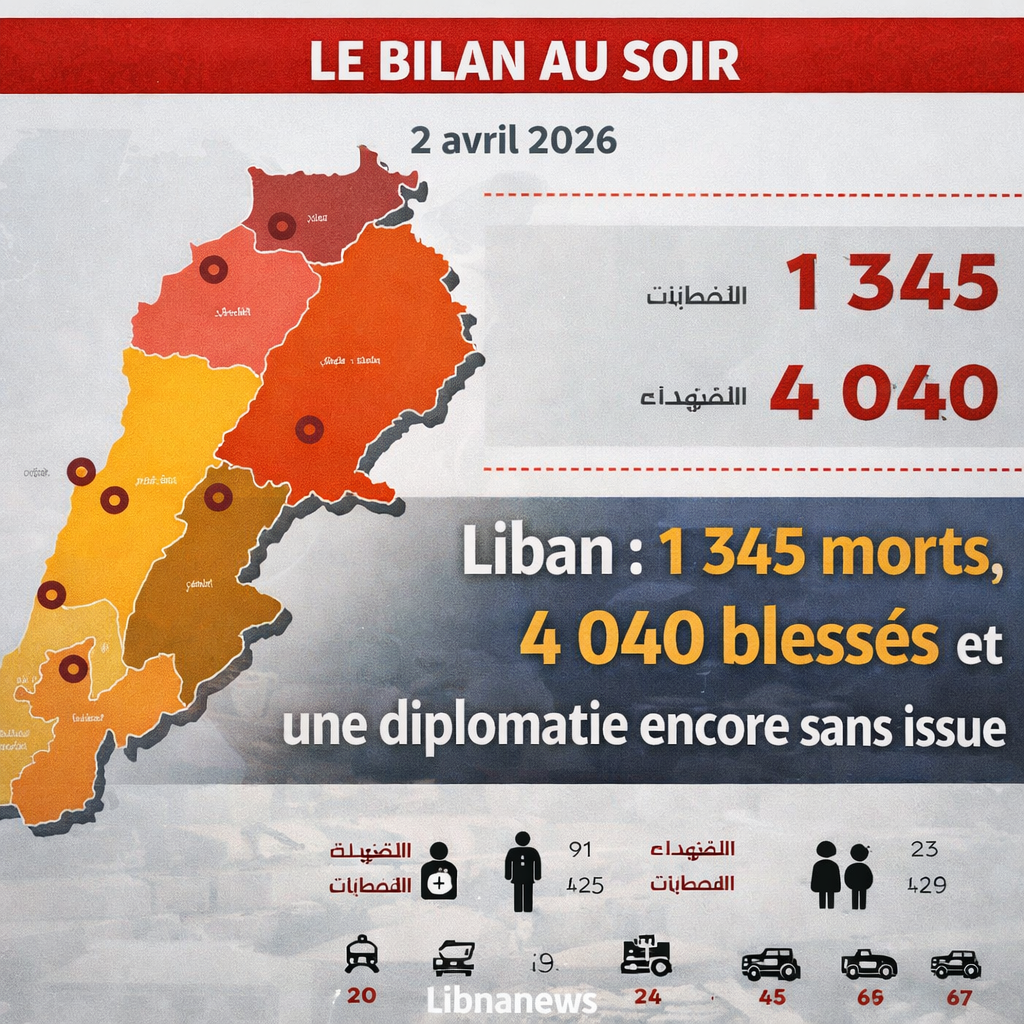
The human record continues to grow in Lebanon, as the war enters its second month without a clear prospect of a halt. According to the daily report released by the Ministry of Health on Thursday, 1,345 people have been killed and 4,040 injured since 2 March. At the same time, the bombing continues, while Beirut, Israel and Iran maintain incompatible diplomatic lines at this stage. As the figures rise, the gap widens between the speed of destruction and the slow pace of political opportunity.
The human record continues to grow in Lebanon at the pace of a war that enters its second month without a clear prospect of a halt. In its daily report issued by the Centre for Emergency Health Operations on Thursday, the Lebanese Ministry of Health reported that the total number of deaths since 2 March had reached 1,345, while the number of injuries now stood at 4,040. In the last 24 hours alone, 27 people were killed and 105 injured. These figures, which are reflected in the results released during the day, confirm that the intensity of the Israeli strikes remains high despite the increase in calls for de-escalation.
The information provided by the Ministry further refines this table. It shows that 125 of the deaths recorded were children, 91 women and 1,129 men. On the injured side, 430 children, 486 women and 3,124 men were reported. The health sector is also paying a very heavy price. The ministerial visual mentions 53 deaths in the health professions, 137 injuries, 82 attacks on health structures or teams, 20 targeted relief centres, 67 damaged ambulances or rescue vehicles and 5 hospitals forced to close. The image alone summarizes the shift from a border war towards a large humanitarian crisis.
Beyond the gross figure, the report of the day establishes an even heavier political reality. Lebanon no longer faces a series of ad hoc bombings, but a war that redraws the territory of the conflict, massively displaces civilians and gradually exhausts the capacity of the State. On Thursday, Reuters reported that more than one million people had already been displaced in a month, while the Israeli authorities were increasingly showing their intention to maintain or expand a control area in the South. Prime Minister Nawaf Salam himself said that no end was in sight and that no one was today able to say how this war would end or when.
It is in this context that we must read the situation of the day, between bombings, aggravation of the human balance and simultaneous diplomatic activism in Beirut, Israel and Iran. In the field, the strikes continued to affect inhabited areas. The Associated Press reported on Thursday that a strike on Zebdine in Nabatiyah governorate had targeted a residential building and killed three members of the same family, while another attack on Ramadiyeh in Tyre district had resulted in four deaths and three injuries. This continuity of the strikes shows that the day of 2 April did not constitute a pause, but a new stage of a war that continued into civilian localities.
Beirut tries to hold together the humanitarian emergency and the political battle
In Beirut, the Council of Ministers attempted to respond on two fronts: the political front and the social front. Nawaf Salam reiterated that Lebanon had become the « victim of a war » imposed on the country and said that the government would redouble diplomatic and political efforts to get the fighting stopped. He also recalled the official position of the executive that the decision on war and peace should remain in the hands of the State. In his speech, he linked the continuation of the bombings to broader Israeli objectives: expansion of occupation, creation of buffer zones and mass displacement. Reuters points out that this line is now at the centre of the Lebanese government message.
At the same time, the Lebanese government wants to prevent the external war from turning into an internal divide. Salam stressed the plight of internally displaced persons, who were the first victims of a war they neither chose nor decided upon, and called for increased international support for their accommodation and care. In the same vein, he addressed a sustained greeting to the inhabitants who remained in their cities and villages in the South. This link between sovereignty, national solidarity and support for civilians has become the matrix of official Lebanese discourse. It aims to hold together the humanitarian emergency and the refusal of a shift in the country towards a civil war that has been unleashed.
On the diplomatic front itself, Beirut continues to rely on a political initiative without achieving, at this stage, a visible breakthrough. Reuters states that President Joseph Aoun’s call for direct discussions with Israel has not yet been answered. At the same time, the Lebanese authorities are seeking to mobilize more Arab and international support for a cessation of hostilities, while the idea of a Lebanon transformed into a secondary theatre of regional war is becoming increasingly central to official statements. This gap between Lebanese diplomatic voluntarism and the lack of a concrete outlet feeds the impression of a country which pleads, but which has not yet mastered the levers of exit from crisis.
This official line is coupled with a battle of internal credibility. The government wants to convince that it continues to act despite the asymmetry of the military power ratio. But the longer the war lasts, the more pressure rises on the executive to produce something other than a language of denunciation. Lebanese diplomacy therefore seeks to avoid a double failure: the external failure of an initiative ignored by Israel, and the internal failure of a State perceived as incapable of preventing war, protecting civilians or curbing social collapse. This is also the reason for the increasing number of speeches on internally displaced persons, on sovereignty and on the exclusive role of the State in the decision to war.
In Israel, conflicting signals on negotiation
Israeli signals remain contradictory. As early as mid-March, LBCI reported, in a dossier that continues to shed light on the current blockages, that negotiating initiatives around the Lebanese front remained blurred and sometimes contradictory within the Israeli power itself. According to the report, Ron Dermer, charged by Benjamin Netanyahu with the Lebanese case, allegedly mentioned the idea of a ceasefire during a visit to Saudi Arabia. At the same time, however, Israeli Foreign Minister Gideon Sa LBCI also noted that Israel was preparing for the engagement of new units in Lebanon and had released more than $840 million for urgent security purchases.
This dual Israeli language weighs heavily on diplomatic prospects. On the one hand, the existence of exploratory channels suggests that de-escalation is theoretically possible. On the other hand, the continuation of military operations, the extension of the threats to southern Lebanon and the discourse on a « fired » negotiation set up a balance of power that reduces the margin for any initiative. The contradiction between the opening of indirect discussions and the demonstrated willingness to reshape the ground militarily has a profound uncertainty about the real intentions of the Netanyahu government. It also explains why, in Beirut, many officials do not yet see Israeli signals as a real offer of exit from war.
This contradiction is compounded by the Israeli strategy on the ground. The speeches on a « safe zone », the prolonged occupation of high points in the South and the repeated strikes against border localities reinforce the idea that Israel seeks first to impose a new military geography before any discussion. In these circumstances, diplomacy appears to be less an instrument of compromise than an extension of the balance of power. It is this reading that dominates today in a part of the Lebanese political class, where it is feared that negotiations, if opened, will come only after a lasting change in military realities on the ground.
Iran maintains a regional line, not a simple ceasefire
In Iran, neither has diplomacy turned into an immediate de-escalation. Al Manar reported on Wednesday the statements of Iranian Foreign Minister Abbas Araqchi, who said that no response had been given to an American proposal in fifteen points. He added that Tehran did not accept a simple ceasefire, but required a complete end to the war throughout the region, including Lebanon, Iraq and Yemen, with guarantees against a resumption of hostilities and compensation for the damage suffered. Araqchi also stated that Iran was preparing to support the war for at least six months if necessary.
This Iranian position directly complicates the Lebanese case. As long as Tehran sets the end of the conflict within a global regional framework, the Lebanese front ceases to be a mere bilateral issue between Beirut and Tel Aviv. It becomes one of the chapters of a larger war, in which exit parameters also depend on the balance around Iran, Iraq, Yemen and the power ratio between Washington and Tehran. This is precisely what the Lebanese government denounces when it states that Lebanon has no interest in remaining a prisoner of external wars on its soil. The difficulty for Beirut is that this analysis is not enough to detach the Lebanese file from the regional framework in which it is now taken.
Other media signals confirm this extension of the diplomatic theatre. On April 1, MTV Lebanon reported that the US allies were exploring diplomatic, economic and military responses to the crisis with Iran. The channel also reported that Tehran had transmitted its positions on the war to mediators, indicating that channels still exist, although their effectiveness remains highly uncertain. The existence of mediation therefore did not disappear. But they are moving forward in a context where military operations continue, public discourse remains maximalist and where each side seems to want to improve its position before any serious discussion.
A human balance that now exceeds the military field
Meanwhile, the human cost continues to expand far beyond fighting alone. The Associated Press noted on Thursday that of the 1,345 deaths reported in Lebanon since 2 March, 53 were registered as caregivers, and 82 emergency medical facilities or services were targeted. A few days earlier, the World Health Organization had denounced several separate attacks against institutions and health workers in southern Lebanon, with direct consequences for access to care. The accumulation of these data draws a war that no longer merely strikes alleged military positions, but disorganizes vital services, emergency response and civilian survival chain.
The Ministry of Health infographic makes this overall degradation visible. Figures on killed and injured children, affected women, affected ambulances and closed hospitals show that the front line no longer corresponds only to the immediate South. The war now extends to the country’s capacity to care for itself, to move around, to accommodate displaced persons and to maintain a minimum of institutional continuity. Perhaps the heaviest data is not just that of the dead. It is that of a public system that must simultaneously absorb strikes, displacements, relief needs and internal political pressure.
At the regional level, this day of April 2 confirms three trends. The first is military: bombardments continue and the balance is still rising. The second is diplomatic: Lebanon pushes for de-escalation, Israel lets filter contradictory signals, and Iran maintains a hard line that goes beyond the only Lebanese front. The third is humanitarian: as the dead, wounded and displaced increase, the question is no longer just how to stop the fighting, but how to prevent the social and health collapse that accompanies their prolongation.
At the end of the day, the most solid point remains that of the Ministry of Health: 1,345 deaths, 4,040 injuries, 27 deaths and 105 injuries in 24 hours. But behind this balance sheet, it is another fact that is needed: the widening gap between the speed of destruction and the slow pace of diplomatic issues. Beirut is still looking for a political door. Israel continues to speak with both its aircraft and conflicting signals. Iran maintains its regional conditions. And on the Lebanese ground, today’s figures add new names to a list that continues to grow.






