

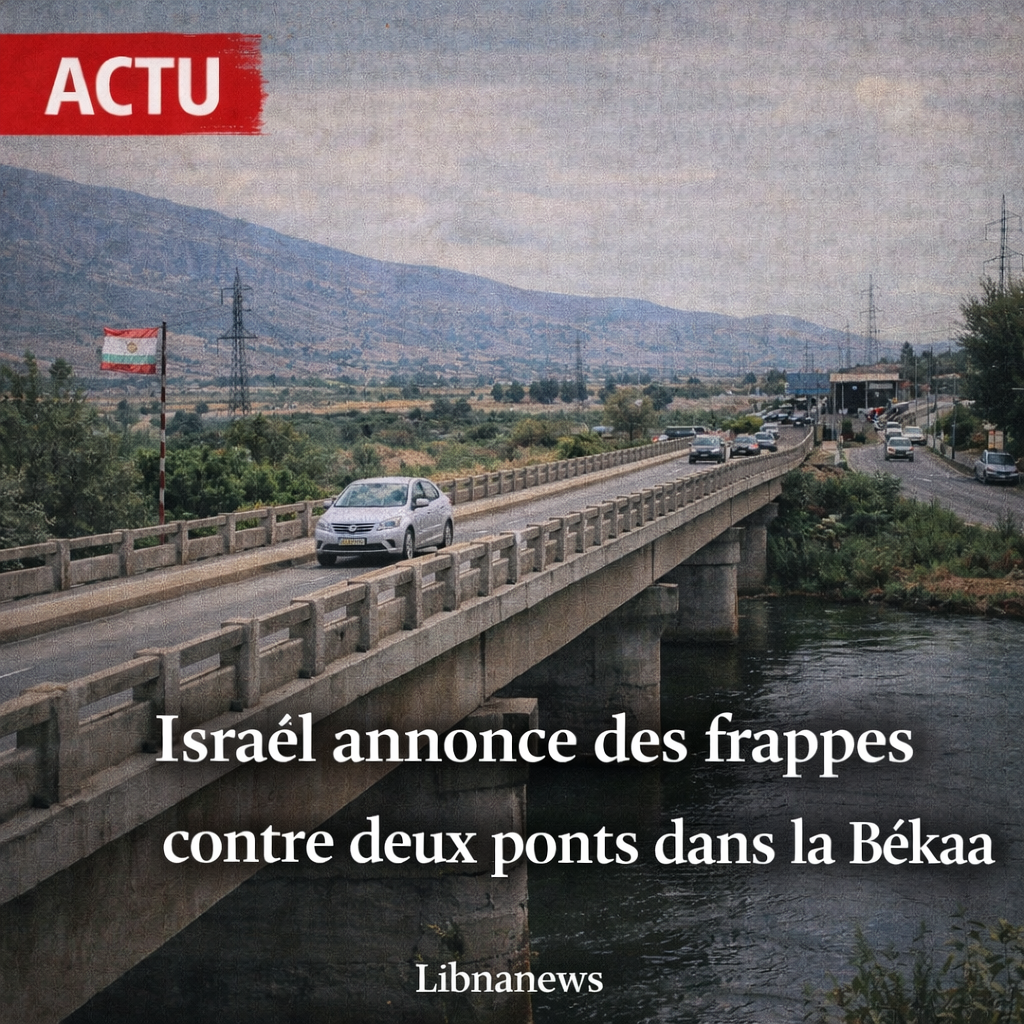
The Israeli army announced on Friday 3 April its intention to strike two bridges in the Bekaa plain in eastern Lebanon. In a message published in Arabic, his spokesman Avichay Adraee claimed that the Sohmor and Machghara bridges would be targeted in order to prevent, according to him, the transfer of reinforcements and means of combat from Hezbollah to the south of the country. The same message calls on the inhabitants to move north of the Zahrani River.
This announcement places for the first time, also explicitly, two infrastructure of the Western Bekaa in the Israeli firing line in the name of the blocking of Hezbollah movements. The localities of Sohmor and Machghara are located in a key area linking western Bekaa, the vicinity of Lake Qaraoun and the roads leading to southern Lebanon. By asking the population to go north of the Zahrani, well beyond the area directly targeted, the Israeli army is also de facto expanding the perimeter of its warning.
A public warning before the strike
The text released by Avichay Adraee uses a formula already used in recent weeks in other sectors of Lebanon. The Israeli army claims to act « because of the activities of Hezbollah » and the transfer of « terrorist elements » under the cover of the civilian population. It therefore presents the announced strike as a preventive operation against lines of communication deemed useful to the Shiite movement. The choice to issue a nominative warning on two specific bridges aims at both preparing the attack and pushing the inhabitants and motorists to evacuate the area before a possible raid.
In the following hours, the Lebanese media relayed the alert as a serious threat against the Sohmor-Mashghara sector. In particular, MTV highlighted the « Israeli threat » against the two bridges, in a context where Bekaa is now more regularly placed in the pressure zones. On the same day, the channel also reported a drone strike at Sohmor targeting members of the church at the exit of a mosque, with two dead and eleven injured according to the NNA quoted by MTV.
A strategy already implemented further south
This new threat comes after several Israeli decisions targeting Lebanese bridges and roads. At the end of March, Israeli strikes had already hit bridges in southern Lebanon, while Israeli Katz had announced that he had instructed him to destroy all the Litani bridges used by Hezbollah. The aim of this crossing targeting strategy is to complicate movement between different regions of the country and prevent the movement of combatants or equipment to the southern front.
The transition to the Bekaa, however, marks a clear geographical expansion. So far, the destruction of bridges had mainly affected areas closer to the southern Litani. By targeting Sohmor and Mashghara, Israel extends this logic to the east of the country, in a region that serves as an interface between the Bekaa and the southward axes. The message sent is twofold: to cut off routes deemed useful to Hezbollah and to show that the depth of Lebanese territory no longer escapes this prohibition strategy.
The Zahrani as a new line of withdrawal
The other highlight of the Israeli announcement is the instruction to the population to move north of the Zahrani. The river, located about 40 kilometres from the Israeli-Lebanese border, is increasingly seen in Israeli military communication as a line of separation imposed on civilians. This is not limited to the immediate environment of the announced target. It draws a wider area in which any movement or presence south of this line is presented as dangerous.
These repeated displacement orders have already been used in other parts of Lebanon over the past few weeks. They are often accompanied by quick strikes following the publication of the warning, which prompts residents to treat this type of message as an imminent threat. Both in Bekaa and in the South, they also contribute to disrupting traffic, local activities and access to villages, even before a strike is actually carried out.
New pressure on eastern Lebanon
Friday’s announcement confirms that the Bekaa is moving more into Israeli war mapping. Until now, this region has been hit by point strikes, but the public targeting of crossing infrastructures gives it new importance. The Sohmor and Machghara bridges are not simple local structures: they structure movements between localities in the West Bekaa and wider roads leading south. Their eventual destruction would therefore affect the mobility of the inhabitants as well as the local logistical capacities.
At this point, the Israeli army has announced its intention to strike, without any assessment of any strikes against these two bridges being further established in the results consulted. But the warning itself is already a military and political fact. He points out that the war on roads, bridges and roads is spreading, and that the east of Lebanon is more directly in the Israeli logic of territorial cut-off.






