

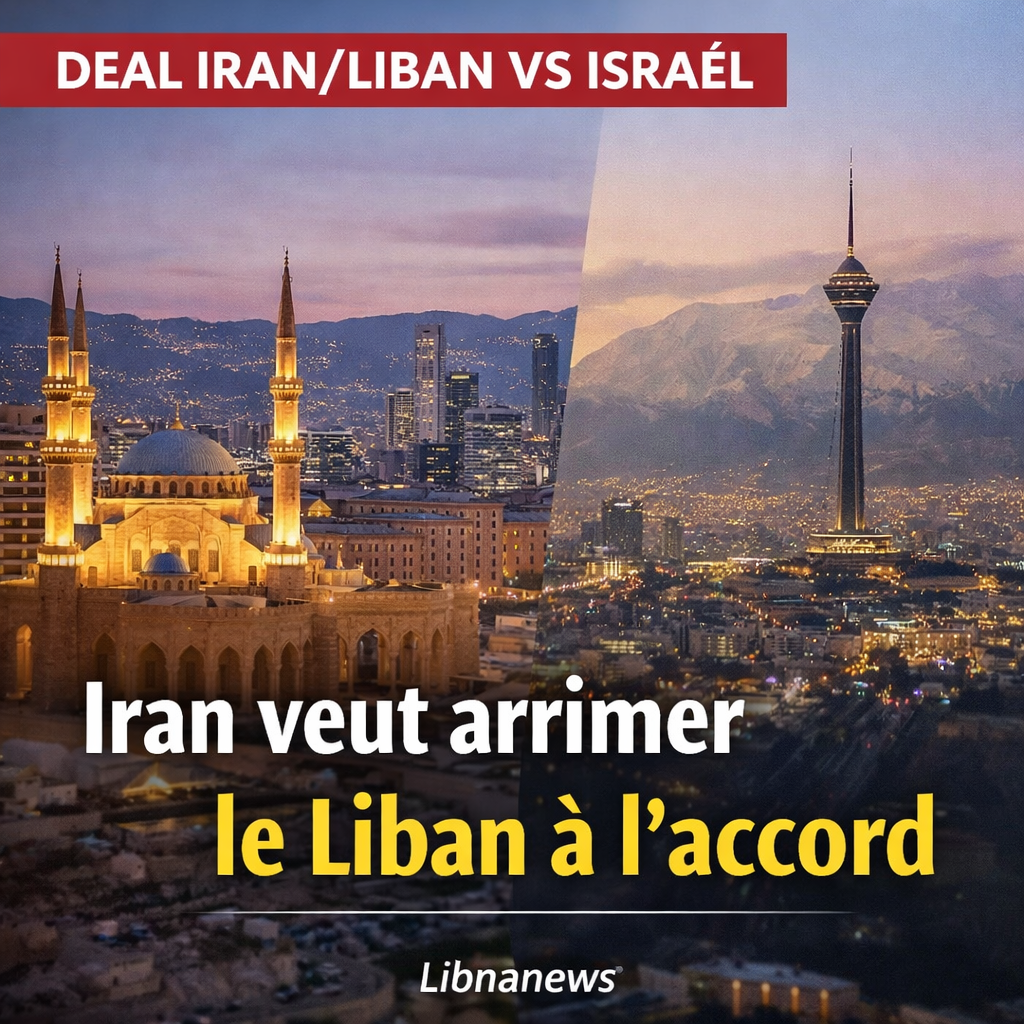
Iran seeks to explicitly link the Lebanese case to the ongoing discussions with Washington. According to reports reported in recent days by regional sources and re-launched on Monday in the Lebanese press, Tehran informed the United States that an agreement could not, in its view, be limited to the Iranian front: it should also include a halt to the Israeli war in Lebanon and the opening of negotiations in that theatre. Otherwise, Iran could respect a ceasefire with Washington while continuing to regard Israel as a target on the regional front. This position was reported on Monday byal-Joumhouriavia a political source close to the negotiations, and it goes along with information previously published by Reuters, according to which Tehran has been asking since mid-March for any agreement to also cover Lebanon.
The central point in this sequence is simple: for Tehran, Lebanon is not a peripheral file. It is a direct extension of the main confrontation with Israel and the United States. This is also expressed by the source cited byal-Joumhouria » Lebanon is an extension of the main stage ». This reading is part of Iran’s strategic logic of protecting its regional allies, first and foremost Hezbollah. Reuters already reported that Iran wanted to halt Israeli strikes against Hezbollah in any global ceasefire, and that the Lebanese movement had been assured of being included in a possible Tehran-supported agreement.
Iranian demand as Washington speaks of « progress »
This Iranian push comes at the very moment when the Trump administration claims that an agreement is moving forward. Donald Trump said on Monday that the United States was engaged in « serious discussions » with what he called a « new, more reasonable regime » in Iran, while threatening to destroy strategic Iranian infrastructure if no agreement was reached quickly and the Strait of Ormuz was not reopened. The Associated Press reported this whileThe Guardianstressed the contrast between this negotiating rhetoric and the maintenance of maximum military pressure.
At the same time, Marco Rubio confirmed on Monday the existence of private messages deemed encouraging by Iranian officials. According to comments from AFP and taken up by several media outlets, the US Secretary of State said he hoped that figures with real power in Iran would take over, citing internal « fractures » at the top of the regime. TheWall Street Journalalso reported that Rubio refused to specify who Trump was referring to when he was talking about a « new » regime, on the grounds that this could endanger potential interlocutors.
This phase therefore creates a special situation: Washington talks about openings, Trump threatens Kharg and Iranian energy infrastructure, and Tehran tries to raise the political price of an agreement by adding the Lebanese front. Lebanon thus becomes an element of negotiation, not as an autonomous dossier, but as a regional variable that Iran refuses to abandon.
Israeli refusal to link the two files
It is precisely on this point that the blocking appears. According to Reuters, Israel rejects the very principle of a link between the agreement with Iran and the Lebanese front, and considers the two theatres separate. In other words, even if an arrangement was reached with Washington and Tehran, Israel does not want that to prevent it from continuing its campaign against Hezbollah in Lebanon. This Israeli line was already visible in the news of last week and it remains consistent with the military decisions announced since.
Even beyond this diplomatic information, Israeli public signals go in the same direction. Israel continued to intensify its operations in South Lebanon, while announcing the expansion of its « security zone » and targeting Hezbollah as its own objective, distinct from the Iranian issue. The PA reported that the Israeli army was continuing its invasion of southern Lebanon to drive Hezbollah out, whileThe Guardianreported expansion of invasion and occupation of areas south of the Litani River. Taken together, these elements suggest that Israel does not treat Lebanon as a mere technical appendix to negotiations with Iran, but as a front to be settled in its own terms. It is an inference drawn from Israeli conduct on the ground and diplomatic information published in recent days.
Why Tehran insists on Lebanon
Iranian insistence responds to several logics. The first is military: Hezbollah remains Tehran’s main regional ally against Israel. The second is political: an agreement that would save the Iranian front while allowing Israel to strike freely in Lebanon would be difficult to sell in the pro-Iranian axis. The third is strategic: by demanding that Lebanon be included, Iran seeks to transform a negotiation centered on its territory into a broader regional negotiation, where its allies would also count in the equation. Reuters already noted that this demand was part of the broader objective of protecting Iran’s allied groups in the region.
The source cited byal-JoumhouriaShe added another element: military pressure would remain, in her view, the fastest way to end the war. This reading joins a regional climate where negotiations are moving forward not in spite of the escalation, but in the middle of it.The GuardianSunday reported that in Pakistan, diplomatic efforts were being carried out in parallel with the war, while the PA referred to American proposals and Iranian counter-requirements already made.
Lebanon, expansion of the main stage
The formula put forward by the source close to the deals is not annoyed: « Lebanon is an extension of the main scene ». It reflects the way Tehran sees the current war. The centre of the conflict is between Iran, Israel and the United States, but Lebanon remains one of the theatres of real power. That is also why the issue of Hezbollah is constantly returning to the discussions on regional war. The PA also noted in recent days that Lebanon had been drawn into the conflict after Hizbullah’s war, and that tensions around Iranian influence in Beirut had risen by one step, to the point that the Lebanese government expelled the Iranian ambassador.
This context weighs directly on negotiations. The more Israel intensifyes its operations in Lebanon, the more Iran has an interest in preventing an agreement with Washington from being interpreted as an abandonment of Hezbollah. On the other hand, the more Washington wants a quick agreement on Ormuz, on American strikes and on de-escalation around Iran, the more the Lebanese case becomes an additional point of friction.
A mediation that now goes beyond Washington-Téhéran
The source cited byal-Joumhouriastates also that several external actors are working to prepare a negotiating framework on Lebanon, including France and Egypt, in parallel with a Turkish-Saudi initiative to end the regional war. Even though these efforts have not yet produced public agreement, the idea of a multiplication of mediation channels overlaps with other press information on the activation of regional capitals.The GuardianMonday reported the meeting in Islamabad of the Heads of Diplomacy of Egypt, Pakistan, Saudi Arabia and Turkey, presented as the draft of a new regional framework for discussion on the war.
This does not mean that a format on Lebanon has already been agreed. This means, however, that, as things stand at present, Lebanon is no longer merely a military front: it is also becoming one of the objects of the early regional negotiations. The problem remains that interests do not overlap. Tehran wants to integrate Lebanon into the agreement. Israel refuses this link. Washington is looking for a quick result on Iran and Ormuz. Beirut suffers the consequences without having a central place at the table.






