

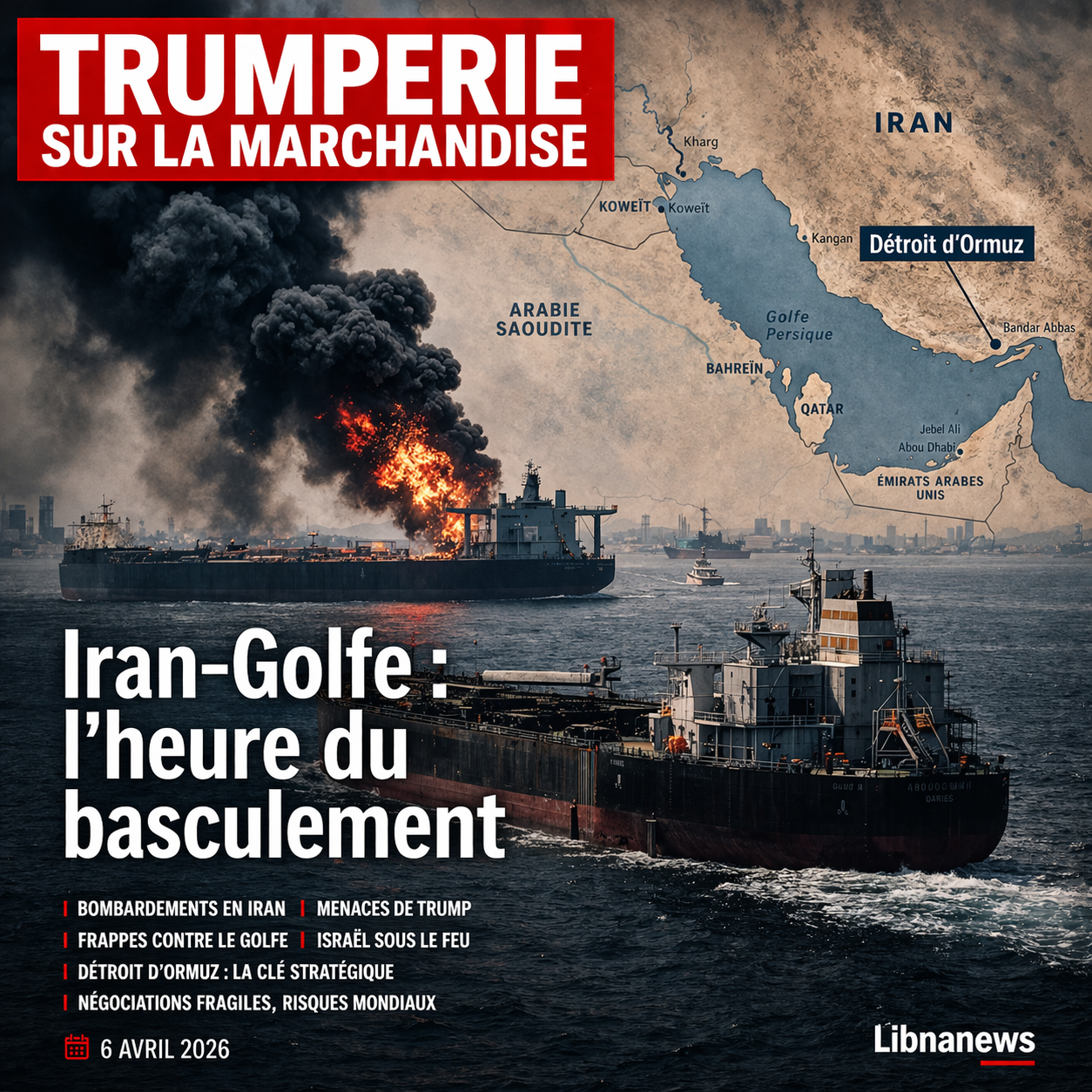
The war between Iran, the United States and Israel has entered an even more dangerous phase. Bombardments on Iranian territory continue. Tehran strikes Israel and Gulf installations. Donald Trump launched an ultimatum on the Strait of Ormuz, while suggesting a negotiation. At the same time, the dramatic rescue of two American airmen shot down over Iran hardened the dramaturgy of the conflict. Behind the threats, one fact is that the crisis is no longer only on the military ground. It is now committed to global energy security, the stability of the Gulf monarchies and Washington’s strategic credibility.
For several days, the war has been changing in scale. Initially, the confrontation seemed to be able to be read as a strike campaign aimed at reducing Iranian capabilities. Now the theatre has expanded. Iran no longer collects only bombings on its cities and sensitive sites. It also uses its regional levers to impose a direct cost on its opponents and their partners. Israel remains targeted by missile fire. The Gulf is in turn under attack on economic infrastructure. And the Strait of Ormuz imposed itself as the nerve center of confrontation. This combination turns a regional war into a systemic crisis, because it affects both security, energy, maritime transport and diplomatic balances.
The most worrying point at this time is precisely this overlay of the fronts. The aerial bombings on Iran did not interrupt its regional nuisance capacity. Donald Trump’s threats have yet to reopen Ormuz. And diplomatic signals, real, remain too fragile to reverse the momentum. It is therefore necessary to read the last few hours not as a series of spectacular episodes, but as a strategic shift: each of the actors is now seeking less to score a point than to impose a global balance of power before a possible negotiation. It is this logic that explains both the brutality of the American discourse, the Iranian resilience and the growing anxiety of the Gulf capitals.
Donald Trump chooses maximum bullying
Donald Trump set the tone of the last few hours. The US President ordered Iran to reopen the Strait of Ormuz by Tuesday night, otherwise the United States would hit the country’s infrastructure. In the same movement, he cited power plants and bridges as possible targets. This threat marks a major break. It no longer targets only conventional military objectives or facilities related to the Iranian programme. It targets structures that belong to the material life of the country. The signal sent is therefore twofold: Washington wants to restore freedom of navigation, but it also wants to convince Tehran that the price of blocking Ormuz could become unsustainable nationally.
This rhetorical choice meets several imperatives. First there is a logic of power. Trump refuses Iran’s long-term imposition of a lock on one of the world’s most important sea crossings. There is then an internal political logic. In a sequence where the United States lost men and exposed aircraft, the White House wants to show that it is keeping the initiative. Finally, there is a logic of coercive negotiation. The same Trump who threatens to hit hard also says that a deal remains possible. This contradiction is not accidental. She is the heart of her method: pushing the opponent to the edge of the abyss to get him to negotiate from a weakened position. The problem is that in the Middle East, this type of strategy often produces as many prestige reactions as real concessions.
The legal and diplomatic scope of these threats should not be underestimated. By explicitly targeting civilian infrastructure, Washington is facing a much stronger international challenge. Even when the stated purpose is strategic, public designation of bridges or power plants as possible targets blurs the boundary between military pressure and collective punishment. This slide has not yet produced a major diplomatic rupture, but it already weighs on the image of the offensive. It also reinforces Iran’s story that the United States no longer seeks only to contain Tehran, but to disrupt the country in depth. In a war where image counts almost as much as tactical effects, this dimension becomes central.
Rescue of pilots, tactical victory and admission of vulnerability
The other major fact of the last hours is the rescue of the two American F-15E airmen shot down over Iran. One was recovered in a first sequence. The second, injured, survived hidden in a mountainous area before being exfiled during a particularly risky operation. The magnitude of the resources committed, the use of intelligence diversion and the exposure of the rescue helicopters gave the episode a high symbolic value. For Washington, this mission is a demonstration of competence, determination and solidarity with its military. It already feeds a heroic narrative that Trump exploits politically.
But this operation also tells something else. If the United States had to carry out such a dangerous mission in the heart of Iranian territory, it was because the war now imposed a high level of risk. The aircraft felling shows that Iranian defences were not neutralized. It also recalls that American technological superiority does not eliminate operational hazards or human vulnerability. Tehran understood it well and sought to turn this episode into proof of resistance. Even when his claims are not all verifiable, the mere fact that he can claim losses inflicted on the adversary is enough to feed his inner and regional narrative. So war is not only in heaven. It is also played in the battle of perceptions.
In Washington, this sequence also has immediate strategic utility. It justifies the hardening of the tone. A president who recovers his men can present the operation as a victory. A president who sees his aviation exposed must, on the contrary, restore the image of control by a word of firmness. The rescue of pilots thus has two parallel effects. He reassures the opinion on the American ability to intervene far and quickly. At the same time, it increases political pressure for this demonstration of force to lead to a visible result, whether it is the reopening of Ormuz, a ceasefire or an Iranian retreat. In this sense, the episode reinforces the logic of escalation as much as it prepares that of negotiation.
The bombings on Iran target more than military targets
On the ground, strikes continue to increase the human balance and affect several Iranian cities. New attacks have killed more than twenty-five people in different locations, according to the latest available counts. The overall volume of losses in Iran since the beginning of the campaign is now extremely heavy. This is enough to show that the objective pursued exceeds the mere demonstration of power. It is a campaign that seeks to use the Iranian strategic apparatus, disrupt its command capabilities and weaken its sensitive infrastructure over time. This is the difference between a series of one-off raids and a war attrition.
The central issue is now the threshold. As long as the strikes focused on facilities considered strategic, Washington and Israel could argue that they were pursuing a targeted neutralization logic. When the American discourse explicitly includes bridges or power stations, the nature of the conflict changes. It is approaching a strategy of national constraint. The idea is no longer simply to reduce a military capacity, but to convince the Iranian state that it cannot maintain its arm without exposing its economic and logistical structure. Such a development would have serious consequences. It could increase pressure on Iranian power, but it could also strengthen patriotic membership around it. Air wars often produce this paradoxical effect: they weaken infrastructure while strengthening targeted companies.
For Israel, the stake is even more complex. By participating in the military effort against Iran, the Hebrew state seeks to reduce an ancient strategic threat. But he also knows that an extended campaign exposes his own territory to repeated responses. The missiles fired at Tel Aviv, Haifa or Petah Tikva recall that Israel cannot completely sanctify its interior space while it strikes Iran. This explains the nervousness of the current sequence. The wider the strikes, the more the risk of gear increases. And the longer the conflict lasts, the more difficult it becomes to distinguish what is a matter of deterrence, punishment or an attempt at lasting transformation of regional balance.
Tehran responds by regionalizing the cost of war
The Iranian response follows a very legible logic. Since Tehran was bombarded on its own territory, it sought to extend the price of war to all the regional architecture supported by Washington. It goes through missiles to Israel. This is also now being done through claimed strikes against petrochemical facilities in the United Arab Emirates, Kuwait and Bahrain. This development is decisive. It means that Iran does not only want to punish its direct enemies. He wants to demonstrate that the United States’ economic and security allies are also vulnerable. In other words, it moves war from the military field to the systemic field.
This strategy responds to a fundamental asymmetry. In air and technology, Iran is under pressure. Geoeconomically, however, it retains powerful levers. The first one is Ormuz. The second is the Gulf’s energy vulnerability. The third is the density of American and Western interests in the region. By striking petrochemical installations, Tehran sends a crude message: if the war continues to destroy its cities and infrastructures, it will cease to be contrived for others. This is one way of saying that the Gulf will not remain an armed observer but protected. He too will become a direct theatre of retaliation.
The desired effect is less military than economic and political. The aim is to raise the pressure on the Gulf governments to weigh in favour of de-escalation. It is also a question of making Washington understand that the war will not only cost security, but also cost market, production and confidence. In a region where energy structures public finances, growth and international influence, this threat is considerable. An affected facility is not only a damaged site. It is a signal to investors, shipowners, insurers and trading partners around the world.
Ormuz, Iran’s central weapon
The Strait of Ormuz remains the real hub of the crisis. Its importance is known, but it is now almost absolute. This passage concentrates a decisive part of world hydrocarbon flows. When disturbed, it is not only riparian states that are concerned. These are global markets, major Asian importers, shipping companies and all States dependent on energy stability. By keeping the strait partially closed or selectively open, Iran uses its largest strategic map. It turns a relative military weakness into a global lever.
Iranian subtlety lies precisely in this selective management. Tehran does not necessarily close Ormuz in a uniform manner to all flags. It allows certain flows to circulate, slows down others, politicizes access. This method allows him to show that he remains master of tempo without automatically alienating all international actors. It also creates a very powerful climate of uncertainty. Markets don’t need a total stop to panic. It is enough that the passage becomes unpredictable, expensive and exposed. The economic effect then appears even before the complete interruption of exports. This threshold war is typically Iranian: it does not always seek absolute blockade, but maximum nuisance capacity at the lowest direct cost.
So for Washington, Ormuz is a credibility test. If the United States accepts on a sustainable basis that such a corridor is used as a currency of exchange, it gives Iran a disproportionate strategic victory. If they strike too hard to reopen it, they risk even more war. It is this trap that explains the brutality of the American ultimatum. Trump wants to prevent the wait from settling in. He wants to make Tehran feel that time doesn’t play for him. But he also knows that a strike on Iranian civil or national infrastructure could further radicalize power and close a still-open diplomatic window.
The Gulf monarchies, allies of Washington but first exhibited
The Gulf States are experiencing this crisis in a deeply uncomfortable position. They remain linked to the United States in security terms. Yet they know that any rise to extremes with Iran directly threatens their ports, energy terminals, industrial facilities and image of stable places. The statements from the United Arab Emirates are, from this point of view, revealing. Abu Dhabi insists on a simple idea: no serious agreement will be viable if it does not guarantee the use of Ormuz and if it does not address the issue of missiles and drones. It’s not an abstract posture. This is the political formulation of an existential vulnerability.
Regional financial markets already give an overview of this anxiety. Several Gulf squares evolved under pressure after Iranian strikes and rising energy risks. This decline not only reflects a fear of material damage. It also reflects the idea that the region could enter a period of prolonged instability. However, the economic model of the Gulf monarchies is precisely the opposite: the ability to attract capital, secure trade routes and project a reliable image. From the moment Iran demonstrates that it can disturb this landscape, even without destroying everything, it gains some of the desired effect.
Active diplomacy, but still too weak
Yet there is a diplomatic route. Discussions are under way on a temporary ceasefire formula, possibly 45 days, which would open the door to wider negotiations. Another scheme was also transmitted to the parties with the idea of an immediate cessation of hostilities and a rapid reopening of Ormuz. These leads show that no one actually regards total war as long lasting. Even those who raise the tone know that they are approaching a point where military, economic and political costs become too high.
But this diplomacy remains fragile for a simple reason: each side wants to negotiate without seeming to yield. Trump threatens to get a quick step back from Iran. Iran strikes to negotiate from a proven nuisance position. The Gulf monarchies are pushing for de-escalation while remaining in the American security camp. Israel wants to keep pressure on Tehran without suffering a long war on its own territory. This convergence towards negotiation therefore exists, but it is masked by needs for internal and regional postures. In this type of crisis, it is often the calculation errors that break diplomatic openings before they even consolidate.
What the next few hours say
In the short term, three questions will structure the future. The first concerns Ormuz: does Iran give a sign of looseness or maintains the passage as a central lever. The second relates to the nature of the American and Israeli strikes: do they remain focused on strategic sites, or slide to broader national infrastructure. The third is political: does the sequence of rescue, threats and attacks against the Gulf prompt mediators to speed up, or does it fuel a new auction. These three variables will determine the regional climate for the next few days.
The most right point, this 6th April, is probably this: no one has complete control of climbing, but everyone is trying to shape its meaning. Trump wants to turn intimidation into a negotiable balance of power. Iran wants to convert its military vulnerability into an economic blockage. Israel wants to weaken a strategic opponent without letting its own cities settle under fire. The Gulf wants to avoid being a lasting hostage to a war that it does not control. It is precisely this intersection of incompatible objectives that makes the period so dangerous. Bombing continues, threats are rising, mediations are activated, and the Strait of Ormuz remains, more than ever, the place where the immediate outcome of the crisis can be played.






