

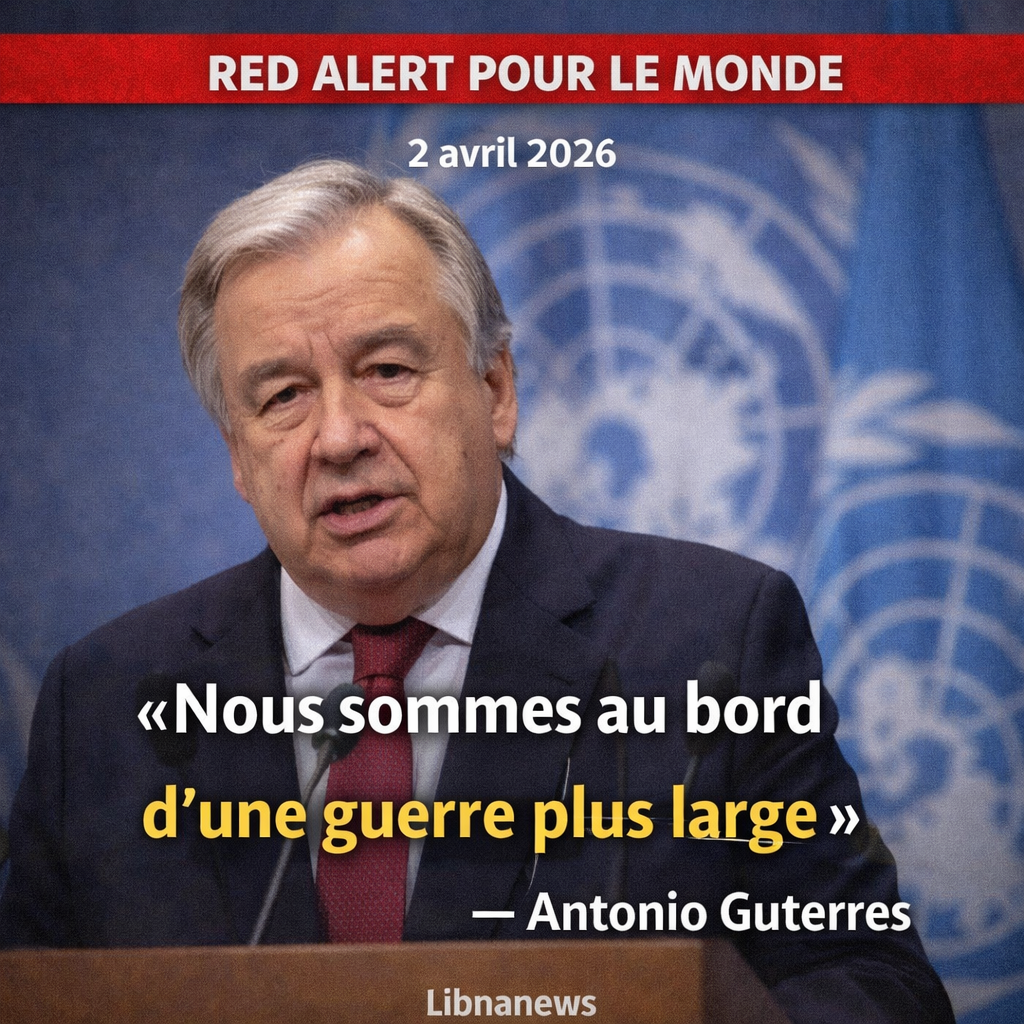
UN Secretary-General Antonio Guterres issued on Thursday a solemn warning against the risk of widespread burning in the Middle East. By denouncing a world « on the brink of a wider war, » he called for an immediate halt to Israeli-American strikes against Iran and at the end of Tehran’s attacks on its neighbours. This alert comes in a context where war is now beyond bilateral frameworks and threatens to transform the region into a focal point for sustainable confrontation.
The UN Secretary-General has chosen words of rare gravity. « We are on the brink of a broader war that would swallow the Middle East, with dramatic impacts across the planet, » said Antonio Guterres, as the crisis crossed a new threshold. In his speech, the head of the United Nations was not content to express general concern. He described a region suspended from a changeover, with the risk that ongoing operations might combine into a conflict of a difficult magnitude to contain.
This alert comes the day after a speech by Donald Trump to defend the US military operation. Antonio Guterres took the counterpoint of this climbing logic. « Many aspects of the conflict are uncertain, but one thing is not: if the drums of war continue to be heard, the escalation will worsen everything, » he said. The Secretary General added: « The spiral of death and destruction must stop. In a few sentences, he summarized the central fear that today dominates diplomatic forums: that of a conflict that no longer stabilizes, no longer limits itself, and no longer responds to legible front lines.
There’s nothing wrong with the tone. When a UN Secretary-General speaks of a Middle East on the brink of a wider war, he points out that the risk is no longer only that of an additional military campaign or a targeted response, but that of an uncontrolled chain of action. The expression refers to both the current strikes and the dynamics they feed. Every attack, every response, every political justification now expands the theatre of conflict. The problem is no longer just who strikes, but how far the mutual strike logic can lead to the whole region.
An alert that goes beyond one-to-one with Iran
The words of Antonio Guterres are part of a moment when the conflict has ceased to be perceived as a mere military confrontation between a few identified actors. The crisis now has simultaneous repercussions on several fronts. Iran is at the heart of the sequence, but Lebanon, the Red Sea, the Gulf and the security balances around Israel are also affected. In speaking of a wider war, the UN Secretary-General therefore designates a space for regional explosion, much larger than the mere addition of current operations.
Its intervention is based on a simple idea: the region is no longer in a phase of tension contained, but in a phase where the accumulation of military operations can produce a scale break. This breakup is not only dependent on a single big offensive. It may arise from repeated strikes, reprisals, computational errors, indirect attacks or decisions taken under pressure. It is this mechanism that the United Nations seeks to stop when it calls for the immediate cessation of Israeli-American strikes against Iran and Iranian attacks against its neighbours.
The word « immediate » counts. He shows that, for Antonio Guterres, classical diplomatic time is no longer enough. The UN is no longer in the register of progressive de-escalation or patient resumption of discussion channels. It is part of the emergency situation. The risk is considered high enough for the Secretary-General to call for a clear halt to military dynamics. This position reveals a deep concern: that of seeing regional and international actors lock in a logic where everyone claims to restore deterrence by aggravating war.
The finding of a spiral becoming autonomous
In his statement, Antonio Guterres insisted on a central formula: « The spiral of death and destruction must stop. This choice of words describes a mechanism that has become almost autonomous. A spiral does not refer to isolated action. It refers to a movement that feeds on itself, increases in intensity and becomes increasingly difficult to stop. This is exactly what the UN seems to see today in the Middle East.
This perception has far-reaching consequences. It means that the problem, in the eyes of the Secretary-General, lies not only in the current violence, but also in the very dynamics of the conflict. As long as each actor considers his own action as a legitimate response to that of the other, the escalation is justified on both sides. In this context, war ceases to be an exception and becomes a mode of relationship. The role of the United Nations is precisely to break this mechanism before it turns the entire region into a zone of permanent confrontation.
Guterres’ sentence on « war drums » also sheds light on the political dimension of his intervention. It is not limited to military operations in the field. It also targets the speeches that accompany, legitimize and prolong them. The words of the leaders play a direct role here in the escalation. When they speak in terms of total victory, expanded targets or necessary strikes without an exit horizon, they feed the logic they sometimes claim to master. The Secretary-General recalls that a regional war is built not only by missiles, but also by the accompanying narratives.
Implicit criticism of American justification
Antonio Guterres’ statement came the day after a speech by Donald Trump to justify the US military operation. Without quoting at length the content of this speech, the Secretary-General contests its general logic. His message is clear: explaining the offensive is not enough to make it politically or strategically sustainable, especially if it opens the way for regional aggravation.
This development is important. It shows that the United Nations refuses to be confined to a debate limited to the immediate justification of strikes. The question posed by Guterres is not only that of the legality or the opportunity of a given operation. It is wider: what does this sequence lead to? If the answer is an extension of the conflict, a multiplication of the fronts and a rise of global instability, then the logic of military action itself becomes the problem.
The Secretary-General thus refers the powers committed to their strategic responsibility. War in the Middle East never remains entirely local. It produces shocks in energy markets, sea flows, security balances, defence policies and diplomatic dynamics in several continents. When Antonio Guterres spoke of « dramatic impacts across the planet, » he recalled that the region was a global node. What is playing in it far exceeds its immediate boundaries.
The UN therefore insists on a reality often drowned by military discourse: the more the conflict widens, the more the costs become global. Energy prices, strait security, supplies, supply chains, financial stability and geopolitical balances are all exposed. This reminder also targets Western capitals tempted to treat the conflict as a strictly regional power sequence. For Guterres, this is not a peripheral war. It is a home that can directly affect the entire international system.
The Middle East on the verge of a change in the nature of the conflict
The UN’s concern is that war threatens to change its nature. A bilateral or trilateral crisis, however serious, remains theoretically negotiable within a limited framework. Open regional warfare, on the other hand, involves many actors, intertwined interests, multiple fronts and often incompatible objectives. It is this transformation that the Secretary-General seeks to prevent.
At this moment, this danger becomes more visible because operations are no longer in parallel, but in interaction. The strikes against Iran influence positions in Lebanon. Threats on shipping routes affect the calculations of Gulf capitals. American positions reconfigure European debates on NATO and security of supply. The Iranian responses are thought on a regional scale. Each theatre becomes the extension of another. This interlocking makes the whole much more unstable.
The word « engulfed, » used by Antonio Guterres, clearly reflects this fear. He suggested a conflict that would gradually absorb the remaining margins of neutrality, mediation channels and balances. A broader war does not necessarily mean that all States officially enter into war. It can also take the form of a military and political contagion where each country suffers the effects of the crisis, directly or indirectly, until it can no longer stand at a distance.
In this context, the role of the United Nations is again central in political language. Even when she does not have the coercive means to stop fighting, she tries to impose a diagnosis, set an alert threshold and recall the systemic consequences of climbing. In speaking with such seriousness, Antonio Guterres seeks to reintroduce a hierarchy of risks in an environment where each actor tends to see only his own front.
An application for a stay that targets all the protagonists
One of the most notable elements of the statement is its apparent balance. Antonio Guterres is not just calling for an end to the Israeli-American strikes against Iran. It also calls for an end to Tehran’s attacks on its neighbours. This formulation allows the Secretary-General to maintain a line of principle: stop climbing cannot be requested from a single camp. It must concern all the protagonists involved in the current dynamic.
This diplomatic symmetry does not erase differences in responsibility or military capability, but it pursues a specific objective. The UN wants to prevent his appeal from being immediately captured by one of the camps as an instrument of propaganda. By targeting all parties, Antonio Guterres seeks to maintain the legitimacy of his intervention and to preserve, as far as possible, the role of the United Nations as a mediator rather than as a resonant body of unilateral reading.
This posture is also a reminder that war is no longer reducible to a single initial sequence. Even when one of the actors opens a new military level, the others then choose their own response methods, sometimes with multiple effects. For the Secretary-General, therefore, the urgent question is not to produce an exhaustive hierarchy of grievances, but to prevent the regional system from tipping into a logic where everyone always finds a reason to pursue.
In this sense, Guterres’ statement is part of a classic UN tradition, but adapted to a more explosive situation. The United Nations does not claim to solve substantive disputes at once. First, it seeks to restore a minimum boundary between limited war and widespread war. His message is that this border is ceding.
A warning also addressed to regional capitals
The UN leader’s appeal is not only against Washington, Tel Aviv or Tehran. It also targets regional capitals that observe the crisis, involve it in varying degrees or are already suffering the effects. When Antonio Guterres talks about the dramatic consequences for the planet, he reminds us first that the Middle East is not a closed theatre. The neighbouring states, whether they are allies of the United States, partners of Europe or in connection with Iran, know that an enlargement of the war would threaten their own stability.
The Secretary-General thus refers the regional powers to a decisive question: do they still want to contain the war, or are they preparing to live in a sustainable way in its extension? Today this question goes through all the diplomacy of the Gulf, the Levant and the Eastern Mediterranean. The United Nations is trying to push these States back to becoming restraint actors rather than escalation relays.
The Guterres alert can also be read as an attempt to retake diplomatic ground before it is totally subordinated to military calculations. The wider the fronts, the more diplomats negotiate in the shadow of the strikes. But when war dictates its pace to diplomacy, the margin of compromise narrows. The Secretary General therefore seeks to reverse this relationship: to bring back the political logic before military logic crushes everything.
Finally, his comment recalls that international organizations speak not only to comment on crises, but to name the point where they change categories. To say that one is « on the brink of a wider war » is not only to describe the moment. It’s warning that the next moment could be much harder to control.
A word of alarm in a moment of strategic fog
The weight of the statement is also due to the fog surrounding the situation. Antonio Guterres himself stressed that « many aspects of the conflict are uncertain. » This sentence deserves attention. It shows that even at the UN summit, accurate evaluation of targets, red lines and exit scenarios remains partial. Uncertainty is not peripheral to the crisis. She’s one of the engines.
A conflict becomes more dangerous when actors no longer have a clear vision of opposing intentions, response thresholds or limits that they are still ready to meet. In such an environment, deterrence becomes blurred and calculation error becomes more likely. It is precisely in these moments that the warnings of international organizations take on special value. They do not dissipate fog, but they report that fog itself is now a major risk.
This dimension explains the seriousness of the vocabulary used. Antonio Guterres does not speak of a simple tension or an additional concern. He’s talking about a threshold. The United Nations suggests that the conflict has reached a point where the lack of strategic clarity can produce a faster than expected package. It is not only violence that worries. This is the unpredictability of the sequel.
In this sequence, the Secretary-General’s speech therefore seeks to reintroduce a form of political legibility. It says, in essence, that the unknown strategic does not justify new strikes, but instead makes their arrest more urgent. The more uncertain the consequences become, the more restraint should be imposed. It is exactly the opposite that the UN seems to fear today.
UN tries to restore limit language
In essence, the declaration of Antonio Guterres reintroduces a word that tends to disappear in the logics of war: the limit. Limit of strikes. Limit reprisals. Limitation of justification speeches. Limit, above all, what actors are willing to risk in the name of their immediate objectives. When the Secretary-General states that « the spiral of death and destruction must cease », he restores the idea that a threshold still exists, and that it is not too late to refuse to cross it.
This insistence is all the more important as the region has been living for years in a series of crises where each new escalation has often been presented as contained, rational or necessary. The UN has come here to say that this grammar is no longer enough. From a certain level of cumulative tension, the argument of control loses credibility. What the Secretary-General expresses is the growing doubt about the real ability of the protagonists to control the conflict they fuel.
His statement alone does not produce a ceasefire. It does not erase military calculations, national narratives or power strategies. But it gives the centre an essential data: the operations under way are no longer mere episodes in a lasting crisis. They are approaching a threshold where everything can change. This is already a major political signal from the head of the United Nations.
At this point, Guterres’ alert does not close any doors. It only recalls that, if the « war drums » continue to resonate, the conflict may soon not be the one that the actors believe to be leading today. And it is precisely this moment, when war ceases to obey those who feed it, which the Secretary General is still seeking to conjure.






