

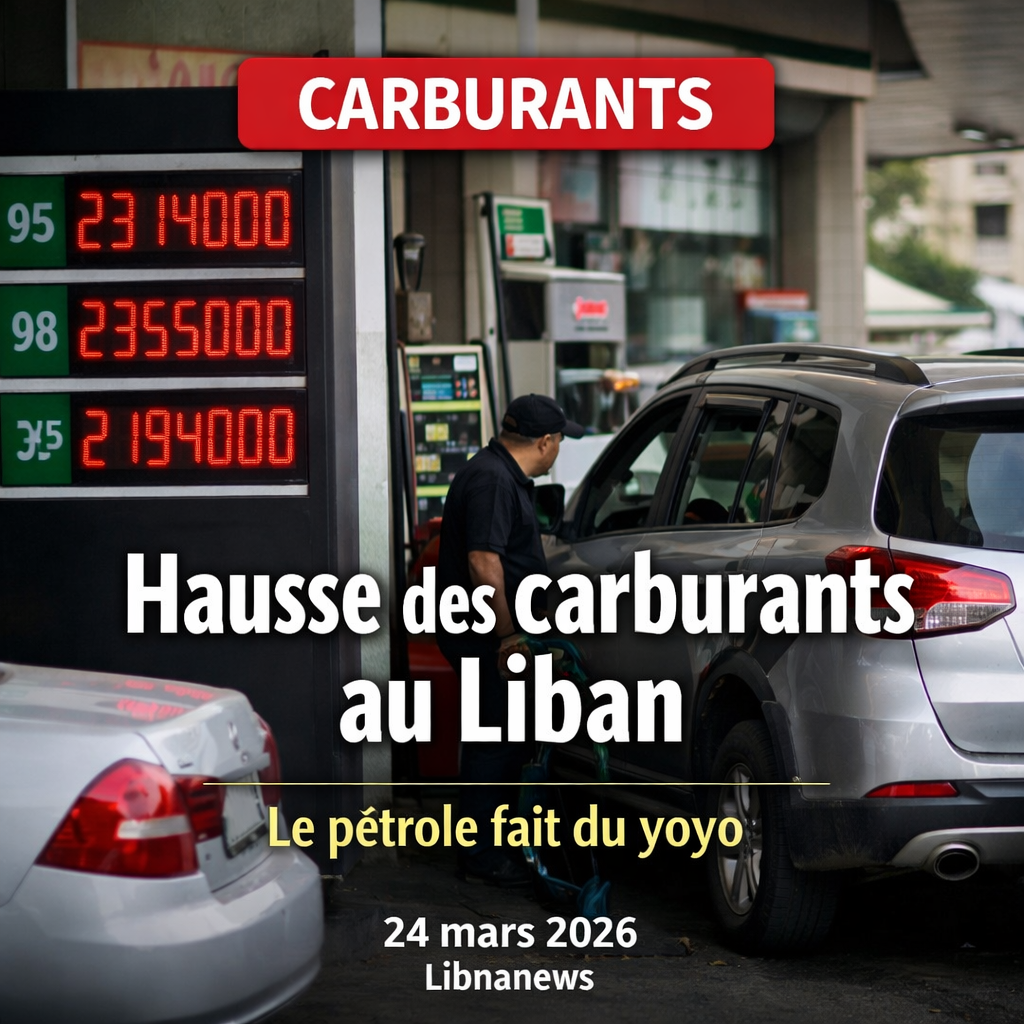
The increase in fuel in Lebanon puts an old anxiety in the fore this morning: that of a shock that starts from the pump, but which always ends up overflowing on transport, private electricity, deliveries, food prices and the daily budget of households. The new scale announces an increase of£25,000Forpetrol 95 octaneandpetrol 98 octane, of£72 000forFuel oiland£37,000forgas cylinder. The new prices thus set£2,314,000for 95 octane,£2,355,000for 98 octane,£2,194,000for fuel oil and£1,840,000for gas. Taken in isolation, these amounts may seem to be just another update in a long series. But their effect is immediate, because at the same time they affect motorists, subscribers to private generators, artisans, restaurateurs, carriers and households which still use gas extensively for the most common uses. In a country where energy remains expensive, fragmented and closely dependent on the outside, each such review acts as a multiplier of social and economic tensions.
This movement takes place in a context that deserves to be clarified more clearly. Yes, the underlying trend of markets remains dominated by geopolitical risk. But no, world prices have not evolved in a straight line. On the contrary, they made a yoyo in the space of two sessions.Monday, 23 Marchoil suddenly stalled after Donald Trump’s statements saying that he was postponing five days of American strikes against Iranian energy facilities, while talking about « productive » discussions with Tehran. The Brent concluded the session at$99.94the barrel, down from10.9%, and the WTI to$88.13, down from10.3 %, after falling even further during the day.Tuesday, 24 March, the market went back in the other direction after the Iranian denial of such contacts: the Brent went back to$102.83and WTI at$90.62. This sequence is essential to understand the local rise of the day. The global market does not send a simple signal of increase or decrease. It sends a signal of extreme instability, where a political phrase, diplomatic denial or threat to the Strait of Ormuz suffice to cause the prices to waver several dollars in a few hours.
Rising prices on all petroleum products
The increase in fuel is not evenly distributed. The increase in£25,000on gasoline remains visible. But it is above all the leap ofFuel oil, up to£72 000, which holds attention. Diesel is particularly important in the Lebanese economy. It is not only used to drive vehicles. It supplies a considerable part of private electricity production, from district generators to ancillary facilities used by companies, shops, workshops or certain health facilities. When it climbs faster than gasoline, the effect does not stop at the gas station. It is passed on to the cost of the private kilowatt hour, therefore to the monthly household bill and to the fixed costs of the shops. To this is added the increase of gas, which weighs directly on domestic kitchens, but also on catering, bakeries and many local activities. The day’s review is therefore not simply an energy increase among others. At the same time it affects mobility, alternative electricity and current consumption, which gives it a wider scope than that of a technical adjustment. This reading stems directly from the central role of diesel and gas in Lebanese economic life.
The new tariffs must also be put back into the real life of households. In a large part of the country, the car remains essential to go to work, drop children off at school, go to a hospital, make deliveries or maintain a professional activity. The increase in gas prices therefore immediately affects the cost of travel. For low-income households or for long-distance employees, budget arbitrage is even more pronounced. The effect then extends to public transport and mobility services. The road transport sector has also warned that a new tariff schedule for public transport should be presented within the week, with a risk of disorder if fuel increases continue. This signal is important because it shows that the day’s revision may not remain confined to stations. It could quickly be reflected in the price of races, long distance journeys and logistics costs of daily life. This is not enough alone to predict a new generalized tariff, but it clearly indicates that industry professionals are already preparing to pass on some of their costs.
The global market has done yoyo after Trump’s words
It is here that the situation on world markets becomes indispensable. Monday’s fall was not just a technical move. It was triggered by a very precise political sequence. Donald Trump announced that he was delaying five days of possible strikes against Iranian power plants and infrastructure, ensuring that contacts with Tehran had led to « major points of agreement ». The market immediately withdrew part of the war premium accumulated over the previous weeks. The Brent, which had reached its highest closing level on Friday since July 2022, ended Monday under the$100, while U.S. gas and diesel contracts also ceded around10 %. The fall was even deeper in session, before a slight recovery due to Iranian denial and the resumption of regional attacks. This detail counts because it shows that the market first wanted to believe in a lull, then immediately regained its cautious reflexes in the face of the persistent risks to supply.
On Tuesday, the same market corrected part of its relaxation. Tehran rejected American claims about the existence of direct discussions, calling them an attempt to manipulate financial markets. At the same time, the risk on the Strait of Ormuz remained central. Abouta fifthworld-wide flows of liquefied oil and natural gas transit through this passage, the traffic of which remains highly disrupted. The Brent thus went back to$102.83the barrel and the WTI to$90.62. Analysts point out that this rebound does not mean that panic has returned entirely. Most importantly, it indicates that the risk floor remains high. Even when missiles are suspended or US statements seem to promise a de-escalation, the prospect of a prolonged blockade of Ormuz continues to impose a strong geopolitical premium on prices. In other words, oil has made yoyo, but above a still very heavy base of tension.
Global volatility directly affecting Lebanon
For Lebanon, this instability is more important than just a photograph of the Brent at a given moment. The country does not have an energy shock absorber strong enough to absorb external shocks calmly. It imports its petroleum products and remains highly dependent on international fluctuations. When the market goes up, the bill increases fast. When the market declines, relief can be brief if the trigger reverses the next day. This is exactly what the sequence of23 and 24 March. A dramatic decline, linked to Trump’s comments, gave way to a marked rebound as soon as the illusion of a rapid de-escalation wavered. For the Lebanese consumer, this nervousness translates into a feeling of chronic instability: prices can be increased again before the effect of the previous relaxation has actually been felt. The problem is therefore not only the level of the courses. It is also the lack of short-term readability. This analytical conclusion is based on the volatility of oil markets and Lebanon’s strong dependence on energy imports.
This dependency becomes even heavier in an already fragmented energy system. Public electricity does not cover all needs. Private generators remain an essential alternative for both households and businesses. In such a model, each increase in fuel oil acts as an indirect increase in electricity. Although the impact depends on the volumes consumed, the exchange rate, the billing arrangements and the cost structure of each operator, the direction of movement is clear: a more expensive diesel tends to produce more expensive private electricity. The increase in fuel prices becomes an increase in urban life itself. It affects businesses, buildings, offices, workshops and homes that depend on this extra energy to maintain a minimum of normal activity. So this morning’s shock should not only be read as a new boost to the pump. It is part of a much wider cost chain, which includes movement, production, product conservation, service operation and household expenditure. The last sentence constitutes an economic inference based on the structure of the Lebanese energy system.
What other markets say
Oil was not the only market to react. In Asia, stock markets experienced a strong energy and geopolitical shock throughout March. Foreign investors withdrew$50.45 billion netregional actions, a new level since at least2008according to the data quoted on Tuesday. This movement reflects a wider fear than a simple shock to the crude. Investors fear both a persistent rise in energy prices, an economic slowdown and an inflationary surge, i.e. a cocktail close to a risk of stagflation for oil importing economies. Asia’s emerging markets are particularly vulnerable to this type of scenario, as many of them rely heavily on energy imports. Even when some Stock Exchanges bounced back Tuesday after the US hit was postponed, this rebound remained fragile. It relies more on tactical relief than on a real return to normal.
This financial nervousness illuminates the Lebanese situation from a different angle. When global markets hesitate between relaxation and new shock, already fragile economies do not get any lasting respite. Energy costs remain high, inflation expectations remain tense and investors remain cautious. For Lebanon, this means that the increase in daily fuel cannot be interpreted as an isolated local accident. It is part of an international environment where financial flows decline, energy importers are penalized and commodity volatility makes any forecast more risky. Even without direct exposure to major Asian equity markets, the country suffers the same fundamental forces: expensive energy, reduced visibility, rapid transmission of external tensions to domestic costs. The last sentence is an economic synthesis based on the behaviour of regional markets and the importing nature of the Lebanese economy.
A shock beyond the pump
One of the most important risks, after an increase like today’s, is its second round effect. Fuel comes into almost everything: passenger transport, freight transport, generator operation, gas cooking, home deliveries, cold chains, small service trades and local logistics. This means that an adjustment to gasoline, diesel or gas may eventually affect sectors that are not apparent to the fuel station. An increase in diesel, for example, does not just hit a truck driver or generator subscriber. It can also increase the cost of transporting food, running a trade, distributing medicines or final bills from a restaurant. In an economy where margins are often low and demand is already compressed, professionals eventually seek to recover some of this extra cost. The consumer then pays twice: first when he fills his tank or replaces his gas bottle, then when he purchases goods and services that have integrated more expensive energy into their cost price. This economic mechanism is classic, but it becomes more brutal in a country weakened by years of monetary crisis and degraded purchasing power.
It should be added that volatility itself produces a cost. A market that regularly rises is already difficult to manage. A market that fell one day and then rebounded the next day further complicates the decisions of importers, distributors, carriers and households. Each adjusts its anticipations in almost permanent fog. Companies delay certain decisions, consumers fear buying at the highest, and then discover that the decline was only temporary. It is this lack of a stable benchmark that makes the oil yoyo particularly harmful. The signal sent on Monday was not that of a real appeasement installed. The one on Tuesday is not that of an out-of-control outbreak either. The two sessions put together tell another story: a market that is hypersensitive to political announcements, always suspended at the risk of Ormuz and still unable to offer a legible path to importing countries. For Lebanon, this is probably the most important data of the day. The analysis of the cost of uncertainty is based on the chronology of prices observed in the last two sessions.



