

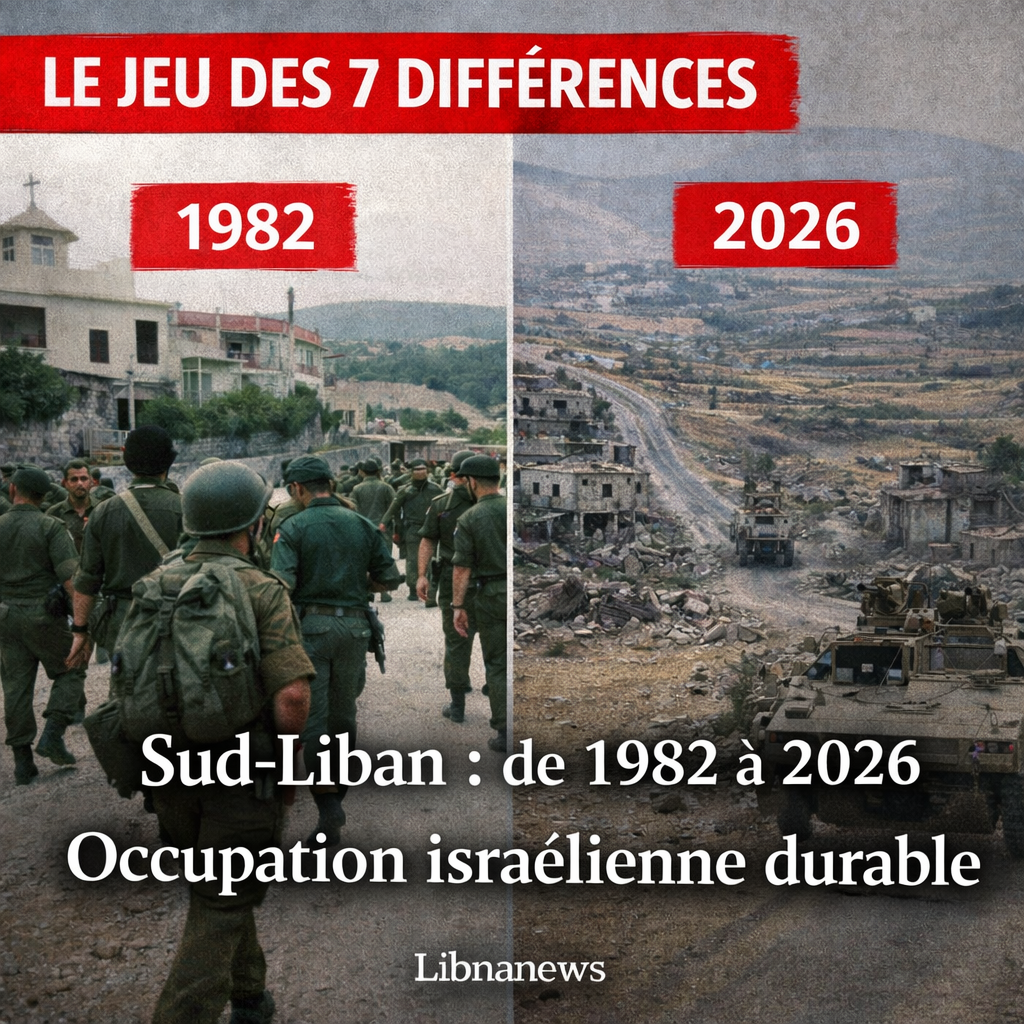
In 1982, Israel occupied southern Lebanon while maintaining the appearance of a residual Lebanese order. The occupation was carried out by a replacement militia, the South Lebanon Army, resulting from a split of the Lebanese army, and the maintenance of a minimum of local relays in the controlled area. In 2026, the logic displayed was of another nature. Israeli leaders no longer speak only of border security. They refer to a buffer zone up to Litani, the destruction of villages close to the border, the ban on return for hundreds of thousands of displaced inhabitants and, in some ministers, an Israeli border which should now be located in Litani. The difference is not secondary. It marks the transition from an occupation that still pretended to respect a facade of Lebanese sovereignty to a strategy that slides towards an annexation of fact.
The turn of the last few weeks therefore obliges us to reread Israeli history in Lebanon. In 1978, Operation Litani was already aimed at repelling an armed opponent beyond the river. In 1982, the invasion pushed the Israeli army to Beirut before leading to a long occupation of the South, held in part with the SLA until the withdrawal of 2000. But these precedents, however violent they may be, did not fully cover the current logic. Israel occupied, controlled, imposed its military superiority, but left a local fiction. Today, this fiction collapses. There is no more credible ALS, no more serious Lebanese facade to brandish, and some Israeli officials now assume a territorial language that is no longer part of the mere security glacis.
This slide is at the heart of the current crisis. Reuters reported that Israel’s Defense Minister, Israel Katz, wanted to establish an Israeli security zone up to the Litani, also control bridges on the river, destroy all houses in villages close to the border and prevent about 600,000 displaced Lebanese from returning south of the Litani until the security of northern Israel was guaranteed. A few days earlier, Finance Minister Bezalel Smotrich had said that « the new Israeli border » should be the Litani. Ended, these elements draw a strategy that is no longer enough to separate Hezbollah. It tends to transform South Lebanon into a space to empty, to hold and, for part of the Israeli right, to annex.
1978: Operation Litani, first version of the ice
The first major precedent dates back to March 1978. After a deadly Palestinian attack in Israel, the Israeli army launched Operation Litani and advanced to the river. The stated objective is then to remove the Palestine Liberation Organization from the northern border of Israel. Encyclopaedia Britannica recalls that this offensive leads to an occupation of part of southern Lebanon, while the Security Council adopts resolution 425 and establishes UNIFIL to confirm the Israeli withdrawal, restore peace and assist the Lebanese State in restoring its authority in the area. From that moment on, the Litani became in Israeli strategic thinking a natural line of separation, both military and political.
But the main teaching of 1978 is not just about military progress. It’s about the control mode. Reuters recalls that Israel then relies on a local militia to become the South Lebanon Army, which allows it to limit the political cost of a direct occupation and to present the South as an area protected by a Lebanese ally. This local mediation is crucial. It allows Israel to make southern Lebanon a glacis without openly assuming a logic of territorial integration. In other words, the occupation exists, but it still drapes itself in an indirect device that allows the survival, even artificially, of a separate Lebanese sovereignty.
This is an important difference with the current sequence. In 1978, the Israeli project consisted of developing a defensive depth. It does not pass, in its dominant public expression, by the idea that the Israeli border itself should rise to the Litani. The logic is that of glacis, not annexation. This distinction is historically valid, even though Lebanese sovereignty is already deeply amputated in the area concerned. Today, on the contrary, some Israeli officials are crossing this verbal and political threshold. They’re not just talking about holding a space. They speak of South Lebanon as a territory whose border could be redesigned.
1982: heavy occupation, but still under Lebanese façade
The 1982 precedent is closer and more enlightening. That year, Israel again invaded Lebanon, advanced to the outskirts of Beirut and participated in the departure of the PLO. Britannica recalls that the Israeli army then far exceeds the narrow framework of border security and settles permanently in the Lebanese conflict. After a partial withdrawal, it maintains a security zone in the South that will last until 2000. Reuters points out that this area is held with the support of the South Lebanon Army, a central proxy force in the occupation architecture.
This period shows that Israel could lead a brutal occupation while maintaining the appearances of a local order. The idea of indirect control was maintained by the Lebanese army, because it was Lebanese in its composition and resulting from a split of the Lebanese army. It was not a question of real respect for Lebanese sovereignty, of course, but of a political setting useful to Israel. The occupied area could be described as a security zone managed with local allies, not as a piece of Lebanon destined to become Israeli. Even the partial maintenance of services and administrative relays in this area was in line with this logic: to operate the occupation without naming it as an annexation.
It is precisely this facade that disappears in 2026. South Lebanon no longer offers Israel a credible equivalent to ALS. The memory of this militia remains that of a supplementary force collapsed with the Israeli withdrawal of 2000. No local actor is now in a position to give Lebanese coverage to a new Israeli domination of the South. This absence changes everything. It makes occupation more naked, more visible, more directly Israeli. And because she can no longer support a strong local fiction, she seems to compensate for something else: habitat destruction, access control and preventing return.
In other words, unlike 1982, when Israel retained a semblance of Lebanese state in the occupied area through SLA and service relays, the current strategy does not even seek to save that appearance. She doesn’t really hide it anymore. It is based on a direct military presence, on the physical crushing of border villages and on a political discourse which, among some officials, is no longer satisfied with the security zone and slides towards annexation. It is in this sense that 2026 appears more radical than 1982.
In 2026, the South is no longer just a front: it is a territory to be reshaped
The Israeli statements of the past few days go far beyond the neutralization of Hezbollah. Reuters reported that Israel Katz wanted not only to hold the space to the Litani, but also to control the bridges and prevent the return of the displaced. The same minister said that Israel would destroy all houses in villages close to the border according to the « Rafah and Beit Hanoun model », two places in Gaza almost entirely destroyed by Israeli operations. This reference is not insignificant. It suggests an assumed import into Lebanon of a method of war based on the destruction of the built environment and territorial emptying.
Change is major. In 1978 and 1982, Israel wanted an armed ice. By 2026, the doctrine was more like a strategy of depopulation separation. When houses are promised destruction, bridges are controlled to cut off an area of the rest of the country and the return of the inhabitants is explicitly refused, the occupation is no longer intended solely to supervise a territory. It aims to transform it so that it is less inhabited, less liveable and therefore easier to dominate. This reading is not a rhetorical exaggeration; It derives directly from the measures reported by Reuters and the UN warnings on the consequences of forced displacement.
The current war has already produced the human framework for this transformation. Since 2 April, more than 1 million people had been displaced in Lebanon and more than 1,300 people had been killed there since the resumption of hostilities in early March. This figure gives concrete scope to Israeli intentions. This is not an abstract project on an empty territory. It applies to a region where a considerable part of the population has already been driven out by fighting, evacuation orders and destruction of infrastructure.
An essential difference: before, we kept the appearances
It is probably on this point that the rupture with 1982 must be most clearly formulated. At the time, Israel occupied southern Lebanon, but maintained the appearance of a residual Lebanese order. LALS served as a political screen. It allowed us to say that the area was not directly annexed, that it remained somehow Lebanese, even under Israeli domination and dependence. Administrative relays remained. Local life, controlled and distorted by occupation, continued to exist. Lebanese sovereignty was violated, but it was not denied in principle.
Today, this caution has virtually disappeared. The toughest Israeli leaders no longer speak as if they simply wanted to secure the border while allowing the fiction of an autonomous Lebanese South to persist. They speak as if we had to reshape the space itself. Smotrich referred to a « new Israeli border » in the Litani. Katz announced the destruction of villages close to the border and the non-return of displaced persons. In such a context, the occupation no longer aims to dominate Lebanese territory by pretending to respect its political existence. It tends to produce a territory where Lebanese sovereignty would be emptied of any real content or even replaced by de facto Israeli sovereignty.
That is why the word annexation is no longer marginal. It does not yet describe a legal act consumed. But he describes a dynamic. In contemporary conflicts, annexation often begins before texts. It begins with a prolonged military presence, the destruction of what allowed local life, the lasting expulsion of the inhabitants and a discourse that naturalizes a new border. From this point of view, the Israeli statements of March 2026 crossed a threshold on the Lebanese file.
Temporary displacement becomes a non-return project
The most serious issue is the nature of the current displacement. In a conventional war, the exodus of civilians is presented, at least in principle, as temporary. People flee fighting and hope to return once the front is far away. UN experts warned on 13 March that when homes are destroyed, communities are broken and return is made impossible, displacement ceases to be temporary protection to become a lasting human rights crisis. They added that forced displacement could constitute a war crime and a crime against humanity.
This directly informs the Israeli strategy in southern Lebanon. By trying to destroy houses near the border and prevent the return of hundreds of thousands of people south of the Litani River, Israel is turning a war displacement into a non-return project. This is no longer just the consequence of a conflict. This is a political purpose assumed. South Lebanon then becomes less a field of operations than a space whose civilian population would be considered an obstacle to the new security architecture desired by Israel.
The Lebanese public debate often uses the expression « ethnic cleansing » here. Legally, we must remain precise. The most robust formulations in the sources consulted refer to forced displacement, arbitrary destruction, illegal prohibition of return and possible war crimes. On 17 March, the Office of the United Nations High Commissioner for Human Rights declared that certain Israeli strikes in Lebanon could constitute war crimes, including the destruction of residential buildings, attacks on health facilities and attacks on displaced persons. This is not a final judgement, but it shows that the possible criminal dimension of this strategy is already taken seriously at the highest UN level.
A more direct occupation, therefore more radical
The absence of a local substitute such as ALS makes the current Israeli strategy more difficult to dress politically. But it also makes it more radical. Yesterday, Israel could say: we are helping an allied area to protect itself. Today, he has only two options left: to occupy directly or empty the territory sufficiently to make it controlable remotely. Statements on the destruction of villages and the ban on return show that the second option is already at work.
This radicality is also reflected in the border report. For decades, Israel has been able to defend the idea of a security zone without formally questioning the international border. In 2026, some of its officials spoke as if war were to be used to move it. Smotrich’s sentence on the Litani is not merely an isolated verbal excess. Reuters I has presented as the most explicit statement by an Israeli senior official calling for annexation of southern Lebanon in the current conflict. Such a speech changes the framework, because it reveals that part of the ruling coalition no longer thinks only in terms of defence, but in terms of territorial acquisition.
The 1982 precedent as a warning, not as a model
Yet history should serve as a warning to Israel. The occupation of the South between the 1980s and 2000s did not produce the lasting security it promised. It nurtured the legitimacy of Hezbollah as an armed resistance force and ended with the collapse of the SLA during the Israeli withdrawal. Reuters recalls this past to show that Israel’s new buffer zone is part of a long series of invasions and occupations that have never really stabilized the northern border.
But this precedent also makes the current strategy more worrying. If Israel returns to South Lebanon without a local facade, with a more annexationist language and with a more direct method based on habitat destruction and non-return, then 2026 does not resemble 1982 reproduced identically. This looks like a harder, more explicit and potentially more irreversible version of the same project. Where the former occupation was still seeking to administer a Lebanese area under control, the new tends to produce a depopulated and militarily reconfigured South, where Lebanese sovereignty would not only be suspended, but virtually denied.
So the heart of the difference is there. In 1982, Israel occupied with appearances. In 2026, some of its leaders assumed these appearances less and less and let us see a strategy that no longer aims only to control southern Lebanon, but to transform it into a de facto Israeli border. This shift explains why the present war cannot be read as a mere return from the past. It marks a leap from occupation covered by local fiction to a logic that approaches open annexation and sustainable displacement.






