






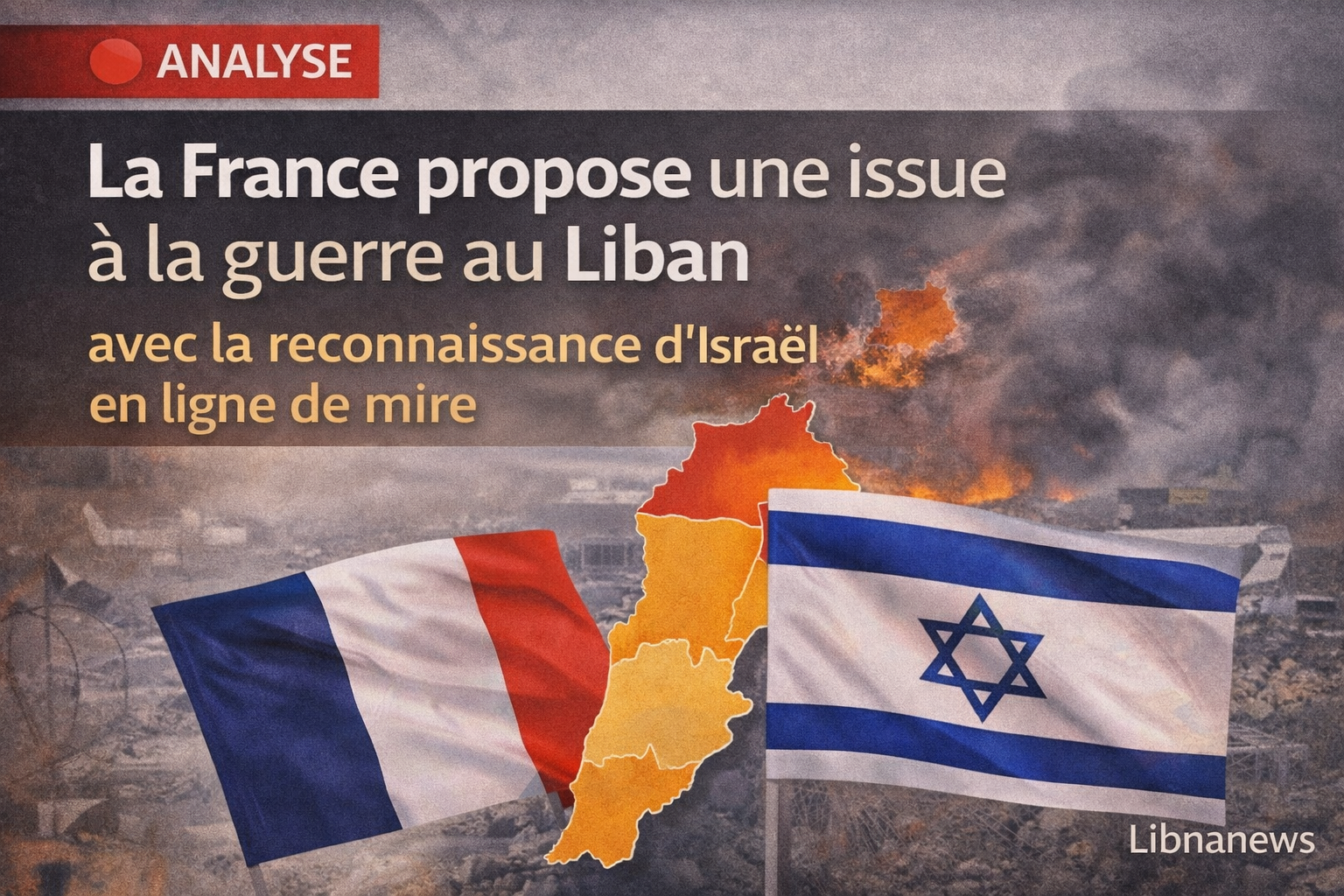
France has transmitted a diplomatic proposal to end the war in Lebanon, and this text foresees an unprecedented step: that the Lebanese Government officially recognize Israel. According to Axios, which cites a number of sources, the French proposal is currently being examined by the United States and Israel. It is part of a wider de-escalation attempt, as the war between Israel and Hezbollah is intensifying, Lebanon has already exceeded 800 dead in 12 days and the risk of a large-scale Israeli land offensive south of the Litani is becoming clearer.
The central point of the French document is its political scope. It would not be just a ceasefire or a limited security arrangement, but a process that could lead to a « political declaration » between Israel and Lebanon within about a month. That declaration would reaffirm the commitment of both States to Security Council resolution 1701 and to the 2024 ceasefire, while at the same time opening negotiations towards a permanent non-aggression agreement. In this architecture, Lebanon’s recognition of Israel would be the most sensitive and far-reaching stage in Beirut.
English text considered by Washington and Jerusalem
According to Axios, the French proposal was drafted by the French Government and transmitted as part of the ongoing efforts to avoid a stalemate in Lebanon, a prolonged Israeli occupation of the southern part of the country and an even wider extension of the regional war. The American media says Washington and Israel are currently reviewing it. This sequence comes at a time when Emmanuel Macron publicly called for « direct discussions » between Israel and Lebanon, proposing that Paris host these exchanges.
Explorez la carte en direct des evenements et points de situation.
The content of the French text, as reported by Axios, is based on several successive steps. Firstly, a return to a logic of political negotiation between Beirut and Tel Aviv. Secondly, a redeployment of the Lebanese army south of the Litani River. In parallel, an Israeli withdrawal from the areas conquered during the current war within about a month. Finally, the opening of negotiations towards a permanent non-aggression agreement between the two countries, after which Israel would also withdraw from five positions it has held since November 2024. In this sequence, the recognition of Israel by Lebanon would therefore not be an isolated gesture, but the political key to a broader arrangement.
Aboutal for an absolute taboo in Lebanon
In Lebanon, the very idea of official recognition of Israel is a historical, political and institutional taboo. The country remains officially in a state of war with Israel. Any such developments would affect the memory of the Israeli occupation of the south, the Palestinian question, the weight of Hezbollah in the Lebanese system, but also the most sensitive religious and partisan balances. In this sense, the French proposal goes far beyond mere technical mediation: it concerns the very definition of Lebanese foreign policy and one of the deepest red lines in the country’s political life.
This is also what gives the French initiative its explosive character. Lebanese President Joseph Aoun had already, according to Axios and then Reuters, announced in recent days that he was ready for direct negotiations with Israel to end the war. But the shift from direct discussions to official recognition is changing. Talks can be presented as a tool for de-escalation. Recognition affects the status of the State, the legitimacy of institutions and the balance of internal forces.
Paris seeks to prevent another long war in Lebanon
The French logic appears more clearly when placed in the current military context. Israel is preparing, according to Axios, for a vast land offensive in southern Lebanon, with the aim of taking control of the area south of the Litani and dismantling Hezbollah’s military infrastructure. Such an operation could become the largest Israeli land campaign in Lebanon since 2006 and lead to prolonged occupation. In this context, the French proposal seems to aim to offer a diplomatic exit before the logic of the ground prevails completely.
This French concern is not new. French sources quoted in the Israeli press warned earlier this month that a large-scale land operation could strengthen Hezbollah rather than weaken politically, bringing the issue of occupation to the fore and undermining the legitimacy of the Lebanese State at the very moment when it is trying to regain its hands. In this reading, the more Israel advances on the ground, the more it complicates Beirut’s ability to impose Hezbollah disarmament without appearing to be acting under external pressure.
What France puts on the table
The French document, as presented by Axios, has several simultaneous objectives. He first seeks to stop the war. It then aims to prevent a lasting Israeli presence in southern Lebanon. He also intends to increase pressure on Hezbollah to disarm him. Finally, it could pave the way for a broader political agreement between Israel and Lebanon. This combination is ambitious. It also explains why the proposal goes further than previous de-escalation frameworks, by asking the question of a new official relationship between the two States.
The text reported by Axios is also based on the idea that the Lebanese government would choose to become the only sovereign actor in the south of the country. The redeployment of the Lebanese army south of the Litani would be at the heart of this scheme. This is an old requirement of resolution 1701, but it has never been fully realized. The novelty of the French plan is that it attempts to link this redeployment to a broader political architecture including Israel, France and the United States, and not just to an abstract requirement of the Security Council.
Israel examines the proposal, but also prepares the escalation
The problem for Paris is that the diplomatic window is shrinking. Axios claims that Israel is preparing a major land offensive and already has three divisions along the border. At the same time, Reuters reported on Saturday that direct discussions between Israel and Lebanon could soon be opened, according to Haaretz, but in an atmosphere of deep mistrust. The Israeli government still doubts the real capacity of the Lebanese State to enforce its commitments to Hezbollah.
This contradiction summarizes the entire current sequence. On one side, a diplomatic channel seems to sketch. On the other hand, military logic remains dominant. Israeli preparations for an operation south of the Litani River, expanded evacuation orders and continued strikes indicate that Israel does not rely exclusively on diplomacy. The French proposal therefore comes at the moment when Jerusalem can still choose to use it as a way out, or to leave it without follow-up to the benefit of a change of reality on the ground.
Washington hasn’t fixed its line yet
The American role also remains decisive. Axios indicated that the United States was considering the French proposal, but without specifying what final position Washington might adopt. However, the White House appears at this time to be being faced with hesitation on several fronts of the regional conflict, including in Lebanon. Reuters recently reported that the Lebanese offer of direct discussions with Israel had been received with coldness and scepticism by American and Israeli officials. If France is today trying to enhance this offer by transforming it into a structured initiative, its success will also depend on the American will to do so or at least not to stop it.
The American factor counts all the more as Lebanon has been trying for several days to convince Washington that it remains a valid political interlocutor. Axios reported on 9 March that Beirut had proposed direct negotiations with Israel through the Trump administration, with the aim of ending the war and reaching a peace agreement. But this proposal did not at that time arouse visible enthusiasm. The French text can thus be read as an attempt to revive, under a European label, a Lebanese opening previously considered unbelievable.
For Beirut, a bet as risky as ever
The Lebanese government is facing a formidable equation. Accepting Israel’s recognition logic could, in theory, pave the way for a halt to the war, an Israeli withdrawal and a restoration of the Lebanese army’s role in the south. But this choice would also expose the executive to a major internal crisis. In an already fractured country, where Hezbollah and its allies remain central, such a decision could trigger an exceptionally intense political confrontation. Moreover, the French proposal seems to be aware of this, since it insists, according to Emmanuel Macron, on the representation of « all components of the country » in possible discussions. However, for the time being there is no mention of the fate of the 500,000 Palestinian refugees in Lebanon.
This caution shows that Paris knows that no Lebanese solution can only be diplomatic. It must also be politically sustainable in Beirut. This is precisely where the French plan meets its greatest fragility. For asking Lebanon to recognize Israel, even within the framework of an agreement to stop the war, amounts to demanding a political leap that no Lebanese government has ever assumed until then. The « unprecedented » nature of the approach, stressed by Axios, is therefore not a matter of focus. It describes a real break with all contemporary Lebanese diplomatic practice.
A French proposal in the middle of a devastated Lebanon
The temporality of the French document finally sheds light on its profound logic. Lebanon is going through one of the most deadly phases of the recent war. Reuters reported more than 800 deaths and more than 800,000 internally displaced persons on Saturday. In these circumstances, France is not only seeking to produce a spectacular diplomatic gesture. It also tries to prevent the Lebanese front from turning into a long, territorial and potentially occupying war. The recognition of Israel, in this perspective, appears to be the maximum political price required in Beirut for a halt to the war and an Israeli withdrawal.
It remains to be seen whether such a proposal has a real chance of success. For the time being, it exists, it circulates, and it is under examination. Above all, she says: in Paris, the risk of a prolonged Israeli offensive in Lebanon and of a further lasting destabilization of the country is now high enough to put on the table a scheme that Beirut would have considered unthinkable a few weeks ago.
The French proposal on Israel, however, meets the Lebanese locks
France has drafted a proposal to put an end to the war in Lebanon, and this text provides for a historic milestone: that the Lebanese government officially recognizes Israel. According to Axios, the proposal is under discussion in Washington and Jerusalem. It comes as Israel prepares a much wider land offensive south of the Litani, while Lebanon has already paid a very heavy human price since 2 March.
The French scheme, as reported, is not limited to a ceasefire. It provides for a political sequence: Israeli-Lebanese discussions under American and French sponsorship, redeployment of the Lebanese army south of the Litani, Israeli withdrawal from the areas taken during the current war within about a month, and negotiations towards a permanent non-aggression agreement. In this context, Beirut’s recognition of Israel appears, an unprecedented measure in Lebanon’s contemporary history.
But this proposal is immediately facing deep blockages in Lebanon. The first is institutional and legal. The country remains officially in a state of war with Israel, and the debate on normalization remains largely taboo in Lebanese political life. Recent statements by Lebanese officials have pointed out that standardization is not, at this stage, a political option accepted in the system.
The second lock is political. Reuters reported on 14 March that direct discussions between Israel and Lebanon could open, but in a climate of Israeli and American skepticism on the real ability of the Lebanese state to impose its decisions, and of strong internal divisions in Lebanon, especially in Shiite circles and around the Speaker of the Parliament Nabih Berri. In other words, even the stage of direct talks remains contested; the recognition of Israel is even more so.
The third block is military and directly affects Hezbollah. Since 2 March, the movement has resumed firing against Israel and has placed the logic of resistance at the centre of its political line. Under these circumstances, any official recognition of Israel by Beirut would be perceived by Hezbollah and its allies as an attempt to radically transform the Lebanese strategic balance under pressure of war. The stronger the military confrontation, the more politically explosive such a development becomes within the country.
Another lock, often less commented but equally central, is the Palestinian presence in Lebanon. According to UNRWA, approximately 222,000 Palestinians now reside in the country, including approximately 195,000 long-standing Palestinian refugees in Lebanon. This is not just a humanitarian issue: it affects one of the most sensitive balances of Lebanese political life, the right to return, the refusal of permanent settlement and internal religious balances. Any recognition of Israel by Beirut would be immediately re-read through this issue, with the fear that it would weaken the Lebanese historical position on the return of refugees or eventually open a more acute debate on their sustainable settlement.
This Palestinian dimension is particularly heavy in Lebanon because it combines memory of civil war, camp status and demographic balance. The subject is not marginal in the Lebanese public debate: it has been one of the main arguments for rejecting any separate normalization or peace with Israel for decades. A recognition of Israel would therefore not only be a foreign policy decision; It would be interpreted as a potential rupture with one of the foundations of the Lebanese position on the Palestinian question.
The moment chosen makes the French proposal even more difficult to carry. Israel is preparing, according to Axios, a large-scale land offensive in southern Lebanon, with the aim of taking control of the area south of the Litani and dismantling Hezbollah’s military infrastructure. In such a context, asking Beirut for recognition of Israel as a new Israeli land operation unfolds amounts to superimposing a maximum political requirement on extreme military pressure. For many Lebanese actors, this may appear less as a peace initiative than as a pattern imposed under the constraint of war.
This also explains French prudence in its public communication. Emmanuel Macron called for direct discussions and proposed Paris to welcome them, but without publicly mentioning, at this stage, the recognition requirement revealed by Axios. Paris seems to be trying to reopen a political channel before the military option completely closes the diplomatic space. But the content of the report shows that France has, in reality, put on the table much more than just a ceasefire: a potential overhaul of the official relationship between Beirut and Tel Aviv.
For Washington and Israel, the interest of the French plan is obvious. It could offer a political exit to the war, strengthen the Lebanese army in the south and increase pressure on Hezbollah. For Beirut, however, the equation is much more risky. Even if part of the Lebanese executive says that it is open to direct discussions, moving from this opening to formal Israeli recognition would require a political leap that no Lebanese government has ever assumed. Between Hezbollah, Nabih Berri, the weight of the Palestinian file, the state of official war with Israel and the pressure on the street, internal obstacles remain considerable.
The French proposal therefore says two things at a time. On the one hand, Paris believes that the risk of a long war, prolonged Israeli occupation of the south and further collapse of Lebanon is now high enough to justify an out-of-standard diplomatic offer. On the other hand, the very content of this offer shows how powerful Lebanese locks remain. Between the Palestinian question, the place of Hezbollah, the opposition of Shiite components and the legal and political taboo of normalization, the main problem of the French plan is not only to convince Israel or the United States. It is to know whether there is today a political majority in Lebanon capable of bearing the price.
