

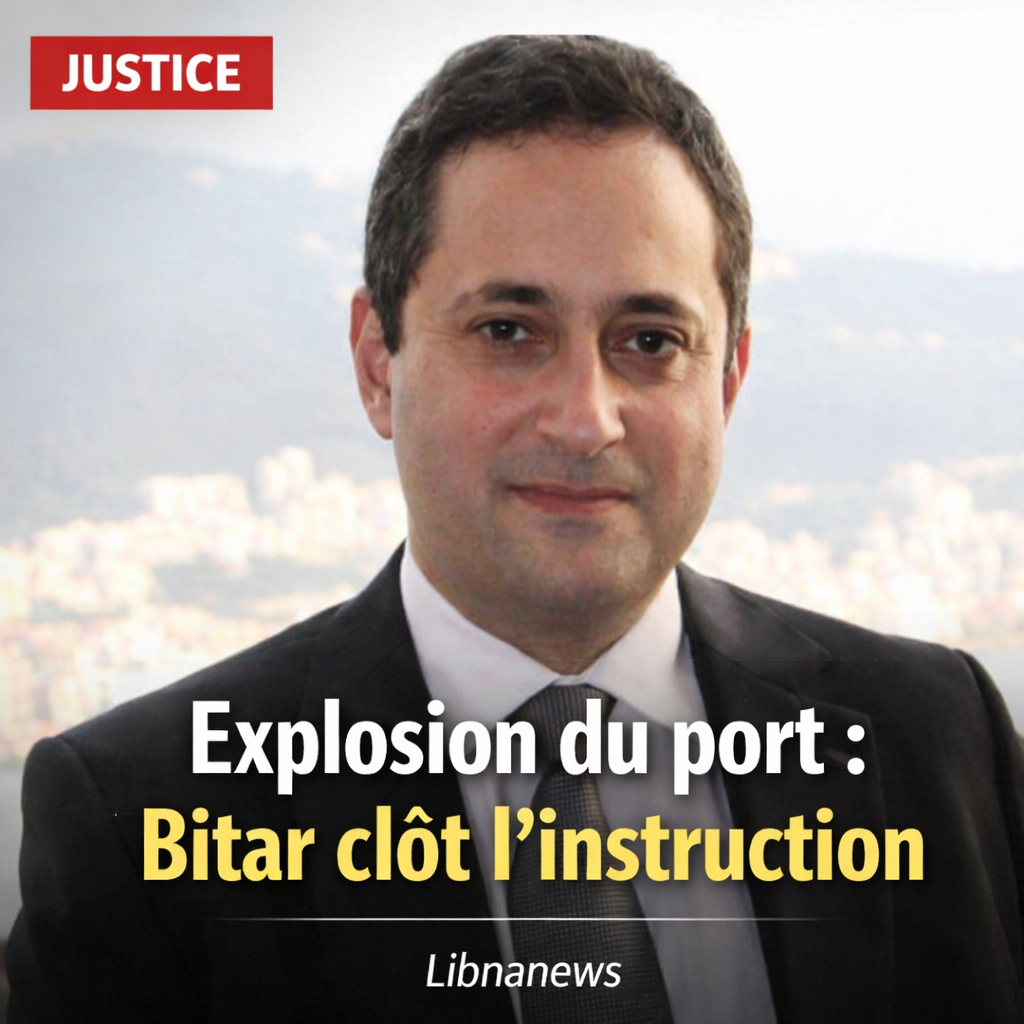
Nearly five years and eight months after the explosion of the port of Beirut, the judicial file has reached a stage expected for years. Investigative Judge Tarek Bitar closed his investigations and forwarded the entire case to the Attorney General of the Court of Cassation, Judge Jamal Hajjar, to give his opinion on the merits, make his observations and clarify his requests concerning the persons questioned since the beginning of 2025 without a decision being taken on them. According to NNA, there are 70 involved in the case.
This decision does not yet mean the end of the proceedings or an imminent judgement. On the other hand, it marks the end of the investigation phase conducted by Judge Bitar, that is, the period during which the magistrate assembles the elements, interrogates the suspects, confronts the versions and establishes the scope of possible responsibilities. In such a sensitive case, which was blocked for long months and then re-launched, this closure has both a judicial and a political scope. It means that the magistrate considers that he has advanced sufficiently to move on to the next stage.
An investigation becomes the symbol of Lebanese impunity
The explosion of 4 August 2020 remains one of the most traumatic events in Lebanon’s contemporary history. Hundreds of tons of ammonium nitrate stored in the harbour exploded, causing a deflagration that killed more than 200 people, injured more than 6,000 inhabitants and ravaged large areas of the capital. Reference NGOs, such as Human Rights Watch, report at least 218 deaths, more than 7,000 injuries and more than 300,000 internally displaced persons. The explosion is widely regarded as one of the most powerful non-nuclear explosions in recent history.
Very quickly, the investigation went beyond a simple criminal case. It has become a test for the Lebanese State, its justice and its ability to establish a chain of responsibility in a case involving port administration, customs, security services, the judiciary and politicians. Several human rights organizations have found that the Lebanese authorities have, over the years, blocked or impeded the manifestation of the truth by protecting high-ranking officials from interrogation, prosecution and arrest.
Why Judge Bitar took so long to get to this stage
Tarek Bitar’s name has become central in this judicial arm. Appointed after the divestment of the first judge in charge of the case, Fadi Sawan, he attempted to broaden the investigation to include prominent political and security officials. This led to an avalanche of appeals, divestiture requests and procedural challenges. In January 2023, after a long suspension, Bitar resumed the investigation, ordered release and provided for further charges. The recapture then triggered an open confrontation with the then Public Prosecutor ‘ s Office, led by Ghassan Oueidate, which challenged its legality and ordered the release of all remaining detainees in the file.
This paralysis has fed the anger of the families of victims for years. On each anniversary of August 4, the relatives denounced the closure of the case. Amnesty International and Human Rights Watch regularly recalled that, five years after the events, the Lebanese justice system had still not delivered a complete truth or clearly established criminal and political responsibilities. The resumption of the investigation in January 2025, mentioned by Human Rights Watch, had therefore been seen as a real, even cautious, revival of a dossier long considered to be practically frozen.
What exactly does the referral to the Attorney General mean?
The transmittal of the case to the Attorney General of the Court of Cassation is a classic step in Lebanese criminal proceedings. The investigating judge terminates his work and then forwards the case to the Public Prosecutor’s Office for written submissions. The prosecutor may issue an opinion, request specific action, support certain prosecutions or make observations on the persons involved. The Lebanese Code of Criminal Procedure provides that the Attorney General may consult the file and issue his findings, which the investigating judge may then accept or reject. In the event of disagreement, the prosecution may challenge it before the indictment chamber.
In the specific case of the port of Beirut, the NNA states that Judge Jamal Hajjar must now render his opinion on the substance and his requests concerning the persons interviewed since the beginning of 2025 without any decision having yet been taken. This precision is important. It means that, for some of the respondents, the investigation has progressed to the point where it now requires a formal position of the prosecutor on their procedural status. In other words, the file is no longer only in the logic of hearings and collection. It is part of that of judicial choices.
What is the continuation of the procedure
The next phase will therefore depend on the opinion of the Attorney General. Once this step has been completed, Judge Bitar will be able to render his closing decision on the merits for the accused. In concrete terms, this may lead, as the case may be, to dismissal for some, referral for trial for others, or indictment within the framework determined by the competent court. If the prosecution is opposed to certain directions of the judge, the indictment chamber may be seized to decide. The text of the Lebanese Code of Criminal Procedure clearly shows that this stage is not purely formal: it can still open new procedural disputes.
In other words, the closure of the investigation does not yet amount to a conviction or even an immediate trial. But it reduces the dilution margin of the backrest. After years of recourse and obstacles, it now obliges judicial institutions to position themselves more clearly. However, there is still a real risk that new remedies, new jurisdictional disputes or new political pressures will arise, as the issue affects power centres still active in Lebanon. This reading is a deduction based on the procedural history of the case and on the blockages observed since 2021.
Why this stage counts politically
The port file is not just about individual responsibilities. It addresses the broader issue of State responsibility. Human Rights Watch believes that the explosion is the result of a failure by the authorities to protect the right to life and has called into question the possible involvement of senior political and security officials. It was this point that made the investigation so explosive internally: establishing responsibilities is not just about designating performers or middle managers, but about determining who knew, who was warned, who refrained from acting and who subsequently held back justice.
In this context, the closure of the investigation by Tarek Bitar can be read as an attempt to lock up his work before a new, more contradictory phase. It creates a moment of judicial truth. Either the case is moving towards substantive decisions, or it is falling back into the procedural blockages that have long been paralyzed. For the families of the victims, this step is not yet worth justice. But she broke with the impression of total immobility that had dominated for years.
A dossier still far from its epilogue
The central point, this Monday, is therefore simple: the investigation is not completed in the full judicial sense of the term, but the investigation is closed. The file is now in the hands of the Attorney-General for Cassation for advice and requisitions. Then the substantive decisions on the respondents questioned since 2025 will come, then, according to the chosen procedural path, the removals, challenges or acts preparing the judgment. The question is no longer whether the file is still moving forward, but whether it will progress to the end.






