

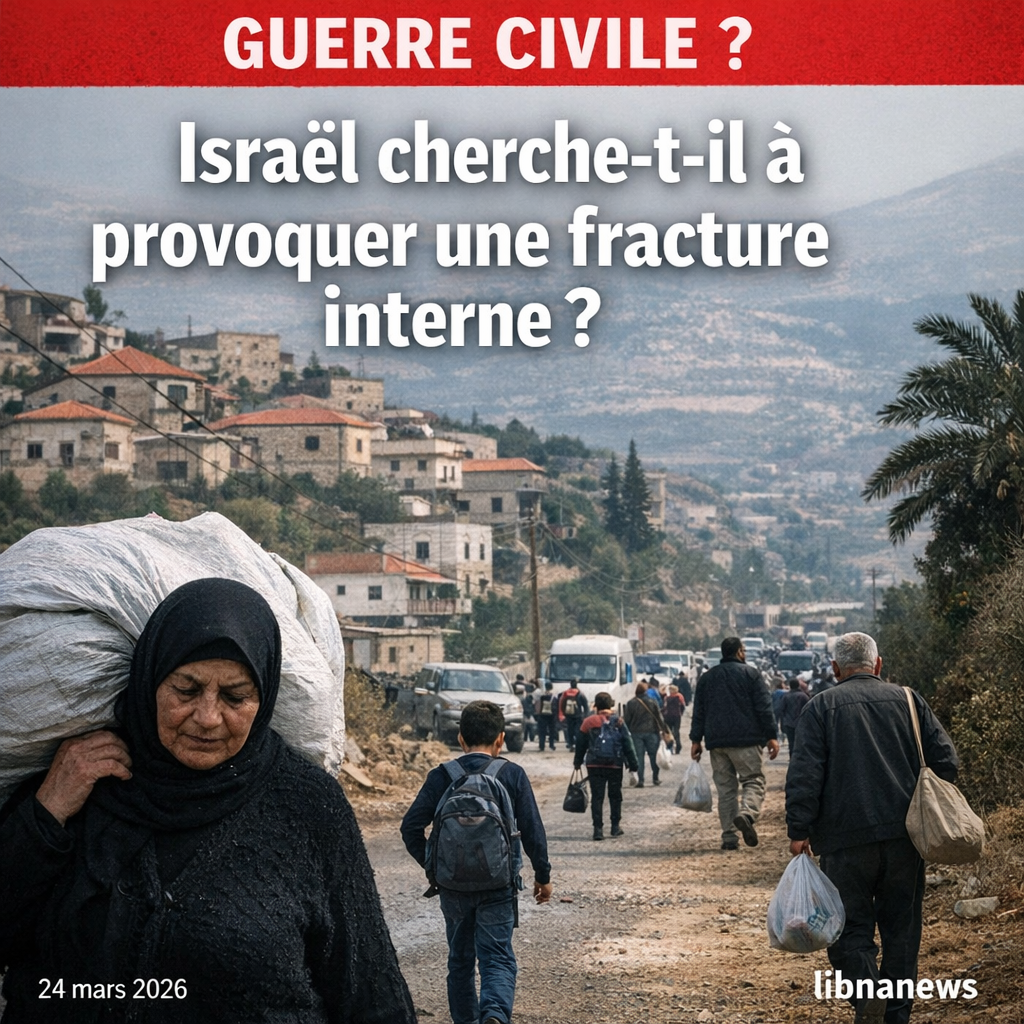
The new front opened by Israel in Lebanon is no longer limited to bombardments, the destruction of bridges and the idea of an advance to the Litani. It now touches on a much more sensitive point: internal coexistence. In several villages in Hasbaya district, municipal officials claim to have received calls from the Israeli army asking them to push out displaced families from Shia communities in the South, considered to be Hezbollah strongholds. At the same time, Israeli Finance Minister Bezall Smotrich called for annexation from southern Lebanon to the Litani, giving the offensive an even greater territorial and political reach. The question is no longer only military. It also becomes social, community and national: by targeting areas of refuge and pushing predominantly Christian villages to expel Shiite displaced persons, does Israel seek to turn the war against Hezbollah into a tension between Lebanese themselves? At this stage, the documented facts show real pressure on the local fabric, but they are not yet sufficient to conclude a shift towards a generalized internal conflict. On the other hand, they reveal a dangerous strategy: moving the fracture line of the battlefield to the interior of the country.
The issue is all the more serious as it intervenes in a Lebanon that has already experienced a very large humanitarian crisis. According to the latest consolidated humanitarian assessments, more1.2 million peoplewere displaced by the March escalation,134 439hosted in636 collective sites. A significant part of these displaced persons come from the South, the Bekaa and the southern suburbs of Beirut, where Hezbollah exerts strong political and social influence. Many have found refuge in places where they do not share the majority faith or the usual settlement networks. In normal times, this already requires significant local solidarity. In times of war, when the bombings approach and local officials receive foreign military orders, this cohabitation can become an extreme point of tension. The risk therefore comes not only from the Community differences themselves. It comes from the fact that they are activated, instrumentalized and placed under direct threat. It is in this context that the calls reported in Hasbaya district should be read.
Mayors say they received orders to expel displaced persons
The facts reported in recent hours are accurate. ToKawkabaIn Hasbaya district, Mayor Elie Abu Nakul explained that he had received a call from the Israeli army on Sunday asking him to clean up his locality within 24 hours. In his village, he detailed,21 displaced familiescohabited with about200 local families. He claimed that he refused to deliver the names of the displaced, explaining that this would violate Lebanese law and that they were innocent civilians. In the neighbouring locality ofAbu QamhaMichael Abu Rached reported a similar appeal and said he too refused to provide names. ToAl-MariOn the contrary, the municipality stated in a statement that it would comply with these imposed directives, while regretting being forced to ask displaced persons to leave. These elements are therefore not part of the general rumour or the simple climate of fear. They are based on nominative, localized and converging testimonies, publicly assumed by local officials.
The most important detail is not only the existence of these calls. That’s their logic. The persons concerned are not described as combatants or armed structures. They are displaced people from majority Shia villages, therefore perceived through collective belonging rather than individual behaviour. The effect of this logic is obvious: it prompts host communities to consider that the mere presence of displaced families is sufficient to endanger them. Hence, the border between security and discrimination becomes extremely thin. The Israeli army would not need to get a frontal break between communities. Suffice it to create a chain of fear: to make it clear to villages that keeping internally displaced persons can expose them, to the point of causing forced departures, voluntary or imposed locally. It is this mechanics that must be observed with the utmost care. The facts establish the pressure. The analysis here consists in deducing the potential fragmentation logic.
Hasbaya, a fragile laboratory of coexistence
The choice of localities is not insignificant. The District ofHasbayahas a rare denominational diversity in the South. There are Druze, Christian and Sunni villages near a nearby district,Marjayoun, marked by Israeli incursions and clashes with Hezbollah. This geography makes Hasbaya a hinged space: neither homogeneous Shiite bastion, nor totally detached hinterland from the front. In this type of configuration, local balances are based on very concrete, often old, arrangements between families, municipalities, religious networks and neighbourhood relations. In other words, coexistence is not a national abstraction. It lives on a daily basis, in towns where everyone knows each other and where the reception of displaced persons depends as much on social ties as on the means available. By exerting pressure on these specific villages, the war thus affects one of the most sensitive aspects of Lebanese society: areas where diversity still depends on local practices of solidarity and restraint.
It is also for this reason that the word internal conflict should be handled with caution. Lebanon has a long memory of religious fractures and civil war. Sometimes it’s only a short time for speeches to ignite. But there is a significant difference betweenCommunity tension under external pressureand oneshift towards a structured internal confrontation. At this stage, the available evidence shows that most villages are faced with an impossible choice: protecting internally displaced persons and exposing them, or separating them under duress. Some local officials refused to cooperate. Others gave in saying that they were forced to do so. This nuance is decisive. It suggests that there should not be an autonomous mobilization of Christian villages against Shiite displaced persons, but an attempt at external pressure to raise the cost of war locally. The danger is no less real. This type of pressure, repeated, can eventually turn fear into a community reflex. The last two sentences are based on an analysis of documented cases in Kawkaba, Abu Qamha and Al-Mari.
Smotrich and the idea of annexation to the Litani
This local pressure must be linked to another major development:Bezalel Smotrichto annex southern Lebanon toLitani. The Israeli Minister of Finance said that the war should lead to a new border, with the river becoming the line to be imposed. This declaration is not in itself a formal decision to annex. But it marks a rare political hardening by its clarity. It intervenes at a time when Israel strikes bridges on the Litani, destroys houses near the border and pushes further north its speech on the new reality to be created in the South. It then becomes difficult to consider separately the words of Smotrich, the destruction of infrastructure and the calls reported to the mayors of Hasbaya. Taken together, these elements outline a strategy that is not just about fighting Hezbollah. They suggest a desire to reshape the southern territory and move its populations, while weakening the mechanisms of coexistence between host and displaced areas.
The link between the two registers, territorial and Community, deserves to be stressed. A lasting annexation or advance to the Litani would in fact imply a emptied South, fragmented or at least deeply disorganized. The destruction of bridges and houses meets a logic of territorial asphyxiation. The pressure on the host villages, on the other hand, responds to a logic of social disintegration. In one case, returns and traffic are complicated. In the other, it is more difficult to accommodate internally displaced persons in mixed or non-Shiite communities. The desired result can be different according to Israeli actors, and it would be imprudent to expect perfect coordination between each political statement and each local appeal. But the cumulative effect is visible: the Lebanese South becomes less habitable, less accessible and more divided. It is precisely this combination that raises fears not only of an extension of the war, but of a deterioration of the Lebanese national fabric itself. This reading is based on an inference based on the simultaneous destruction of the Litani, the calls reported in Hasbaya and the words of Smotrich.
The real risk: fear more than open confrontation
Towards an internal conflict? The formulation requires a nuanced response. At this stage, there is no evidence of widespread armed confrontation between Lebanese communities. There is no solid evidence to speak of a Christian front against Shiite displaced persons, nor of a national dynamics of confessional purging organised by Lebanese actors. On the other hand, the facts clearly document another phenomenon: the rise in therisk of internal tension fed by fearforced displacement and the perception that some localities could be punished for hosting families from areas known to be close to Hezbollah. This slide is already very serious. In a country where the memory of civil war remains alive, fear does not need to immediately turn into confrontation to produce deep damage. It is enough to create suspicion, to reduce acts of solidarity, to push families to leave even before they are forced to do so, and to transform reception into a security burden.
In other words, the most plausible short-term scenario is not an open internal war. It’s that of arampant sectarisation of the humanitarian emergency. Displaced persons can be de facto sorted according to their origin. Villages may feel compelled to choose between their safety and their duty of reception. Political or media discourse can relay the idea that some populations would be at risk with them. Such an evolution is enough to profoundly damage national cohesion, especially if it occurs in the South, i.e. in areas where war is already in direct contact with the inhabitants. The mayors who refused to give the names of the displaced, however, show that this drift was not inevitable. Their attitude indicates that part of the local fabric is still seeking to protect civilians rather than to yield to the logic of separation. This is probably one of the most important points of the moment. The final sentences are based on an analytical assessment based on the reported cases and on the absence of evidence of widespread inter-Lebanese confrontation.
A humanitarian crisis that increases the vulnerability of the country
This Community question cannot be isolated from the humanitarian context. Massive displacements took on an exceptional scale in a few days. The United Nations reported that more than 1.2 million people had been displaced, while other reports published the previous week already mentioned more than 800,000 people forced to flee. Many live outside formal structures, with relatives, in schools, in overcrowded collective shelters, under tarpaulins, in unfinished buildings or even in their cars. When families arrive in localities that lack adequate infrastructure and significant financial margins, local solidarity becomes more fragile. This in no way justifies forced evictions. But this explains why a threatening appeal can have such a powerful effect on mayors or local notables already overwhelmed. In other words, war creates material vulnerability, and this vulnerability makes social divides easier to activate.
It should be added that travel is not only about abstract figures. They re-design the country’s social map. Villages that had so far received only a small number of out-of-home families suddenly had to deal with housing, water, health, food and education needs. Religious, municipal and community networks serve as a safety net, but they have their limits. When the war also imposes an external threat targeted at the very presence of the displaced, the tension increases by one step. It is in this superposition of crises that the most serious risk for Lebanon appears: not an instant civil war, but a gradual collapse of the pact of coexistence under the combined effect of war, mass displacement and fear. This analysis is based on humanitarian data and the testimonies of local elected officials in connection with the calls reported in Hasbaya.
Why this strategy would be formidable for Lebanon
If the objective is to push non-Shiite communities to separate from displaced persons from Shia areas, then the strategy is formidable for at least three reasons. First, it turns humanitarian reception into a security issue, which places a burden on the host villages that they cannot bear alone. Secondly, it shifts the moral burden of war: instead of the primary responsibility remaining that of the power that bombards and threatens, it pushes Lebanese to become themselves agents of a sorting or expulsion. Finally, it feeds the idea that the presence of the displaced, not the war itself, would be the problem. This is how societies crack. Not by a single big slogan, but by a series of local decisions, forced arrangements, forced departures and silences. This paragraph refers to an interpretation of the mechanisms of social fragmentation in the light of the documented facts.
Lebanon has already experienced this kind of slippage in its history: when external conflict or regional confrontation has an impact on its internal balances, the lines of solidarity become more fragile and denominational affiliations regain decisive weight in access to protection. This historical reminder does not imply that the country mechanically repeats its past. It simply recalls that structural fragility still exists. The reassuring point, for the moment, is that documented cases also show local resistance to this logic. Mayors refused to give names. Others explicitly presented their compliance as an imposed constraint, not as an assumed choice. This means that the idea of an internal shift has not yet become a shared evidence in the villages concerned. But the longer the war lasts, the more displaced people increase, and the more the pressures of this kind could produce irreversible effects. The last two sentences are a conservative projection based on the ongoing military and humanitarian escalation.
Towards an internal conflict? A red line Lebanon can still avoid
The most honest answer this morning is:the risk exists, but the threshold is not crossed. Yes, the calls reported in villages in Hasbaya are extremely serious, because they seek to enshrine war in relations between Lebanese communities. Yes, Smotrich’s call to annex southern Lebanon to the Litani gives this pressure a disturbing political depth. Yes, massive displacements, the destruction of infrastructure and the depletion of host communities create a fertile ground for tension. But no, the facts available do not yet make it possible to state that an internal conflict is taking place. What is more played, for now, is an attempt tomanufacture conditionsAn internal divide: by opposing security and solidarity, host villages and displaced persons, Shia South and Christian pockets, territory to annex and territory to empty. It is precisely for this reason that the refusal of some mayors counts as much. They don’t fix anything on their own. But they show that, in the middle of the war, part of Lebanon continues to refuse the internally displaced to become the enemy.



