

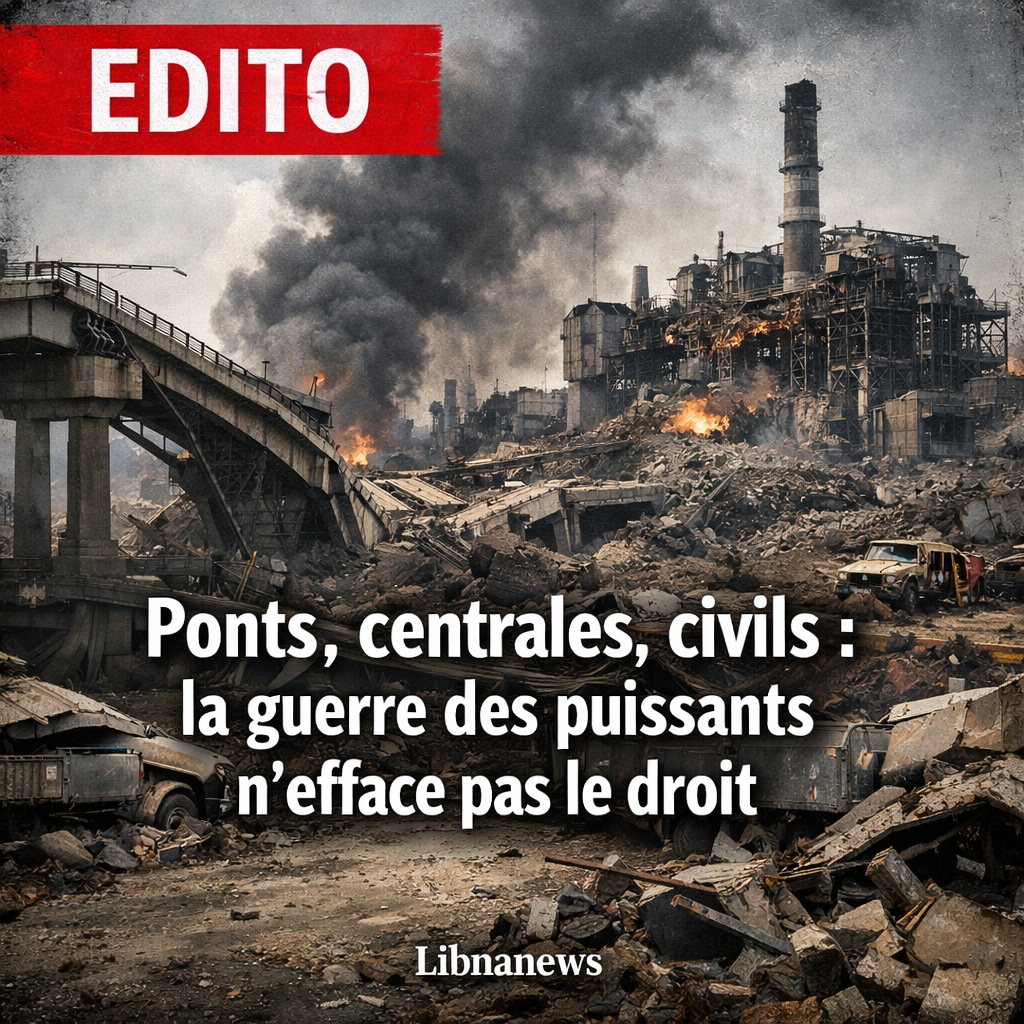
Donald Trump is now threatening Iran with further destruction of bridges and power plants. A few hours earlier, he was already hailing the strike on a bridge near Tehran, which the Iranian authorities say is murderous for civilians. The most serious, in this sequence, is not just the brutality of the word. This is what he reveals in the open: the idea that it would be legitimate to bend a country by using infrastructures whose primary function is civilian.
A bridge, a power station, a power grid, a road axis do not become morally neutral because a head of state designates them as war targets. International humanitarian law has a clear principle: civilian property is protected. They can be targeted only under extremely strict conditions, when they are indeed military objectives, with a concrete and direct military advantage, and subject to proportionality and precaution. In other words, one cannot transform a country’s civil infrastructure into a political target to increase the suffering of society and call it a simple strategy.
In Lebanon, this reality was not an abstract one. She’s already lived. In 2006, large-scale bridges, roads, communication lines and critical facilities were struck. The Jiyeh power plant was bombed, causing a major oil spill on the Lebanese coast. Infrastructures devoid of obvious military value have been reached, including in remote areas with immediate fighting logic. In some Christian regions, too, strikes on bridges, roads and civilian equipment left a lasting conviction: it was not just about reaching an armed opponent, but about putting pressure on the population, paralyzing the country, transforming society itself into a lever of war.
This is exactly where the heart of the problem lies. Civil infrastructure can sometimes be claimed as a dual purpose. That’s the classic argument. But this argument is not enough to clear up any destruction. When a bridge, a power station or a road is targeted not for an immediate, concrete and identifiable military advantage, but for disrupting civilian life, exhausting a country, increasing fear and pushing the population to give in, it is no longer a tactical strike. We’re talking about a logic of coercion against civilians. And it is this logic that can tip such attacks into the scope of war crimes.
Lebanon knows very well what this means. A destroyed bridge is not just concrete blocks that fall. They are slow ambulances, isolated villages, families cut off, complicated relief, and an economy. A hit power plant is not only a neutralized technical installation. They are neighbourhoods immersed in the dark, fragile vital services, a methodically degraded daily life. An oil spill caused by the bombing of an energy plant is not a collateral detail. It is a lasting violence inflicted on an entire country.
That is why the current threats against Iran resonate so strongly in Lebanon. They recall a method already known: to strike what enables society to hold, to raise the human, psychological and political cost of resistance. It is not simply a question of defeating a military apparatus. The aim is to make a population bend by the violation of its living conditions and ultimately avoid any reconstruction.
It is not an abstract bloc that must be called into question, but a perfectly identifiable political practice: to denounce as barbaric strikes against civilian infrastructures when they come from the enemy, and then to requalify them as strategic necessity when they come from the right camp. The right then becomes selective. It ceases to be a universal norm for becoming an instrument of power.
A duty applied with variable geometry is no longer a right. That’s permission granted to the strongest.
The most worrying, in Donald Trump’s words, is not only their violence. It’s their growing banality. As if the threat of bridges and power stations could now come from an ordinary war language. As if the very idea of hurting civil society in order to achieve a political result no longer called for an increase of shoulders. As if certain Powers could still present as a strategy what would be immediately described elsewhere as a serious violation of the law of war.
Lebanon knows what it costs to let this hypocrisy pass. He knows that when civilian infrastructure becomes targets, the entire population is taken hostage. He also knows that from the moment when this method is tolerated in some while being condemned in others, it is not only the moral coherence of the great powers that collapses. It is the norm itself that is undermined.
By justifying among the allies what is condemned among the adversaries, international humanitarian law is not only weakened. We are preparing the wars of tomorrow, those where each one in turn will invoke the military necessity to strike bridges, power stations and everything that still allows a society to live.






