

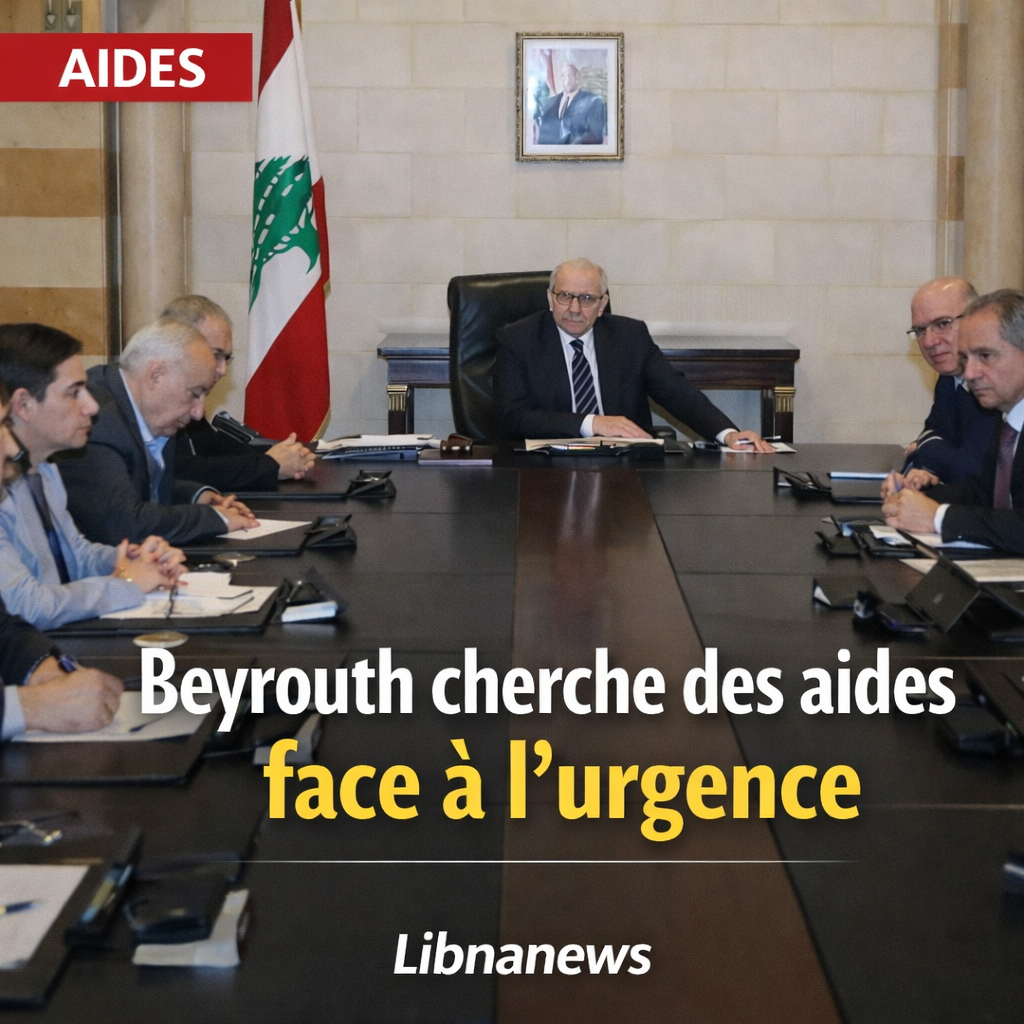
The Lebanese Government devoted a large part of its daily ministerial meeting on Monday to the Great Serail to the worsening of the humanitarian and security situation. At the end of the meeting chaired by Nawaf Salam, Information Minister Paul Morcos said that the focus of the discussions had been on targeting civilians and journalists, on the rise of a divisive speech deemed worrying, and on the growing needs of internally displaced persons. The Head of Government, for his part, stressed a central point: the available aid remains far below the needs, and the executive must now concentrate its efforts on mobilizing wider support.
This development is taking place in a context where Lebanon has several crisis fronts. In addition to the bombings and internal displacements, there is continuing economic pressure, community tensions revived by the war and a state apparatus called upon to respond urgently. According to Paul Morcos, the ministers examined both military and security developments, accommodation and relief needs, as well as measures already adopted by the government to try to keep pace with the crisis.
A meeting dominated by humanitarian emergency
The main message from the Great Serail is clear: the Lebanese state is facing a growing gap between available resources and the magnitude of needs. Paul Morcos reported that Nawaf Salam had warned the ministers that the volume of current aid was still « very much lower » than the increase in needs on the ground. The Prime Minister therefore emphasized how to strengthen the collection and coordination of support, as the waves of displacement multiplied and public capacity remained under strain.
The Minister of Social Affairs Hanine el-Sayed, in the same spirit, stressed that aid mobilized in this war appears weaker than that observed in previous conflicts. It called for an increased international mobilization effort, believing that the gap between needs and available responses continues to widen. This observation weighs politically, because it means that Lebanon is not only facing a crisis on the ground, but also a problem of financing and absorptive capacity at a time when aid networks are already weakened.
Targeting civilians and journalists at the heart of the dialogue
Among the topics highlighted by Paul Morcos, the issue of attacks on journalists has been an important one. The Minister referred to repeated attacks against media professionals that resulted in the deaths of several of them. He explained that the Ministry of Information was following this issue, but that a broader response also required government positioning and action, in coordination with the Ministry of Foreign Affairs.
This insistence is not insignificant. It reflects a shift from the formal debate towards the protection of civilian actors who document war, as the border between military theatre and civilian space blurs. More broadly, the fact that targeting civilians and journalists is among the main topics of the meeting shows that the executive is seeking to include this issue in a political response, not just in an ad hoc response to each attack.
A Power Concerned About the Rise of Discord Speech
The other strong signal from the Serail is the rise of a speech called » fitnawi », i.e. a speech of discord or confessional incitement. Paul Morcos said the ministers warned against a worsening of this rhetoric, especially on social networks. In the Lebanese context, this alert goes beyond the mere register of political communication. It refers to a structural risk: that of the external war fuelling internal fractures, at the very moment when the State tries to maintain a minimum of national cohesion.
This is all the more sensitive because the current crisis is not limited to clashes in the South. It acts as an accelerator of already old vulnerabilities: social fatigue, distrust of institutions, competition between partisan narratives and economic anguish. When the government publicly refers to the danger of an incentive speech, it recognizes that the internal front is also part of the battle to be contained.
Security, border and human rights
On the military front, Defence Minister Michel Menassa presented the ministers with the latest developments, in particular the Israeli « tôghol », i.e. the reported incursions or advances, as well as the situation on the Lebanese-Syrian border. According to the same report, he recalled that1,238 deathsand3,543 injuredcaused by Israeli attacks. Ministers also referred to the death of a United Nations Blue Helmet and several injured in its ranks, indicating that even international peacekeeping forces are now operating in an increasingly exposed environment.
The incorporation of this assessment into the government meeting shows that the executive seeks to articulate two levels of response. On the one hand, it must manage military and humanitarian immediateity. On the other hand, it must build a State speech capable of documenting the extent of the losses and of supporting, on this basis, its diplomatic and humanitarian efforts. The figures are therefore not only used to inform. They also become a lever to try to convince external partners to raise their level of commitment.
Oil, fraud and law enforcement
The meeting was not limited to bombings and internally displaced persons. Paul Morcos also reported that Nawaf Salam had assured that the fuel oil would reach its beneficiaries, while announcing firm measures against those involved in fraud related to this distribution. In a war context, this clarification is important. Fuel supply is not just about economic comfort; It also conditions the operation of shelters, generators, emergency structures and some of the essential services.
Interior Minister Ahmad Hajjar, for his part, presented the efforts against the thefts and arrests in cases of oil fraud. This link between conventional security and crisis management shows that the government is trying to avoid a wider collapse of public order. In periods of prolonged conflict, war does not only fuel destruction; It also opens spaces for trafficking, misappropriation and petty crime, which the State clearly seeks to contain before they settle in a sustainable manner.
What this meeting really says
Beyond the announcements, this ministerial meeting reveals a clear hierarchy of government priorities. The first is humanitarian: housing, rescue, refuelling, getting more aid. The second is political: contain the discourse of division and prevent the war from further breaking up the Lebanese interior. The third is diplomatic: turning the human balance, targeting civilians and attacks against journalists into arguments for increased international support and political attention.
The most striking point is probably this: in the government’s reading of the crisis, the urgency is no longer only measured at strikes. It is also measured by the speed with which needs increase in relation to aid, the spread of flammable discourse on networks, and the increasing difficulty of maintaining clean distribution channels in an already damaged economy. It is this combination that gives the Serail meeting its real political significance, at a time when Beirut is still trying to show that even a weakened state continues to hold its decision-making centres.






